Shrimp · Bamboo Shrimp
Bamboo Shrimp — Atyopsis moluccensis: Habitat and Care
A stream-dwelling fan feeder needs a dependable food-carrying current and several usable perches. Learn to distinguish feeding from mere filtering, support a vulnerable moult and interpret freshwater juvenile observations alongside published larval research.
- Identity
- Atyopsis moluccensis; a fan-feeding atyid, distinct from Atyopsis spinipes and the larger African Atya gabonensis.
- Adult scale
- Usually around 8–10 cm overall; published and trade size accounts vary, with larger examples reported.
- Aquarium plan
- An 80 × 35 cm or larger mature aquarium for a small group, with several elevated feeding stations and protected retreats.
- Maintenance
- Around 24–26°C, pH 6.8–7.8 and 6–12°dGH is a practical moderately mineralised freshwater plan.
- Food
- Suitably fine suspended complete food delivered to the fans, alongside natural particles; filter flow is not itself a food supply.
- Development
- Published work supports a brackish larval phase; observation of small shrimp alone does not establish the whole cycle or disprove an owner’s account.
Four fans, a robust body and a useful identity check
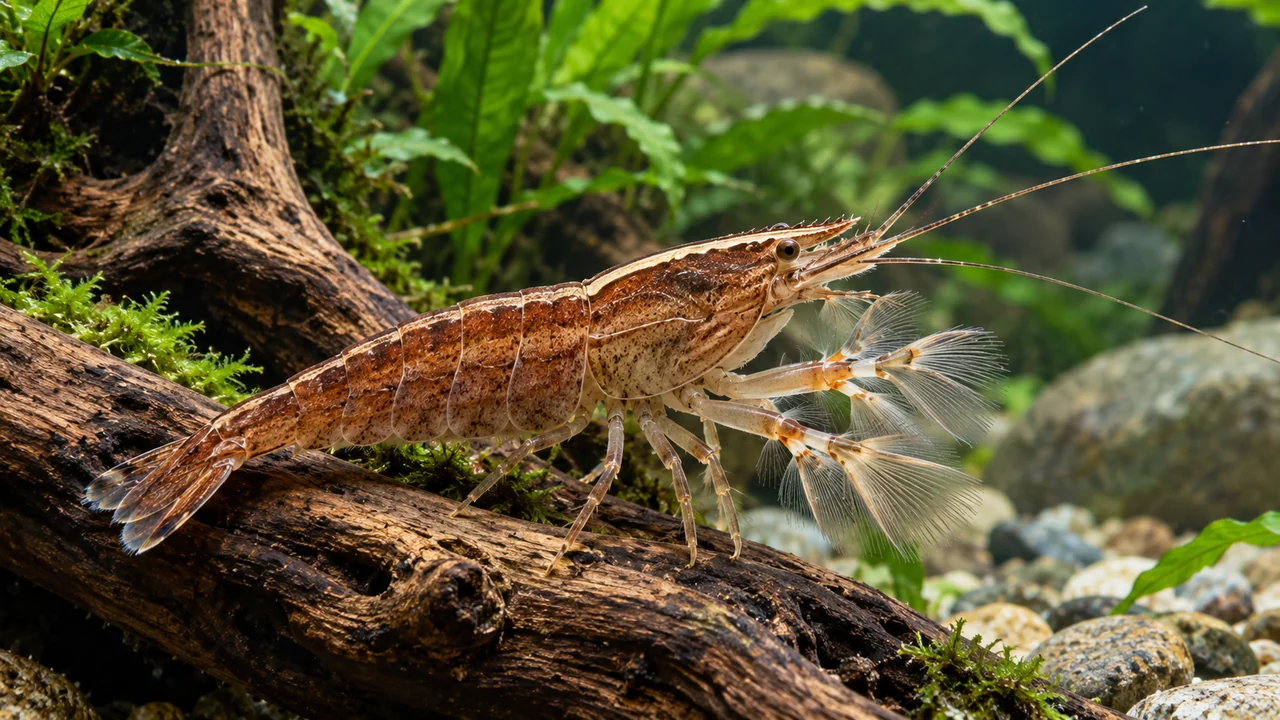
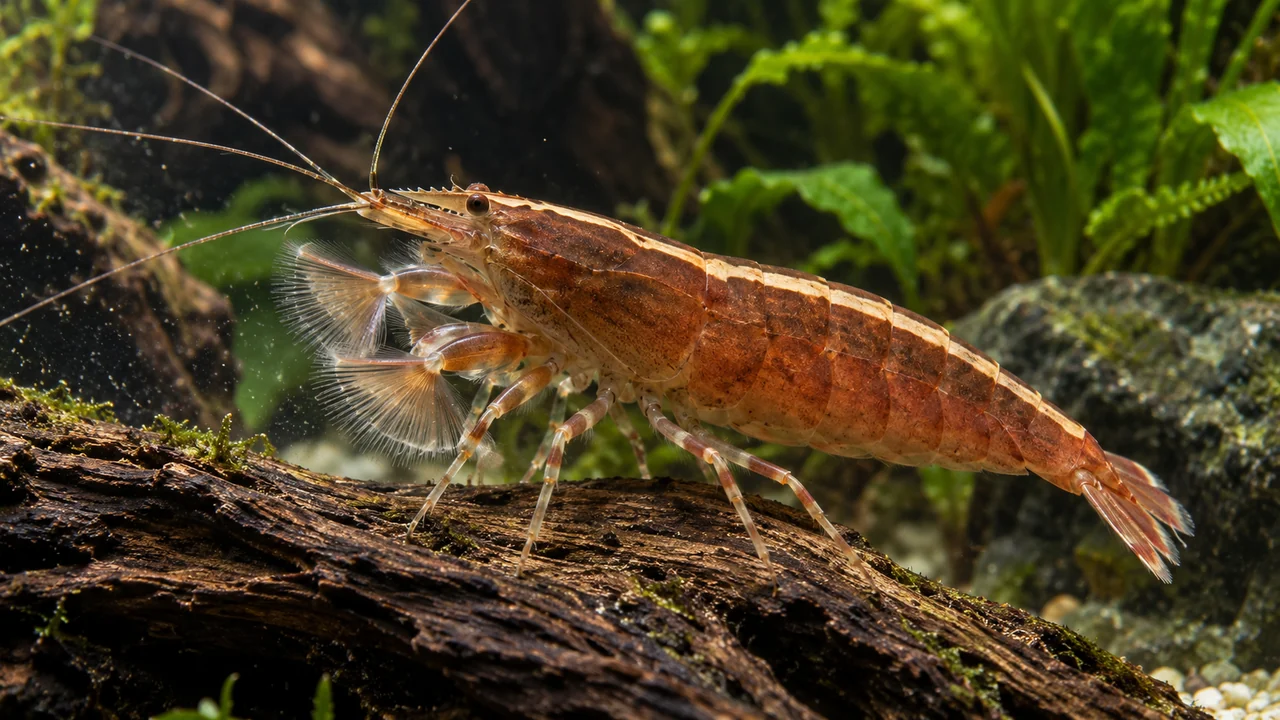
The Bamboo Shrimp holds feathery feeding fans into moving water, periodically bringing them to its mouth. The fans are carried on the first two pairs of legs, giving four feeding structures rather than a pair of predatory pincers. A brown to reddish body and a pale dorsal line are familiar, but colour can change with condition and background.
Check the full animal and supplier identity. Atyopsis spinipes is a separate Asian fan shrimp; a vague Wood Shrimp label does not distinguish it. Older Atya moluccensis records refer to a historical generic combination, whereas African Atya gabonensis is a different species. Do not assign a particular origin from a cream stripe alone.
What the stream habitat tells us
Records centre on tropical Southeast Asian flowing waters, particularly the Greater Sunda region. Some older broad range accounts combine uncertain records, so a retail label is not evidence for every country sometimes listed. Documented habitat includes rocky current and submerged roots where shrimp can hold a position while intercepting food.
The useful aquarium translation is a feeding station that faces a productive current, with somewhere sheltered nearby. This is different from pointing a powerful pump into an empty glass tank. Provide mature surfaces and a predictable feeding plan. The water should remain clean even though it carries small edible particles; visible dirt and dissolved waste are not nutritional requirements.
Build several usable feeding stations
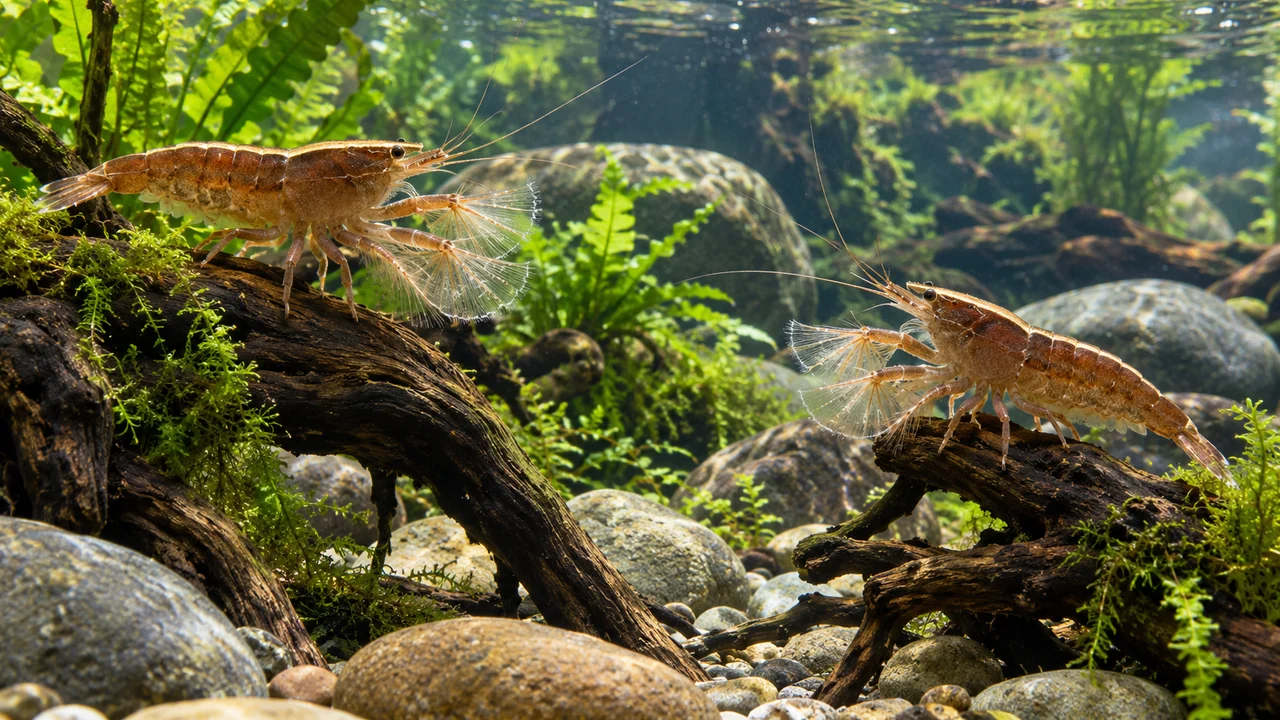
An 80 × 35 cm or larger mature aquarium is a practical plan for a small group rather than a claim of an experimentally proven minimum. Arrange smooth wood and stable stones at different heights, with more than one position receiving the food-carrying flow. The shrimp should be able to reach a perch without crossing a dangerous intake.
Include quiet retreats large enough for the full body and antennae, especially during moulting. Plant around the structure without blocking the feeding current. Keep enough access to see whether each animal is feeding. A larger aquarium gives more room to separate flow, shelter and maintenance, but it does not excuse leaving an unseen individual without food.
Deliver fine food; do not simply add more filtration
Offer a suitably fine, balanced food for suspension feeders, mixed into a little aquarium water and delivered gently upstream of occupied fans. Use small portions and watch whether the shrimp catches particles and brings the fans to its mouth. Food that falls behind the wood or goes immediately into the filter has not necessarily fed the animal.
Natural suspended material can contribute, but a very efficiently filtered aquarium may carry little edible food. Continual scraping of the floor can indicate an inadequate supply and deserves investigation, although one brief scraping episode is not a diagnosis. Adjust placement and particle size before increasing the dose substantially. Clouding the whole tank with powder can degrade water and oxygen while still failing to feed a poorly positioned shrimp.
Water and a predictable maintenance routine
Around 24–26°C, pH 6.8–7.8 and 6–12°dGH is a practical starting plan for stable, moderately mineralised adult freshwater care. These are maintenance recommendations within published husbandry guidance, not survival boundaries. Match the established stock’s water and avoid sudden changes in temperature or mineral concentration.
Use mature biological filtration and effective surface exchange. Keep ammonia and nitrite undetectable, remove excess food and maintain the flow path. Check that the pump still performs when its guard becomes dirty. Regular matched water changes and measured feeding are more useful than trying to keep a permanent haze of particles. A fan-feeding shrimp is not a substitute for water-quality tests.
Moulting needs minerals, food and physical security
The old exoskeleton may look surprisingly complete after a moult. Leave a healthy shrimp undisturbed while it hardens, and maintain shelter where fish cannot repeatedly inspect it. Adequate mineral balance, a complete ration and stable water support normal growth; one failed moult does not identify a single deficiency by itself.
Do not add calcium, iodine or other supplements automatically because a shell is found. Review measured hardness, recent water changes, feeding and possible contamination first. Use treatments only when appropriate for the actual problem and invertebrates present. Avoid sharp gaps and exposed intakes that turn a temporary soft shell into a mechanical injury.
Peaceful company still competes for resources
Bamboo Shrimp can share an aquarium with carefully selected peaceful animals, but their size does not protect them from persistent picking during a moult. Avoid large predatory fish, aggressive bottom dwellers and crayfish. Several fan feeders also need enough productive stations and food for each animal.
Small fish and dwarf shrimp may take offered particles before they reach the fans. Watch the actual route of a feed and inspect the quieter individual’s condition. Do not assume that a shrimp hidden behind a dominant perch is simply content. A species-focused feeding arrangement is often easier to manage than a crowded display where no one can tell which shrimp ate.
Larval research and the owner’s freshwater observation
Hamasaki and colleagues tested A. moluccensis larvae at several temperatures and salinities. Larvae reached the juvenile stage in their brackish treatments of 17–25.5 ppt at 24–32°C; the study did not establish a complete freshwater rearing protocol. These are experimental larval conditions, not instructions to salt the adult aquarium or heat adults to the upper test temperature.
Dany reports keeping Bamboo Shrimp and observing juveniles in freshwater. That observation is retained without inventing its cause or claiming a scientifically demonstrated breeding result. A documented identification of the young, their developmental sequence and any relevant water or introduction history would be needed to connect it to a completed species-specific life cycle. Small shrimp in freshwater alone neither settle that question nor justify dismissing what was observed.
Botanicals and sensible first checks
Aged wood provides useful perches, while modest prepared leaves can add sheltered edges. Keep the main feeding positions clear and avoid burying them beneath decomposing material. Botanicals do not replace suspended complete food or guarantee successful larval development.
If the fans remain closed, inspect disturbance, recent moulting and water conditions. If the shrimp continually searches the floor, review food delivery and acceptance. For rapid movement or escape attempts, check temperature, gas exchange and contamination promptly. Change the factor supported by observation rather than simultaneously increasing current, food and additives.
A few prepared Dried Beech Leaves (Fagus sp.) – Natural Aquarium Leaf Litter can form a small sheltered edge away from the occupied feeding perches. Keep the main current open; this leaf choice concerns structure rather than suspended nutrition.
Further reading and sources
Identity and natural-history sources are distinguished from aquarium husbandry. Recommended care is not a set of experimentally established survival limits; breeding conditions may differ from adult maintenance.
- U.S. Fish & Wildlife Service — Bamboo Shrimp screening summary — Institutional identity, historical synonyms and natural-history synthesis; conflicting range and size accounts are retained as such.
- Hamasaki, Tanaka & Dan — Atyopsis larval performance (2024) — Species-specific laboratory comparison of temperature and salinity; experimental larval results are not adult maintenance limits. Published online in 2023, volume dated 2024.
- Flowgrow — Atyopsis moluccensis — Specialist aquarium database for adult scale and maintenance context, not experimental larval requirements.
- Kieler Aquarienfreunde — fan-shrimp husbandry (2019) — Aquarium society husbandry discussion of feeding, current, adult size and differences between Asian and African fan shrimp.