One of the questions I hear around botanical aquariums is whether tannins and leaf litter will stop live plants from growing. The short answer is: not automatically. Plants and botanicals can work beautifully in the same aquarium. The important part is not choosing one or the other.
It is understanding that water tint, physical leaf litter and the plant's actual growing position are three different things. A plant can struggle because the water is strongly tinted and less light reaches it. It can struggle because a pile of leaves has physically buried its growing point.
Or it can struggle because it was placed under wood, outside the strongest light, in poor substrate or somewhere difficult to maintain. Those are very different problems, and they need different solutions.
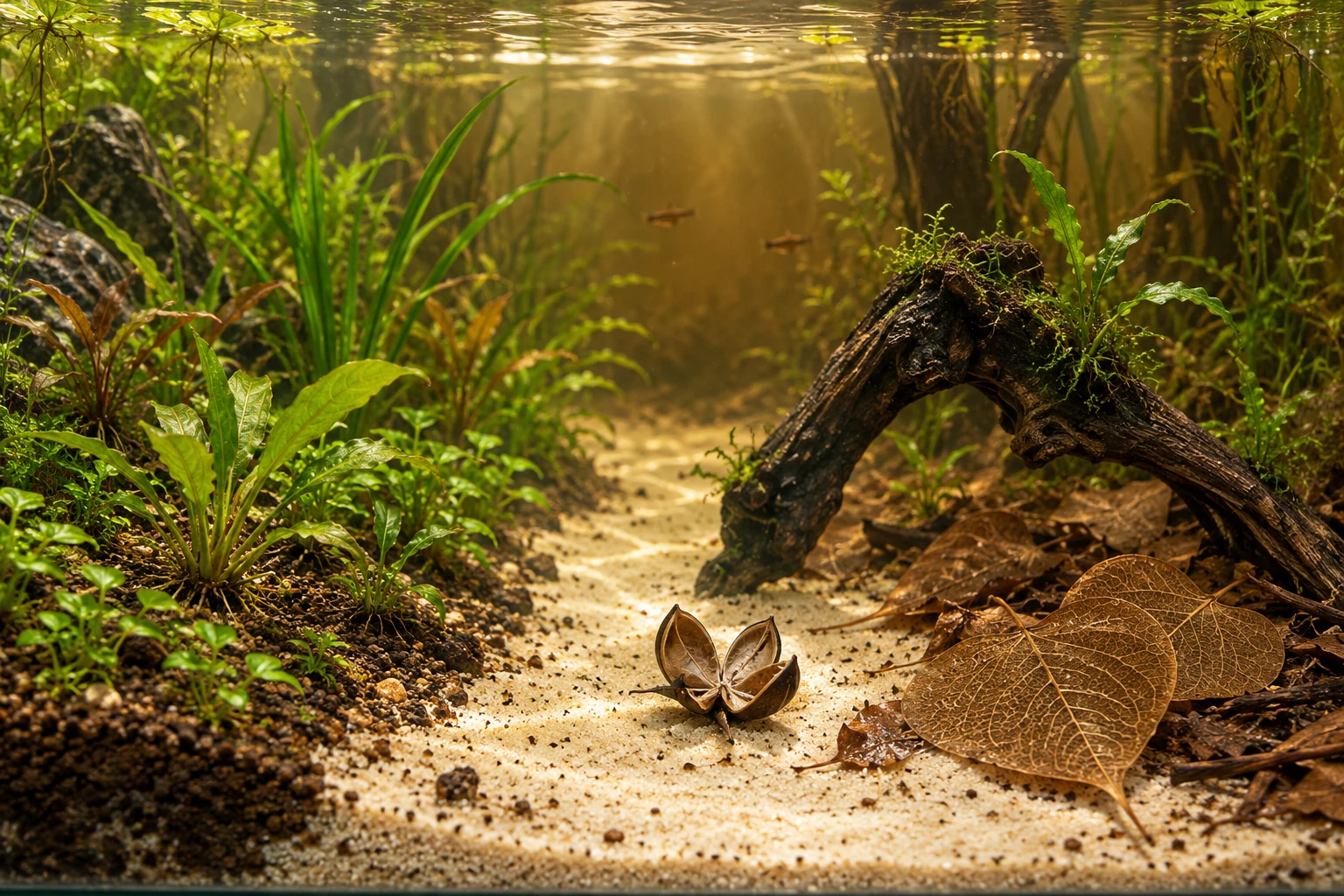
Plants and botanicals are not opposites
I do not see a botanical aquarium as a choice between: plants or leaf litter. Both can belong in the same system. The trick is giving each one a place where it can actually do its job. Botanicals can create:
- litter zones;
- shade;
- natural surface complexity;
- structure;
- cover around planted areas.
Plants can occupy:
- open substrate;
- brighter margins;
- wood;
- rock;
- raised hardscape;
- clearer spaces between heavier botanical deposits.
The aquarium does not need to be treated as one uniform floor. In fact, I think it usually looks better when it is not.
Think in zones, not in one continuous carpet
If I want rooted plants, I leave somewhere for them to grow. If I want leaf litter, I give it places where it can collect naturally without burying every crown and shoot. If I want attached plants, I can raise them above the litter on wood or rock.
That gives the aquarium different layers instead of forcing everything into the same few centimetres above the substrate. A botanical aquarium becomes much easier to maintain when you deliberately create: planting zones litter zones open swimming space hardscape zones maintenance access rather than covering everything equally.
Brown water and leaves on the substrate are two different kinds of shade
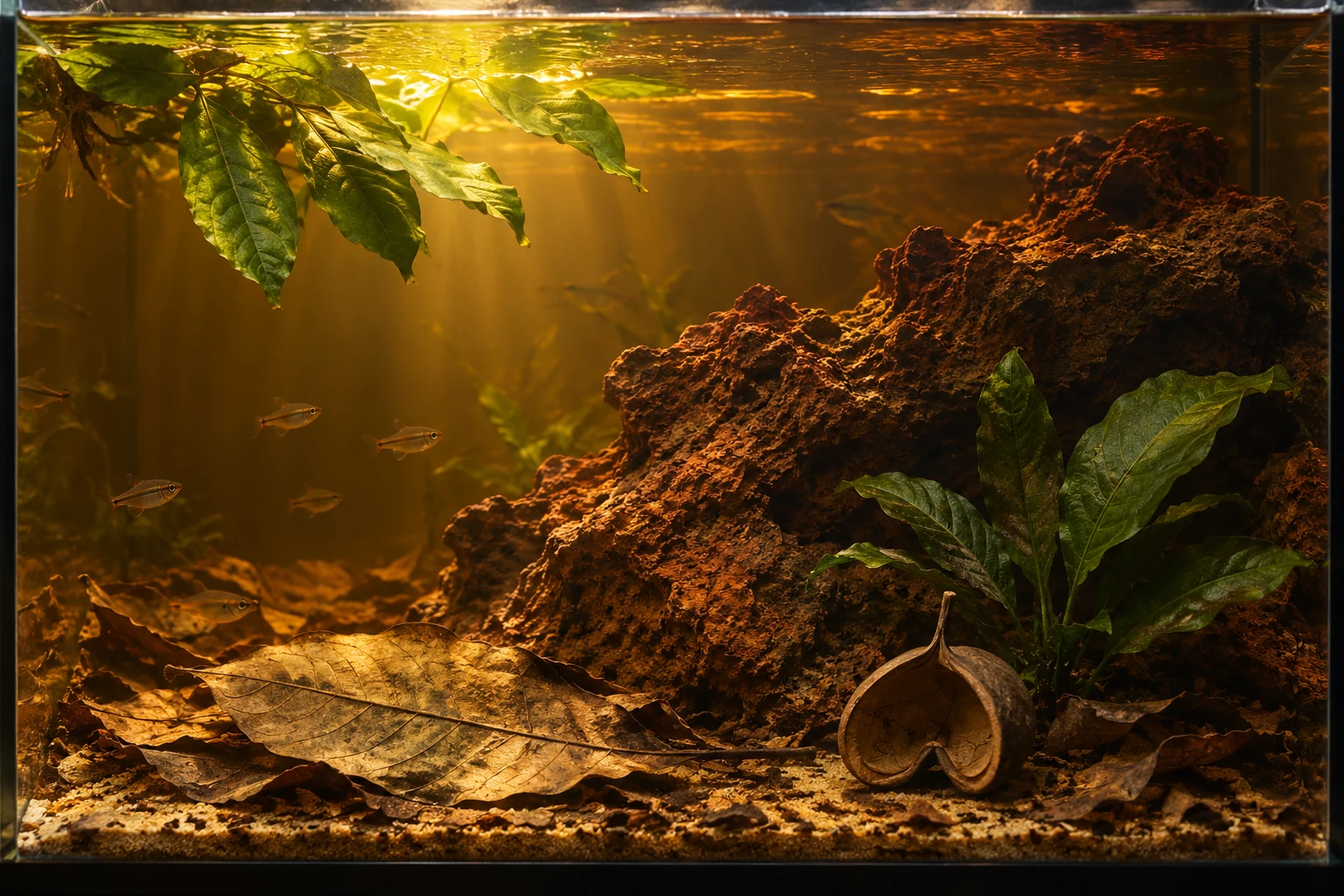
This distinction is important. A plant can receive less light even when there is not a single leaf sitting on top of it. Strong amber tint changes the light passing through the water. At the same time, a completely separate problem can happen when physical leaf litter settles directly over a plant.
So I would never treat these two things as the same issue.
Tint affects the light path
The deeper the plant is, the longer the path between the light and the growing point. Now add:
- amber water;
- wood above it;
- floating plants;
- broad leaves;
- neighbouring plants;
- aquarium depth.
All of those can combine. That is why two plants in the same aquarium can experience very different light conditions. A plant near the surface in an open area may be perfectly happy. The same species placed low behind a root in a deeper, heavily tinted part of the aquarium may behave very differently.
I would not blame tannins first
If a plant is not growing as expected, I would not immediately decide: “The tannins are killing it.” I would look at the whole growing position. Where is the light coming from? How deep is the plant? Is wood or another plant shading it? Has litter moved over it? Is the plant being fertilised appropriately?
Can I still reach it for maintenance? Has anything else changed? The colour of the water may be part of the picture, but it should not automatically become the explanation for everything.
Leaf litter can become a very physical problem
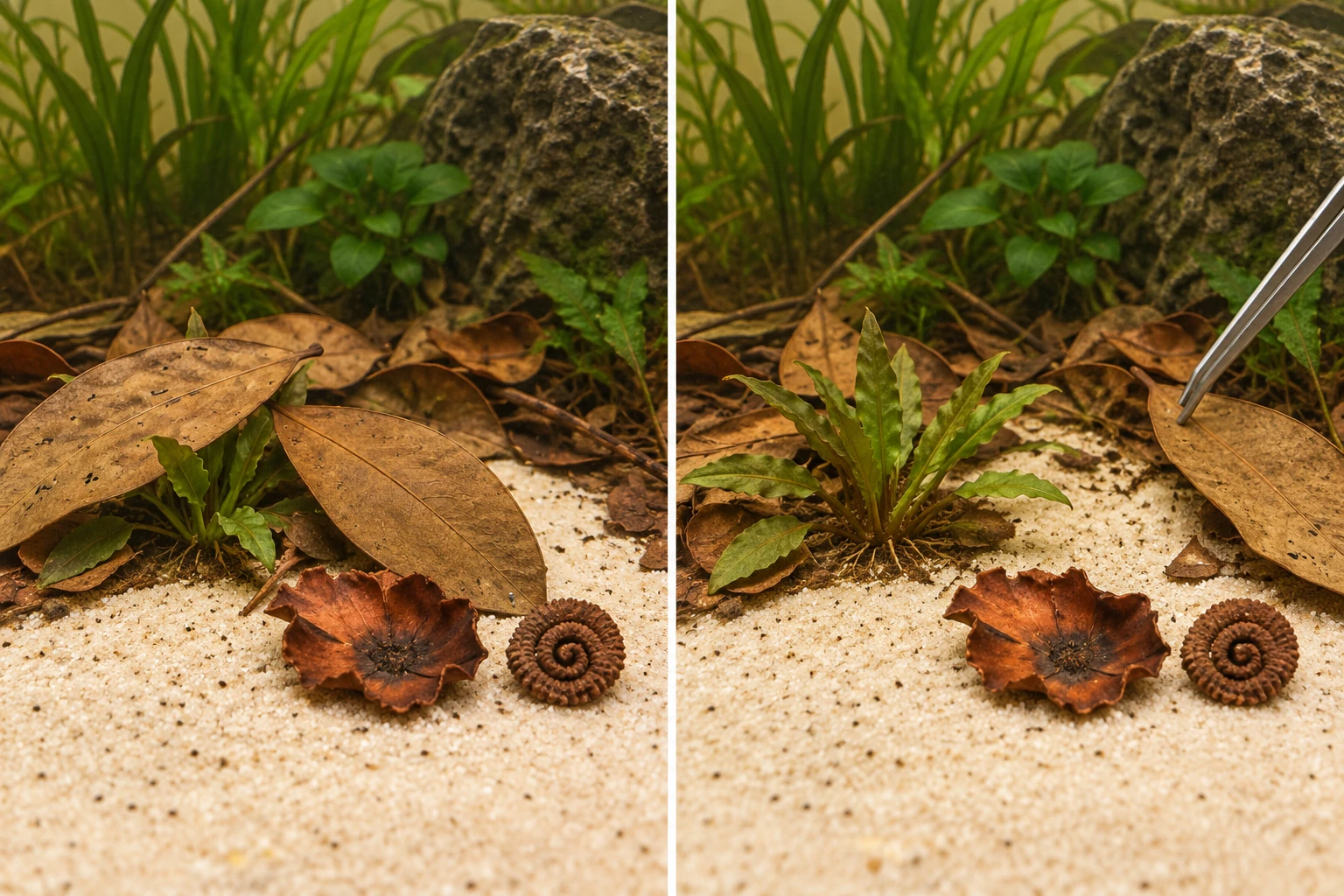
Sometimes the issue really is much simpler. A small plant disappears under leaves. That can happen even in completely clear water. Loose litter moves. Fish disturb it. Flow shifts it. Maintenance moves it. What started as an open planting space can look very different a week later.
When that happens, I do not conclude that plants and botanicals are incompatible. I move the litter. That is usually the first and most sensible response.
Rooted plants need their own ground
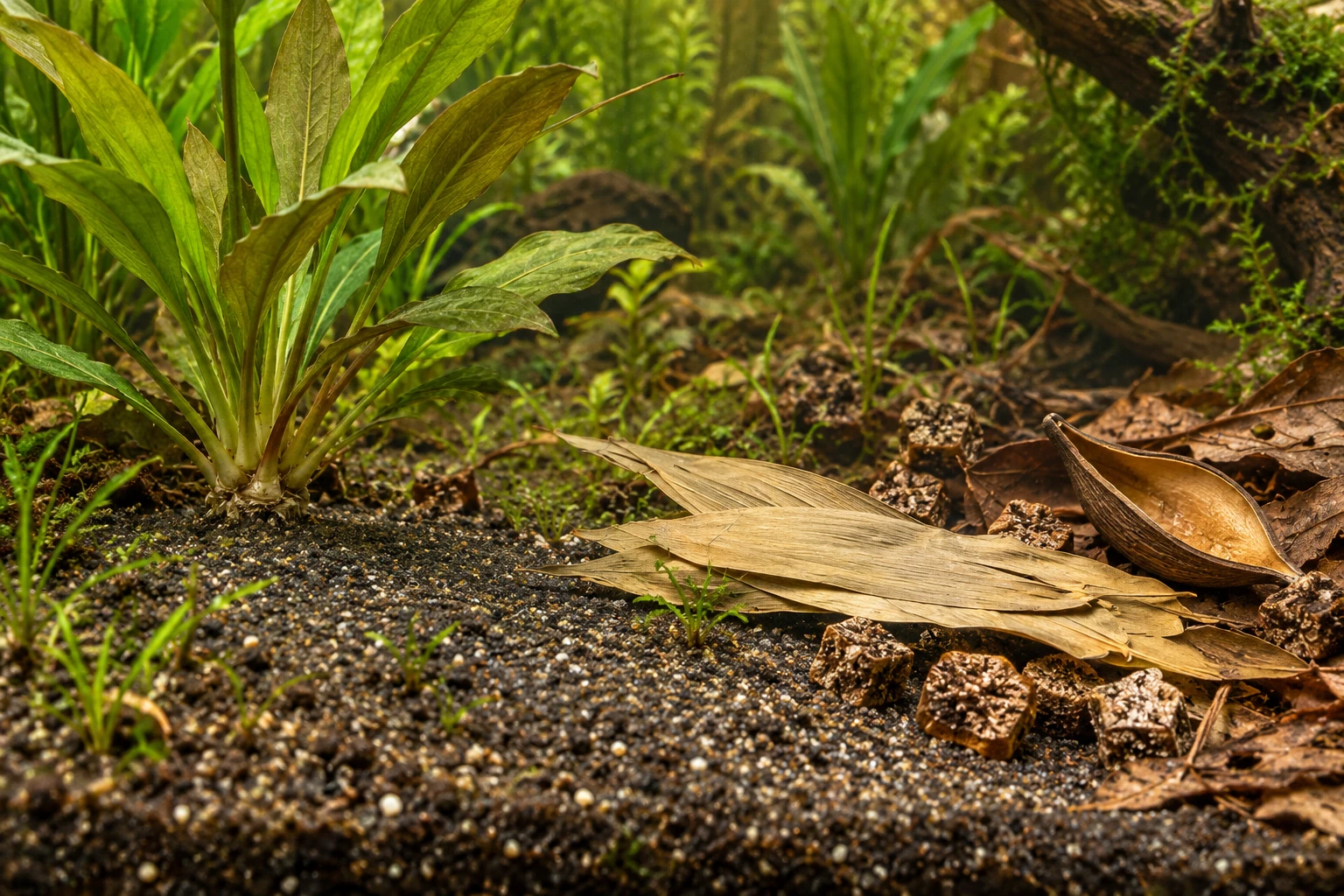
Rooted plants depend on the area around their base. Small plants and new growth are especially easy to bury. So I like to keep the plant's crown and immediate growing area visible and accessible. Leaf litter can begin just outside that zone.
The result often looks more natural than trying to cover everything anyway because real deposited material is rarely spread in one perfectly even layer.
Where the chosen substrate-rooted plants need root-zone nutrition, Aquarium ROOT TABS PRO are one product option to assess under their directions. Keep them within the appropriate growing area; leaves and pods are not a replacement for the plant’s nutritional plan.
Attached plants give you another option
Plants that grow attached to wood, rock or hardscape can solve a completely different design problem. Now the plant is physically raised above the deeper litter layer. That gives you vertical separation: botanicals below plant above and the two can occupy almost the same footprint without competing for the exact same growing space.
This is one of the easiest ways to create a planted botanical aquarium without making every part of the substrate a planting bed.
Open planting zones and botanical zones can flow into each other
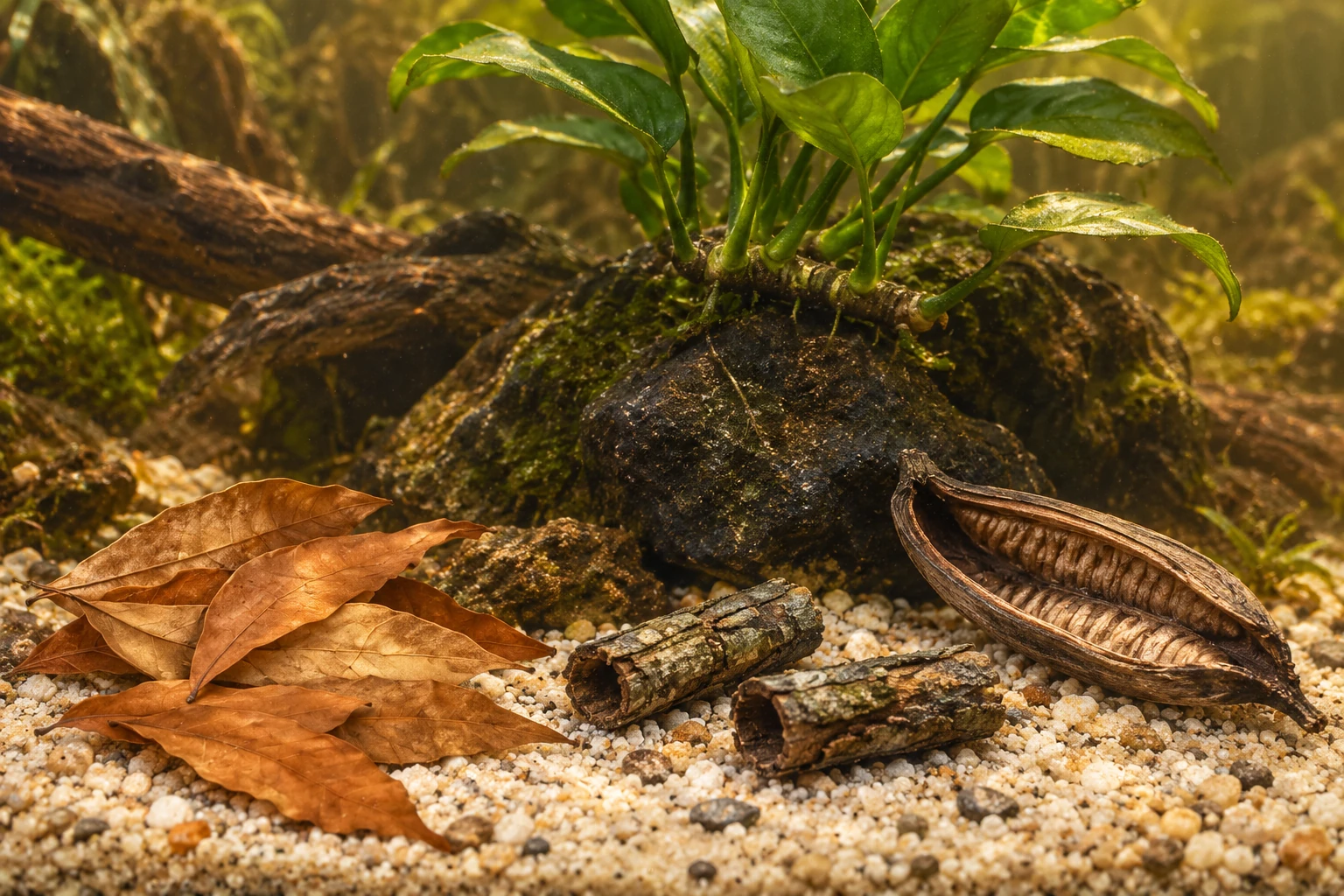
I would not draw a hard line through the aquarium and say: plants stop here, leaves start there. That usually looks artificial. Instead I like a gradual transition. A planted patch may remain relatively clear around the crowns. A few leaves can sit around its edge. Further away, the litter becomes deeper.
Wood connects the two areas visually. Pods and other botanicals can sit among the litter or around hardscape. The idea is not separation for its own sake. It is intentional placement.
For a varied botanical edge outside the planting crowns, compare Dried Guava Leaves – Natural Aquarium Leaf Litter with selected leaves and small forms from TanninBae Beginner Variety Pack – 45-Piece Botanical Starter Box. Keep the rooting zone accessible and the light path open; a mixed box provides material choices rather than a requirement to fit every component into the planted area.
What natural flooded forests teach us
Nature does not usually arrange plants and litter like an aquascaping diagram. Flooded habitats change with:
- water depth;
- season;
- light;
- current;
- deposited material;
- plant growth form;
- changing water levels.
One photograph captures one moment. That is important because it means we should not look at one beautiful flooded-forest photograph and turn it into a rigid planting recipe. Some areas may hold heavy litter. Others remain open. Some plants occupy margins. Others sit higher on structure.
Some spaces may be almost entirely wood, roots and leaves. Variation is part of the habitat.
Natural blackwater does not mean “no plants”
This is the same mistake from the opposite direction. Not every natural blackwater scene is densely planted. But neither is every blackwater habitat empty of plants. The real picture depends on:
- season;
- water depth;
- shade;
- flow;
- bank structure;
- available growing positions.
A home aquarium can therefore combine:
- amber water;
- plants;
- leaf litter;
- pods;
- wood;
- rock;
- open substrate;
- multiple light zones
without pretending that every centimetre represents one exact natural locality.
You do not need to plant every empty space
An aquarium can contain live plants without becoming a dense planted tank. Open substrate is useful. Leaf litter is useful. Bare sand can be useful. Dark space under roots can be useful. The aquarium does not become more natural or more successful simply because every surface carries a plant.
Sometimes the open areas are what make the planted areas work visually.
Botanicals are not fertiliser
This is another distinction worth making clearly. Leaf litter and botanicals do not automatically replace:
- appropriate fertilisation;
- suitable lighting;
- good substrate where needed;
- plant-specific care.
I would never use a layer of dead leaves over the substrate as a substitute for understanding what a plant actually needs. If the plants require fertilisation, fertilise them appropriately. If they need more light, botanical litter is not going to solve that. The botanicals have their own role.
Four layouts that make sense to me
Open planted area with litter around it
A rooted plant group sits in relatively open substrate. Leaves and pods begin around the edges instead of directly covering the new shoots. You still get botanical character without burying every centimetre.
Attached plants above deeper litter
A plant grows on wood or rock. Leaf litter sits underneath. This works especially well when I want a visually rich botanical floor without forcing the plant to grow through it.
Strong tint with plants low in the aquarium
Now I would look carefully at the complete light path. The plant is deep. The water is strongly tinted. Maybe hardscape or floating growth adds more shade. If growth weakens, I would review all of those things together instead of blaming one factor immediately.
Leaf litter keeps burying a small plant
Move the litter. Do not redesign the whole aquarium because one local relationship is not working. That is exactly the sort of small adjustment a botanical aquarium should allow you to make.
Watch where the botanicals actually go
One thing I have learned with loose natural material is that it rarely stays exactly where you place it. Flow moves it. Fish move it. Maintenance moves it. As pieces soften, their shape changes too. So after adding new botanicals, I look at the aquarium again after it has had time to settle. I ask:
- Can I still see the plant?
- Is the growing point open?
- Has litter drifted into the planting zone?
- Is a lower plant now shaded?
- Can I still maintain the area?
- Has the intended open light path disappeared?
That tells me more than the original layout photograph.
Move the problem, not necessarily every botanical
If one plant keeps getting buried, removing all botanicals is usually an unnecessarily large reaction. Start locally. Move the loose leaves. Open the growing area. Reposition one pod. Adjust the plant if its original position does not work. Change local flow where that makes sense. Reduce only the material causing the problem.
Then watch again. A living layout should be adjustable.
A simple rule I use
When plants and botanicals are sharing an aquarium, I keep three questions separate: 1. What is the water tint doing to the light? 2. What is the physical litter doing to the plant? 3. Is the plant in a sensible growing position in the first place?
If I answer those three questions separately, most layout problems become much easier to understand.
Frequently asked questions
Can aquarium plants grow in tannin-stained water?
Yes, depending on the plant and the conditions you provide. Tint is only one part of the light environment. Aquarium depth, lamp position, hardscape, floating cover and plant placement all matter too.
Will leaf litter stop my plants from growing?
Not automatically. But litter repeatedly covering crowns or new growth can become a physical problem, especially for small or newly establishing plants.
Should I remove botanicals if my plants are struggling?
Not as the first response. Look at the local arrangement and the plant's full growing conditions first. Often only the material directly obstructing the plant needs to move.
Can I grow plants above leaf litter on wood or rock?
For plants suited to attached or hard-surface growth, raising them above deeper litter can be a very useful layout approach.
Do botanicals fertilise aquarium plants?
Do not treat them as a predictable replacement for appropriate plant fertilisation. Plant nutrition remains a separate decision.
Continue with BBA
Source book
Amazonian Blackwater Plants & Flooded-Forest Flora
Part of the five-book BBA educational series.
The complete educational system
Go deeper with the five-book BBA series.
Your first successfully paid BBA website order containing at least one physical product includes all five guides. Individual guides are also available for £3, or as the fixed five-guide collection for £10.