I understand why people do it. Tannins are visible. Organic load usually is not.
If the water becomes dark amber, it is tempting to think:
“I must have added a lot.”
And if the water stays fairly clear:
“There probably isn't much happening.”
Neither conclusion is necessarily true.
A small amount of a strongly tinting leaf can colour the water noticeably. A much larger amount of pale pods or woody material may barely change the colour at all.
Tannin colour and organic load are related to botanical use, but they are not the same thing.
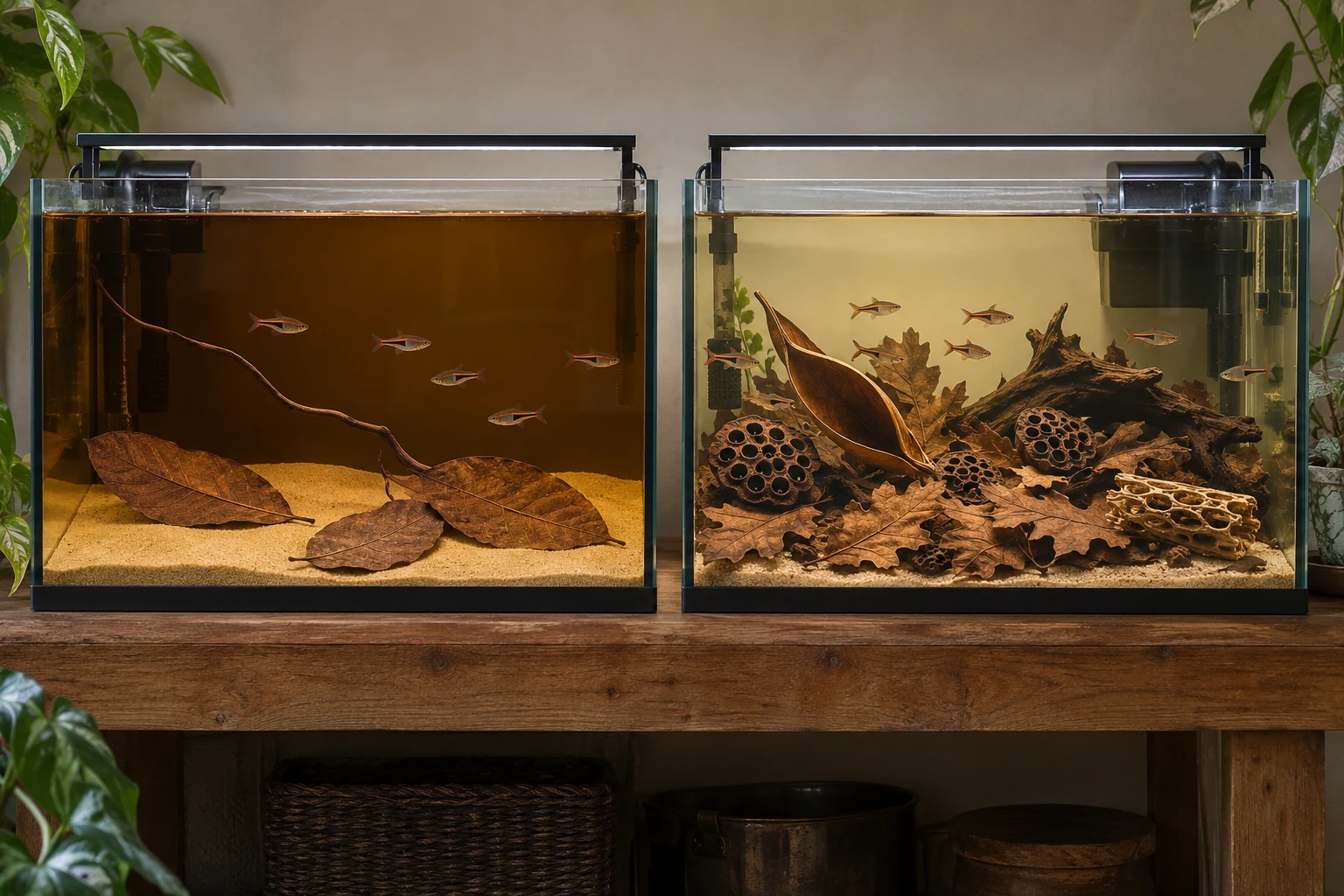
What tannins actually tell you
Tannins and other dissolved compounds can give aquarium water that familiar yellow, amber or brown appearance.
That colour is useful because it tells you that material is interacting with the water.
But that is about as far as the colour can take you.
Different leaves, pods, cones, bark and woods release colour at very different rates. Preparation, aquarium volume, water changes, filtration and simply the amount of time the material has been submerged can all change what you see.
So when I look at amber water, I see one visible part of the system.
I do not see a measurement of how much physical botanical material is present.
And I certainly cannot look at the colour and know exactly what the pH, KH or hardness is doing.
Organic load is the part you cannot judge by colour
Organic load is more about what the aquarium actually has to deal with physically.
Leaves wet and soften.
Pods and wood remain in the system while their surfaces change.
Microbial life begins colonising natural material.
Some pieces break down quickly; others remain firm for a long time.
The aquarium has to process all of that while continuing to provide good circulation, filtration and suitable conditions for the livestock.
That is why ten grams of one botanical cannot automatically be treated as identical to ten grams of another.
A thin leaf and a dense pod do not behave in the same way underwater.
And the same amount of material may behave very differently in two different aquariums.
The easiest way to see the difference
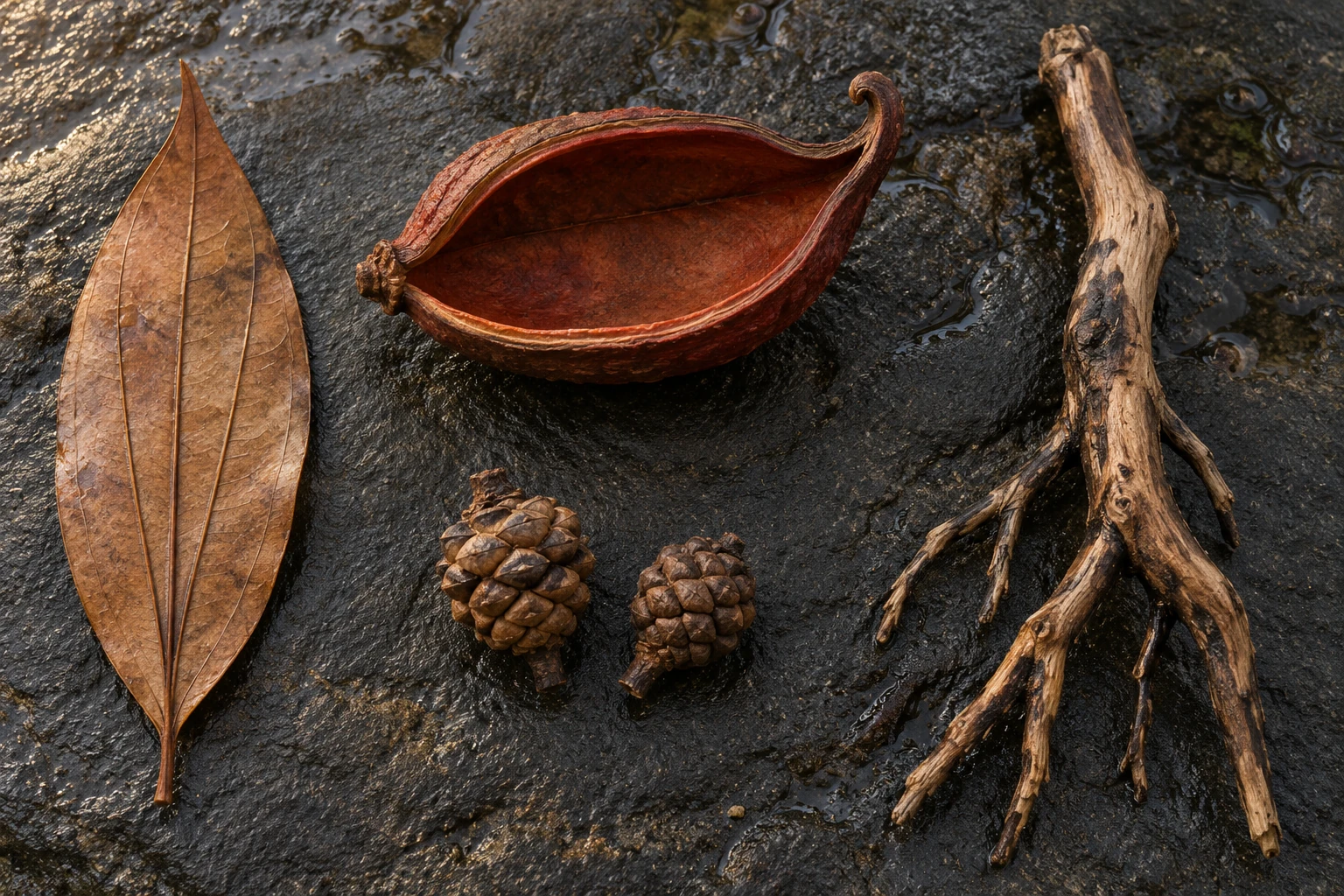
Imagine two tanks.
Aquarium A
There are only a few leaves in the aquarium, but they release colour readily.
Within a short time the water becomes a strong amber.
Visually, the aquarium looks heavily “tannined”.
But there may still be relatively little physical botanical material in the tank.
Aquarium B
The water is much paler.
But the aquarium contains several pods, woody pieces and slowly tinting materials.
There may be far more physical material for the system to process, even though the water looks clearer.
This is exactly why colour is such a poor shortcut for judging botanical load.
Filtration can make the illusion even stronger
Now imagine that we put activated carbon or Purigen into one of those aquariums, or simply carry out regular water changes.
The visible amber colour may become much lighter.
But the leaves, pods and wood are still sitting in the aquarium.
The physical material did not disappear simply because some of the visible colour was removed.
This is one of the most useful things to remember:
Clearer water does not automatically mean a lower botanical load.
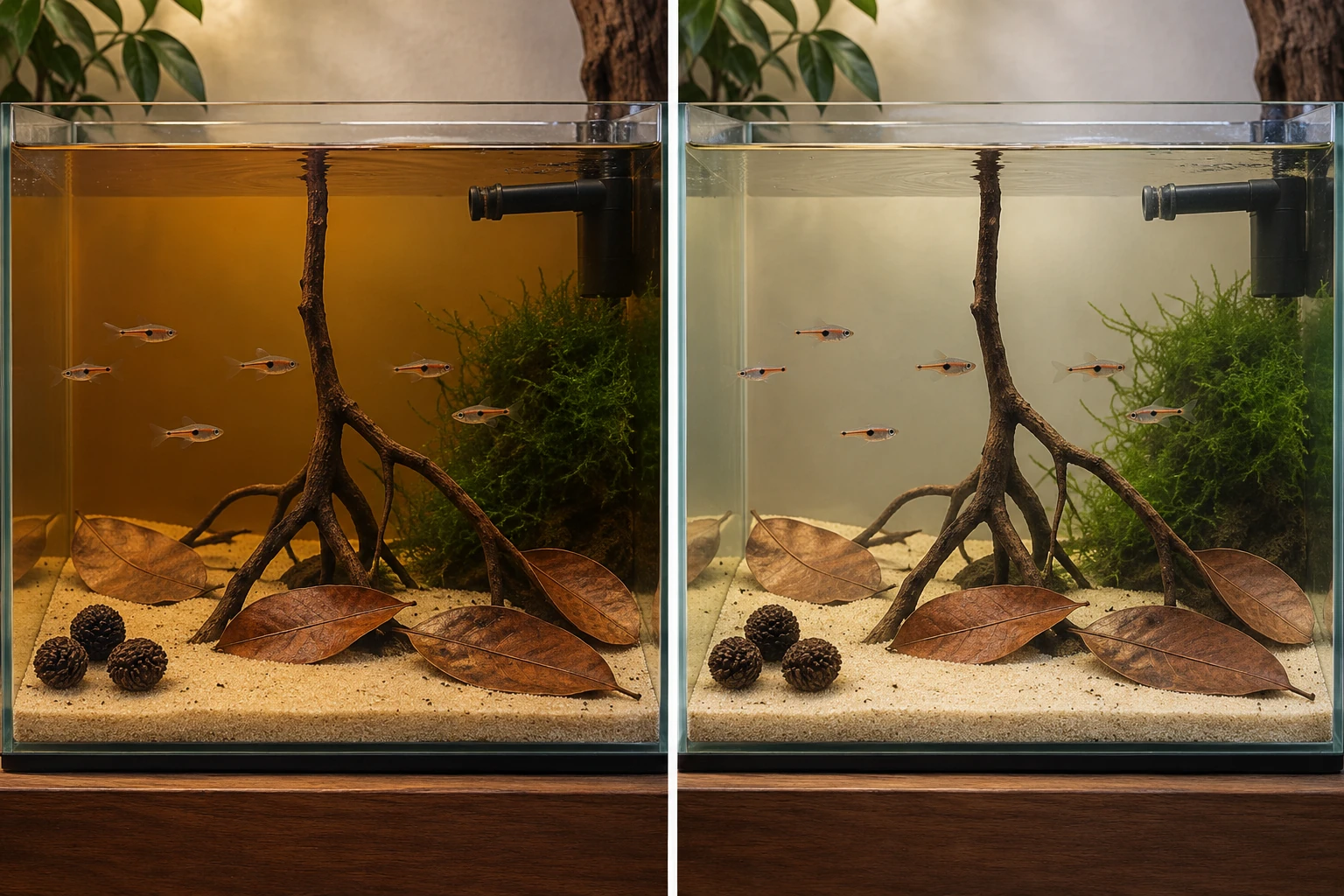
Preparation changes what you see first
Preparation can change the first visual effect too.
Rinsing, soaking or pre-wetting a botanical may remove or release some colour before the material enters the display aquarium.
The tank may therefore look lighter initially.
But preparation does not magically turn a large physical addition into a small one.
The material is still there.
What I actually look at
Instead of asking:
“How dark is the water?”
I would look at the whole aquarium.
How much material did I add?
Not how dark it looks — how much physical material actually went in.
What kind of material is it?
Thin leaves, hard pods, bark and wood all behave differently.
How large is the aquarium?
The same addition represents a very different change in a small aquarium than in a much larger one.
Is the filtration and circulation still working properly?
Material should not restrict flow or interfere with the filter.
What is happening to the botanicals?
Are they simply wetting and softening normally, or are they breaking down unusually quickly?
How are the animals behaving?
This matters far more than whether the water is the perfect shade of amber.
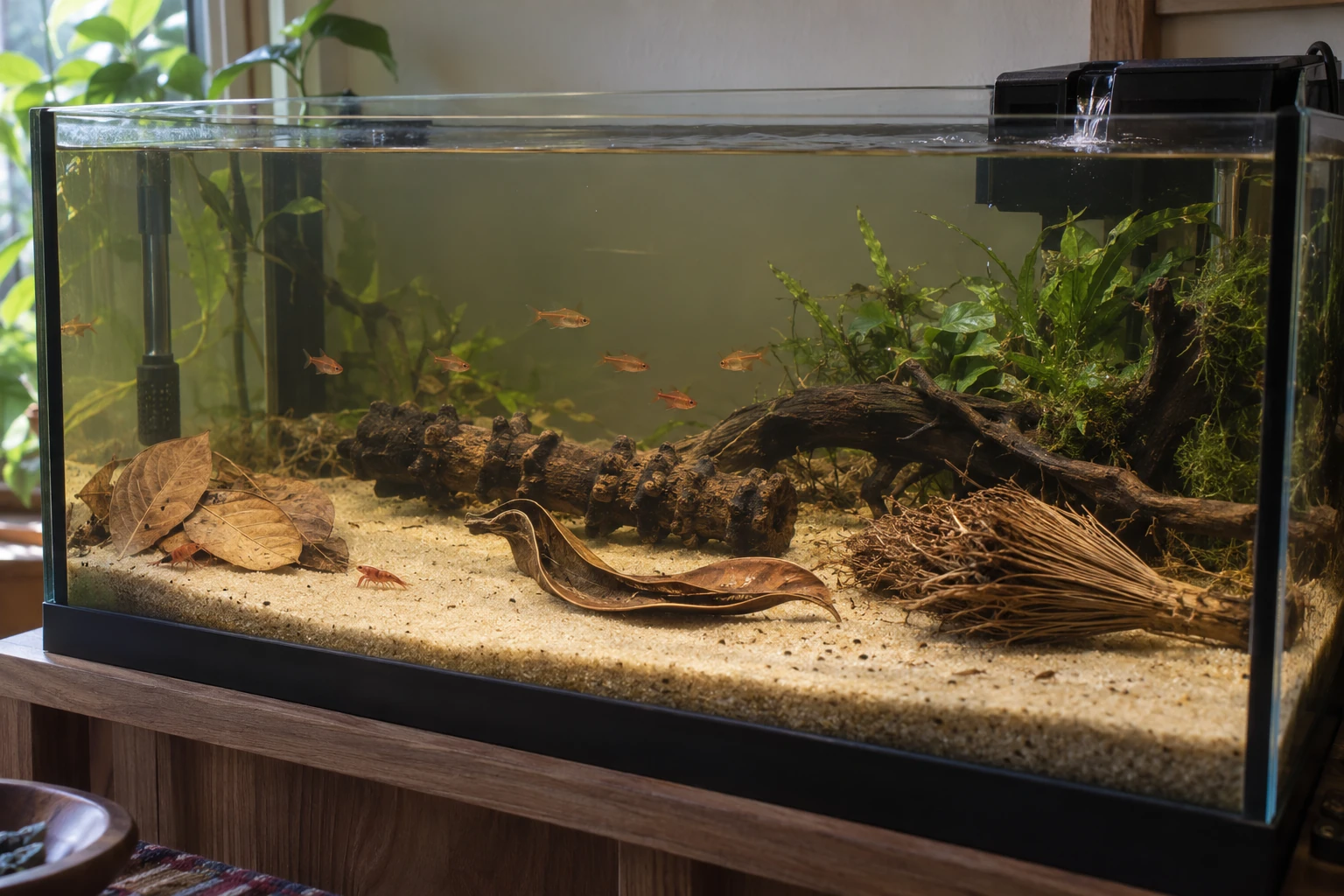
These are the clues that tell me whether an addition remains manageable.
Dark water is not automatically a problem
Strong colour by itself does not tell us that the aquarium has been overloaded.
A comparatively small quantity of a strongly tinting material may create very dark amber water.
If the aquarium remains stable, circulation is good and the animals are behaving normally, the colour itself is not enough reason to conclude that something is wrong.
But the opposite is equally important:
dark water is not proof that something beneficial is happening either.
Colour is colour.
The rest of the aquarium still has to make sense.
Clear water can still contain a lot of botanicals
Some materials naturally release very little visible colour.
Others release it slowly.
Some may have released part of their colour during preparation.
And filtration or water changes may continually remove colour from the water while the physical material remains in the aquarium.
So I would never look at a clear botanical aquarium and assume:
“There isn't much organic material in there.”
Look at what is actually in the tank.
Hard water makes the colour/chemistry confusion even easier
Another common misunderstanding is to assume that darker tannin colour must mean a large pH change.
It does not.
Water chemistry and buffering matter.
Hard or strongly buffered water may take on a noticeable amber colour while showing relatively little pH movement.
That is why I would never use botanicals as a reliable pH-control product.
If pH, KH or GH matters for your livestock, measure it rather than trying to read it from the colour of the aquarium.
How I would add botanicals
I would treat a pack as a supply, not automatically as one dose.
That distinction matters.
Just because ten leaves or several pods arrived in one packet does not mean they all belong in the aquarium at once.
Start with a smaller selection.
Prepare each material according to its own instructions.
Add it gradually.
Then watch what happens before adding more.
Look at:
- water clarity;
- smell;
- circulation;
- filtration;
- how the material is changing;
- and how the livestock is behaving.
If everything remains stable, you can decide whether another addition makes sense.
If something begins looking wrong, stop adding more and investigate first.
For future structural choices in a stable aquarium, compare individually inspected pieces from the Curated Blackwater Botanical Pod Pack – 13-Piece Mix with Catappa Bark Tubes – Indian Almond Bark Hiding Tubes. Start with the amount and form that serve the layout, then observe their change; a mixed pack is not a prescribed organic load.
If you want colour without adding more loose material
Sometimes the goal really is simply to build more amber character without putting more loose leaves or pods into the aquarium.
That is a different decision.
BBA Amber Tannin Infusion Bags are a contained way of developing tannin colour without adding additional loose botanical pieces.
The Premium XXL Botanical Aquarium T-Bags use a larger contained format based around named leaf and bark materials.
For a prepared liquid option, BBA Live Tannin Culture – Botanical Tannin Infusion, 250 ml is a separate product to assess under its current directions. It is not a substitute for filtration, oxygenation or measuring the water, and the visible tint should not be read as a complete account of the aquarium’s condition.
What you may notice after adding botanicals
Natural materials change underwater.
Depending on the material, you may see:
- gradual amber tint;
- pieces floating initially;
- leaves or pods becoming darker;
- materials softening;
- biofilm developing on submerged surfaces;
- occasional surface film.
Animals may also investigate or graze mature botanical surfaces.
None of these observations should be treated as a promise that every botanical will behave in exactly the same way. Natural materials vary.
When I would stop adding more
If livestock begin behaving abnormally, the water becomes concerning, circulation changes or something develops an unpleasant rotten smell, I would stop adding more botanicals.
Then I would check the things I can actually measure and observe:
water quality, oxygenation, filtration, circulation and the condition of the material already present.
The important thing is not to decide automatically that botanicals caused every problem — but also not to ignore a change because the aquarium is supposed to look “natural”.
A simple rule to remember
If you remember only one thing from this article, make it this:
Water colour tells you about visible tint.
It does not tell you how much botanical material your aquarium is processing.
To judge that, look at the actual material, the aquarium volume, filtration, circulation, water conditions and the animals.
That gives you a far more useful picture than asking whether the water is dark enough.
Frequently asked questions
Does darker water mean the aquarium has a high organic load?
No. A small amount of strongly tinting material can create dark water, while a larger amount of weakly tinting material may remain much less visible.
Can clear water still contain a significant amount of botanical material?
Absolutely. Some botanicals tint weakly, and filtration or water changes can remove visible colour while the material remains in the aquarium.
Does strong tannin colour mean the water is unsafe?
Not by itself. Look at the amount and type of material, aquarium volume, filtration, water conditions and livestock behaviour.
Can botanicals reliably lower pH?
No fixed change can be assumed. Buffering and the aquarium's existing chemistry matter greatly.
Should I add the whole packet?
Usually, no. Treat the packet as a supply unless the specific product instructions tell you otherwise.
Continue with BBA
If you want a ready-curated mixed starting point, the Leaf Litter + Tannins Starter Bundle combines several loose botanical materials intended for gradual introduction.
Otherwise:
Source book
Amazonian Blackwater & Botanical Aquariums
Part of the five-book BBA educational series.
The complete educational system
Go deeper with the five-book BBA series.
Your first successfully paid BBA website order containing at least one physical product includes all five guides. Individual guides are also available for £3, or as the fixed five-guide collection for £10.