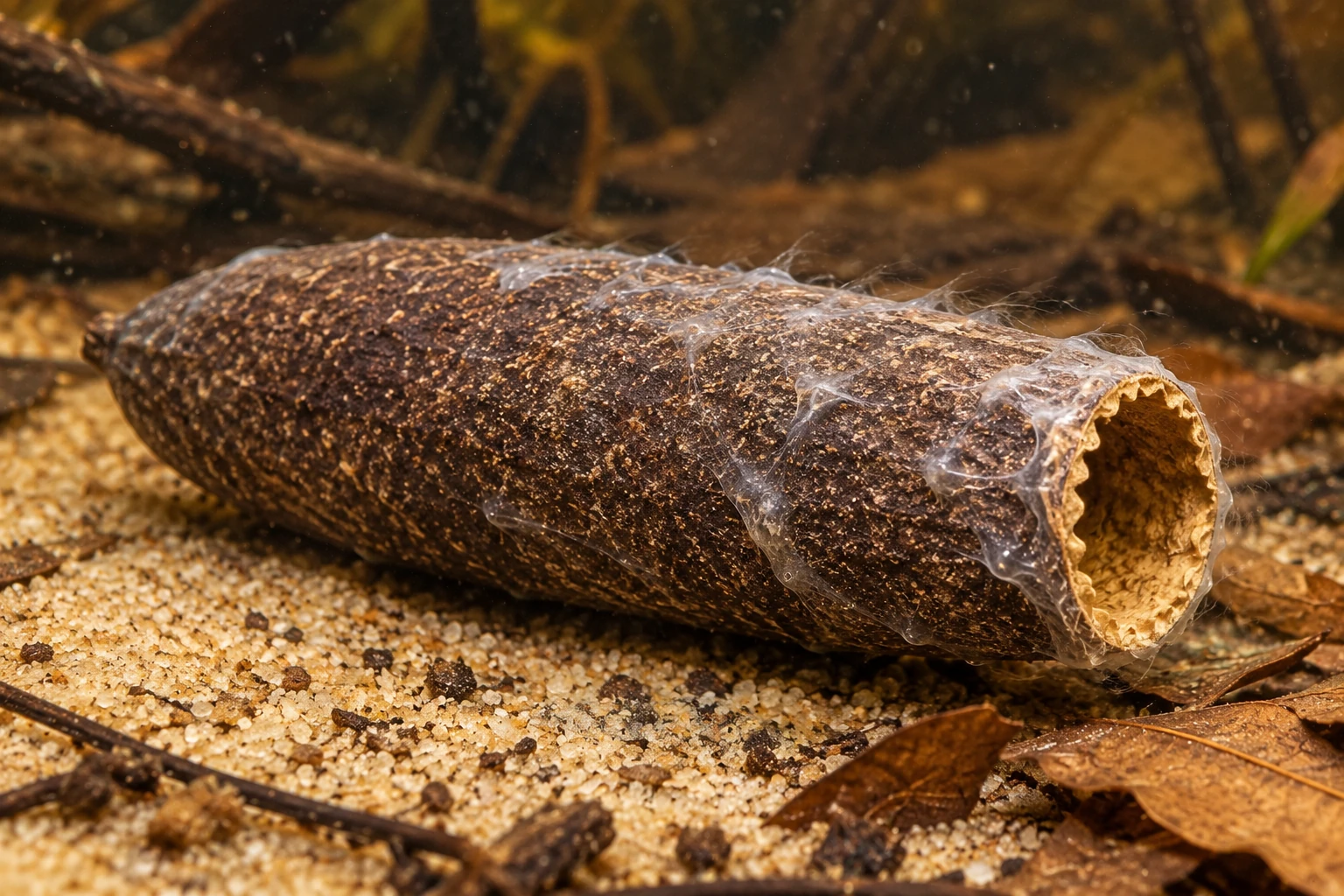
A pale white or translucent coating appears on a newly added leaf, pod or piece of wood. Sometimes it looks soft and slimy. Sometimes it clings to one edge. Sometimes it spreads across most of the surface.
And the first reaction is usually:
“Is this mould? Is something wrong?”
Very often, the answer is not necessarily.
A pale surface film can appear as dried natural material becomes wet, begins to soften and starts interacting with the biology already present in the aquarium.
The important thing is not to judge the whole aquarium from the colour of one surface.
Look at the piece itself — but also look at everything around it.
What is actually happening?
The moment a dry botanical goes underwater, it starts changing.
Water moves into the fibres and small cavities of the material. Soluble compounds begin moving out. The surface becomes available to microorganisms already living in the aquarium.
That is why a piece that looked completely clean and dry yesterday can look very different a few days later.
You may see:
- a thin translucent coating;
- a thicker white layer;
- a slightly slimy surface;
- fine thread-like growth;
- film concentrated in cracks or crevices.
Different materials show this in different ways.
A textured pod may collect visible growth around holes and ridges, while a smooth leaf may only develop a thin coating along part of its surface.
I would not try to identify it from appearance alone
People often call every white coating fungus, mould, biofilm or even food for shrimp.
That is where I would be careful.
You can describe what you see:
a pale or white surface film
But you cannot reliably identify every organism involved just by looking at a photograph.
For practical aquarium keeping, you usually do not need to.
What matters much more is how localised the change is and how the rest of the aquarium is behaving.
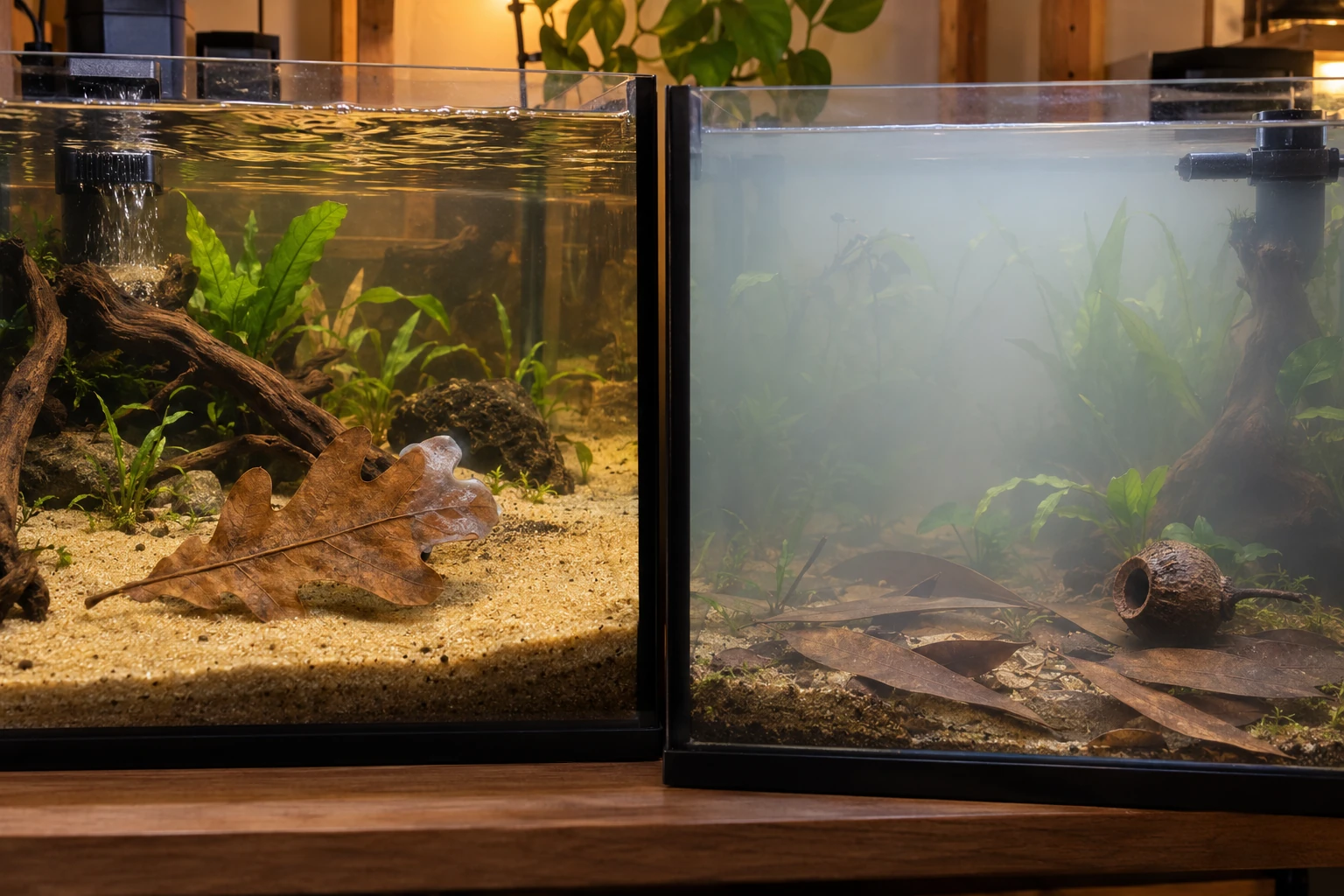
A local film and a struggling aquarium are two very different things
This is the distinction I would make first.
If the change is local
The coating is mainly on the newly added botanical.
The water remains reasonably clear.
There is no unusual smell.
Circulation and surface movement remain normal.
The fish, shrimp or snails are behaving normally.
In that situation, I would usually watch the piece before doing anything dramatic.
Natural material changes underwater. That is part of using it.
If several things begin changing together
Now I pay much closer attention.
For example:
- the entire aquarium becomes increasingly cloudy;
- an unpleasant smell develops;
- several botanicals begin collapsing unusually quickly;
- surface movement or circulation falls;
- livestock starts gasping, hiding abnormally or behaving as though it is under stress.
That is no longer just “there is some white film on one pod”.
That is a reason to stop adding more material and check the aquarium as a whole.
What I would expect from a normal early change
A newly introduced botanical may:
- float at first;
- darken;
- soften;
- become waterlogged;
- develop a temporary surface coating;
- change texture as it matures underwater.
The coating may become less obvious with time, but I would never promise that every material behaves on one fixed schedule.
Leaves, pods, bark and wood are all different.
Even two pieces of the same natural product can behave slightly differently.
That variation is one of the reasons botanical aquariums are interesting in the first place.
What changes how much film you see?
A lot of things.
The material itself matters.
A smooth leaf does not have the same surface as a deeply textured pod or a piece of wood.
Preparation matters too. Rinsing or soaking may change what happens first after the material enters the aquarium.
Then there is the aquarium itself:
- temperature;
- circulation;
- oxygenation;
- aquarium volume;
- how much botanical material was added;
- how mature and stable the system already is.
This is why I would never expect one botanical to produce exactly the same surface growth in every tank.
When choosing future material for an otherwise stable aquarium, compare the real surfaces and openings of Canoinhas Pods (Funtumia elastica) – Natural Seed Pods and Kurrajong Pods – Natural Botanical Shelters & Texture. Favour positions you can inspect and reach as the pieces change. Choosing a different pod is not a treatment for an unexplained coating.
Shrimp and snails may investigate it — but watch the animals, not the myth
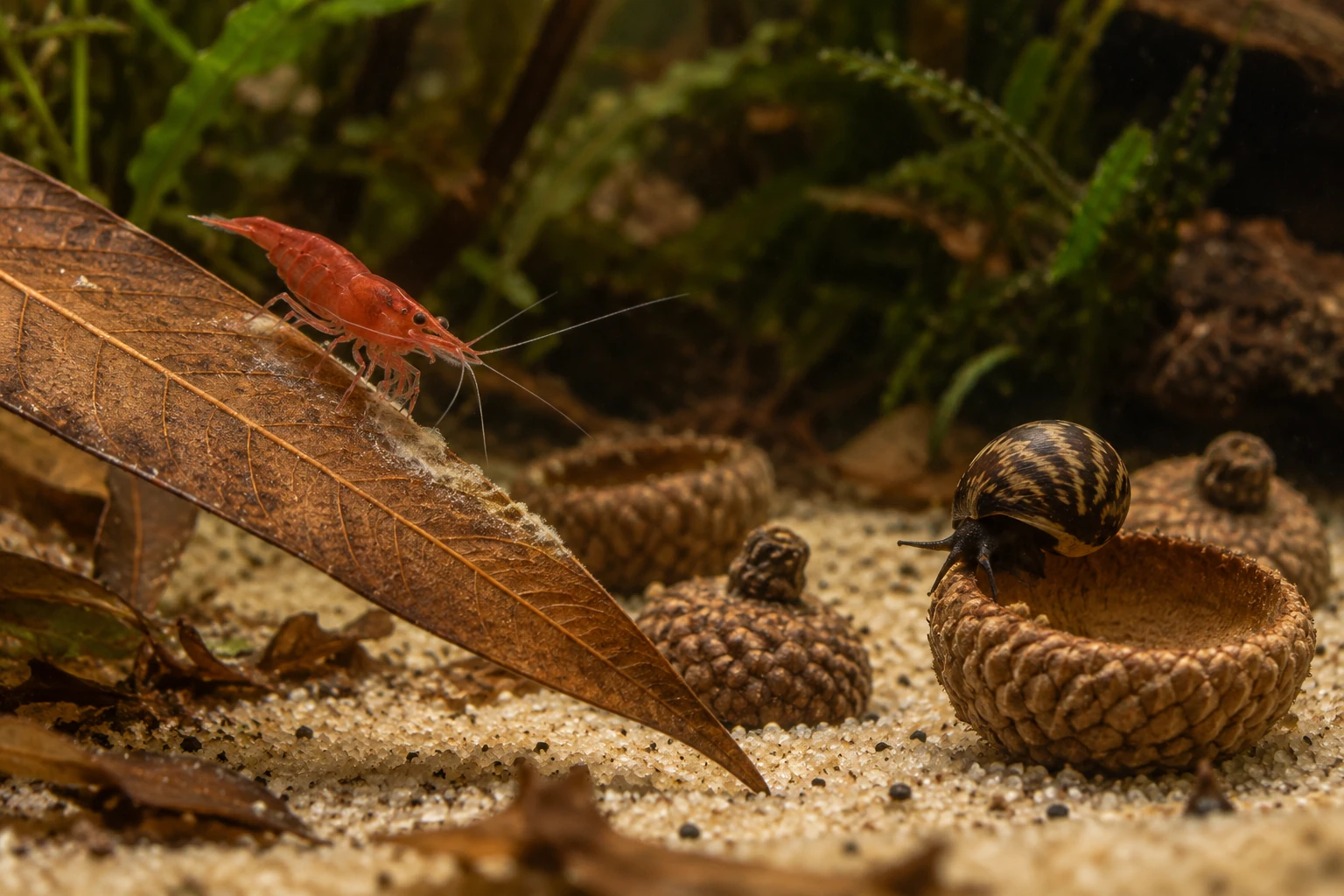
Shrimp and snails often investigate changing botanical surfaces.
That is perfectly normal behaviour to observe.
But I would not use that behaviour as proof that every white coating is automatically safe or that the coating should replace normal food.
Some animals may graze.
Others may ignore it.
What matters is that the livestock remains active and behaves normally in the aquarium as a whole.
If shrimp are happily picking at a leaf while everything else in the tank is stable, that is useful context.
If livestock is gasping or hiding abnormally, the fact that one shrimp touched the surface earlier tells you very little.
Should you remove the film?
Not automatically.
If the coating is localised and the rest of the aquarium remains stable, I would be perfectly comfortable observing it for a while.
There is no prize for making every piece of natural material look sterile.
But removing or cleaning the piece is also reasonable if:
- you want to inspect it more closely;
- the botanical itself looks questionable;
- the coating has become excessive;
- loose material is spreading;
- normal maintenance is already due.
The decision should come from the condition of the material and the aquarium — not simply because the coating happens to be white.
If you want to clean it
For a removable hard botanical, a gentle rinse in aquarium-safe water can be enough.
A loose local coating may also be siphoned during routine maintenance.
I would not reach for household disinfectants or chemicals.
And I would not automatically boil every botanical again simply because a coating appeared.
Preparation should still follow the individual product rather than becoming one universal reaction to every surface change.
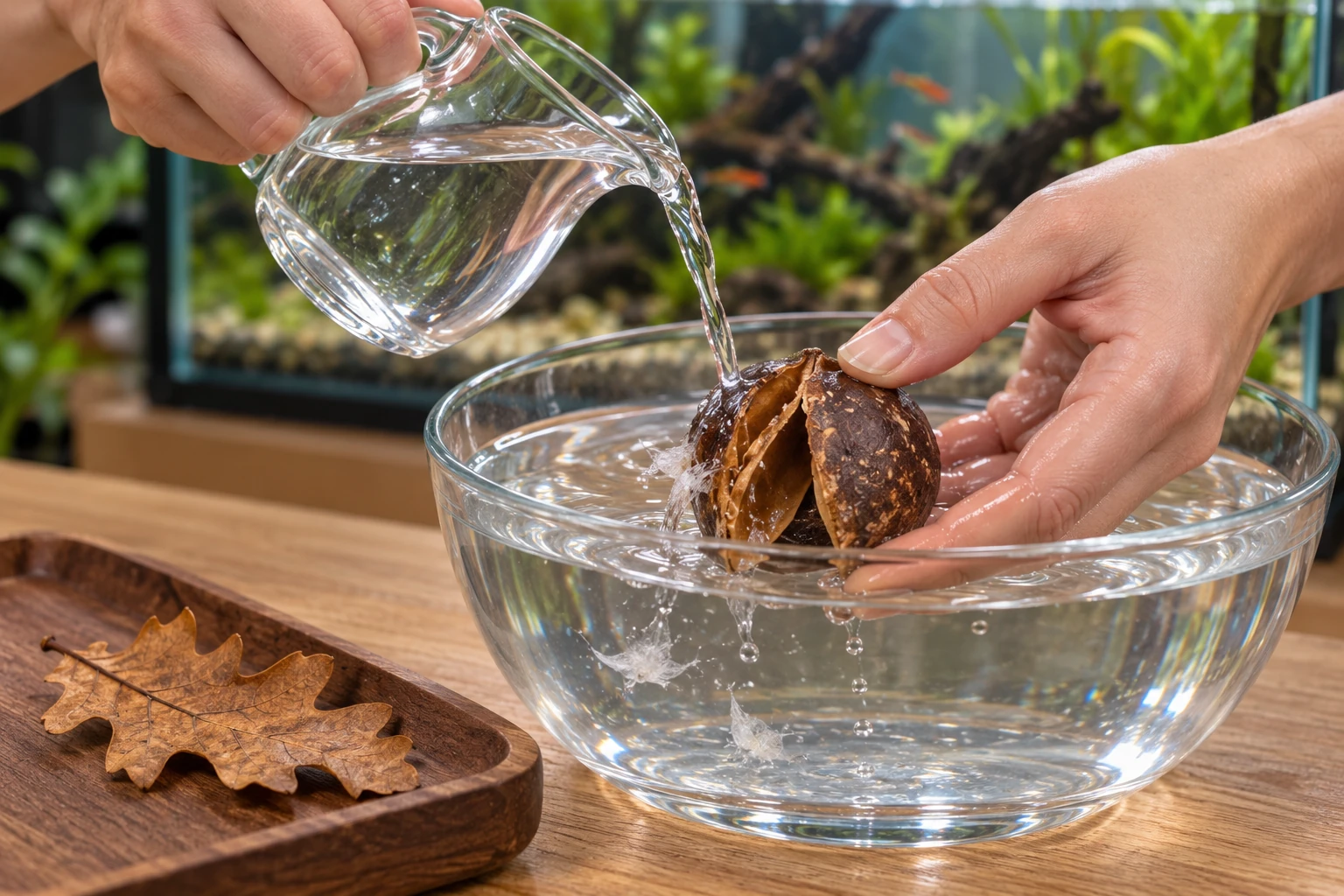
Do not keep adding botanicals while you are trying to understand a change
This is one of the simplest habits that makes botanical aquariums easier to read.
If you have just added a substantial amount of material and a new film appears, wait before adding more.
If you keep changing the aquarium every day, it becomes much harder to work out what you are actually seeing.
Give the existing material time.
Watch the water.
Watch the animals.
Check the circulation.
Then decide whether another addition makes sense.
When I would pause and investigate
I would stop further additions and take a closer look if I saw several of these things together:
- worsening cloudiness;
- an unusual or unpleasant smell;
- fish or shrimp showing distress;
- poor surface movement;
- noticeably reduced circulation;
- several botanicals breaking down much faster than expected;
- a very large recent botanical addition.
Those signs do not automatically prove that the botanical caused the problem.
But they are enough reason to stop adding more and check what can actually be measured.
Before blaming the botanical, look at the whole aquarium
Aquariums change for many reasons.
If something starts looking wrong, I would also review:
- water quality;
- oxygenation;
- circulation;
- filtration;
- temperature;
- recent feeding;
- maintenance;
- substrate disturbance;
- water changes;
- equipment performance;
- medication or treatment;
- dead plant or animal material;
- newly introduced livestock.
The timing of a change matters, but timing alone does not prove the cause.
The sensible approach is to gather the observations you can trust, correct any measurable problem and then decide what role — if any — the botanical played.
Only once an unexplained change has been assessed and the aquarium is stable, a mixed supply such as the Curated Blackwater Botanical Pod Pack – 13-Piece Mix can provide individual replacement choices for later use. It is not something to add while investigating a struggling aquarium; retain the pause described above.
A few real examples
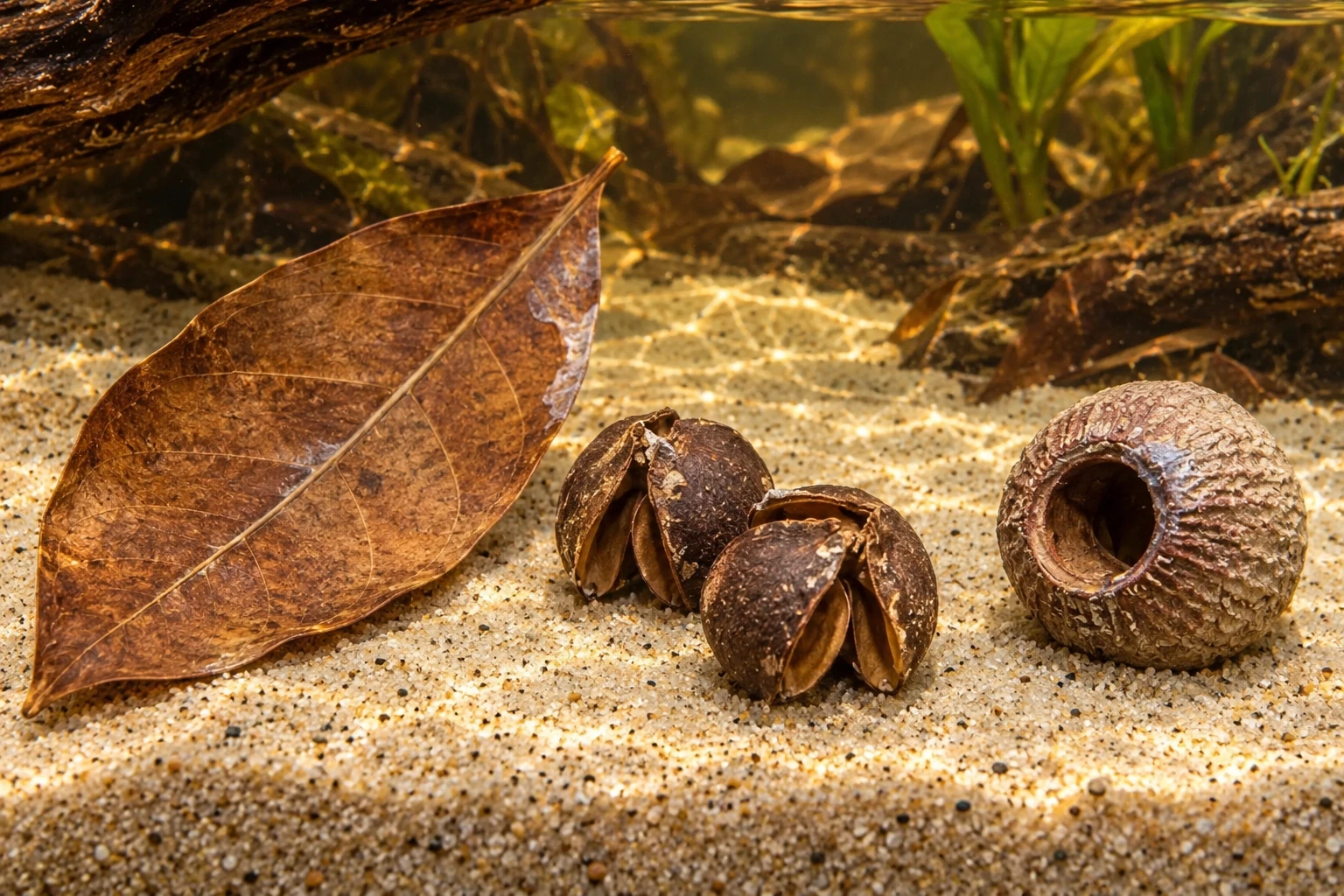
Jequitiba / Savu Pod, Dried Jackfruit Leaves, Bakuli Pods and Eucalyptus Bell Pods offer very different surface shapes. These examples illustrate material variety, not a fixed biological response.
If you want amber/tannin character without adding more loose botanical surfaces, BBA Amber Tannin Infusion Bags offer a contained infusion route.
A simple rule to remember
If the white film is local to the botanical and the rest of the aquarium looks normal, observation is often enough.
If the film appears alongside cloudiness, smell, poor circulation, low-oxygen behaviour or livestock distress, stop adding more material and investigate the whole system.
That is far more useful than trying to diagnose an aquarium from the colour of one coating.
Frequently asked questions
Is white film on aquarium botanicals mould?
Not necessarily. A pale surface film can appear while newly wetted natural material is being colonised and changing underwater. Appearance alone cannot tell you exactly which microorganisms are present.
Should I remove it immediately?
Usually not just because it is white. If it is localised and the aquarium remains stable, watch it. Rinse, wipe or siphon it if maintenance or closer inspection makes that useful.
Will shrimp eat it?
They may investigate or graze changing botanical surfaces, but behaviour varies. Keep feeding and caring for the animals normally.
How long will it last?
There is no fixed timetable. The material, preparation, circulation, aquarium biology and conditions all affect what happens.
When should I worry?
When the film is no longer the only thing changing. Increasing cloudiness, unpleasant smell, poor circulation or oxygenation, rapid material collapse or livestock distress deserve attention.
Continue with BBA
Source book
Amazonian Blackwater & Botanical Aquariums
Further reading about botanical aquarium materials, early changes and practical observation.
The complete educational system
Go deeper with the five-book BBA series.
Your first successfully paid BBA website order containing at least one physical product includes all five guides. Individual guides are also available for £3, or as the fixed five-guide collection for £10.