You add leaves or pods, the water develops a beautiful amber colour… and when you test the pH, almost nothing has happened. That does not mean the botanicals have failed. It usually means that two different things are being confused:
what the water looks like and what the water chemistry is actually doing. Botanicals can release colour and other plant-derived compounds into the aquarium while harder or more strongly buffered water resists a large movement in pH. The aquarium can look dramatically different while the measured chemistry remains much closer to where it started.
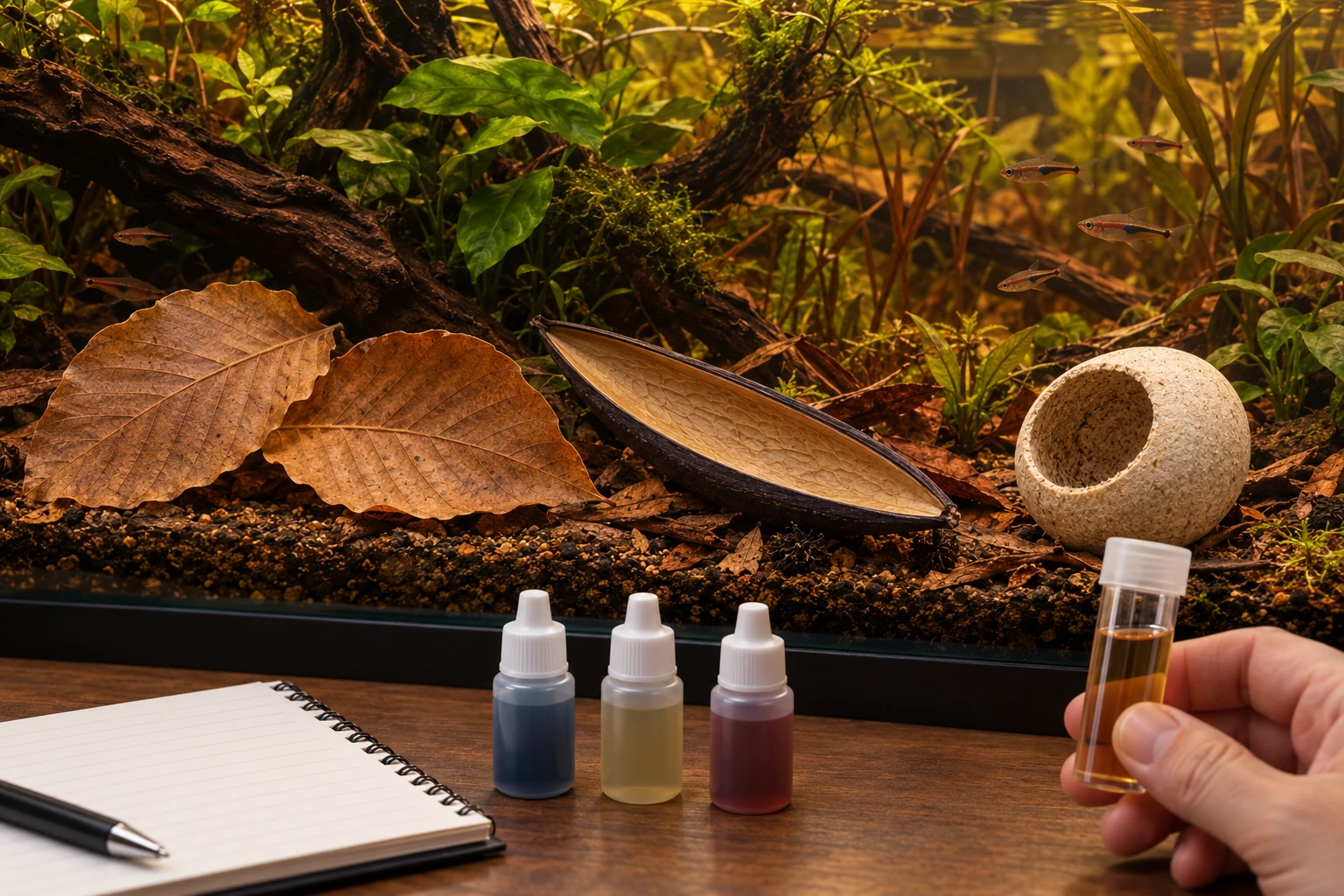
Amber water does not automatically mean soft water
This is probably the most important thing to understand. If the water turns yellow, amber or brown, you know that something visible has changed. You do not automatically know:
- the pH;
- the KH;
- the GH;
- whether the water has become soft;
- or how strongly the aquarium is buffered.
Those things need to be measured separately. A strongly amber aquarium can still have relatively hard, well-buffered water. And a much paler aquarium may have softer water than the darker one.
The colour is useful information — but it is only one kind of information.
Three different questions: colour, pH and hardness
I find it much easier to think about them separately.
What colour is the water?
This is the visible part.
Leaves, pods, bark and wood can all contribute colour at different rates and intensities.
The amount used, aquarium volume, preparation, filtration, water changes and time all affect how strong that colour becomes.
What is the pH doing?
That is something you measure.
The pH may move, or it may remain close to where it started.
The size of any movement depends heavily on the water already in the aquarium and how strongly it is buffered.
What are GH and KH telling you?
They are not the same measurement.
GH gives useful context about dissolved minerals associated with general hardness.
KH gives useful context about buffering and how resistant the water may be to pH movement.
Neither one should be guessed from the colour of the aquarium.
Why hard water can stay stubborn
If your source water has stronger buffering, it can resist rapid changes in pH. That is why you can add a tint-producing leaf, see the aquarium become noticeably amber and still find that the pH barely changes.
The leaf has not “done nothing”. It may still be adding colour, structure, cover and natural surfaces to the aquarium. It simply has not overridden the chemistry that was already there.
This is also why copying somebody else's botanical quantity is such a poor way to copy their results. Two aquariums can use the same leaves and still respond differently because the source water, filtration, buffering, water-change routine and established biology are different.
A simple way to think about buffering
You do not need to turn every botanical aquarium into a chemistry lesson. But it helps to understand one simple idea: some water is easier to move than other water. If the aquarium starts with stronger buffering, the pH may resist change.
If the buffering is lower, you may see more movement from a similar addition. That does not mean there is one “correct” KH for every blackwater aquarium. The animals, source water and overall stability still come first.
GH and KH should not be treated as the same thing
This is another place where people get into trouble. GH and KH describe different parts of water chemistry. A visible tannin tint does not prove that GH has fallen. And leaves, pods or wood should not be treated as a reliable way to substantially reduce general hardness.
If the real goal is much softer source water, that is a water-management question — not something I would try to solve by repeatedly adding more botanicals.
Why dark water can still have a relatively high pH
This catches a lot of people out because visually the aquarium looks exactly how they imagine blackwater should look. The water may be deep amber. The leaves and wood may look perfect.
The whole tank may have a strong blackwater atmosphere. And the pH can still remain relatively close to the starting value. That is not a contradiction. The colour tells you what the aquarium looks like.
The test tells you what the water chemistry is doing. Both descriptions can be true at the same time.
What botanicals are genuinely good at
I would use botanicals because I want the things botanicals are actually good at providing. They can add:
- natural physical structure;
- leaf litter, pods or wood to the layout;
- amber or brown visual character;
- surfaces within the habitat;
- gradual softening and breakdown;
- cover and texture;
- and, depending on the water, possibly some measurable chemistry movement.
That last point is the one I would never build the whole plan around. The size, speed and permanence of any pH response can vary with the material, amount, aquarium volume, source water, buffering, filtration, water changes and the established system.
For optional physical habitat material, compare a restrained patch of Dried Bamboo Leaves (Bambusa sp.) – Premium Shrimp & Blackwater Botanical with Dried Mulberry Leaves – Aquarium Shrimp Food & Leaf Litter, or select individual pieces from the Small Blackwater Botanical Box – up to 60L. These are choices of leaf shape and structure, not a water-softening plan or a reason to add more until the pH moves.
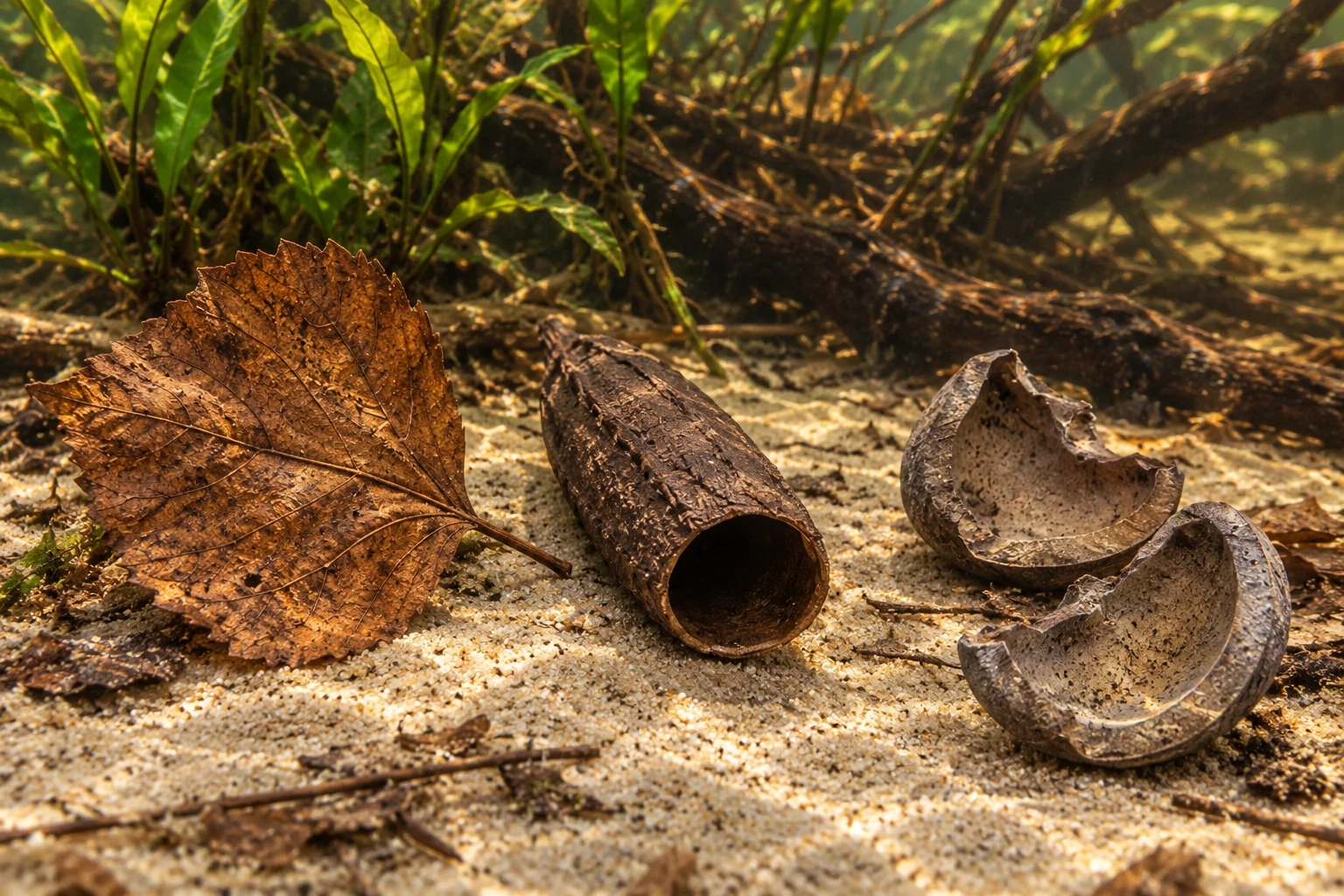
What I would not use botanicals as
I would not use them as a precision chemistry-control device. If I need an exact pH target, I do not want to keep adding leaves and hoping the number eventually lands where I want it.
The same applies if the real aim is to reduce GH substantially or guarantee a lower KH. Botanicals are natural materials in a living aquarium. They are not a fixed setting that produces the same result every time.
The mistake I would avoid: “The pH did not drop, so I need more leaves”
This is where chasing a number can create a completely different problem. Imagine a hard, well-buffered aquarium. You add Catappa leaves. The water becomes amber, but the pH hardly moves.
So you add more. Still little movement. Then more again. At that point you may be increasing the physical botanical load significantly while the water chemistry continues resisting the change you were chasing.
More material is not always the answer. Before adding more, I would ask: What was I actually trying to achieve? Was I trying to create structure? More cover? A darker tint? More natural surfaces?
Or was I really trying to force the pH downward? If the answer is the last one, I would stop treating botanicals as the main control tool and look at the water itself.
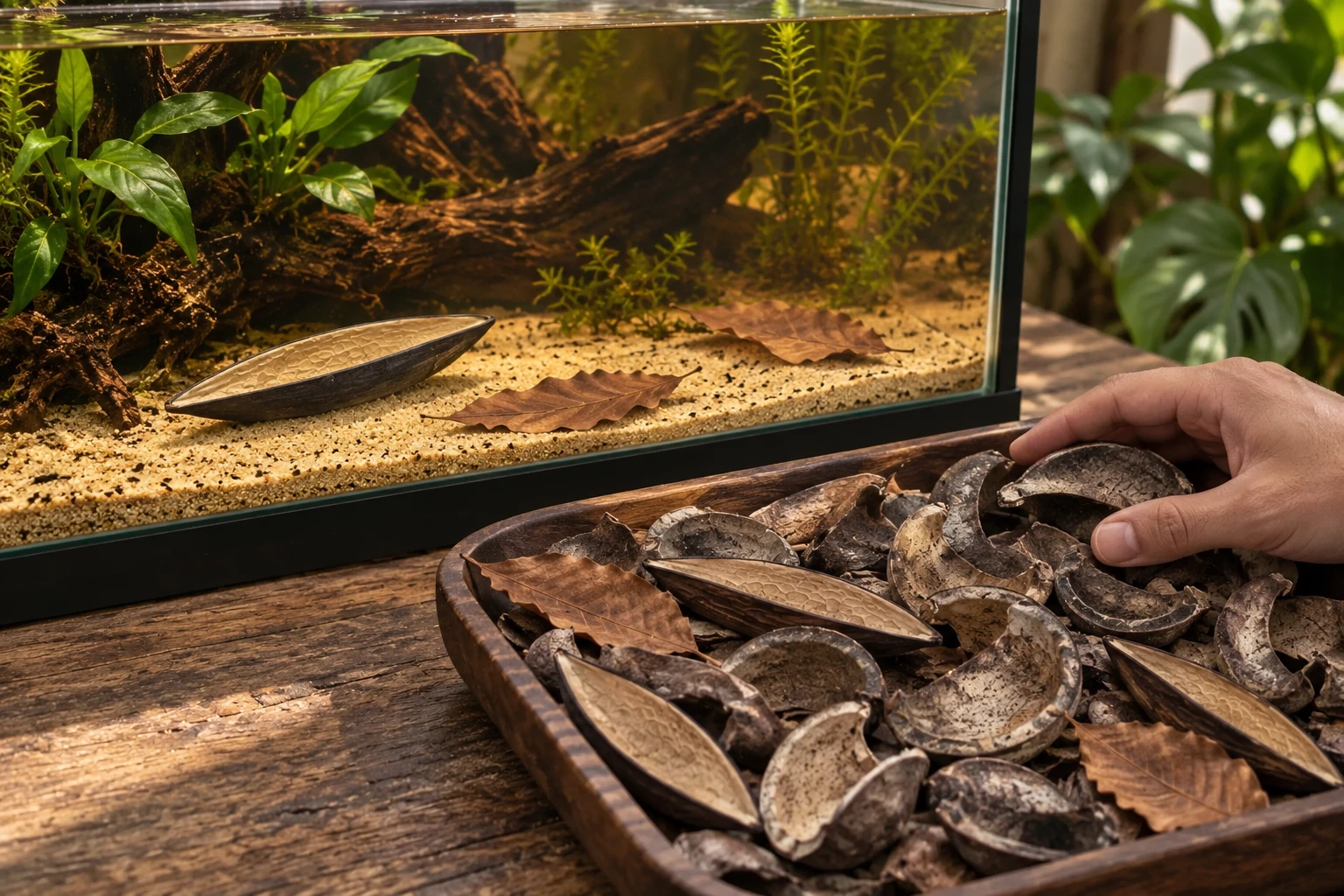
Four practical examples
Darker water, little pH movement
A hard or strongly buffered aquarium receives Catappa or another tint-producing botanical.
The water becomes noticeably amber.
The pH changes very little.
That is completely possible because visible tint and measurable chemistry are not the same thing.
Same botanicals, different aquariums
Two tanks receive similar material.
One has lower buffering and shows more pH movement.
The other remains much closer to its starting pH.
The botanical is the same.
The water is not.
Filtration changes what you see
Activated carbon, Purigen or regular water changes may reduce the amber tint.
That does not mean pH, KH and GH all moved in the same direction.
It may simply mean that the visible colour has been reduced.
Adding more creates more load
If you keep increasing the amount of botanicals because the pH has not moved enough, the physical material continues to accumulate even if the chemistry response remains limited.
That is when a chemistry problem can quietly become an organic-load problem instead.
Filtration can change the appearance without changing the whole story
Activated carbon, Purigen and water changes can all make an aquarium look less amber. But once again: appearance is not the same measurement as chemistry. If you are comparing one reading with another, remember what else changed between them.
Did you change filter media? Carry out a large water change? Remove botanical material? Add more? Change the source water? Those details matter far more than simply saying: “Yesterday the tank looked darker.”
What I would actually measure
You do not need to test obsessively. But if chemistry is part of what you are trying to understand, test consistently. Use the same method. Follow the test instructions. Compare readings under reasonably similar conditions.
Look for a pattern rather than panicking over one isolated number. And keep a simple note of things that changed — water changes, filter media, botanical additions and anything else that could affect the comparison.
At the same time, do not stop looking at the aquarium itself. Water clarity, smell, circulation, filtration and livestock behaviour still matter.
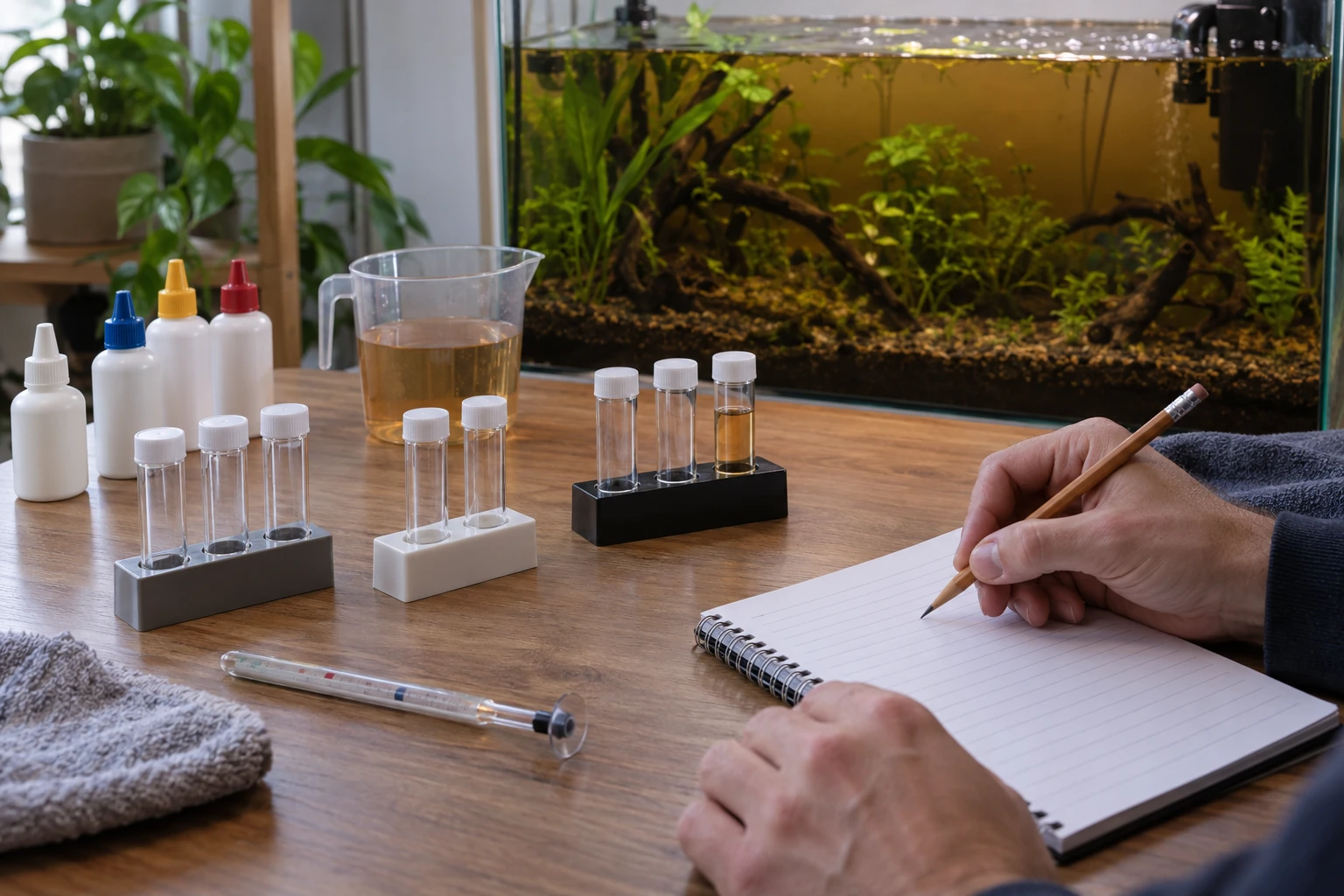
When chasing a target number becomes the wrong goal
It is very easy to become fixated on a number because a book or website says a species comes from very soft or acidic water. Species requirements absolutely matter. But so does the water you actually have, the stability of the aquarium and what the animals are doing in it.
I would rather understand the real requirements of the livestock first than keep throwing natural material into the aquarium simply because I want the pH to fall. That does not mean ignoring unsuitable water.
It means solving the right problem with the right tool.
If you want amber colour without adding more loose material
Sometimes the goal really is visual. You want more amber/tannin character, but you do not want to keep adding loose leaves or pods. That is where a contained option can make more sense.
BBA Amber Tannin Infusion Bags are designed to build amber/tannin character in a contained format. They are not a hardness-reduction product and should not be treated as a guaranteed way to lower pH.
For a liquid alternative to more loose material, compare BBA Live Tannin Culture – Botanical Tannin Infusion, 250 ml under its own directions. The product name does not turn it into a GH/KH adjustment method; keep the colour decision separate from the measured conditions required by the inhabitants.
A simple rule to remember
If your botanical aquarium becomes darker but the pH barely changes: do not assume the botanicals failed. Ask what you wanted them to do. If you wanted structure, cover, natural surfaces and amber character, they may already be doing exactly that.
If what you really wanted was precise control of pH, GH or KH, then you are asking botanicals to do a job they are not designed to perform reliably.
Frequently asked questions
Why did Catappa make my water darker without lowering pH much?
Because visible colour and pH movement are different things. Stronger buffering may resist pH movement even while the water becomes noticeably amber.
Do botanicals soften hard water?
They should not be treated as a reliable method for substantially lowering general hardness. If much softer water is the goal, that needs to be approached as a water-management question.
Can I keep adding leaves until the pH drops?
I would not. You may simply keep increasing the physical and organic load while the buffered water continues resisting the change.
Does dark brown water mean the aquarium has become soft and acidic?
No. It means the aquarium has dark brown water. Test the chemistry if the chemistry matters.
Should I stop using botanicals in hard water?
Not simply because the pH does not move much. Botanicals can still provide structure, cover, surfaces and visual character. Judge them by the role you actually want them to perform.
Continue with BBA
Source book
Amazonian Blackwater & Botanical Aquariums
Further reading about botanical materials, water conditions and practical aquarium observation.
The complete educational system
Go deeper with the five-book BBA series.
Your first successfully paid BBA website order containing at least one physical product includes all five guides. Individual guides are also available for £3, or as the fixed five-guide collection for £10.