Shrimp · Amano shrimp
Amano Shrimp — Caridina multidentata: Habitat and Care
A busy freshwater grazer needs more than algae to eat. Plan stable, oxygenated water, planted shelter and a varied diet — and understand why keeping adults is very different from raising their larvae.
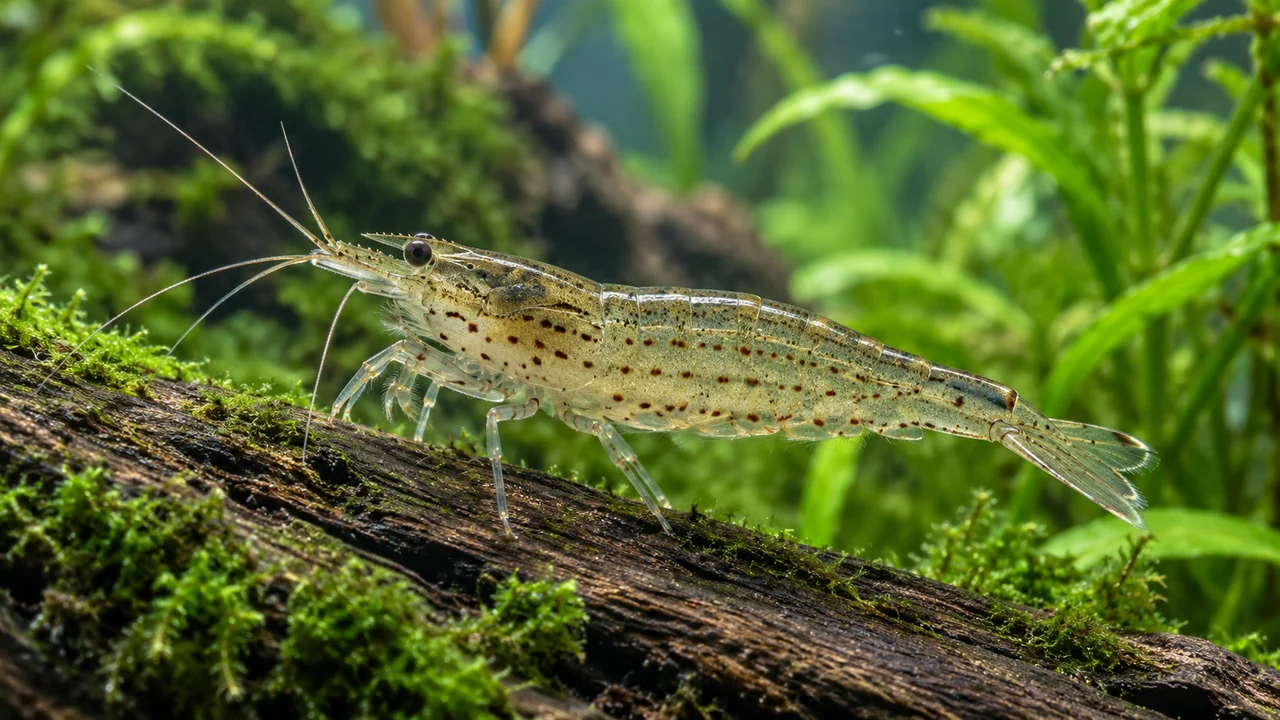
- Identity
- Caridina multidentata, family Atyidae; formerly widely sold as Caridina japonica. Also called Japanese algae-eating shrimp.
- Adult size
- Around 4–5 cm; females are generally larger and fuller-bodied than males. Plan for adult size, not shop juveniles.
- Space and company
- A small group of five or more is a useful starting plan where food and space allow. Aim for a mature aquarium around 60 cm long or larger; this is planning guidance, not a proven universal minimum.
- Practical water guide
- Fluval gives 20–27°C, pH 6.5–7.5 and hardness 3–18°dH. Stable conditions within these care ranges matter more than reaching their edges; keep ammonia and nitrite undetectable.
- Daily essentials
- Mature filtration, surface movement, safe intakes, grazing surfaces, shelter and deliberate supplementary feeding.
- Breeding distinction
- Adults live in freshwater. Free-swimming larvae require saline rearing conditions; an ordinary freshwater aquarium will not normally produce a growing Amano colony.
Know the shrimp you are buying
Amano shrimp are Caridina multidentata. The familiar name Caridina japonica in older books and shop labels refers to the same species: Cai and colleagues clarified the naming in their 2006 taxonomic revision. Do not confuse the scientific name with a requirement to keep them like soft-water bee shrimp simply because both belong to Caridina.
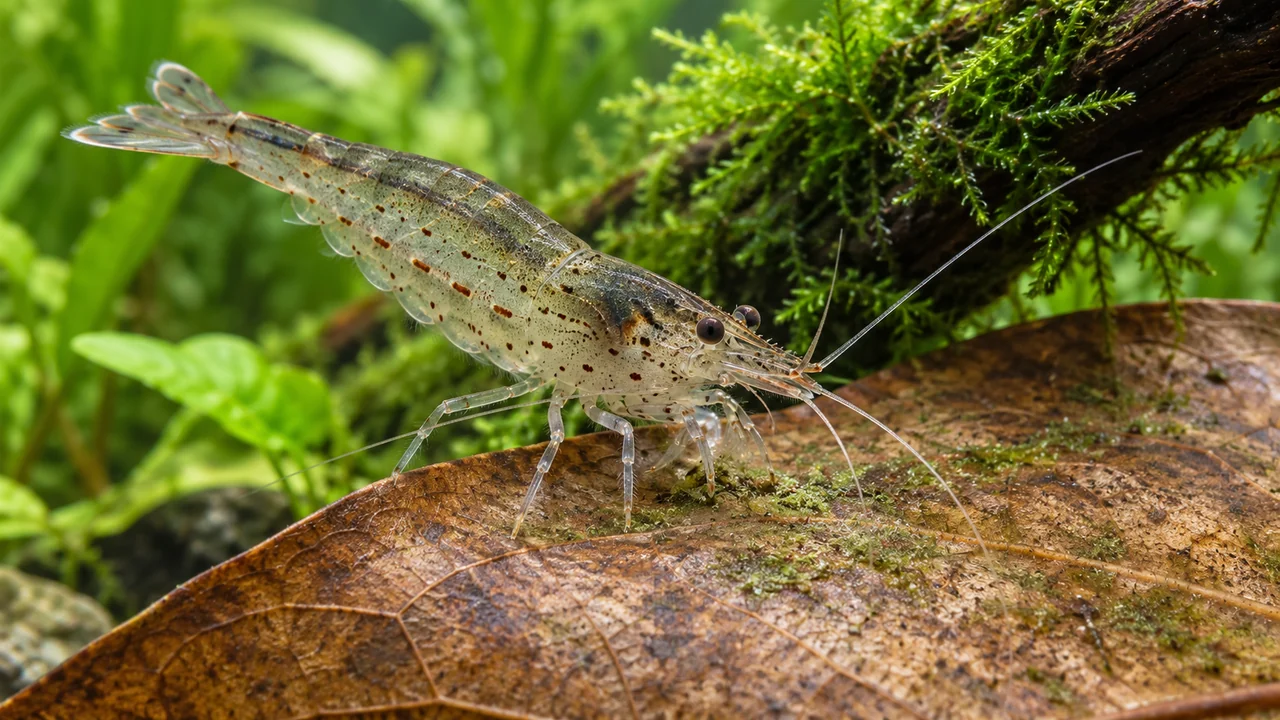
Look for a translucent grey, tan or slightly greenish body with rows of brownish dots and short marks along the flanks, rather than a solid red cherry-shrimp colour. Females commonly show more elongated marks and a deeper abdomen; males tend to be smaller with rounder spots. These are useful buying clues, not a guarantee of identification from colour alone. Other clear shrimp are sold under similar common names: confirm the species, especially if a supposedly Amano colony produces miniature shrimplets entirely in freshwater.
Natural range and habitat
Japan and Taiwan are the well-supported native range used in the US Fish and Wildlife Service assessment. Older literature lists a wider distribution, but some records, including Fiji and Madagascar, have been questioned as other species. A seller's export location is not evidence of the shrimp's natural origin.
Adults inhabit freshwater rivers; boulder substrates are documented in the taxonomic and institutional accounts. Their life cycle connects rivers with the sea through a dispersing larval stage. A planted aquarium can meet adult needs without reproducing every feature of a wild river. Clear, well-oxygenated water and accessible surfaces make more sense than assuming this is a specialist of still, extremely acidic blackwater.
Adult size, a group and enough usable space
An adult of roughly 4–5 cm is a substantial shrimp beside a cherry shrimp. Start the layout around the adult animals, with several feeding areas and routes between cover. A group of five or more follows OATA's general shrimp guidance, but does not mean these shrimp form a tightly schooling group or need a fixed number per litre.
For a new setup, a mature aquarium around 60 cm long or more is a sensible starting point, following Dennerle's Amano guidance. Published volume recommendations differ; no single litre figure proves every smaller tank unsuitable or every larger tank adequate. Consider footprint, established grazing area, filtration, companions and how you will feed the whole group. A larger bare tank can still offer less useful habitat than a thoughtfully arranged planted one.
Water conditions: a practical starting point
Fluval's adult-care guide gives 20–27°C, pH 6.5–7.5 and hardness 3–18°dH. Use these as husbandry guidance, not survival thresholds or permission for abrupt movement between extremes. Choose a steady temperature suited to the whole aquarium, check it with a thermometer and avoid deliberately keeping the tank at its warmest acceptable edge.
Conditioned tap water can be suitable when its measured chemistry fits the stock. Do not replace it with pure reverse-osmosis water without appropriate remineralisation, or add acids merely to create an Amano 'blackwater' recipe. Measure GH and KH as well as pH when diagnosing instability. Introduce new shrimp with attention to temperature and differences in water chemistry; repeated large corrections are not a substitute for a stable routine.
Filtration, oxygen and routine maintenance
Use an established biological filter and keep ammonia and nitrite undetectable. Protect an exposed intake with a suitable sponge pre-filter and maintain it so flow does not quietly fall away. A newly filled aquarium with spotless surfaces is not ready simply because the water looks clear.
Maintain visible surface movement and circulation around the wood without blowing the shrimp off their grazing surfaces. Dense planting does not remove the need for gas exchange, especially overnight or in warm weather. Check the filter, temperature and water quality regularly; make planned partial water changes with conditioned, suitably matched water. Siphon accessible debris while leaving some established grazing surfaces intact, rather than stripping and scrubbing the entire habitat at once.
Arrange a planted aquarium you can maintain
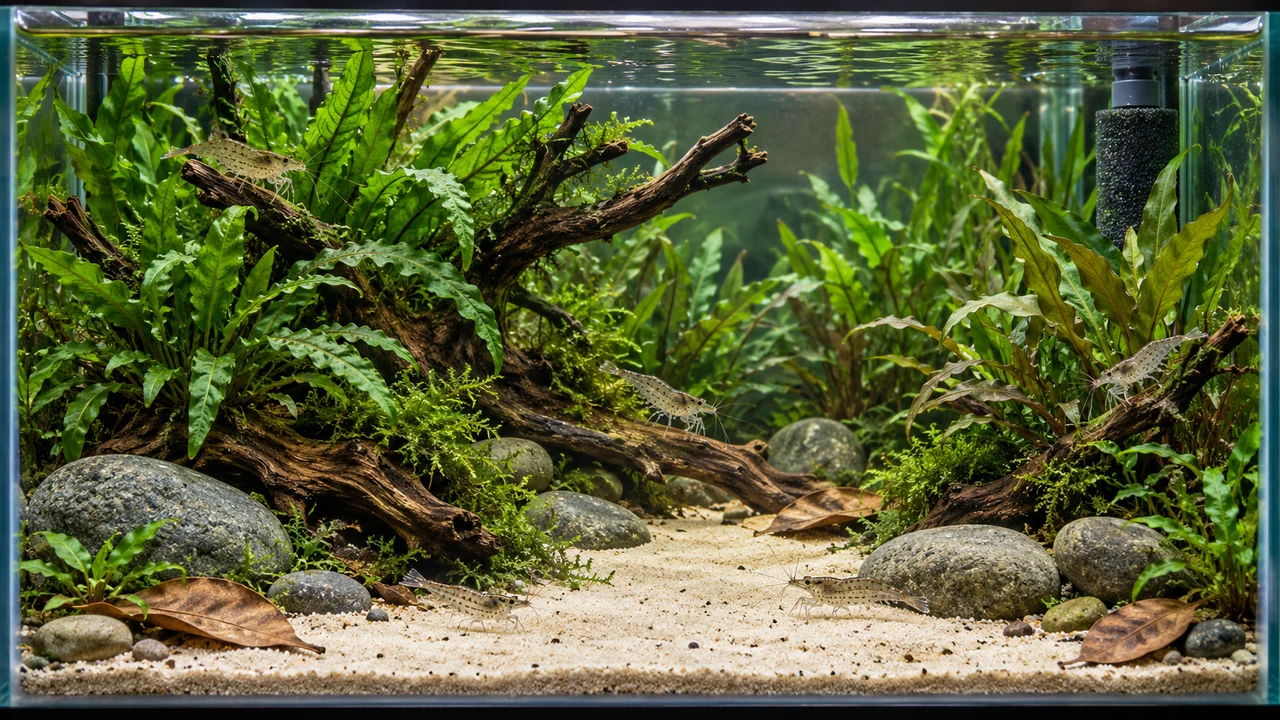
Use branching wood, moss and established plants to create a mixture of exposed grazing faces and sheltered recesses. Keep an open feeding patch and a route for the siphon. Place a few magnolia leaves beside the structure rather than burying the whole floor; check that loose pieces cannot cover the intake.
Anchor the wood securely, leave access behind it and fit a cover around cable openings. Planting can soften the current and provide retreat without blocking the surface. Our guide to plants and growing space explains this balance. The arrangement shown here combines sheltered edges with a visible central area, so feeding and maintenance remain straightforward.
Feed the shrimp, not just the idea of an algae eater
Amano shrimp graze soft growth and material collected on surfaces, but the amount available changes as an aquarium matures and is cleaned. Offer a suitable complete shrimp food, with vegetable and other appropriate supplementary foods as variety. Start with small portions and watch which animals actually reach them.
Spread food between a few accessible spots if larger shrimp monopolise it. Remove uneaten portions before they disappear into the leaf bed. Neither a brown leaf nor a clean-looking pane tells you that a complete diet is available. Do not starve the group to make it tackle unwanted algae: investigate the aquarium's light, nutrients and maintenance as well.
Compare Pure Shrimp Meal Shrimp Food for a protein-forward supplementary portion with Premium Natural Spirulina Tablets for a different grazing option. Offer them separately as variety alongside the complete ration, spreading small portions between accessible spots.
Behaviour, moulting and companions
Expect frequent picking, climbing and short swims between surfaces. After moulting, a shrimp may withdraw while its new shell hardens. An empty, translucent moult is not the same as a dead animal; avoid pulling the layout apart merely because one individual is briefly hidden. Repeated failed moults call for a check of water chemistry, recent changes and diet, rather than blind mineral dosing.
Small, genuinely peaceful fish can be suitable companions, but assess their adult mouth size and hunting behaviour. Large predators, persistent pickers and crayfish are poor choices; a betta is not automatically safe. Adult Amanos are still vulnerable after moulting. Neocaridina can share suitable conditions, although Amanos may take food first: give the smaller shrimp separate feeding opportunities and cover. No list can guarantee the behaviour of every individual.
Eggs in freshwater do not mean freshwater recruitment
Females carry eggs beneath the abdomen and can release free-swimming larvae in freshwater. These are not the miniature bottom-dwelling shrimp produced by Neocaridina. Amanos are amphidromous: larval development normally takes place in saline water, followed by a juvenile return to freshwater. Eggs and newly hatched larvae therefore do not promise a self-sustaining colony in an ordinary aquarium.
Kondo, Hamasaki and Dan's 2021 experiments obtained juvenile development at salinities of 17–34 ppt under their tested conditions. That is a larval research result, not an adult-care range or a complete home-breeding recipe. Do not salt the community aquarium or move the adults into seawater to pursue it.
What deliberate larval rearing requires
Plan a separate larval system before eggs hatch: controlled saline water prepared with a marine salt mix, a calibrated way to measure salinity, stable temperature, gentle aeration and a means of keeping larvae away from dangerous intakes. The published work uses specialised small suspended foods, including cultured microalgae, rather than treating adult pellets as a larval diet.
Lee's National Taiwan University larviculture study found initial feeding and microalgal choice important. A workable project therefore needs reliable food cultures, observation of development and careful water maintenance, not just salt added to a jar. Once larvae metamorphose into juveniles, their return to freshwater must be managed as a separate transition. Follow a complete, documented rearing method; keeping healthy adults is a much simpler goal and does not require breeding them.
The specific role of wood, leaves and botanicals
Wood creates climbable surfaces and refuge; leaves add softer, changing surfaces where microbial communities and trapped particles can be grazed. Their value depends on the material, its condition and the aquarium around it. They are optional parts of a working habitat, not a requirement for dark water, a complete shrimp food or a treatment.
Follow the botanical preparation guide and introduce modest additions gradually. Keep water moving around the leaf bed and inspect what accumulates beneath it. Biofilm can be part of normal decomposition, while thick growth accompanied by cloudiness or stressed animals needs a water-quality check. Tannins and organic load are different: darker water cannot tell you whether oxygen, feeding or waste management is adequate.
A restrained leaf edge can use Dried Terminalia catappa Leaves – Aquarium Leaf Litter or the curled shapes of Dried Mango Leaves – Natural Aquarium Leaf Litter, with clear access around the larger shrimp and their feeding positions.
Common problems: sensible first checks
Several shrimp climbing towards the surface or trying to escape together: check oxygenation, filter flow, temperature, ammonia and nitrite promptly, along with recent additions or maintenance. Improve aeration and correct a measured water-quality problem with suitable conditioned water; do not respond by adding more botanicals. A lone missing shrimp warrants a look around cover, the filter and lid gaps, as well as possible predation.
Poor feeding, repeated deaths or moulting trouble: review recent water changes, measured hardness, feeding access and any medicines, pesticides or contaminated materials. Only use treatments specifically suitable for the animals present; copper-based medicines can be dangerous to shrimp. Persistent unexplained losses need competent aquatic-health advice, not a guessed cure. Keep unwanted shrimp and aquarium contents out of natural waters.
Further reading and sources
Taxonomy and larval biology are supported by research and institutional records. Adult care figures are practical husbandry guidance, not experimental survival limits; the sources differ in their suggested aquarium size. No source establishes a treatment effect for a BBA botanical product.
- Cai, Ng, Shokita & Satake (2006): Japanese atyid shrimp revision — Primary taxonomic revision establishing the relationship between C. multidentata and C. japonica; its older distribution records are read alongside the later institutional assessment.
- US Fish and Wildlife Service: Caridina multidentata assessment (2017) — Institutional synthesis of accepted identity, river habitat and uncertainty in some wider distribution records; not a care sheet.
- Fluval: Amano shrimp species spotlight — Species-specific adult size, temperature, pH, hardness, diet and shelter guidance. Its care ranges are recommendations, not laboratory tolerance limits.
- OATA: Freshwater shrimp and snails care — General UK husbandry guidance on group keeping, water quality, introduction and maintenance. Its older taxonomy and group-wide ranges are not used to identify this species.
- Dennerle: Beginner guide, part 1 — Professional husbandry guidance recommending an aquarium at least 60 cm long for Amanos; supports the space-planning recommendation, not a universal biological minimum.
- Aqueon: Freshwater shrimp care guide — Manufacturer husbandry guidance on mature systems, safe intakes and species-specific water needs; Amanos are distinguished from specialist soft-water Caridina.
- Aquarium Co-Op: Amano shrimp care guide — Practical identification and husbandry observations, including flank markings, escape gaps and feeding competition. Supplementary husbandry reference, not primary taxonomy.
- Kondo, Hamasaki & Dan (2021): Larval performance under temperature and salinity treatments — Primary experiment on amphidromous larvae. The reported 17–34 ppt development range belongs to the tested larval conditions, not adult aquarium care.
- Lee, Hung-Wen (2009): Larviculture of Caridina multidentata — National Taiwan University research on larval culture and initial microalgal feeding; highlights the specialist food requirements of a separate rearing project.