Shrimp · Vampire Shrimp
Vampire Shrimp — Atya gabonensis: Habitat and Care
A large armoured fan feeder whose impressive legs are for holding position, not hunting fish. Provide roomy cover, clean oxygenated water and fine food that actually reaches its fans; reproduction is a separate larval-rearing project.
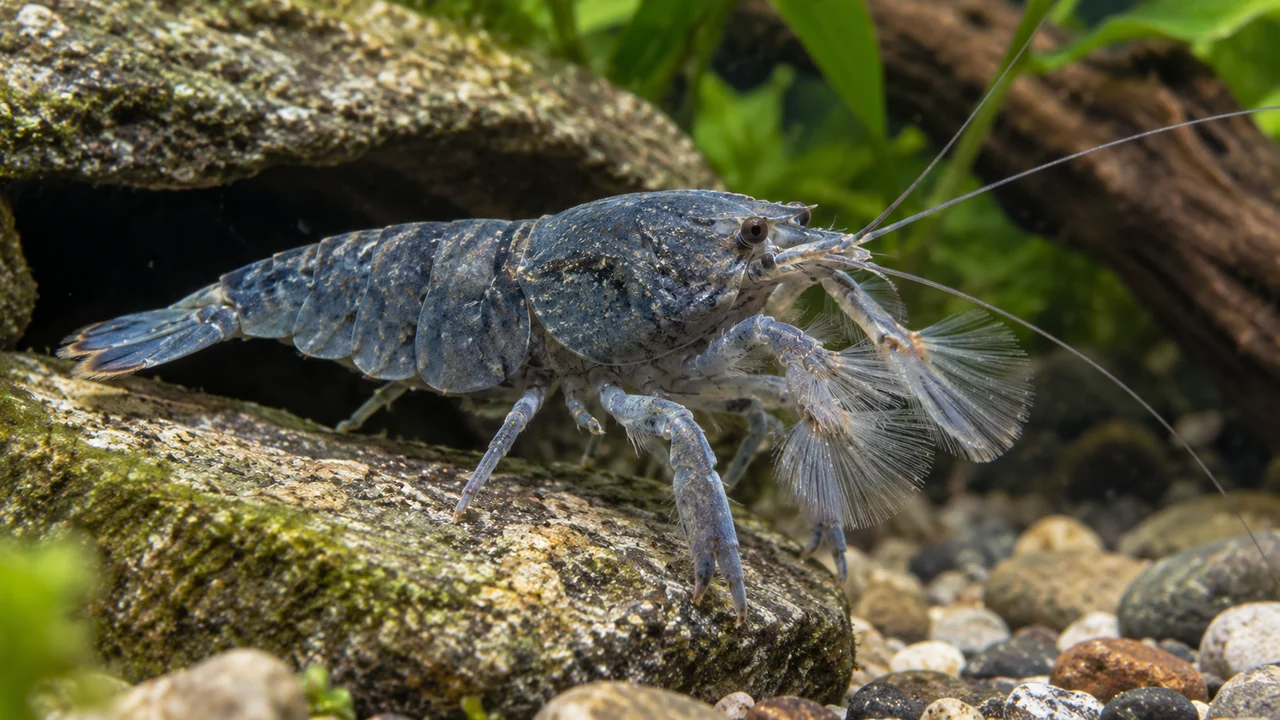
- Identity
- Atya gabonensis, a robust African fan shrimp; “Atyopsis gabonensis” is not the accepted combination used here.
- Adult allowance
- Plan for approximately 12–15 cm overall rather than a dwarf-shrimp footprint; some size reports are larger.
- Aquarium
- A mature aquarium around 100 × 40 cm or larger for a small planned group, with separately usable broad refuges and feeding positions.
- Routine conditions
- About 24–27°C, pH 6.8–7.8 and 6–12°dGH, with reliable oxygenation and stable matched changes.
- Diet
- Fine balanced suspended food and natural edible particles; an oversized filter cannot manufacture a complete diet.
- Breeding
- Freshwater adults produce small planktonic larvae; a dedicated saline larval approach is distinct from adult freshwater maintenance.
Armour does not make a predator
Atya gabonensis has a broad, heavy body and strong walking legs adapted to gripping surfaces. Its feeding equipment consists of feathery fans, not lobster-like weapons. Blue is a familiar aquarium colour, but cream, grey and brown tones can occur. Colour alone cannot diagnose mineral status, sex or health.
Use the accepted name Atya gabonensis and distinguish it from Asian Atyopsis moluccensis. The often-repeated Atyopsis gabonensis label should not become a second scientific identity or a duplicate profile. Vampire is a common name, not a description of a blood-feeding animal. Assess the body, fans and supplier information together.
An African river animal with different scale
West and Central African river records provide the relevant natural-history context, including research from the Cross River in Nigeria. Adults occupy fresh water and use flowing habitats. Older distribution summaries and trade labels are not sufficiently precise to assign an aquarium specimen a particular collection locality.
The aquarium must accommodate a substantial animal rather than merely the juvenile offered for sale. Allow for an adult around 12–15 cm overall, with room for its appendages and retreat. A small opening that appears adequate when the shrimp arrives may become a trap later. Broad, inspectable shelter matters as much as an attractive display position.
A broad refuge beside a productive current
A mature aquarium around 100 × 40 cm or larger is a practical plan for a small group, with more room when feeding positions cannot be separated. Construct stable shelters before adding loose substrate. Smooth rock edges and roomy root arches should let the whole animal enter, turn and withdraw.
Provide flow across accessible perches, alongside quieter hiding places. Several shrimp should not have to crowd into the only useful food stream. Keep pump guards secure and avoid making the main cave impossible to inspect. Planting can soften the arrangement, but open maintenance routes are essential for a large animal whose condition may otherwise be hidden.
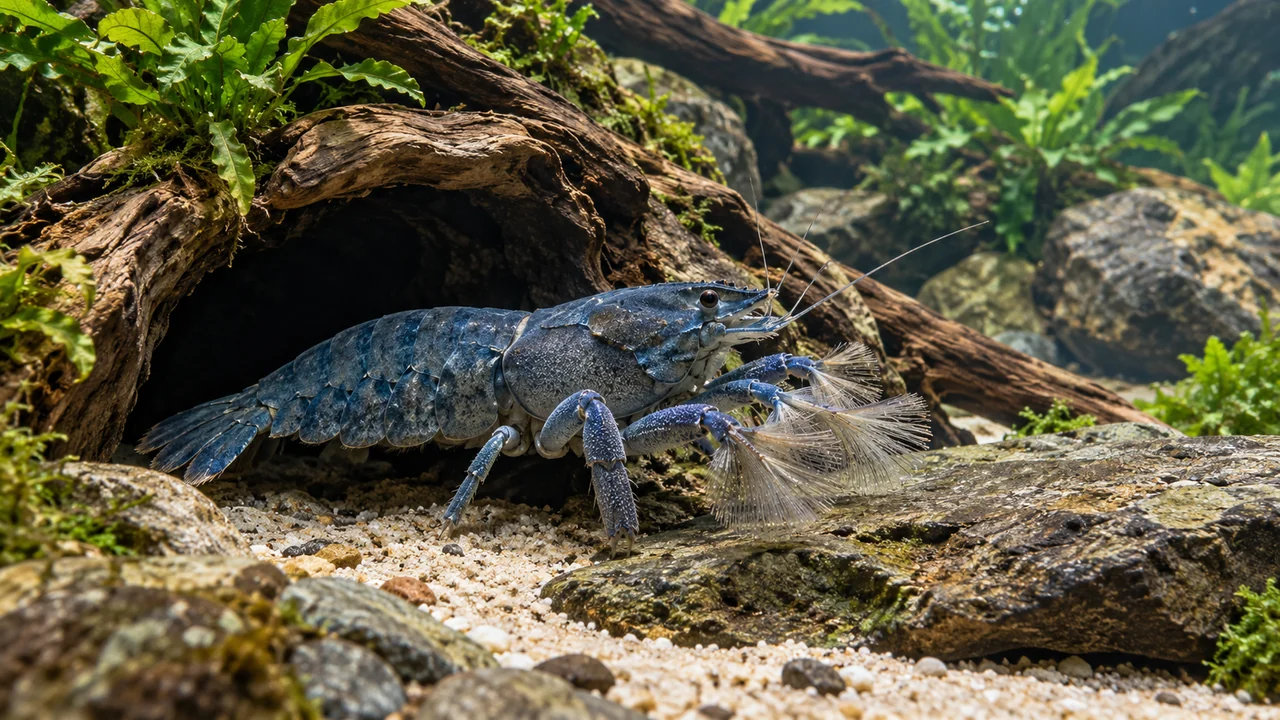
Fine food has to arrive at the fans
Pre-wet an appropriate complete suspension-feeding food and introduce a small amount upstream of an occupied perch. Watch the fans catch material and move it towards the mouth. A strong current can transport food past the shrimp, while a filter can remove it before it arrives; neither piece of equipment proves nutritional adequacy.
Adjust delivery and particle size to what is actually captured. A wide scattering of powder is not automatically better than a small targeted feed. Inspect feeding at quieter times if the shrimp avoids busy daytime activity. Persistent floor searching or declining condition merits a review of the ration and access, rather than an assumption that a large fan shrimp can live on aquarium waste.
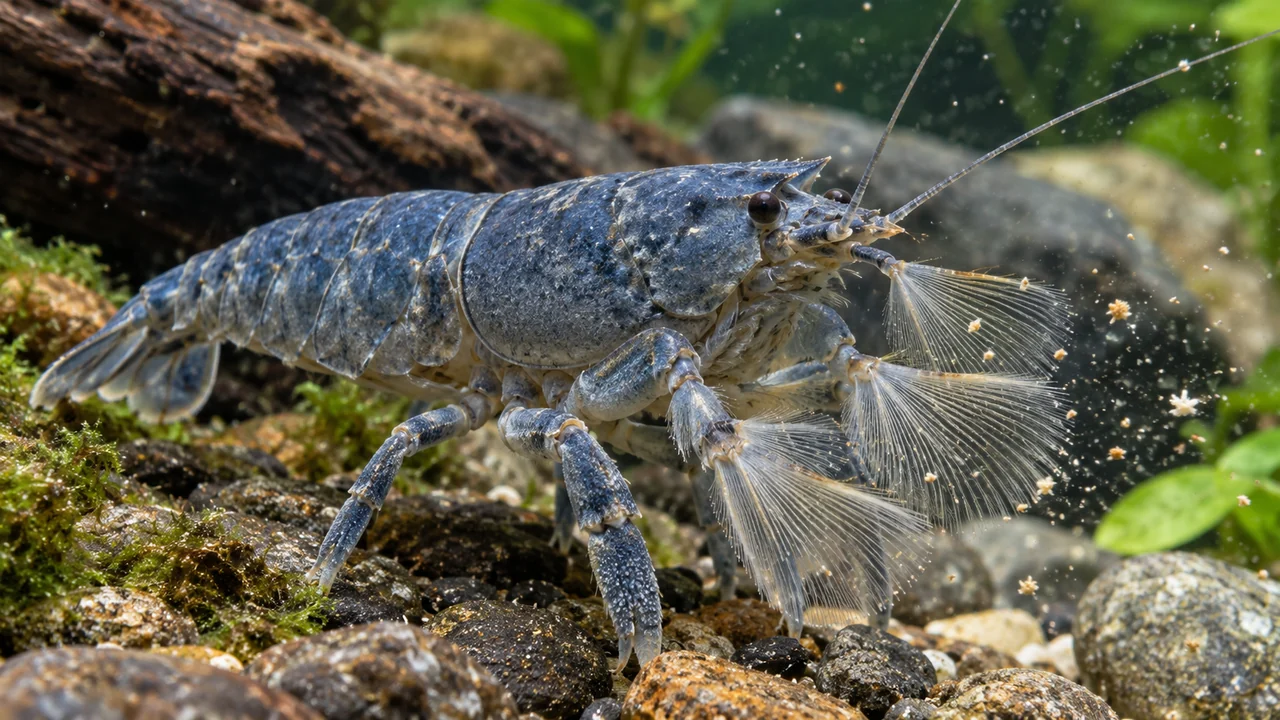
Warm, clean water with a safety margin
A working adult plan of about 24–27°C, pH 6.8–7.8 and 6–12°dGH sits within published aquarium guidance. It is not a set of experimentally measured limits. Match the fish-free or carefully chosen community system to the supplier’s established conditions and maintain it predictably.
Effective biological filtration, surface exchange and circulation through occupied areas are essential. Keep ammonia and nitrite undetectable, remove surplus food and check the actual current after maintenance. Warm water and fine feeding make neglect of gas exchange particularly unhelpful. A spare means of aeration is more useful preparation than another decorative cave in an overcrowded aquarium.
Moulting and the hidden shrimp
A shrimp may retreat before or after shedding its shell. Keep a protected refuge and avoid pulling it out merely because it is less visible. An intact cast can be left for normal grazing if water quality and the animal’s condition are satisfactory; it is not evidence that a dead shrimp needs replacing.
For repeated moulting trouble, review measured mineral conditions, recent changes, food and contamination. Do not treat every pale individual as calcium deficient or add supplements without checking the system. Large fish and curious bottom dwellers can injure a soft shrimp even when they ignored the hardened adult. Physical security must remain part of the care plan.
Company should respect the feeding station
This fan feeder is generally peaceful, but a community must leave it enough food, space and shelter. Avoid large predatory mouths, crayfish and fish that repeatedly pick at antennae or fans. A tough exterior does not protect delicate feeding appendages or a newly moulted body.
If several fan feeders are kept, make each useful station observable. A quiet individual can lose access without a dramatic confrontation. Choose numbers around the mature system and the available feeding area, not a universal group-size promise. More animals also mean more powdered food and a greater need to control excess organic load.
Reproduction is not ordinary freshwater recruitment
Female Atya gabonensis carry many small eggs and release free-swimming larvae rather than a few fully formed miniature adults. Field reproductive observations must be distinguished from proof that those larvae complete development in a freshwater aquarium. Institutional atyid summaries support a saline larval requirement for this species.
Do not simply copy the exact Atyopsis experimental salinities onto Atya. A serious rearing attempt needs a separate larval system, appropriate food, controlled salinity and a verified species-specific method. No guaranteed home protocol is supplied here. Keep adult freshwater housing stable rather than adding salt to the entire community when a female becomes berried.
A useful role for wood, not a leaf-litter ration
Safe aged wood can make a stable platform and a broad shelter. A modest quantity of prepared leaves may add shaded edges, but keep the flow path, food delivery and siphoning route open. Decomposing material is not a substitute for balanced fine suspended food.
If the shrimp never uses a feeding perch, examine disturbance, current direction and refuge placement. If the fans appear damaged, check handling, equipment and neighbours. For sudden distress, test water and inspect temperature and aeration promptly. Avoid dismantling every refuge and changing several water variables before establishing what has actually failed.
For a broad leaf edge beside the wood, consider a modest amount of Dried Magnolia Leaves – Natural Aquarium Leaf Litter. Position it outside the food-carrying current and leave the full refuge entrance accessible.
Further reading and sources
Identity and natural-history sources are distinguished from aquarium husbandry. Recommended care is not a set of experimentally established survival limits; breeding conditions may differ from adult maintenance.
- Nwosu (2009) — Biology of Atya gabonensis in the Cross River — Primary field biology and reproductive context; field eggs and larvae are not treated as a completed captive freshwater breeding protocol.
- U.S. Fish & Wildlife Service — atyid life-history context — Institutional synthesis explicitly distinguishes freshwater adult Atya gabonensis and Atyopsis from their saline larval development.
- Kieler Aquarienfreunde — African fan-shrimp care — Aquarium society account provides adult dimensions, aquarium scale, feeding and water context; not a laboratory tolerance study.