Natural botanicals can create some of the most interesting structure in an aquarium. Pods, woody pieces, bark, cups and hollow natural materials can form shaded spaces, tunnels and small cavities that fish immediately want to investigate. But there is one thing I would never assume:
just because a fish can get into an opening does not mean it can use that opening safely. The entrance is only the beginning of the route.
What matters is what happens after the fish goes inside — how narrow the space becomes, whether the animal can turn around, whether its fins have enough clearance and whether it can leave again without forcing itself through the same opening.
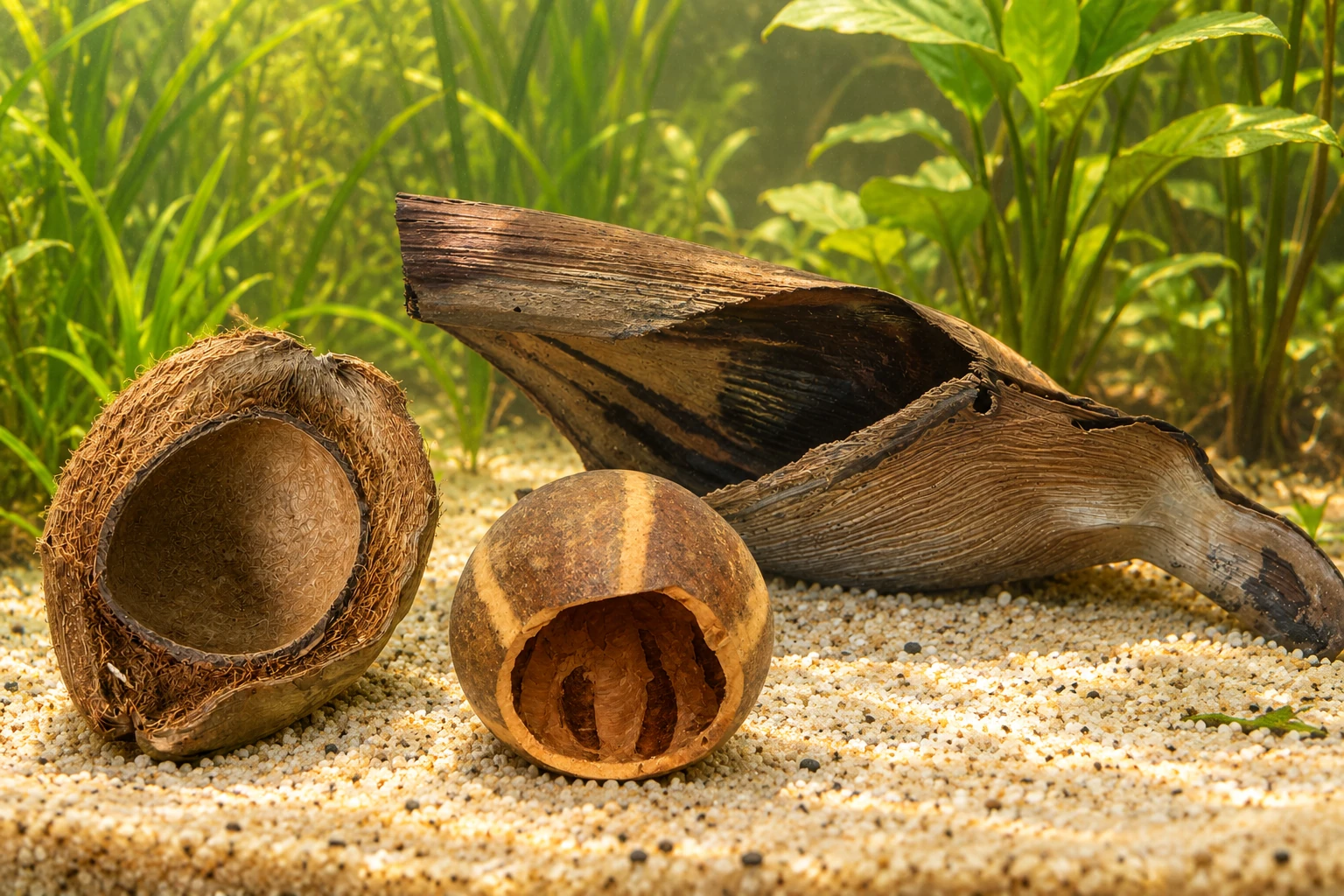
Natural structure is irregular — and that is both its beauty and its risk
A manufactured cave is usually designed around a predictable opening and interior. A natural botanical is different. One pod may have a wide entrance and a narrow internal chamber. Another may split as it softens. A woody cavity may look smooth from the front but contain a ridge or projection further inside.
Some shapes taper gradually. Others end abruptly. That irregularity is exactly what makes natural material look so good in an aquarium — but it also means I want to look at the whole shape, not simply measure the hole I can see from the front.
“The head fits” is not a compatibility test
Fish are very good at putting their heads into places. That does not mean the rest of the animal has enough room. When I look at an opening, I am thinking about:
- the widest part of the body;
- body depth;
- the head and shoulders;
- extended fins;
- tail movement;
- barbels;
- spines;
- armour;
- and the space the animal needs to turn or reverse.
A fish that can slide forward through an opening may discover that going backwards is much harder. That is why there is no useful universal rule such as: “the hole must be X times wider than the fish.” Different animals have completely different shapes and ways of moving.
Judge the adult fish, not the fish you have today
This is especially important with juveniles. A cavity may be perfect for a young fish and completely unsuitable once that animal reaches adult size. The botanical does not grow with the fish. And natural material may also change underwater — soften, split or expose a different internal shape.
So if an animal regularly uses a hollow pod or woody cavity, I would reassess that space as the animal grows. Successful use today does not guarantee a good fit next year.
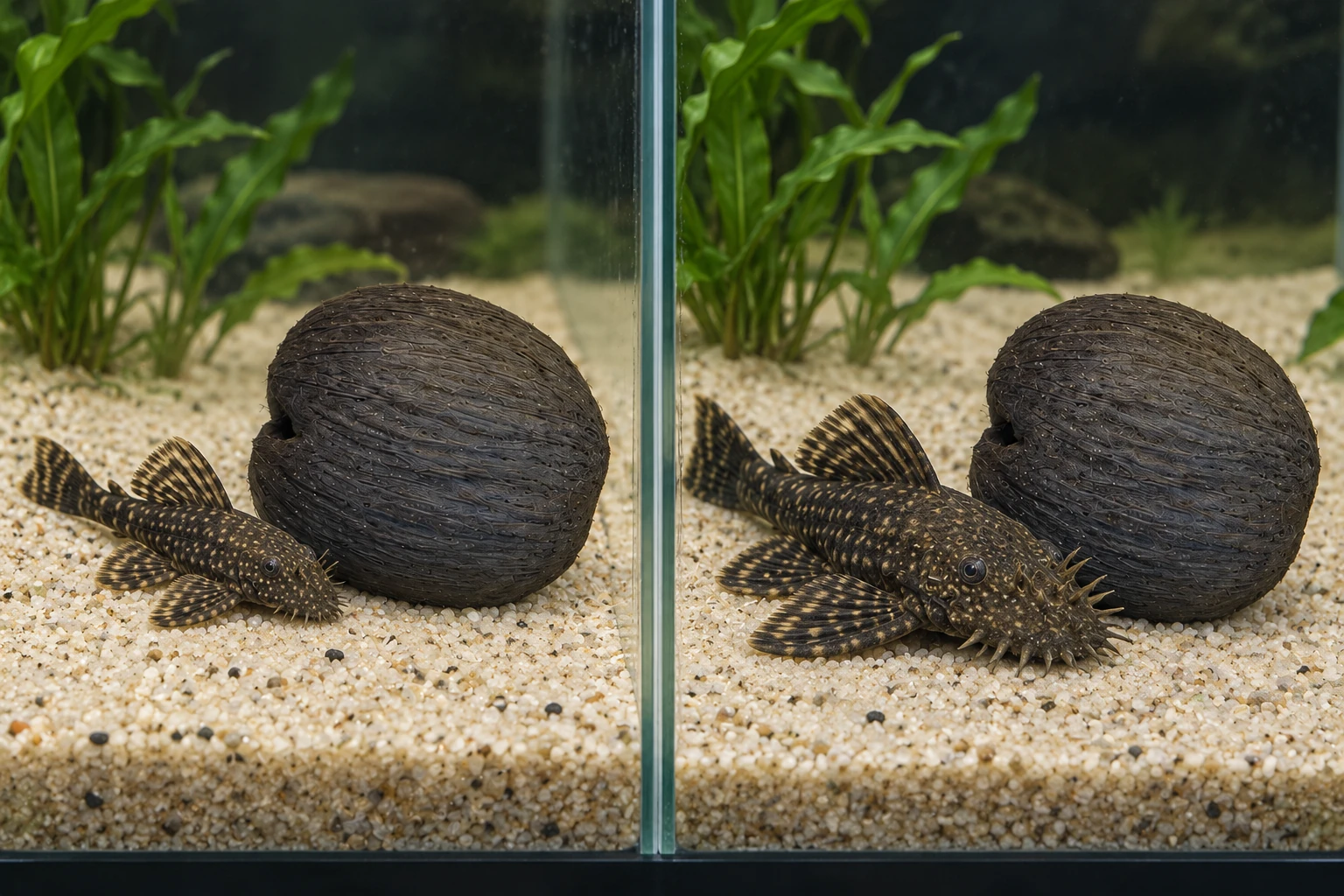
Body shape can matter more than length
A long slender fish may move comfortably through a space that causes problems for a much shorter but deeper-bodied animal. Likewise, a broad head, rigid armour or limited body flexibility may require far more clearance than the total length suggests. This is why I do not judge a cavity from centimetres alone. I look at how that animal actually moves.
Fins, barbels and armour need space too
The central body is only part of the animal. Long fins can fold or drag against a narrow surface. Rigid fin rays or spines may catch where a smooth-bodied fish would pass. Barbels can enter narrow splits. Armoured catfish may brace against surfaces while moving.
A route that technically allows the body through may still be a poor route for the complete animal. That does not mean every moment of contact is dangerous. Fish naturally brush against structure. What I am looking for is forcing, repeated snagging, poor clearance or an animal that cannot move normally.
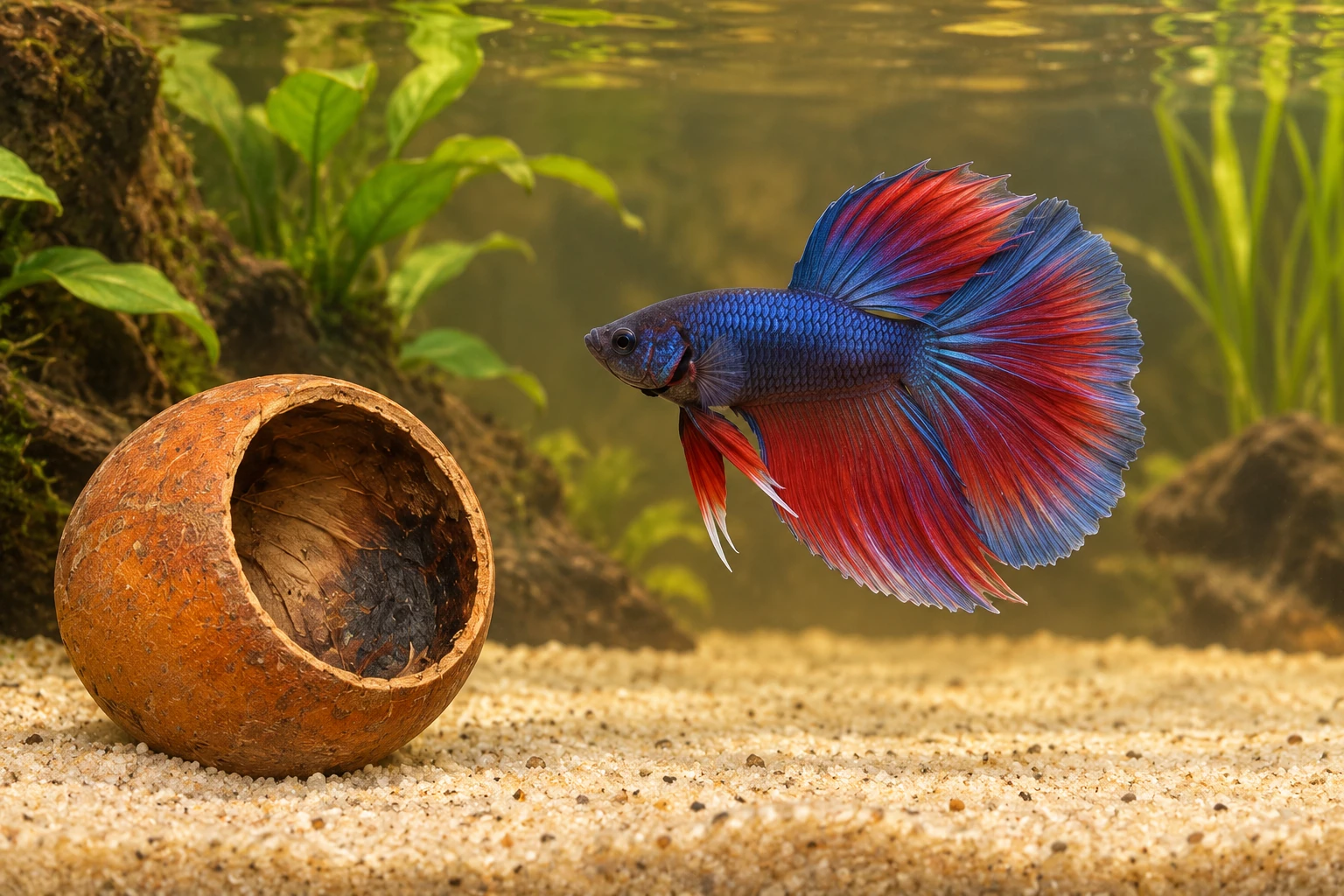
Wide entrance, narrow interior
This is probably the easiest trap to miss. From outside, the opening looks huge. The fish enters easily. But inside, the cavity tapers. Now the animal has moved into a space where:
- the body becomes wedged;
- turning becomes difficult;
- reversing requires more clearance than entering;
- or the only exit is behind it.
That is why I would never treat the visible opening as the complete route. If I cannot inspect the interior confidently, I am much happier using the botanical as open structure rather than declaring it a cave.
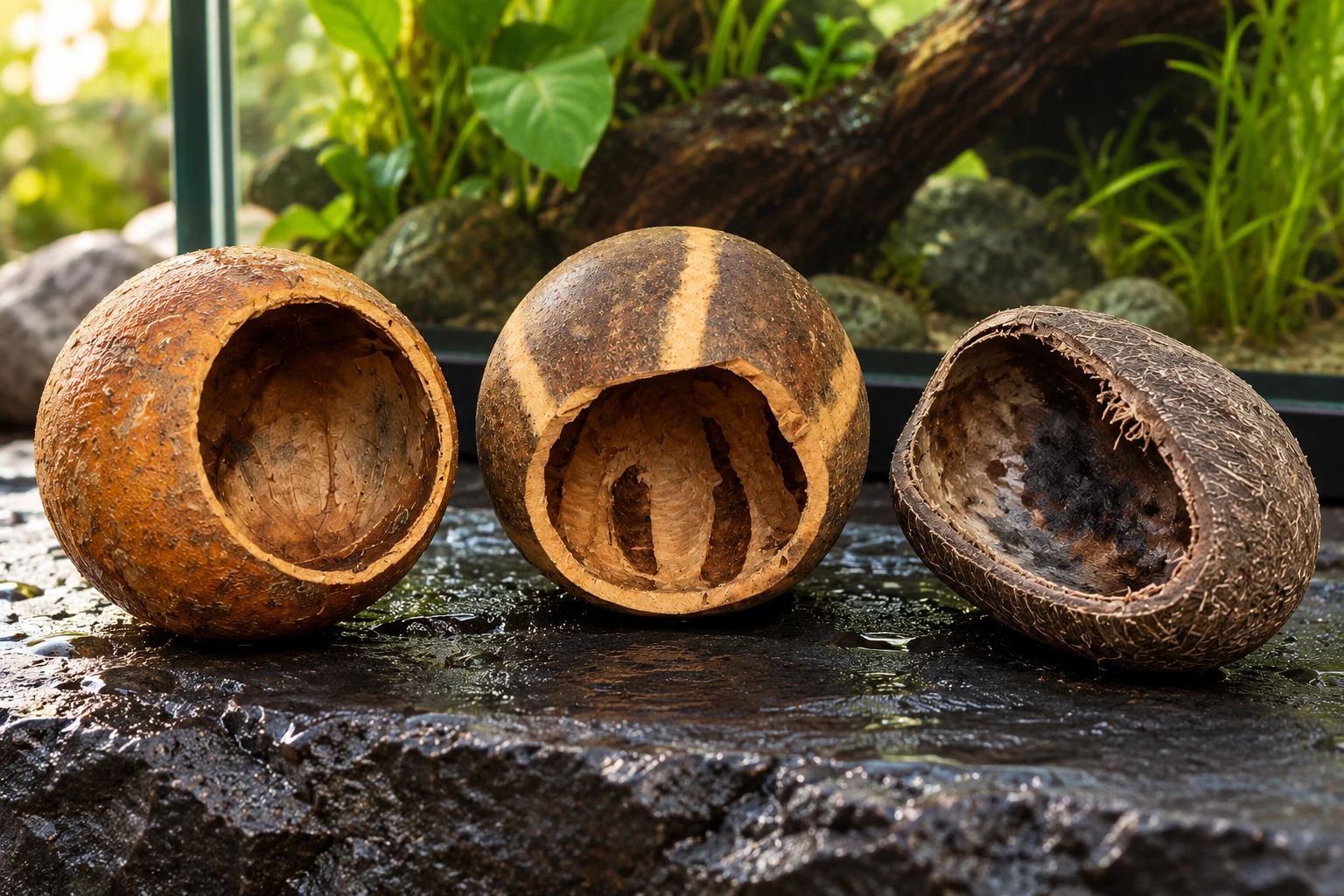
A dead end deserves more thought
A single-entry cavity is not automatically bad. Many animals naturally use enclosed spaces. But if there is only one route in and out, I want that route to be very easy to understand. Can the fish reverse? Can it turn? Can I see what is happening inside? Can I retrieve the botanical if something changes?
If the answer to those questions is uncertain, I would not deliberately encourage an animal to use the space as an enclosed hide.
Sharp edges can appear later
Natural material changes. A pod that looks smooth today may split later. A woody edge may soften and break. A brittle wall may expose a point that was not visible when the piece first went into the aquarium. That is why the first inspection is important — but it is not the last inspection. I would look for:
- broken edges;
- sharp points;
- split walls;
- brittle sections;
- exposed fibres;
- rough internal ridges;
- loose fragments.
And I would look again after the material has spent time underwater.
Can the animal actually turn around?
For me, this is one of the most useful practical questions. Imagine the fish entering head first. Once inside: Can it turn its widest body section through the arc needed to face the exit? If not, can it reverse naturally? Are the fins free? Is the tail free? Does another usable exit exist? Can you still see enough of the route to know what is happening?
Those questions are far more useful than simply asking whether the entrance looks large enough.
Structure and shelter are not the same thing
This distinction is important because a botanical does not become useless simply because I would not trust the cavity as a hide. It may still be excellent structure. A piece can provide:
- shade;
- visual cover;
- line-of-sight breaks;
- surfaces;
- leaf-litter character;
- routes around and underneath it.
The fish does not have to crawl inside every botanical for that botanical to be useful. Sometimes the safest and best-looking use is simply: around it, under it and beside it.
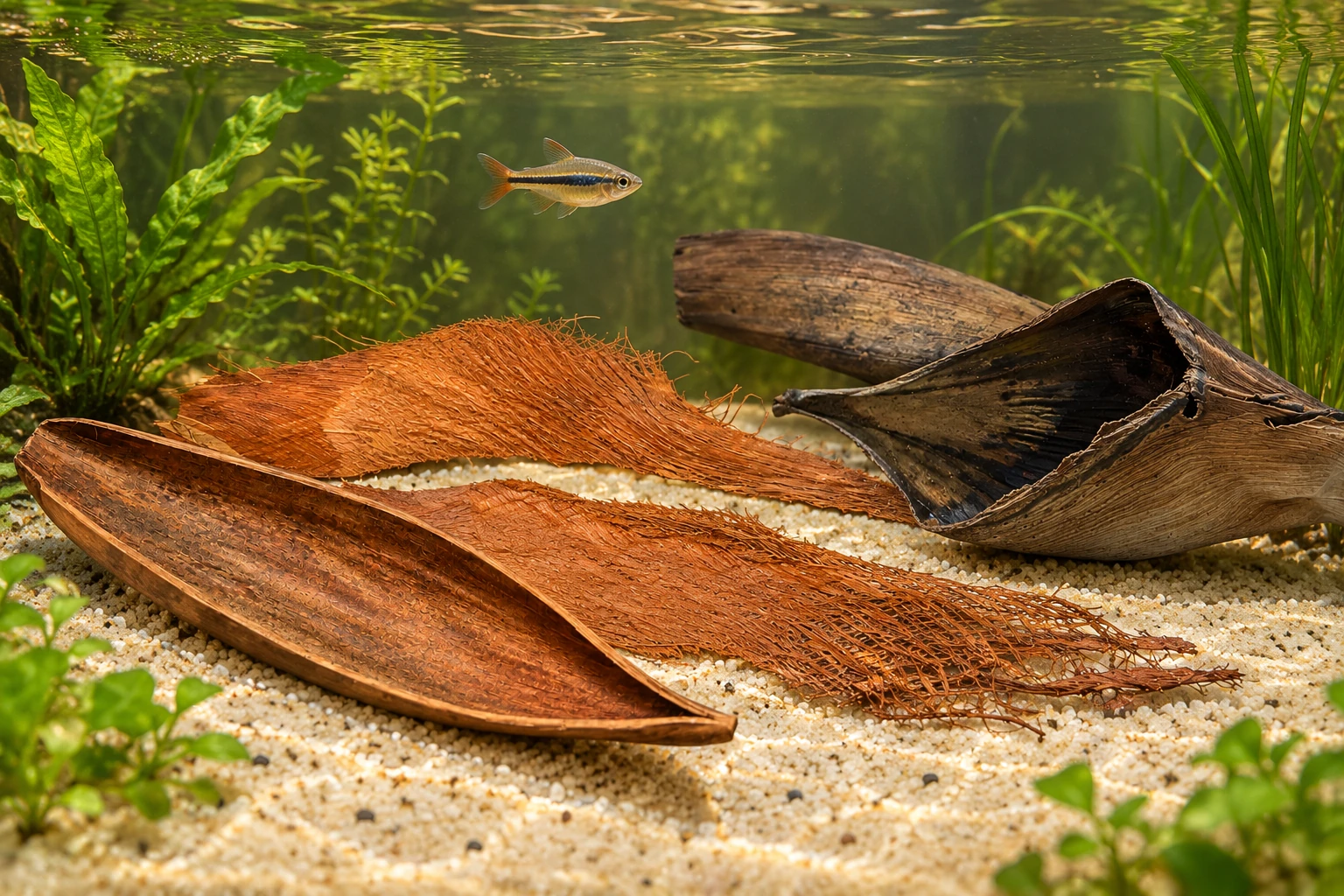
For structure that does not depend on a fish entering a narrow cavity, compare low Mahogany Slices (Swietenia spp.) – Natural Botanical Slices accents with an appropriately sized Coco Boat – Dried Coconut Flower Spathe (Cocos nucifera). Check edges, stability and the route around the actual piece; an open shape still needs inspection and does not automatically become a safe hide.
Four situations I would recognise immediately
Big entrance, narrow interior
The opening looks generous, but the cavity becomes much tighter further inside.
Use: inspect the entire internal route, not just the entrance.
Fits the juvenile, not the adult
A young fish uses it comfortably today.
Six months later the same opening may be too restrictive.
Use: reassess the space as the animal grows.
Body fits, fins do not
The central body passes, but fins rub or fold against the sides.
Use: clearance has to include the whole animal.
Excellent structure, poor cave
The shape gives wonderful overhead cover and visual complexity, but the cavity is too irregular to trust as a hide.
Use: keep it as open structure instead.
Plecos are a good example of why the outside can be misleading
Plecos and other catfish often investigate tubes, cavities and undersides. But they are not soft little cylinders. Head shape, armour, pectoral fins and the way they brace against structure can completely change how easy an exit is.
So I would never look at a hollow botanical and automatically call it a pleco cave simply because a pleco could put its head inside. Purpose-built breeding caves and naturally hollow botanicals are not automatically interchangeable.
Long-finned fish create a different problem
With long-finned fish, the body may have plenty of room. The fins may not. A narrow split, damaged pod edge or rough internal surface can contact extended fins even though the fish itself fits through the centre. Again, the question is not: “Can the fish physically get through?” It is: “Can it move through normally?”
Small shrimp using a hole does not make it a fish cave
At the other end of the scale, tiny invertebrates may happily explore openings that are irrelevant to larger fish. That can be perfectly useful. But I still want the material itself to remain sound:
- no collapsing cavity;
- no dangerous debris;
- no newly exposed points;
- no route that becomes blocked as the piece changes.
Different animals can use the same botanical in completely different ways.
Before I put a hollow botanical into the aquarium
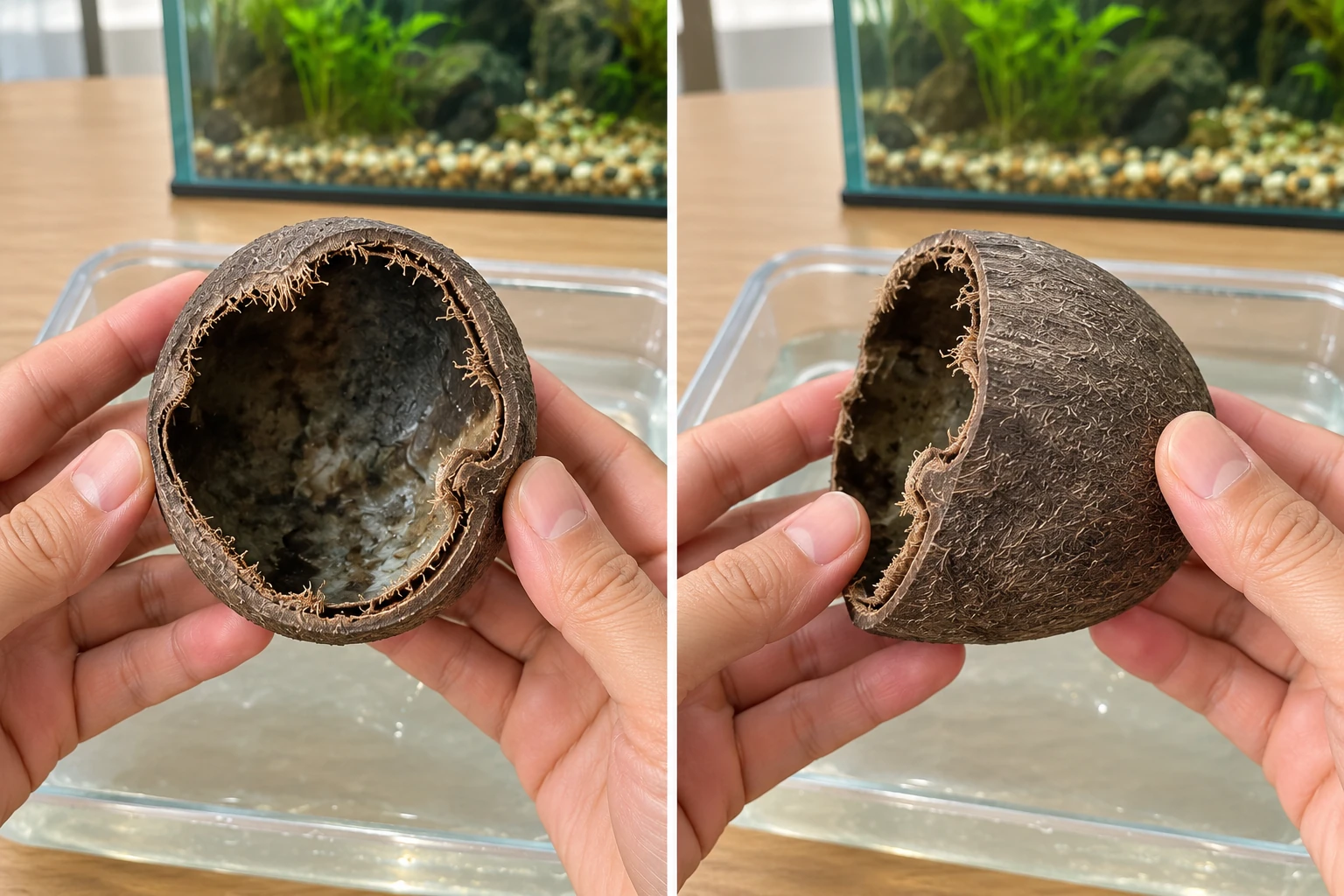
I would inspect the actual piece in good light. Not just the product photograph. The actual piece. I would look from several angles and decide what I expect that botanical to do: Is this open structure? or Am I deliberately offering it as an enclosed shelter? If it is going to function as a shelter, my inspection becomes much stricter. I would check:
- the outside opening;
- visible internal width;
- taper;
- blind ends;
- projections;
- rough ridges;
- sharp points;
- split walls;
- brittle areas;
- loose fragments;
- another route out where appropriate;
- whether I can retrieve the piece later.
For contrasting open cup forms, compare Bellani Pumpkin Cups – Cut Natural Botanical Cups with Palmyrah Pod Half (Arecaceae sp.) – Natural Botanical Cave. Assess the real rim, interior, body clearance and access after positioning, rather than deciding safety from the product photograph or assuming that a split piece cannot trap an animal.
And I keep checking it after immersion
This is natural material. It changes. A botanical can:
- soften;
- split;
- move;
- collect debris;
- expose a new edge;
- collapse;
- become harder to inspect.
At the same time, the animal may be growing. So the relationship between the fish and that opening is not fixed forever. That is why I include hollow pieces in normal aquarium observation rather than treating the initial inspection as a permanent approval.
When I would remove or reposition the botanical
I would stop access if I repeatedly saw an animal:
- struggling to enter;
- struggling to reverse;
- forcing its body through;
- catching fins;
- repeatedly wedging into the same space.
I would also reassess a botanical that develops:
- a sharp new edge;
- collapse;
- a much tighter opening;
- hidden interior damage;
- poor visibility;
- or a position where I could no longer retrieve it easily.
There is no reason to insist that a botanical remain in one place if its safest use has changed. Reposition it. Use it as open structure. Or remove it.
If a fish is genuinely trapped
This is where I would stop experimenting. Do not keep forcing the animal through a tight opening. Stabilise the situation and, if safe release is not straightforward, get experienced or veterinary help.
I would not give generic cutting or drilling instructions around a live trapped fish because the correct response depends entirely on the animal and the material involved.
A simple rule to remember
Can enter does not mean can use safely. And even: can use safely today does not necessarily mean will still fit when fully grown. Look at the whole route: entry → interior → turn/reverse → exit and judge it against the whole animal: adult body → fins → spines → barbels → armour → normal movement That is the real compatibility check.
Frequently asked questions
If my fish can get into a pod, does that mean the pod is safe?
No. Entry only tells you that the fish can enter. You still need to consider internal clearance, turning or reversing and the exit.
How large should a botanical opening be?
There is no universal size that works for every animal. Body shape, fins, behaviour and the complete interior route matter more than one fixed measurement.
Are hollow pods safe for plecos?
Some pieces may be usable, but do not assume that every hollow pod functions as a pleco cave. Judge the individual piece against the mature fish.
Can sharp botanicals damage long fins?
Rough or damaged edges can be a problem when clearance is poor. Inspect the piece and allow enough room for fins to move normally.
Should I remove a botanical when my fish grows?
Reassess it. If the original route has become too restrictive, use the piece differently, reposition it or remove access.
Continue with BBA
Source book
Amazonian Blackwater Fish & Invertebrates
Part of the five-book BBA educational series.
The complete educational system
Go deeper with the five-book BBA series.
Your first successfully paid BBA website order containing at least one physical product includes all five guides. Individual guides are also available for £3, or as the fixed five-guide collection for £10.