Fish · Siamese fighting fish
Betta splendens — Habitat and Care
A warm-water labyrinth fish needs a usable surface, sheltered resting places and room to explore. Build around the individual fish, rather than treating air breathing as permission to use a bare bowl.
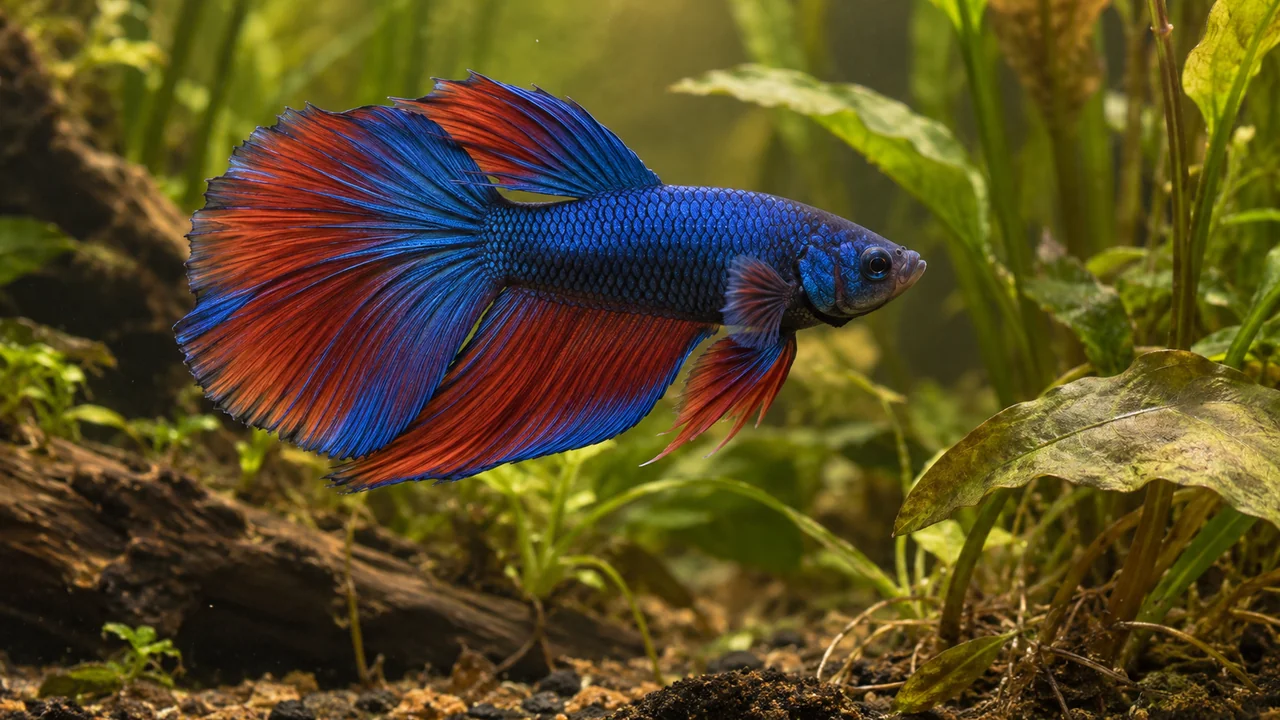
- Identity
- Betta splendens; Osphronemidae. Ornamental strains differ visibly from wild fish.
- Adult scale
- ADW reports an average length of 7.5 cm; body size and selected fins must both inform space.
- Space and social needs
- Plan an individual male setup with uninterrupted surface access; no fixed litre minimum is inferred here.
- Water and maintenance
- Warm, stable, conditioned water and gentle filtration. Match the breeder’s established conditions; check water quality.
- Key limit
- Two territorial males must not be treated as routine tankmates. Labyrinth breathing does not remove waste.
- Botanical role
- Light cover and resting structure; not a substitute for heating, filtration or suitable food.
Natural environment and identity
Wild Betta splendens is associated with densely vegetated, slow or standing fresh waters in South-East Asia. The ornate fish in shops are selected domestic forms, not photographs of a wild blackwater community.
Field measurements in a seasonal breeding margin describe that place and time. They are not a recipe for maintaining every domestic betta at the same depth, temperature or acidity.
Build usable space
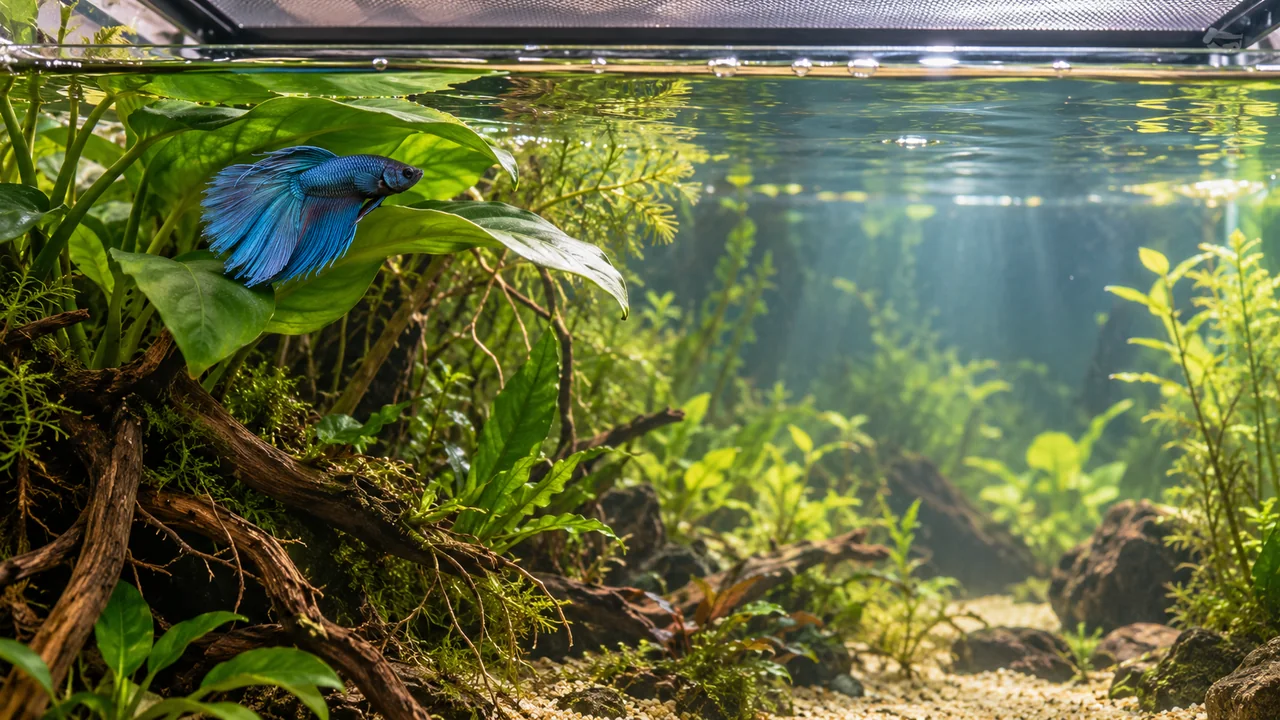
Start with a covered, established aquarium that gives the fish routes through the planting and clear access to air. Arrange broad resting surfaces near the surface and gentler shaded areas without sealing the whole top with floating plants.
Choose smooth wood and check every opening against the actual fish and its fins. A long-finned animal may find a current difficult that a short-finned fish negotiates easily. Keep the filter useful while diffusing its flow; do not remove biological filtration merely because the species likes quiet water.
Water and routine maintenance
Use a thermometer, an appropriate heater where needed and a filter with a mature biological community. Test for ammonia and nitrite, address waste and keep replacement water conditioned and temperature-matched.
Avoid chasing the colour of a photograph with acids or large botanical additions. Consistency and suitable source water matter more than an arbitrary brown tint. Changes in breathing, appetite or posture should prompt a check of the animal and its environment.
Behaviour and companions
Males can be strongly territorial. An individual setup is a practical way to provide cover without asking other animals to absorb that aggression. A community needs a separate assessment of fin-nipping, competition, flow and available retreat routes.
Do not assume that shrimp are safe companions: small animals can be taken as prey. Nor does a female label make a group automatically peaceful. Observe the individual and have an appropriate separation plan.
Feeding
Offer a suitable complete food intended for insect-eating ornamental fish, with appropriately sourced live or frozen foods as variety where suitable. Match particle size to the fish and observe what is actually eaten.
Feed deliberately rather than letting food settle into leaves and crevices. Botanical surfaces and incidental micro-organisms do not replace a balanced diet. Remove uneaten portions before they become hidden organic load.
For supplementary invertebrate-food variety, Microalgae Freeze Dried Tubifex Worm Cubes offers a freeze-dried cube format that can be presented at the surface or against the glass. Offer only an appropriately small wetted portion the fish can swallow; this is a prepared food, not live prey or a fry starter.
Breeding biology
This is a bubble-nesting species: the male places fertilised eggs in the surface nest and tends the early young. That natural history explains why access to the surface and sheltered water are important.
Breeding is a separate project requiring safe adult separation, food suitable for tiny fry and space for growing fish. A bubble nest is not a promise that breeding is appropriate, and adding leaves is not a reliable breeding trigger.
Botanicals in this setup
A few prepared leaves can create shaded edges and another layer around roots. Place them so you can inspect the fish and remove accumulated debris. Broad pieces should provide cover without pinning fins or narrowing the route to air.
Prepare and introduce materials gradually. Their visible tint is not evidence of a treatment effect or a particular pH. Retain open swimming and feeding space alongside the sheltered parts.
For the sheltered lower edge beneath the fish’s surface routes, compare Crushed Catappa Leaves – Indian Almond Leaf Pieces with BBA Nano Botanical Variety Box – 32-Piece Shrimp & Betta Pack. Select accessible pieces that complement the refuges while leaving atmospheric access and feeding positions open. A mixed box provides material to choose from over time, rather than a quantity to add all at once.
Common mistakes to avoid
Do not confuse the ability to survive low-oxygen habitats with good long-term housing in an unheated, unfiltered container. Avoid sharp decorations, persistent reflected rivals and overfeeding.
Check the aquarium as a working habitat: surface route, temperature, water quality, current, shelter and the fish’s actual behaviour. A beautiful leaf bed cannot compensate for a failure in those basics.
Further reading and sources
Natural observations and experimental conditions are distinguished from home-aquarium guidance. These sources do not constitute approval of a BBA product.
- University of Florida IFAS: Evolution, Culture, and Care for Betta splendens — Labyrinth breathing, vegetation, aggression and breeding biology; commercial production is not a home-aquarium minimum.
- University of Michigan: Animal Diversity Web — Betta splendens — Natural history, adult scale and feeding.
- RSPCA: Keeping fish as pets — General welfare, aquarium preparation and consequences of exaggerated fin traits.