Fish · White-Seam Betta
White-Seam Betta — Betta albimarginata: Habitat and Care
A small Bornean paternal mouthbrooder with a brick-red male and layered white-and-black fin borders. Keep its identity, sheltered stream-edge arrangement and brooding routine separate from bubble-nesting bettas.
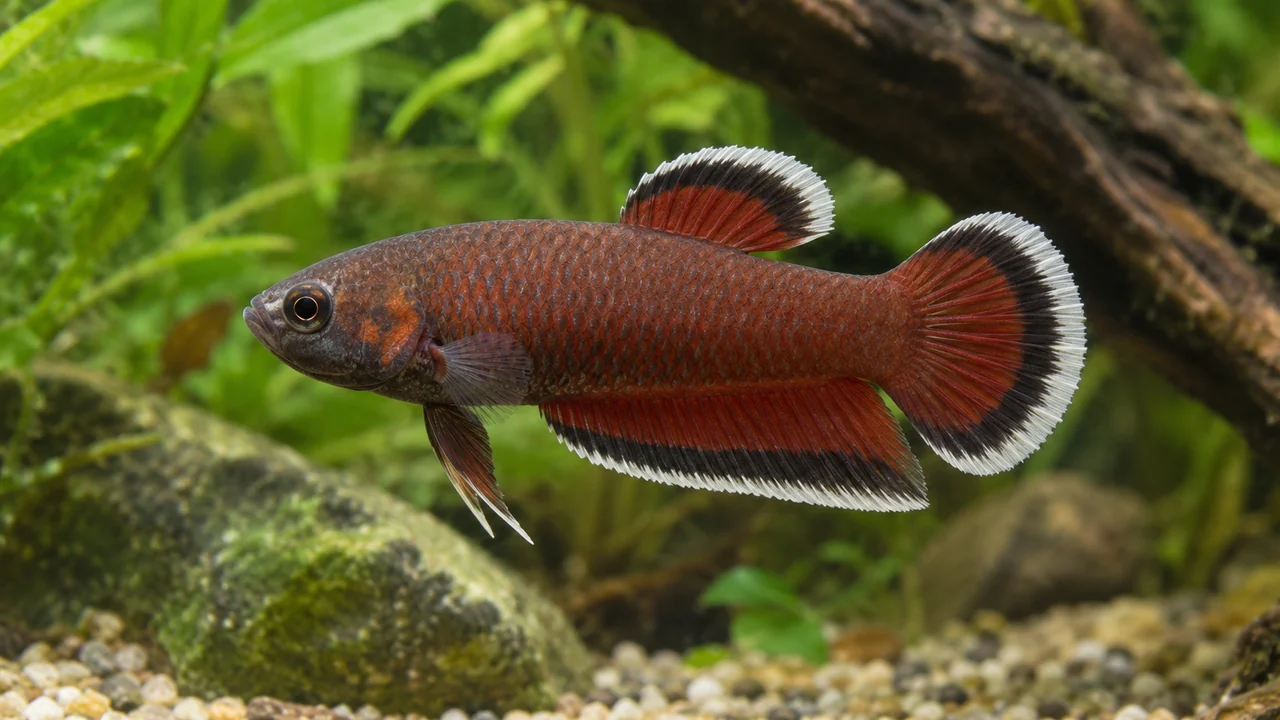
- Adult scale
- About 3 cm standard length; some aquarium accounts describe approximately 5 cm overall, including fins.
- Routine conditions
- Around 24–26°C, pH 5–6.5 and 1–5°dGH is a practical soft-water plan.
- Aquarium
- A 60 × 30 cm sheltered arrangement is useful; published pair/small-group guidance starts at 45 × 30 cm.
- Identification
- Brick-red male, broad white seams and broad dark submarginal bands, including the dorsal fin.
- Social plan
- Pair or considered small group with multiple refuges, reliable feeding access and separation ready.
- Reproduction
- The male incubates eggs in his mouth; no surface bubble nest is required.
Read the white, black and red layers
Betta albimarginata is an accepted species described by Kottelat and Ng in 1994. A coloured adult male has a brick-red body and prominent pale seams outside dark bands on the unpaired fins. The head is broad, with darker lower regions and an orange cheek area. Females are generally less colourful, often brownish and mottled; a white edge alone is not a dependable sexing test.
The close relative B. channoides has an almost entirely red dorsal fin with a thin white edge, rather than albimarginata’s broad white-and-black dorsal border. Its upper tail pattern also differs. Examine several characters together and keep trustworthy stock records. Colour shifts during courtship, and a photograph cannot resolve every scale-count or provenance question.
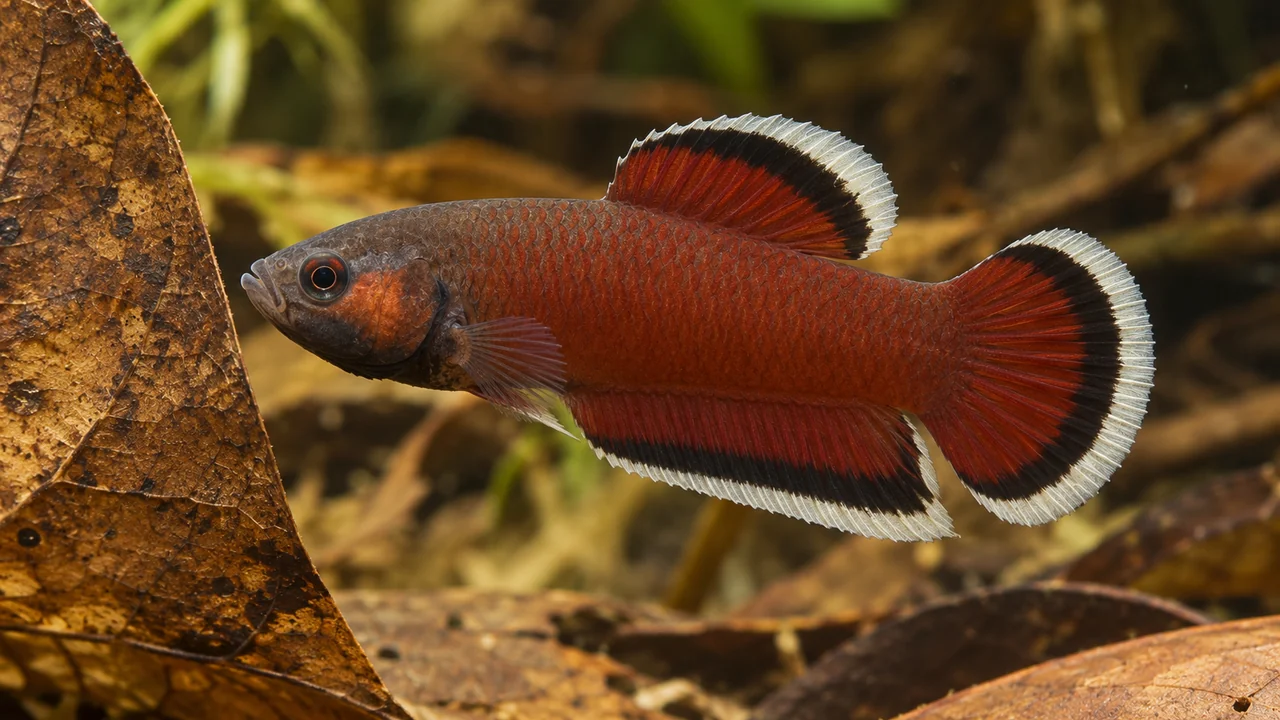
A shallow margin within a forest stream
The species is associated with the Sebuku drainage in Indonesian Borneo, with the type locality in a tributary of the Tikung. Older administrative labels use East Kalimantan; these do not justify assigning an undocumented aquarium fish to a particular village. Preserve the actual breeder’s locality record instead of inferring one from its appearance.
Documented habitat includes very shallow marginal water among plant roots and leaves, beside a moderately moving stream. The aquarium lesson is to provide protected edges with some circulation, not to fill a tank only a few centimetres deep or expose the fish to the full outlet jet. A sheltered resting place and a clean, accessible feeding edge belong in the same design.
Space for several quiet routes
Plan a species-focused 60 × 30 cm aquarium as a useful working arrangement, with the smaller published 45 × 30 cm baseline understood in context. A carefully assessed pair can work; a small group requires additional usable cover and monitoring. Neither body size nor the relatively calm reputation removes the need to notice a fish that consistently misses food.
Place fine roots and broad leaves so there is more than one route between cover, food and the surface. Keep some open floor for observation and cleaning. Secure the lid and leave a humid air space. Before stocking, check whether the net, siphon and filter can be used without lifting every root or dismantling the fish’s whole shelter.
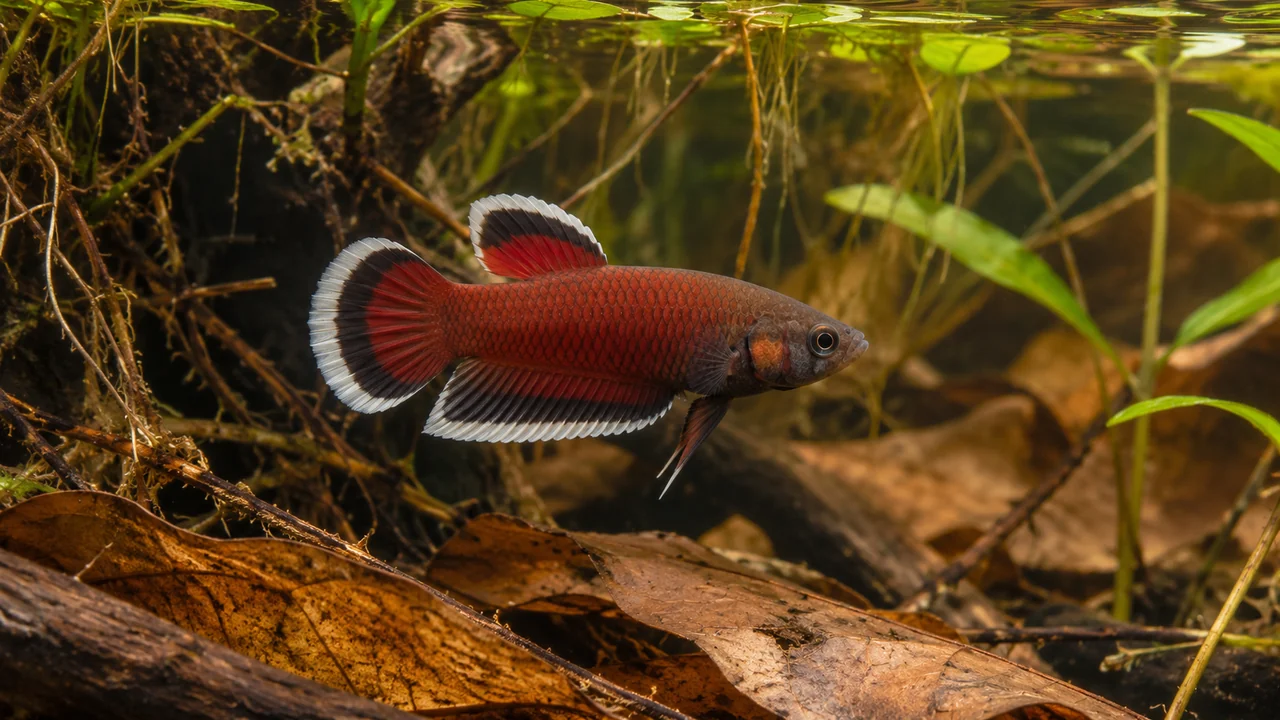
A realistic maintenance-water plan
Routine care around 24–26°C, pH 5–6.5 and 1–5°dGH gives a useful soft-water framework. Husbandry accounts differ: an older IBC report describes considerable captive tolerance, while another species profile stresses very low hardness and acid conditions. That disagreement is not resolved by promising success in any tap water or by forcing every fish to pH 4.
Use known stock history, gradual acclimation and a repeatable replacement-water supply. Monitor the actual aquarium and prepare changes before they are needed. A leaf-stained tank may still be hard, and a clear one may be soft. Keep ammonia and nitrite undetectable; match temperature and mineral content rather than changing water only when the tint appears too pale.
Feeding before and between broods
Offer suitable small live or frozen invertebrates, alongside an appropriate complete food once reliably accepted. Watch swallowing at close range. A small fish may investigate a pellet without being able or willing to eat enough of it. Feed where the group actually gathers, using more than one point if a confident fish monopolises the first portion.
Condition breeding fish without keeping them permanently overfull. A brooding male may stop feeding while carrying eggs; note when incubation began, observe his condition and avoid repeated attempts to make him open his mouth. Once feeding resumes, offer manageable meals and recovery time rather than promoting another immediate brood regardless of condition.
Mature filtration around the sheltered edges
Use established biological filtration with guarded intakes and calm refuge zones. A gently operated sponge filter can suit a small arrangement, while other filters need careful outlet placement. The natural stream context means clean circulating water matters even though the fish should not be fighting a current. Preserve access to atmospheric air under the cover.
Wood and a modest layer of prepared leaves can create shaded lower edges. Keep waste traps reachable and clean in sections. Mature surfaces add interest, but they do not supply a complete ration or eliminate the nitrogen load. Watch how the filter draws food and debris: a feeding station directly beside the intake can look active while delivering little to a hesitant fish.
Pairing and a quiet social setting
Albimarginata can be kept as a pair or a considered group, but practical success depends on individual access and space. Observe who moves freely and who waits behind equipment. Persistent pursuit, blocked feeding or a fish unable to rest calls for rearrangement or separation. A backup enclosure is more useful prepared in advance than improvised after injury.
Very active or much larger companions undermine a quiet specialist setup. Any small community proposal must match water and food requirements and adult mouths. Shrimp young and fry are potential prey. Keep albimarginata and channoides separate when maintaining stock identity; their comparison is a learning link, not a mixed-breeding recommendation.
The male carries the eggs
This species is a paternal mouthbrooder. Courtship embraces and egg transfer culminate in the male holding the developing brood in his mouth, eventually releasing swimming young. It does not require a bubble nest. Breeder reports commonly describe roughly two weeks of incubation, while broader accounts extend to about three; temperature and individual progress matter more than a fixed release appointment.
Avoid catching or repeatedly inspecting a carrying male. Published advice differs on moving brooders, so plan a quiet breeding arrangement beforehand and minimise disruption once he is holding. Have protected filtration and small suitable foods ready for the released fry; microworms or newly hatched Artemia may be appropriate when swallowed. Keep portions modest, remove leftovers and provide a covered, stable nursery or a carefully observed family arrangement.
Botanicals and useful first checks
Prepared leaves and small roots can connect the lower shelter without sealing off the floor. They neither trigger mouthbrooding reliably nor guarantee egg retention. Retain clean working areas, observe material as it decomposes and maintain the same water-preparation routine around a brood rather than postponing all care until release.
If a male stops feeding, look for a recorded spawn and a genuine brooding pattern before treating every fast as disease. Also check water, pursuit and body condition; not every refusal means eggs. For repeated brood loss, review disturbance, social pressure and parental recovery. For damaged fins, check the layout as well as neighbours. Respond to observed causes rather than changing every parameter together.
For the sheltered lower edge beneath the fish’s surface routes, compare Dried Jackfruit Leaves (Artocarpus heterophyllus) – Blackwater Leaf Litter with Mahogany Slices (Swietenia spp.) – Natural Botanical Slices. Select accessible pieces that complement the refuges while leaving atmospheric access and feeding positions open.
Further reading and sources
Identity and natural-history sources are distinguished from aquarium husbandry. Recommended care is not a set of experimentally established survival limits; breeding conditions may differ from adult maintenance.
- Seriously Fish — Betta albimarginata — Species-specific husbandry, adult scale, social arrangements and reproduction. Read explanatory water notes, not just summary numbers.
- International Betta Congress — Betta albimarginata — Specialist maintenance and breeding observations; older broad or conflicting statements are assessed rather than transferred without qualification.
- FishBase — Betta albimarginata — Accepted name, documented distribution and measured size; measurement conventions are kept distinct from aquarium planning.
- Practical Fishkeeping — White-Seam Betta care — Specialist practical observations and visual comparison with channoides; locality and generic captive claims are not treated as universal limits.