Fish · Snakehead Betta
Snakehead Betta — Betta channoides: Habitat and Care
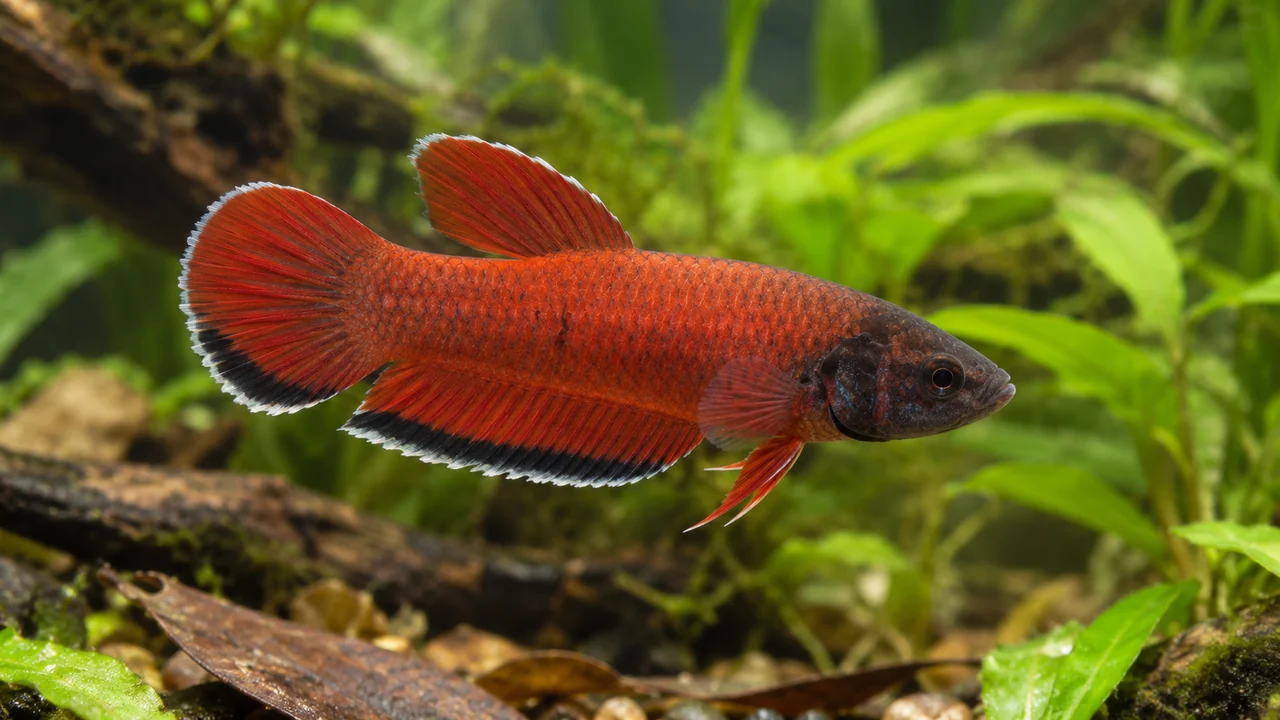
A scarlet male mouthbrooder from the Mahakam basin, with a broad head and predominantly red dorsal fin. A quiet, well-observed pair or group needs fine food, sheltered edges and an undisturbed brooding plan.
- Adult scale
- Plan for roughly 4 cm body length and approximately 5 cm overall; smaller taxonomic specimens are not a maximum husbandry target.
- Routine conditions
- Around 24–27°C, pH 5–6.5 and 1–5°dGH, with consistent replacement water.
- Aquarium
- A sheltered 60 × 30 cm plan offers useful room beyond the published 45 × 30 cm pair/group baseline.
- Pattern
- Scarlet male; mostly red dorsal fin with thin white trim, unlike the broad layered border of albimarginata.
- Feeding
- Suitable small invertebrates and an accepted complete food, with individual access checked.
- Reproduction
- Paternal mouthbrooder; released young are free-swimming, not larvae hanging in a bubble nest.
A broad head and the dorsal-fin distinction
Betta channoides is an accepted species, not a true snakehead of the genus Channa. The name refers to its head resemblance. A coloured male is scarlet with a dark broad head; the dorsal is chiefly red with a narrow pale edge. The dark band beneath the tail’s pale margin does not continue into the uppermost portion in the same way as in albimarginata.
Females are generally quieter and more mottled in colour, and male intensity changes with condition and display. Use the combined fin pattern, head and stock history rather than a red body alone. Do not turn a shipment labelled Pampang into a certified locality line without a reliable chain of information. Related-looking fish deserve separate records, not a shared name because both mouthbrood.
Mahakam forest-water edges
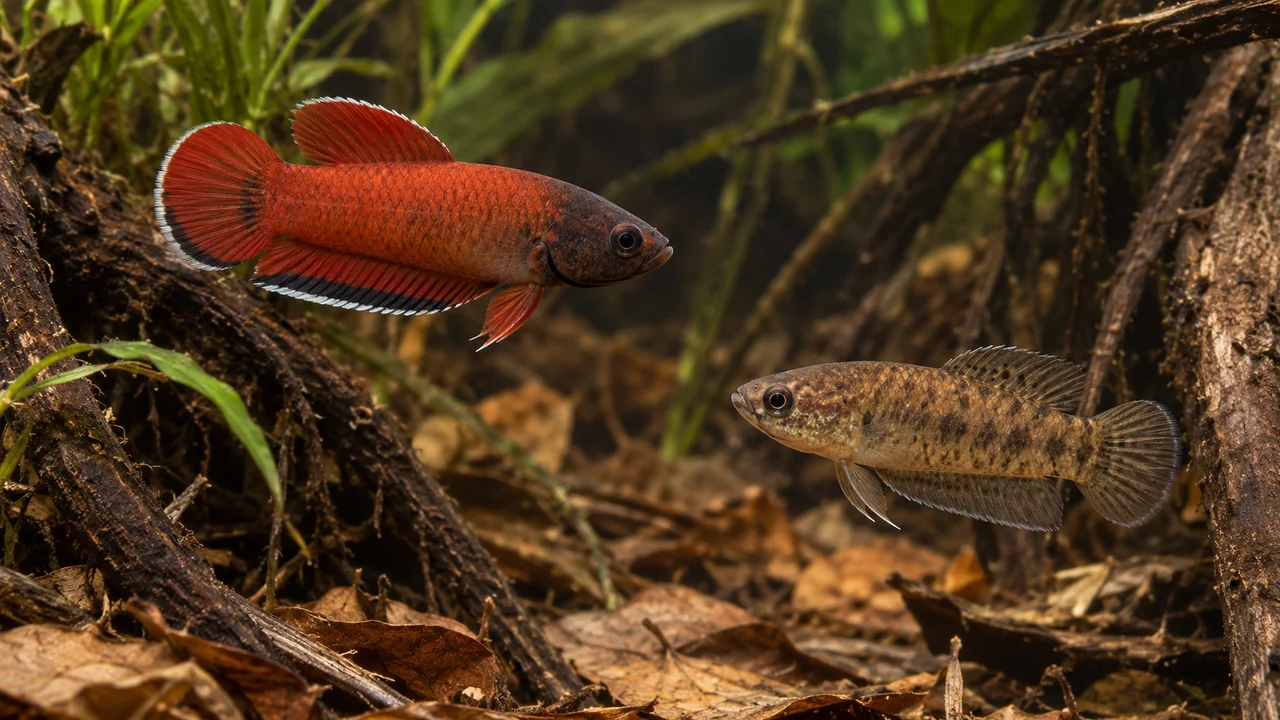
The documented range is the Mahakam basin of Indonesian Borneo. The type locality is an unnamed blackwater tributary near Mujub; other aquarium locality labels need their own provenance. This is distinct from the Sebuku association of albimarginata. Current political boundaries and older province names can differ without indicating a different species.
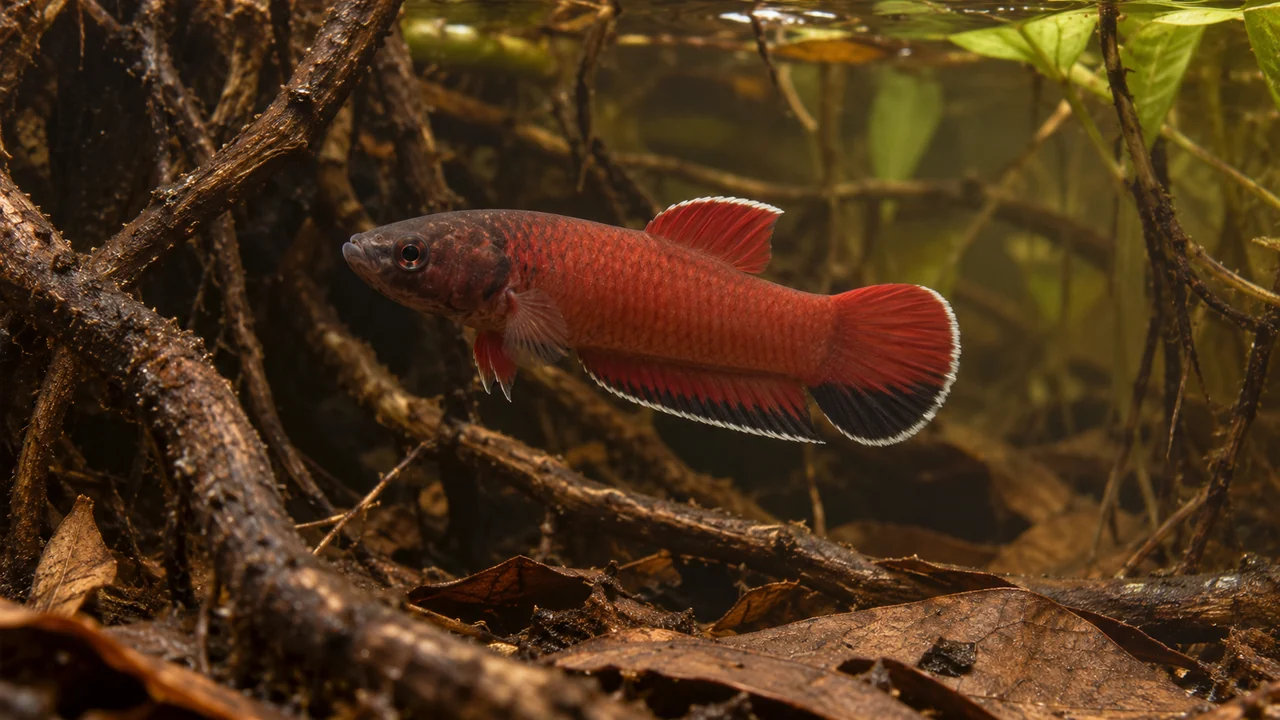
Shallow forest streams with brown acidic water, marginal roots and leaves provide the ecological model. Build the aquarium around protected edges rather than treating brown colour as the entire habitat. Leave routes for air breathing, food and maintenance. A captive setup should remain stable through ordinary water changes, not imitate an unstable shrinking pocket merely because such a place can contain fish in nature.
A practical pair or group arrangement
Allow around a 60 × 30 cm base for a useful sheltered working layout; smaller published 45 × 30 cm guidance is not a guarantee of compatibility for any group. Plan for roughly 4 cm adult bodies with the tail adding to overall length. A database’s smaller measured specimen should not be presented as a promise that the fish stays a two-centimetre miniature.
Keep more than one retreat and observe the actual social pattern. Broad leaves near the surface and roots below can divide sight lines while leaving an open feeding area. Secure every lid gap and retain an air space. Make room for a brooding fish to stay quietly in cover without having to compete at the most exposed part of the tank.
Soft water without an improvised recipe
A routine target around 24–27°C, pH 5–6.5 and 1–5°dGH is a practical soft-water plan within published guidance. Wider temperature ranges are not an instruction to keep a carrying male at the hottest endpoint to hurry the brood. Use the source stock’s history and a controlled transition rather than sudden chemical changes after arrival.
Older specialist accounts describe broad captive tolerance, whereas other guidance is stricter about acidity and mineral content. Maintain the distinction and monitor your own repeatable water supply. An old suggestion to add iron is not adopted as an automatic supplement: there is no need here to invent an unmeasured mineral treatment. Keep ammonia and nitrite undetectable and investigate changes in behaviour promptly.
Food that reaches each fish
Suitable small live and frozen foods are useful for settling and conditioning. Introduce a properly sized complete food only while checking acceptance. Deliver a modest ration near the occupied edges and observe mouths, not just how quickly food disappears. If one fish intercepts everything, change distribution before increasing the quantity and filling the floor with leftovers.
A carrying male may fast during incubation, so record the start and assess his condition calmly. Do not force open his mouth or repeatedly net him to prove he is holding eggs. After release, allow feeding and recovery; a female ready to spawn again does not mean the male has recovered from the previous brood. Manage the pair or separate them when that pressure becomes a problem.
Filter gently and keep access visible
Use established biological filtration with protected intakes. Modest water movement should circulate through the aquarium while leaving quiet pockets; placing a fish in a powerful current is not required by the word stream. Surface access remains essential, but air breathing does not exempt the aquarium from clean water and sensible oxygenation.
Keep root bases and leaf margins reachable for a small siphon. Clean in portions and avoid simultaneously stripping all cover or filter media. A thin arrangement of prepared leaves can add structure, but accumulated food beneath them still needs attention. Check that settling material and floating roots have not closed a previously usable exit.
Social observation rather than a peaceful promise
A species-focused pair or considered small group can show interesting interaction. That does not mean every fish tolerates the same arrangement. Watch access to food and resting space, and keep a separation option ready. Sustained chasing or an individual spending all day behind the filter warrants intervention even before obvious damage appears.
Choose any companions by real adult mouths, food competition and water needs. A busy upper-water community can make this quiet fish withdraw. Eggs, fry and small shrimp do not receive a safety guarantee. Keep separate locality lines and the similar albimarginata distinct for deliberate breeding; a comparative guide is not a licence to merge uncertain stock.
Mouthbrooding, release and recovery
The male incubates eggs in his mouth following courtship and transfer from the female. There is no surface bubble-nest stage. Reports give incubation over roughly ten days to three weeks, with variation rather than one guaranteed release date. The useful observation is a carrying male progressing normally and ultimately releasing swimming young.
Arrange the nursery and fine foods before spawning, minimise disturbance during holding and manage companions deliberately. Advice about moving brooders differs; avoid using a net transfer as a routine inspection method. Released young may take small motile foods such as microworms or newly hatched Artemia when sized appropriately. Observe intake, remove excess food, match water changes and plan the space needed as young grow.
Botanicals and practical problem solving
Wood and prepared leaves can create the shaded marginal structure without making the whole tank inaccessible. Keep the amount proportionate. Tannins do not guarantee successful incubation, replace food or certify the right hardness. Brood care still requires clean, stable water and a male that can recover between attempts.
For fasting, check whether there was a genuine spawn as well as water quality and pursuit. For repeated early egg loss, review disturbance and condition before trying to accelerate temperature or alter chemistry. For thin females, watch access to food. For unusual breathing, test water and check heat and circulation. A record of the sequence is more useful than treating every problem as a need for darker water.
For the sheltered lower edge beneath the fish’s surface routes, compare Dried Longan Leaves – Natural Aquarium Leaf Litter with Indian Almond / Catappa Bark Sticks – Terminalia catappa. Select accessible pieces that complement the refuges while leaving atmospheric access and feeding positions open.
Further reading and sources
Identity and natural-history sources are distinguished from aquarium husbandry. Recommended care is not a set of experimentally established survival limits; breeding conditions may differ from adult maintenance.
- Seriously Fish — Betta channoides — Species-specific husbandry, adult scale, social arrangements and reproduction. Read explanatory water notes, not just summary numbers.
- International Betta Congress — Betta channoides — Specialist maintenance and breeding observations; older broad or conflicting statements are assessed rather than transferred without qualification.
- FishBase — Betta channoides — Accepted name, documented distribution and measured size; measurement conventions are kept distinct from aquarium planning.
- Betta albimarginata comparison — Comparative dorsal and upper caudal pattern; the species retain separate ranges and care profiles.