Fish · Emerald Betta
Emerald Betta — Betta smaragdina: Habitat and Care
An emerald-scaled bubble-nester from the north-eastern Thai–Mekong region. Preserve locality information and manage territorial space, surface access and breeding separately from the idea of a peaceful community fish.
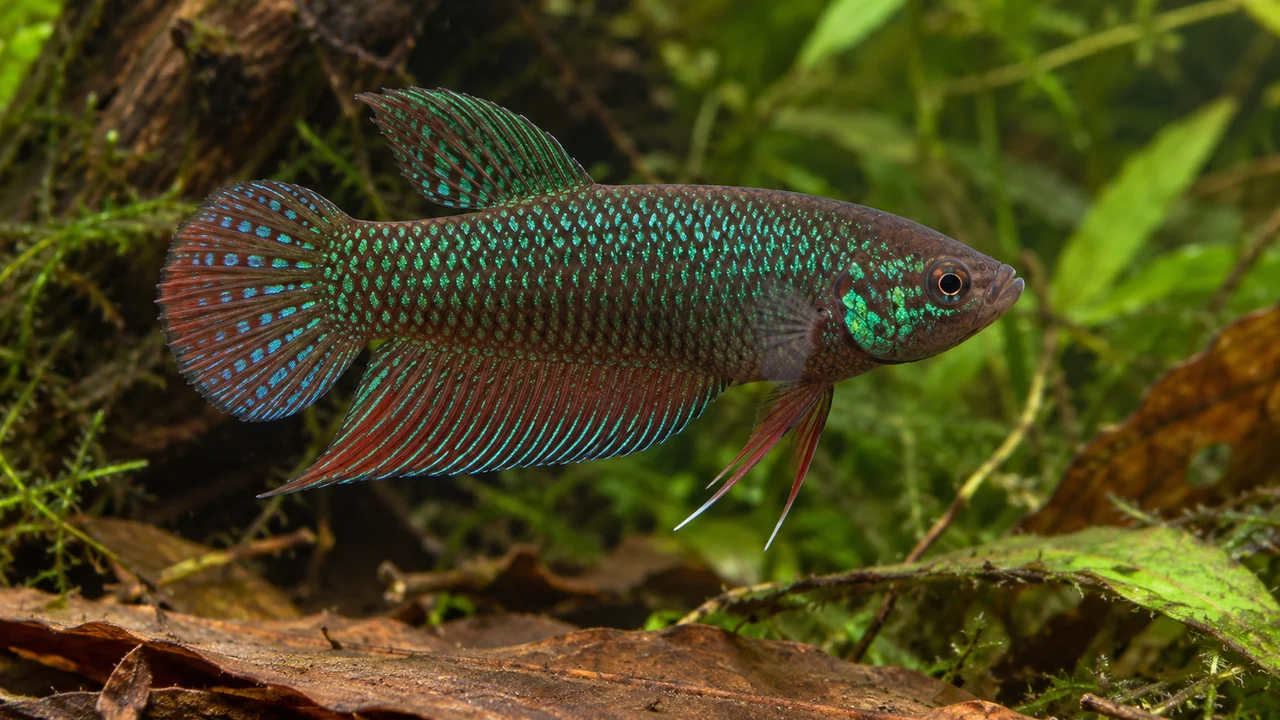
- Adult scale
- About 5–6 cm body length, with total length sometimes reported around 7 cm.
- Routine temperature
- 24–27°C is a useful maintenance target within published guidance.
- Water plan
- Approximately pH 6–7.5 and 3–10°dGH for established aquarium stock; not compulsory extreme blackwater.
- Social plan
- Territorial; one fish or a deliberately managed pair, with separation ready. Not a shoaling species.
- Aquarium footprint
- A planted 60 × 30 cm base or larger is a practical plan; paired or group keeping requires additional management.
- Identity
- Green-blue mosaic scales, including the operculum; locality and lineage labels must not be invented.
Emerald scales on body and gill cover
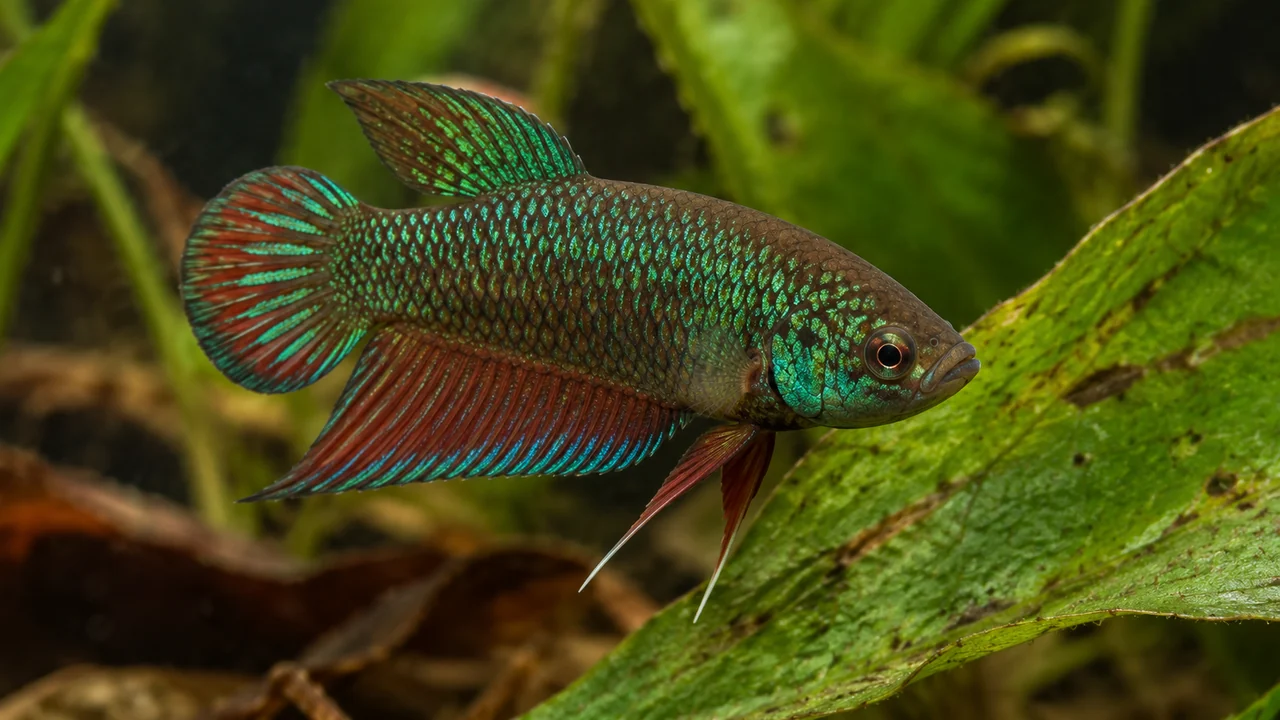
Betta smaragdina is the accepted Emerald Betta. A natural male has a brownish to reddish base with green-blue iridescent scales across the body and much of the gill cover. Fin colour and rays add to the pattern; females are generally quieter in colour and can show longitudinal markings. This is not a domestic long-finned splendens simply given a green name.
Compare the more extensive opercular mosaic with the characteristic bars and red caudal crescent of imbellis. Green iridescence alone cannot establish identity: other bettas and ornamental crosses can share it. Use provenance and the combination of characters. A normal portrait shows the representative appearance, not genetic purity or every microscopic distinction between closely related populations.
Khorat Plateau waters and geographic variation
The core range includes north-eastern Thailand’s Khorat Plateau and associated Mekong waters, with records in Laos. Nong Khai is the type locality. Accounts of still and sluggish vegetated waters, including seasonal wetlands, suggest sheltered surface space and planting, not a universal requirement for the most acidic peat-swamp water.
Geographic variation deserves care. Genetic work has found structure and candidate lineages among fish discussed around smaragdina, and locality names in the trade do not all carry equal documentation. Preserve the breeder’s original record where credible and keep uncertain stock qualified. Do not automatically assign a guitar-tail label, a claimed river or a related species name from colour alone.
Territory before community stocking
This is a territorial labyrinth fish, not a social shoaler. One well-kept individual is a straightforward plan. A pair needs cover, close observation and a second suitable arrangement ready; several males require a much more deliberate space and management plan than simply adding extra plants. Neither emerald colour nor a wild-type label guarantees mild behaviour.
An aquarium around 60 × 30 cm or larger is a practical planted starting plan. The smaller published pair baseline does not certify compatibility for the pair obtained. Assess whether each fish can rest, breathe and feed without being pursued. Continuous hiding, repeated interception or refusal to leave one corner can reveal a problem before physical damage becomes obvious.
Warm freshwater with a sustainable routine
A useful maintenance plan is around 24–27°C, pH 6–7.5 and 3–10°dGH. These values fit the overlapping species care guidance without imposing extreme acidity. Older database recommendations extend harder or more alkaline; do not average all values into one supposedly precise requirement or abruptly alter established stock to fit a new care sheet.
Prepare replacement water consistently and use mature gentle filtration. Keep ammonia and nitrite undetectable, inspect accumulation and match temperature. Surface access and atmospheric breathing are important, but they do not replace oxygenation or a clean environment. If the fish changes its breathing pattern, check the actual water and recent conditions before assuming that a labyrinth organ makes the symptom unimportant.
A wetland-inspired aquarium that works
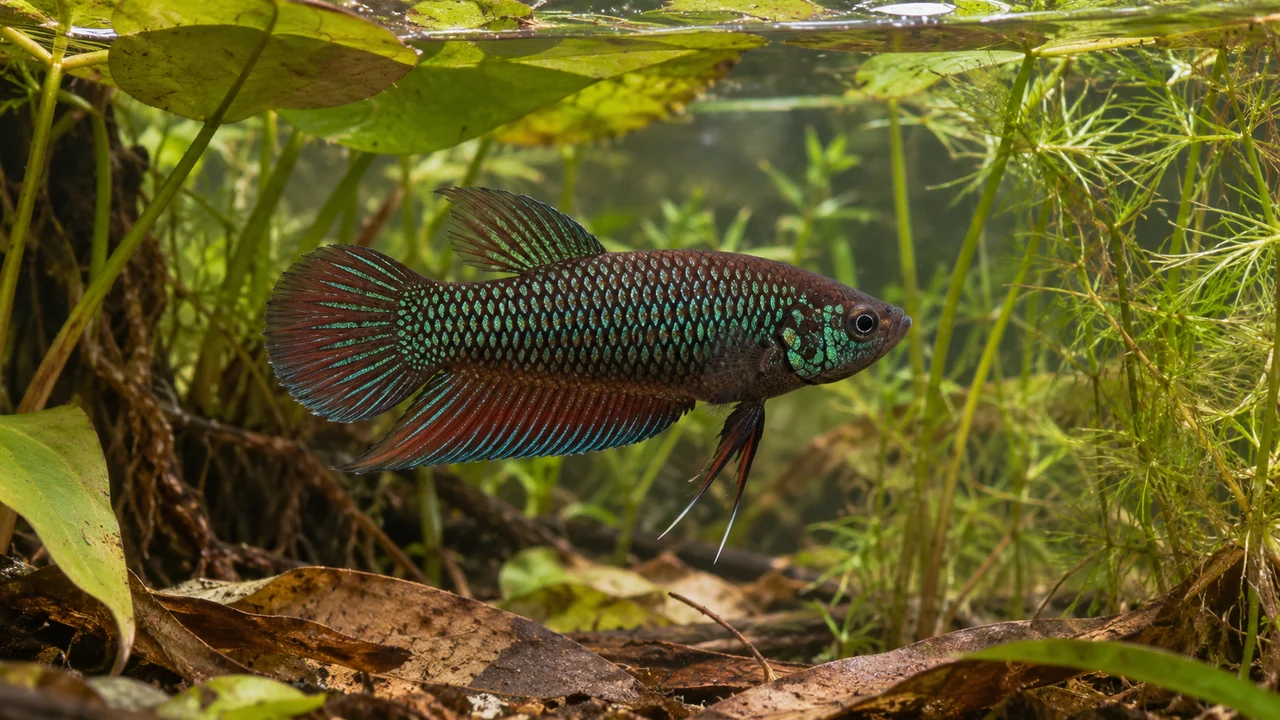
Combine broad resting leaves near the surface with fine plants, floating roots and stable wood. Leave an air gap under the secure cover and several open routes to the surface. Mostly clear or lightly tinted water can suit a planted interpretation; a thick dark leaf bed is not required to prove that the fish belongs in the Knowledge Centre.
Arrange sight breaks so a fish can withdraw without being trapped. Keep maintenance access along the floor and behind equipment. For supervised pairing, provide more than one useful sheltered patch, and watch how the pair actually uses them. A large central ornament can divide the aquarium visually while still allowing one fish to patrol every exit, so evaluate routes rather than decoration count.
Feed for condition, not endless response
Use a suitable complete food with appropriate small live or frozen invertebrates for variety. Check recognition and swallowing after introduction. A fish that repeatedly spits out a pellet may need a different size or texture, while a fish missing meals may be avoiding a dominant partner rather than refusing food altogether.
Offer measured portions and remove leftovers. Follow body shape and condition rather than feeding again whenever a fish approaches the glass. A paired setup may need separate feeding positions or separation to ensure reliable intake. Tiny shrimp and fish young may be prey; neither incidental aquarium growth nor a nominally natural layout supplies a dependable complete ration.
For supplementary invertebrate-food variety, Microalgae Freeze Dried Tubifex Worm Cubes offers a freeze-dried cube format that can be presented at the surface or against the glass. Offer only an appropriately small wetted portion the fish can swallow; this is a prepared food, not live prey or a fry starter.
Keeping names and companions honest
Retain locality and breeder information with the group and keep distinct lines separate for deliberate breeding. Genetic variation does not mean every attractive fish should be promoted to a new species, nor that all named forms can be mixed without losing useful information. Ordinary trade stock can be enjoyed while its uncertain provenance remains honestly recorded.
A species-focused aquarium is easiest to observe. Any community proposal must consider food competition, adult mouths, territorial overlap and disturbance near the surface. Other male bettas and similar territorial fish are not automatic companions. Compare the existing splendens and new imbellis profiles for useful differences, then assess the particular fish and layout rather than importing a blanket compatibility rule.
Bubble-nesting and the female’s escape route
Smaragdina builds a bubble nest, often associated with sheltered surface cover. During a breeding attempt the pair embraces, eggs are collected into the nest and the male tends the early brood. The female needs substantial refuge and normally a separate arrangement after spawning when she is no longer tolerated. A peaceful introduction does not establish permanent pair compatibility.
Prepare fine first food and a covered, warm, protected nursery in advance. Use gentle guarded filtration and matched maintenance, observe when fry become free-swimming and manage parental presence accordingly. Plan further space as the brood grows and territorial behaviour develops. Botanical cover can help the setting but cannot replace a rearing and separation plan.
Botanicals and first responses to problems
Use prepared leaves and stable wood for lower shelter and additional surfaces while retaining live planting and surface access. Keep the quantity manageable, inspect decomposing material and adjust maintenance. These materials do not make a dominant fish safe or turn a particular colour into proof of water quality.
For hiding, check pursuit and exits. For poor intake, observe food recognition and access. For damaged fins, inspect both the surroundings and the social arrangement. Rapid or unusual breathing calls for water, temperature and oxygen checks. Record recent changes and respond to the specific observation; more heat, darker water or an extra companion is not a universal answer.
For the sheltered lower edge beneath the fish’s surface routes, compare Dried Cinnamon Leaves – Natural Aquarium Leaf Litter with BBA Nano Botanical Variety Box – 32-Piece Shrimp & Betta Pack. Select accessible pieces that complement the refuges while leaving atmospheric access and feeding positions open. A mixed box provides material to choose from over time, rather than a quantity to add all at once.
Further reading and sources
Identity and natural-history sources are distinguished from aquarium husbandry. Recommended care is not a set of experimentally established survival limits; breeding conditions may differ from adult maintenance.
- Kowasupat et al. (2012) — comparative bubble-nesting Betta taxonomy — Primary morphology comparing imbellis, smaragdina and related species; not a trial of their aquarium compatibility.
- Kowasupat et al. (2014) — smaragdina genetic diversity — Primary genetic study of geographic structure and candidate lineages; indexed evidence consulted, not a captive-care or universal compatibility trial.
- FishBase — Betta smaragdina — Current combination and referenced natural-history records; older numerical summaries are not experimental survival limits.
- Seriously Fish — Betta smaragdina — Species-specific husbandry, adult scale, social arrangements and reproduction. Read explanatory water notes, not just summary numbers.