Fish · Scarlet Betta
Scarlet Betta — Betta coccina: Habitat and Care
A wine-red forest specialist whose identity, food and soft-water routine deserve attention before purchase. Plan sheltered territory and a protected nest site rather than a miniature community centrepiece.
- Adult size
- Approximately 4 cm standard length; FishBase also records 5.6 cm total length, which includes the tail.
- Maintenance plan
- 24–26°C; approximately pH 4.5–6 and 1–4°dGH, with consistently low carbonate hardness.
- Aquarium
- A 60 × 30 cm planted base is a useful practical plan; published pair guidance starts at 45 × 30 cm.
- Social arrangement
- One fish or a carefully managed pair; group tolerance is not assured.
- Feeding
- Small invertebrate foods and an accepted suitable complete food; observe individual intake.
- Reproduction
- A bubble-nester, often using a sheltered cavity or leaf underside; the male tends the nest.
Identify more than a red body
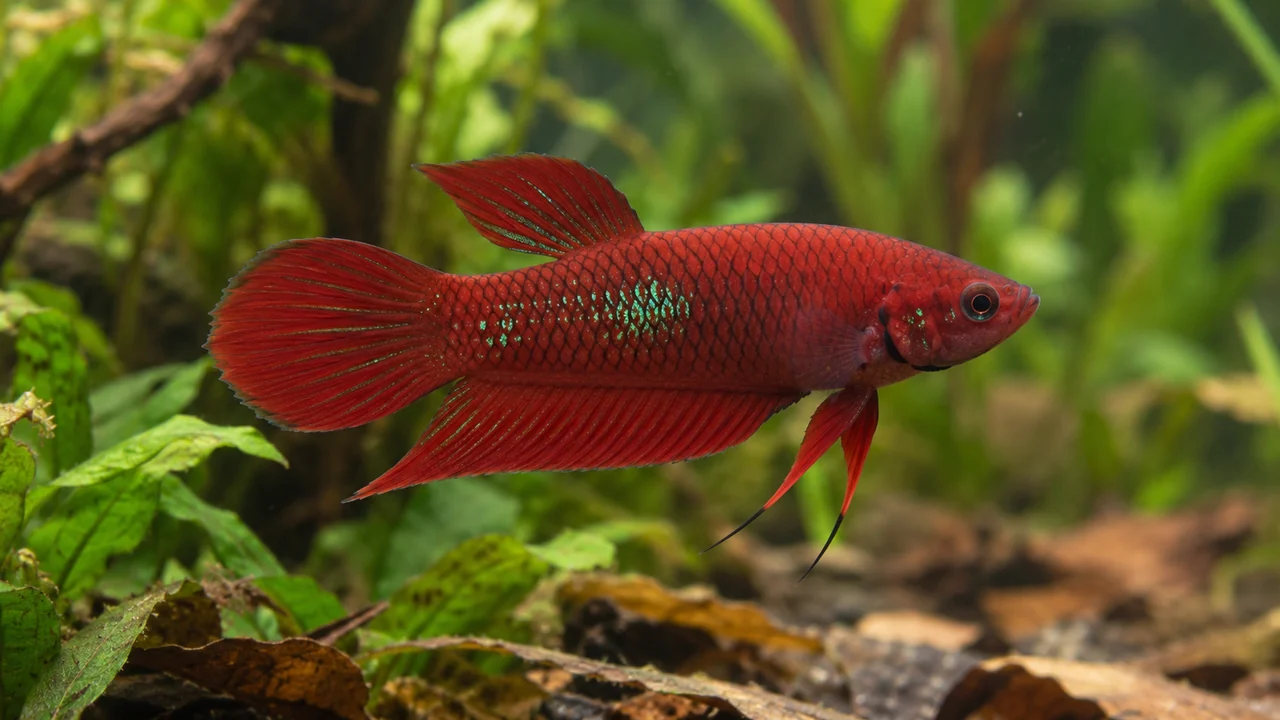
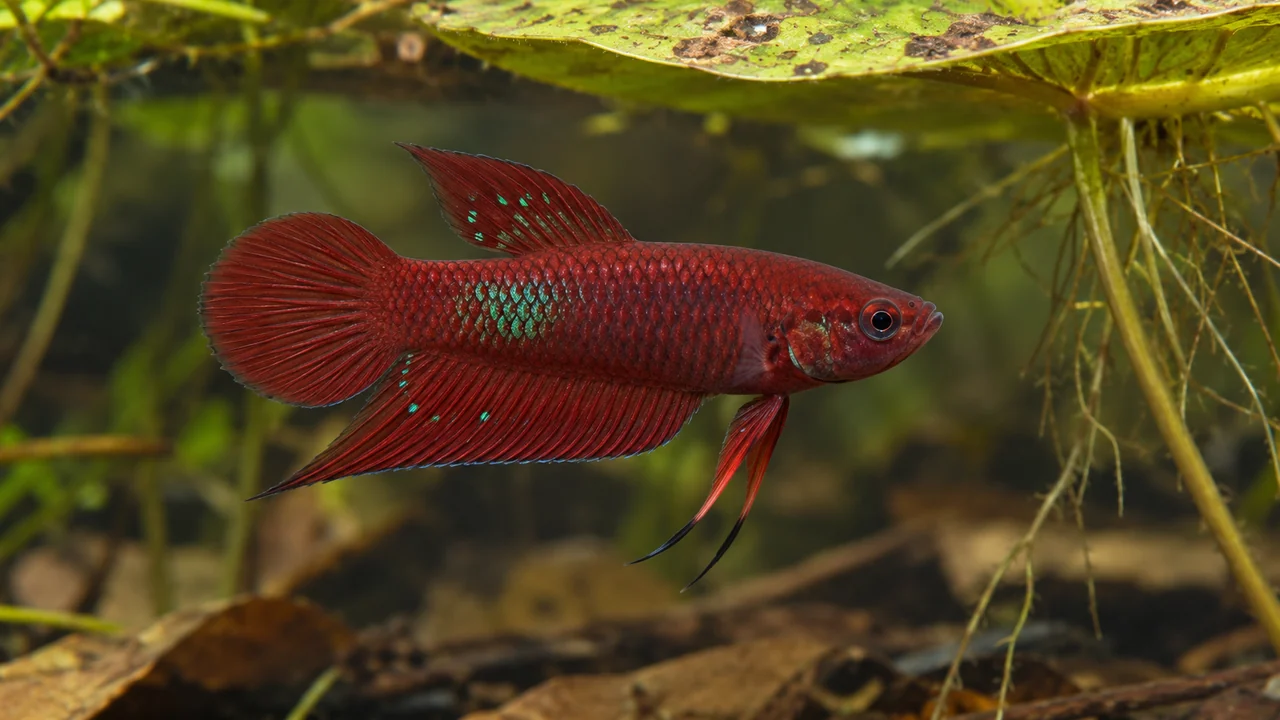
Betta coccina is an accepted species, commonly called Scarlet or Wine Red Betta. A representative male is slender and dark red, with a green-blue flank patch and scattered iridescent points in the median fins. Its narrow pelvic extensions have dark tips. Females are usually less colourful; the diagnostic lateral patch is associated with males, although visible pattern varies among stocks and moods.
Brown’s Betta is not the same fish with a different shop label. In brownorum the lateral green patch is usually conspicuously large in both sexes, the median fins lack the discrete green spotting and the pelvic filaments have pale tips. Use these features together and preserve credible collection records. A patch missing from one unsettled coccina does not by itself disprove the identity.
Forest water from Sumatra and the peninsula
Published records include Jambi and Riau in Sumatra and Johor in Peninsular Malaysia. Older sources differ over the status of some peninsular populations, so a simple country list should not be turned into a precise origin claim for aquarium stock. Keep locality information only when it comes with a reliable collection or breeding history.
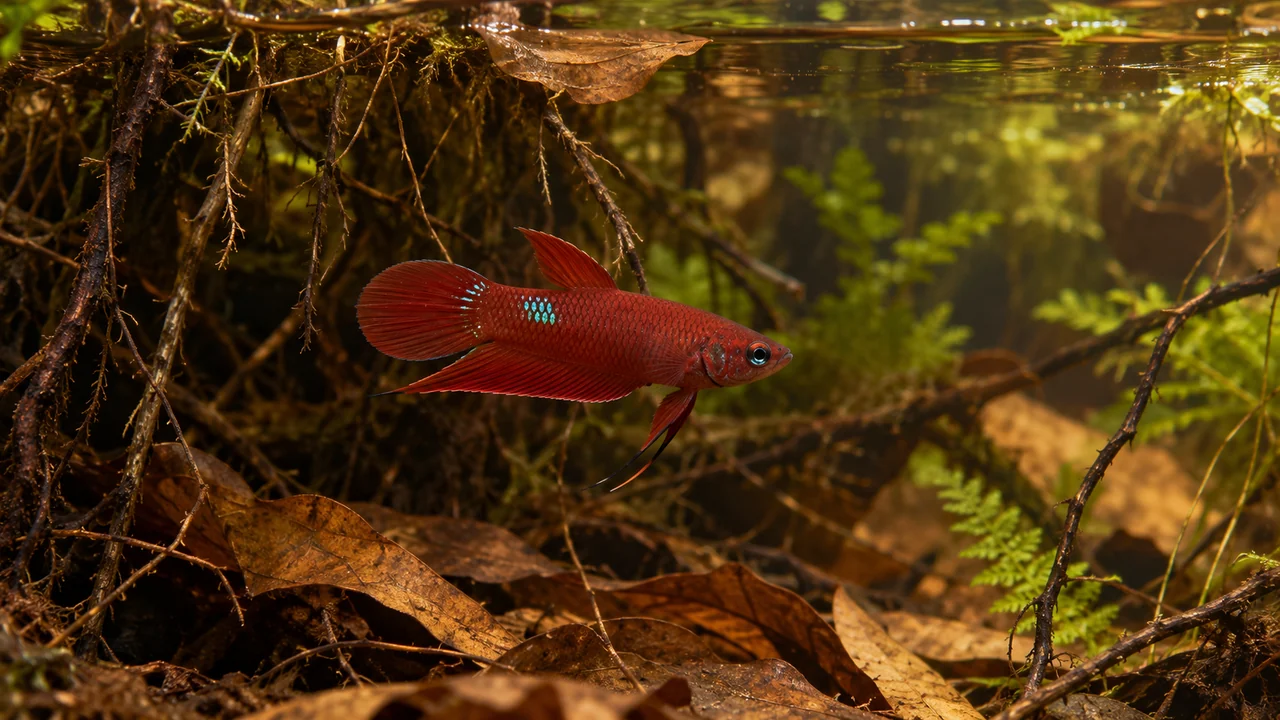
Peat-swamp forest and associated sheltered blackwater are central to its ecology. Translate that into shade, suitable water and connected refuges. Do not reproduce a tiny drying forest pocket as the permanent volume for a captive pair. A home aquarium must also allow stable temperature, dependable filtration, feeding observation and access for removing waste.
Build territory around usable cover
Begin with a species-focused aquarium. A 60 × 30 cm footprint leaves room beyond the published 45 × 30 cm pair baseline for separate resting patches and an observable front margin. This is a practical layout recommendation, not an experimentally determined minimum. A single fish does not need a compulsory schooling group, and a pair must have a separation option ready.
Use fine roots, broad leaves and dim-tolerant planting to interrupt long views. Each refuge should have a clear exit and a route to the surface. Keep the lid secure while leaving an air space above the water. Check gaps around cables and filter pipes; a small labyrinth fish can disappear through an opening that looks insignificant from the front.
Make the soft-water routine first
A useful maintenance target is 24–26°C, pH around 4.5–6 and 1–4°dGH. Species accounts give wider temperature limits; the middle of an appropriate range is a more sensible routine than using its hottest endpoint. Low carbonate hardness matters, and water tint does not measure it. Check the stock’s established conditions and prepare a repeatable replacement-water recipe before buying fish.
If the supply is hard, a controlled soft-water source may be needed. Avoid pouring acid into the occupied aquarium to chase a field value. Track temperature, conductivity where useful, pH trends and nitrogen waste with suitable tests. Very soft water needs an informed routine: small errors in preparation can produce larger changes than expected from a heavily buffered community aquarium.
Food for a small deliberate predator
Have appropriately small live or frozen invertebrate food available during settling. Offer manageable particles where the fish actually waits, not only at the brightest open corner. A suitable complete food is useful when recognised and swallowed; investigation or repeated spitting is not proof of adequate feeding. Keep a reliable accepted ration while introducing anything new.
Watch each fish’s condition, especially in a pair. Food can be missed because one animal controls the approach, not because the species is inherently difficult to feed. Use separate feeding positions if needed and remove leftovers before they collect beneath leaves. A continuously rounded abdomen is not an objective; adjust the ration to intake and condition rather than the fish’s willingness to approach again.
Filtration without sweeping the refuges
An established sponge filter or suitably guarded gentle filter can provide biological support without forcing a fish away from cover. Position circulation so the aquarium does not develop stagnant debris pockets while retaining calm resting edges. Atmospheric breathing does not make ammonia, nitrite or poor maintenance acceptable. Keep both undetectable and respond to changes in breathing or behaviour.
Trim in sections and lift accumulated debris from accessible patches rather than dismantling every refuge together. Broad aquatic leaves, fine roots and a modest quantity of prepared leaves can create structure, but a floor packed with material becomes harder to inspect. Keep the filter intake visible and maintain a clear working route for a small siphon.
Pairs and neighbours need observation
Reports of keeping several coccina together are mixed. Brief display differs from sustained pursuit, blocked feeding or a fish confined behind equipment. A pair is a managed arrangement, not a guarantee issued by the species name. If one fish loses normal access to rest, food or air, use the prepared separation arrangement rather than waiting for obvious injury.
A busy community usually makes this specialist harder to observe. Larger mouths, fast feeders and surface competitors are poor default neighbours. Small shrimp young, eggs and fry may be eaten. Keep other coccina-group species and uncertain locality lines separate if breeding or identity preservation matters; comparison pages are for learning, not an instruction to mix lookalikes.
A sheltered bubble nest and prepared young
Coccina is a bubble-nester, including nests beneath leaves or within a protected cavity. Courtship and an embrace lead to eggs being gathered into the nest, where the male takes the main tending role. Provide female refuge away from the nest and manage the particular pair according to behaviour. A closed refuge must remain safely accessible, not become a trapping hazard.
Prepare protected filtration and small first foods before free-swimming young appear. Check actual food acceptance rather than assuming incidental growth among leaves will feed an entire brood. Keep warm humid air beneath the cover and match replacement water carefully. A nest does not prove fertilisation, and a brood still needs space and a feeding plan as it grows.
Botanicals and the first useful checks
Suitable wood and prepared leaves can make a shaded, layered setting. Add material gradually, retain maintenance access and check how it changes the waste load. Botanical tint does not guarantee the required softness, prevent disease or ensure spawning. Natural peat extraction is not necessary to create a responsible aquarium interpretation of peat-forest structure.
For hiding, examine light, pursuit and exits. For weight loss, observe swallowing and food access. For unusual breathing, promptly check water, heat and oxygenation. For a nest abandoned after disturbance, review how much the aquarium was moved or opened. Record the recent change before making several more interventions; the aim is a stable routine the fish can use normally.
For the sheltered lower edge beneath the fish’s surface routes, compare Ceylon Cocoa (Cacao) Leaves – Natural Aquarium Leaf Litter with Canoinhas Pods (Funtumia elastica) – Natural Seed Pods. Select accessible pieces that complement the refuges while leaving atmospheric access and feeding positions open.
Further reading and sources
Identity and natural-history sources are distinguished from aquarium husbandry. Recommended care is not a set of experimentally established survival limits; breeding conditions may differ from adult maintenance.
- Seriously Fish — Betta coccina — Species-specific husbandry, adult scale, social arrangements and reproduction. Read explanatory water notes, not just summary numbers.
- International Betta Congress — Betta coccina — Specialist maintenance and breeding observations; older broad or conflicting statements are assessed rather than transferred without qualification.
- FishBase — Betta coccina — Accepted name, documented distribution and measured size; measurement conventions are kept distinct from aquarium planning.
- Tan & Ng (2005), fighting fishes of Singapore, Malaysia and Brunei — Comparative primary revision. Indexed diagnostic passages consulted; full PDF could not be retrieved in this batch.