Fish · Brown’s Betta
Brown’s Betta — Betta brownorum: Habitat and Care
A tiny magenta-red Bornean peat-swamp Betta with a prominent green side patch. Soft-water preparation, small food and a workable territorial layout are central to its care.
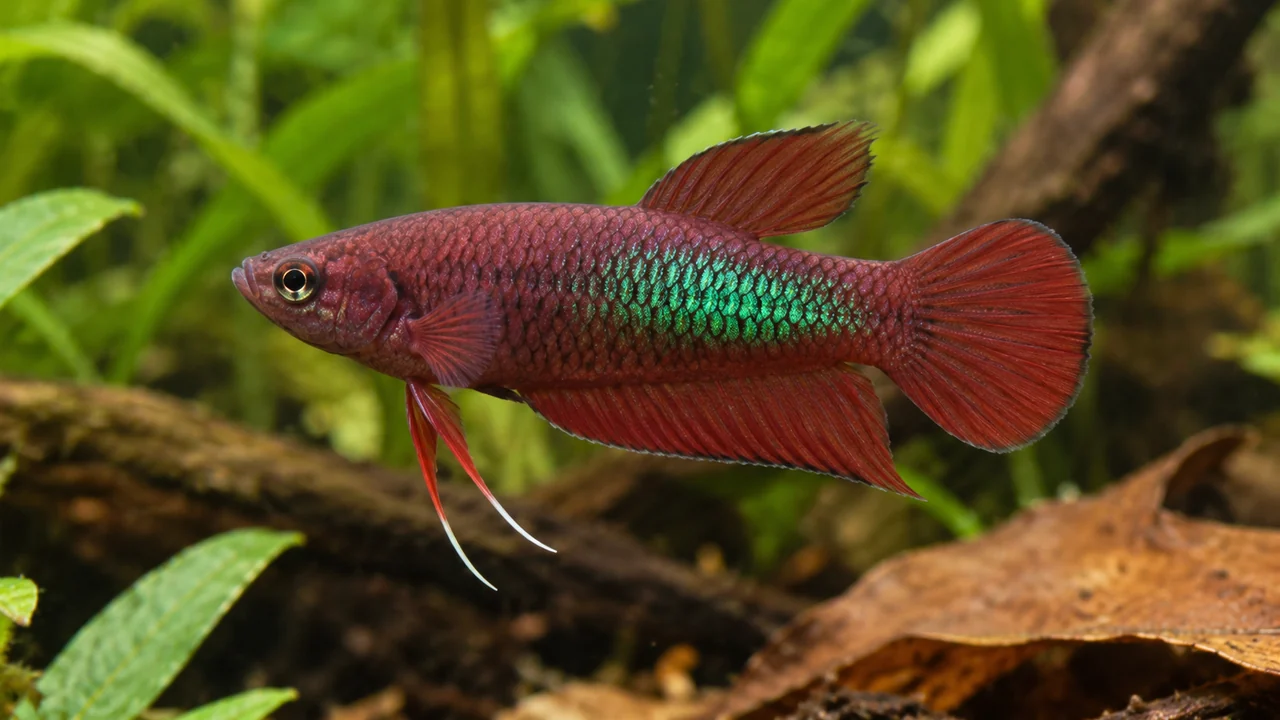
- Adult scale
- Approximately 2.5–3 cm standard length; older 6 cm claims are not used as its measured body size.
- Routine temperature
- Around 24–25°C is a cautious overlap between cooler specialist advice and broader published ranges.
- Water
- Very soft acidic water; a practical pH 4.5–5.5 and 1–3°dGH plan requires reliable preparation.
- Footprint
- A shaded 60 × 30 cm arrangement is useful for a managed pair; 45 × 30 cm is a published baseline.
- Identification
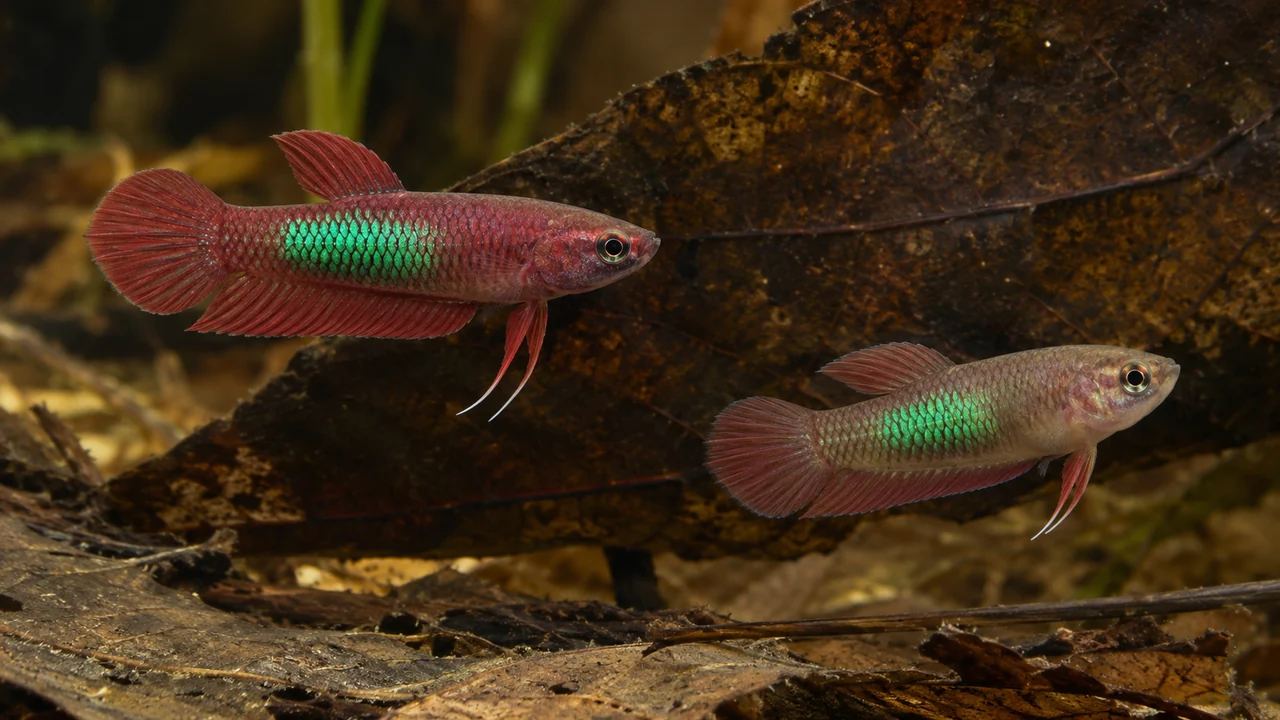
- Large green lateral patch in both sexes; plain red median fins and pale pelvic filament tips.
- Breeding
- Primarily a bubble-nester; older reports of mouthbrooding are not treated as the routine method.
The patch is part of a larger identity
Betta brownorum is an accepted species named for Barbara and Allan Brown. Its small reddish-magenta body carries a large iridescent green patch on the side in both sexes. The median fins are predominantly plain red, and the curved pelvic fins end in pale filaments. Those features distinguish the representative fish from coccina’s smaller or variable male patch, green fin points and dark pelvic tips.
Do not identify every small red Betta from the patch alone. Related species, stress patterns and locality variation complicate visual judgement. Keep the supplier’s scientific name and reliable provenance together. Brown’s is a personal-name common name, not a statement that the fish should be uniformly brown, and an attractive portrait cannot authenticate a collection locality.
Borneo, not a generic mainland range
The documented range centres on southern and western Sarawak, with populations across the border in West Kalimantan. The type locality lies near the Sibu–Kuching route in Sarawak. An older IBC page contains a contradictory mainland occurrence line; that is not used here to extend the species across Thailand and Vietnam.
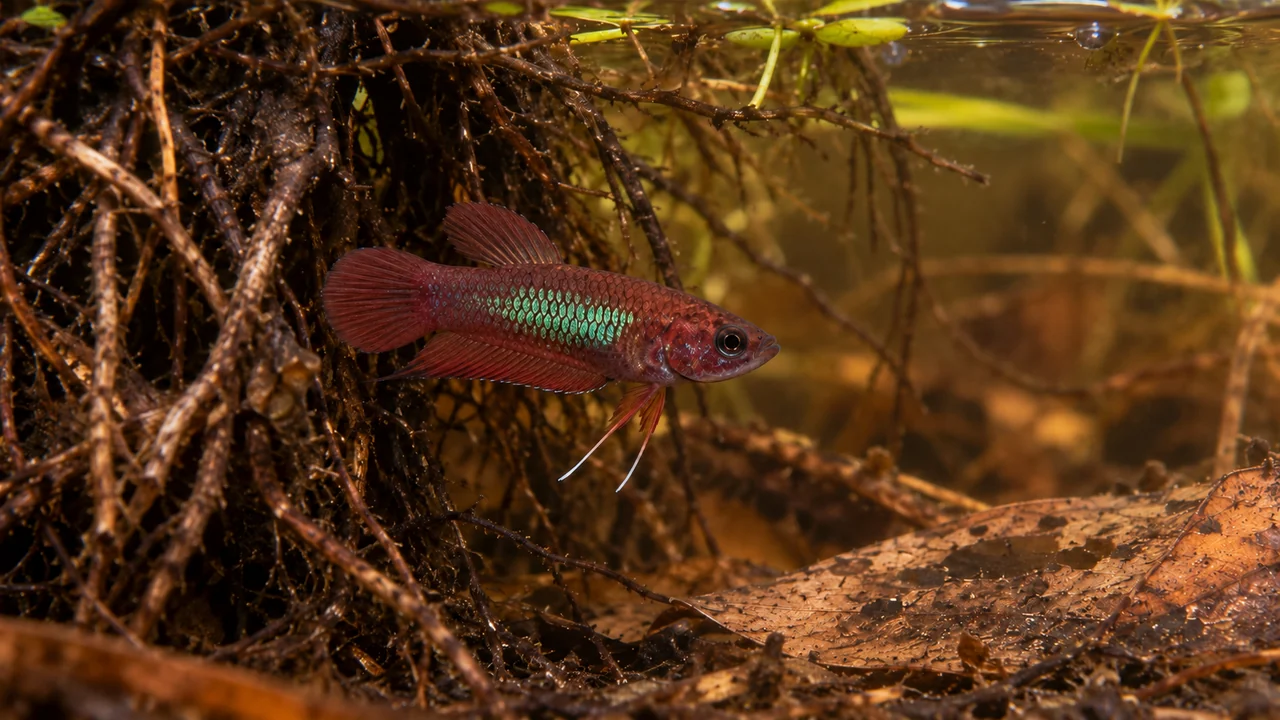
Brownorum is closely associated with peat-swamp forest and shallow blackwater. These are specialised waters with low mineral content, shade and organic structure. Field acidity is ecological evidence, not a challenge to reproduce the lowest reported pH in a new aquarium. Choose an adult-care routine that can be sustained and measured, with sufficient water volume for ordinary maintenance.
A small fish with real territorial needs
A single individual or carefully watched pair is easier to manage than a speculative group. A 60 × 30 cm planted base offers room for several usable refuges beyond the smaller published pair baseline. Its tiny body does not remove the need for exits, feeding positions and access to atmospheric air. Have a second suitable space ready if pairing fails.
Use narrow roots, leaves and low-light planting to divide the aquarium into sheltered patches. Keep at least one observable feeding edge. A hiding fish should be able to move to another refuge without crossing the dominant fish’s only patrol route. Check around equipment, and secure the cover while retaining a humid air space above the water.
Choose a sustainable soft-water target
A practical starting framework is about 24–25°C, pH 4.5–5.5 and 1–3°dGH, with very low carbonate hardness. Published sources differ in temperature breadth: older specialist observations favour cooler to middle tropical conditions, while another account extends to 30°C. The overlapping routine here avoids presenting either extreme as compulsory daily care.
Prepare replacement water before stocking and record its characteristics. If soft water is produced by dilution or another controlled supply, make the recipe repeatable rather than improvising at each change. Do not confuse low general hardness with zero need for dissolved minerals. Avoid abrupt acid additions, and select tests that work meaningfully in the low range being maintained.
Small food where the fish waits
Start with suitable small live or frozen invertebrates and verify swallowing. This is a tiny predator; coarse particles can be repeatedly mouthed without supplying much food. Introduce an appropriate complete food if accepted, but keep a dependable alternative during the transition. There is no advantage in allowing a fish to lose condition to prove it will eventually eat a preferred packet.
Feed into the sheltered occupied water and watch each member of a pair. Two small delivery points may work better than a large portion in one exposed place. Remove uneaten material and follow body condition. An aquarium rich in microbial surfaces can still fail to provide sufficient intentional food, especially after transport or during repeated reproductive activity.
Gentle filtration and inspectable structure
Use mature biological filtration with a guarded intake and modest flow. Aim for circulation and surface exchange without pushing a resting fish away from the roots. Low-oxygen natural habitats do not justify deliberately poor oxygenation at home. Keep ammonia and nitrite undetectable and maintain a routine that prevents food and waste accumulating unseen.
Prepared leaves can layer the lower refuge, with small stable wood above. Keep the quantity manageable and remove debris from accessible areas without stripping the whole setting. Watch floating cover as it grows: dense roots can close the surface route or make a once-open exit too narrow. The aquarium should remain practical to inspect without catching the fish.
Social decisions for a specialist aquarium
Group keeping has produced different outcomes in specialist reports. Do not assume that a group disperses aggression harmlessly. Monitor whether each fish feeds, rests and moves normally. Sustained interception, a permanently clamped individual or occupation of the space behind the heater calls for a change or separation before injury makes the problem unmistakable.
A quiet species aquarium keeps the picture clear. If companions are considered, compare their adult mouth size, food competition, water and activity, not just a peaceful label. Keep distinct red-Betta species and undocumented locality mixtures separate for deliberate breeding. Fry and small shrimp are not protected by the adults’ small size.
Normal nesting and the unusual report
Brownorum is normally managed as a bubble-nester. A male may choose a sheltered tube, leaf underside or covered surface edge, with the female needing space outside his immediate nest area. After spawning, observe the actual pair and retain a separation option. Do not repeatedly disturb a hidden nest simply because it is not visible from the front.
The IBC records occasional mouthbrooding reports under uncertain triggers. That is worth distinguishing from the normal method, not converting into a mouthbrooder’s recipe or a reason to force a pair into unusual conditions. Prepare protected filtration, fine first food, a covered warm nursery and suitable replacement water. Confirm free-swimming young and their intake before increasing food size.
Botanical use and practical troubleshooting
Use suitable leaves and roots for shade and lower cover, not as proof that the water chemistry is correct. Add them gradually and keep the feeding edge accessible. A dark setting can still contain excessive waste, unsuitable hardness or a dominant fish that excludes its partner. There is no need to harvest peat to obtain a natural-looking aquarium floor.
For fading or hiding, check disturbance and social access. For thinness, watch feeding rather than simply increasing the ration. For changed breathing, inspect water quality, temperature and circulation promptly. After a water change, compare the replacement recipe with the previous one. A brief log of these observations makes the next decision more useful than a sequence of unmeasured additives.
For the sheltered lower edge beneath the fish’s surface routes, compare Dried Guava Leaves – Natural Aquarium Leaf Litter with Crushed Catappa Leaves – Indian Almond Leaf Pieces. Select accessible pieces that complement the refuges while leaving atmospheric access and feeding positions open.
Further reading and sources
Identity and natural-history sources are distinguished from aquarium husbandry. Recommended care is not a set of experimentally established survival limits; breeding conditions may differ from adult maintenance.
- Seriously Fish — Betta brownorum — Species-specific husbandry, adult scale, social arrangements and reproduction. Read explanatory water notes, not just summary numbers.
- International Betta Congress — Betta brownorum — Specialist maintenance and breeding observations; older broad or conflicting statements are assessed rather than transferred without qualification.
- Tan & Ng (2005), fighting fishes of Singapore, Malaysia and Brunei — Comparative primary revision. Indexed diagnostic passages consulted; full PDF could not be retrieved in this batch.