Fish · Crescent Betta
Crescent Betta — Betta imbellis: Habitat and Care
A natural short-finned bubble-nester with a red caudal crescent. The name Peaceful Betta does not remove territorial behaviour: plan sheltered surface access, proper food and a workable separation option.
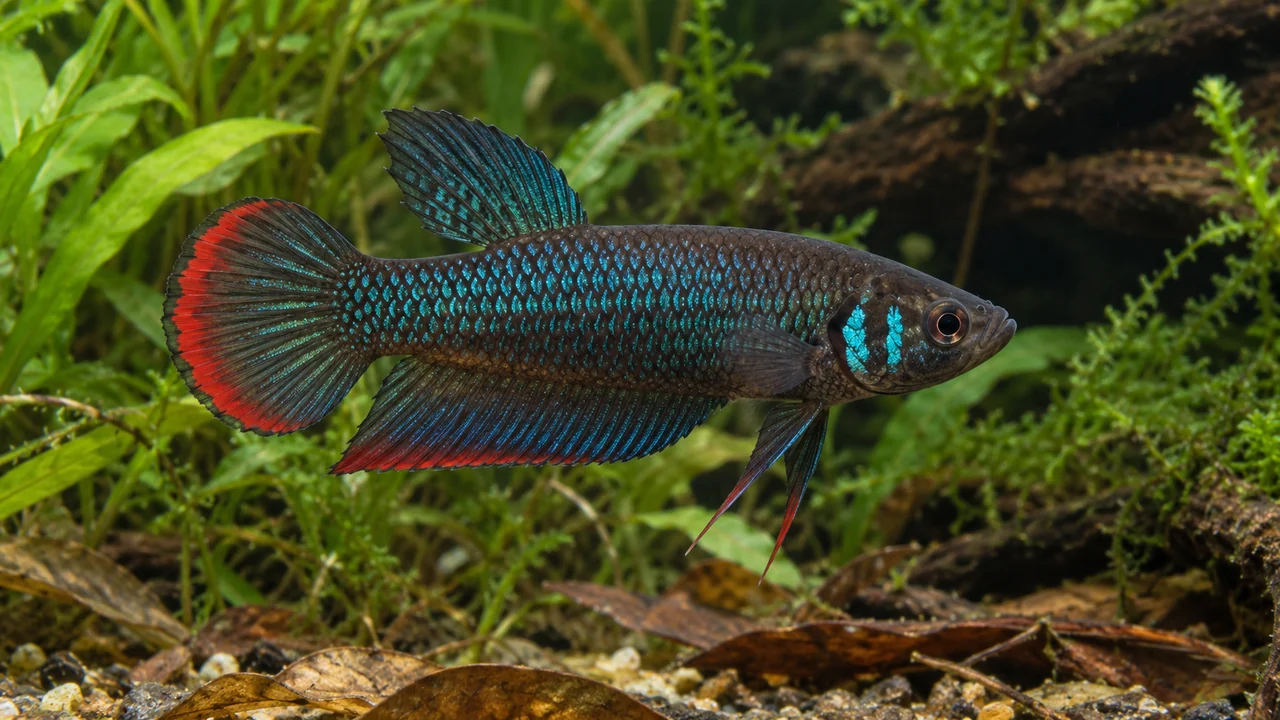
- Adult scale
- Around 5–6 cm body scale; natural fins differ from domestic long-finned splendens.
- Routine temperature
- 24–27°C is a useful warm maintenance target within broader published guidance.
- Water plan
- Approximately pH 6–7.2 and 3–10°dGH for an appropriately acclimated group or individual.
- Social plan
- A single individual is straightforward; any pairing needs dense cover, supervision and a ready separation option.
- Aquarium footprint
- Around 60 × 30 cm is a useful planted plan; a smaller published pair baseline does not guarantee pair compatibility.
- Surface
- Secure lid with air space above the water, accessible surface and gentle filtration.
A crescent, opercular colour and provenance
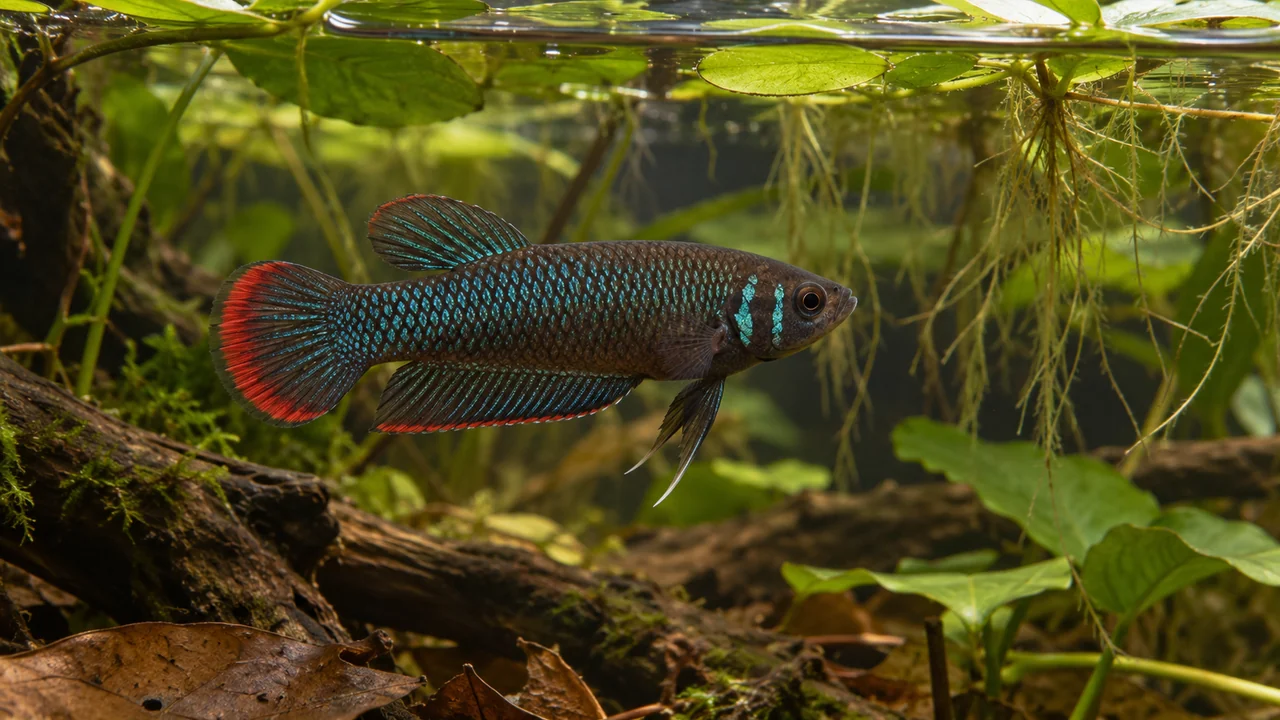
Betta imbellis is the accepted Crescent Betta, also widely called Peaceful Betta. A representative natural male has a dark body with blue-green iridescence and a red crescent around the outer caudal edge. Opercular markings and fin pattern help comparison with other members of the splendens group; the fish is not simply a small domestic splendens with shorter fins.
Smaragdina typically has a more extensive mosaic of iridescent scales over the gill cover and a different overall fin pattern. Identification should use several features and a trustworthy stock history. Ornamental crosses and selected lines can obscure them. A red tail edge or the word wild on a sales label does not certify species purity or a named collection locality.
Vegetated lowland water and the surface
The species is associated with southern peninsular Thailand and Malaysia, with accounts also including northern Sumatra. The type locality is near Kuala Lumpur. Introductions complicate some wider records, so do not treat every country listing as proof of native origin. Still or sluggish vegetated waters provide a useful ecological theme, rather than one compulsory peat-swamp scene.
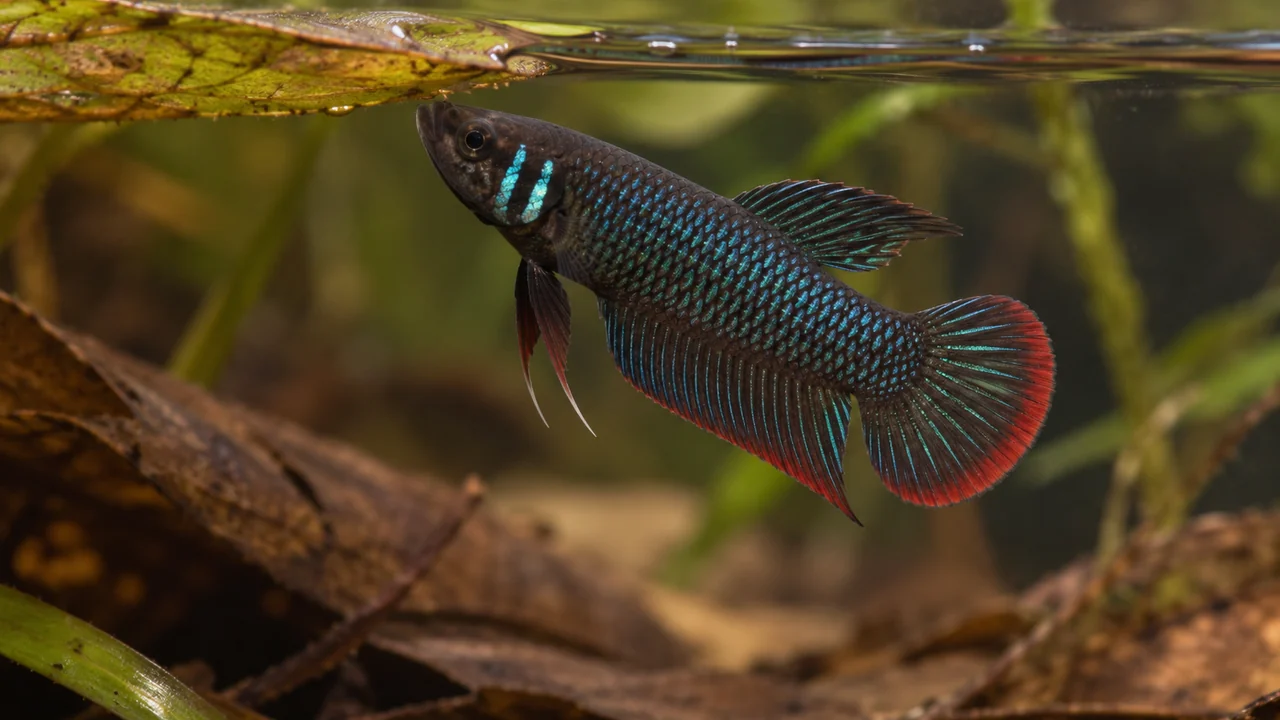
Its labyrinth organ allows access to atmospheric air, but the aquarium still needs clean, oxygenated water. Leave a warm humid air space under a secure cover and keep routes to the surface open. Floating roots and broad resting leaves are useful when the fish can reach and leave them easily. A sealed mat of vegetation or a deep obstacle course is not improved by calling it natural.
Peaceful is a name, not a stocking guarantee
Plan first for one fish or a carefully assessed breeding pair, not a shoal. Males display and defend space, and females can be pursued or become assertive themselves. The fact that some keepers manage several fish with extensive cover does not make a new mixed group automatically safe. A solitary individual is not deprived of a compulsory schooling requirement.
A planted aquarium around 60 × 30 cm gives a useful space for surface routes, shelter and observation. The published 45 × 30 cm pair baseline is not a promise that a particular pair will coexist. If a pair is intended, prepare a second suitable enclosure or effective separation before introduction. Watch access to food and resting places, not just whether fins remain intact.
Stable warmth and measured water care
For ordinary maintenance, around 24–27°C, pH 6–7.2 and 3–10°dGH offers a useful plan within the broader care literature. Older summaries include harder-water recommendations; stock history and gradual acclimation matter more than suddenly forcing a healthy fish into a different target. Most aquarium keeping here is freshwater, even though some natural populations occur near coastal brackish water.
Use mature gentle filtration, a stable heater where needed and a moving but unexposed surface. Keep ammonia and nitrite undetectable. Match replacement water and remove uneaten food. Air breathing does not make poor water harmless, and a surface visit is not by itself proof of a problem. Look for a change from the individual’s normal breathing and movement.
Build several sheltered surface routes
Broad leaves near the surface let the fish pause without continuous swimming. Fine plants and low wood can divide sight lines, but each refuge should have a usable exit. Keep some feeding space visible and avoid pinning a fish between a dense root mat and glass. A narrow pod opening is not automatically a suitable cave for an adult labyrinth fish.
Trim in sections, retain familiar cover and inspect behind equipment. A paired setup needs more than one good refuge and more than one route to air. If one animal controls both, the effective aquarium is much smaller than its dimensions. Change the arrangement or separate the fish rather than waiting for injury to demonstrate that the arrangement has failed.
A small predator with a measured ration
Offer an appropriate complete food for small insect-eating tropical fish, with suitable live or frozen invertebrates for variety. Check whether an unfamiliar individual recognises dry food; do not assume that a pellet disappearing beneath a leaf was eaten. Use portions that can be swallowed readily and observe the mouth, especially after purchase.
Feed according to body condition and actual intake. A fish approaching the keeper does not necessarily need another meal. Remove leftovers and use more than one feeding position for a supervised pair. Snails, shrimp or incidental aquarium life should not be relied on as an adequate permanent diet, and tiny shrimp young may themselves be regarded as food.
For supplementary invertebrate-food variety, Microalgae Freeze Dried Tubifex Worm Cubes offers a freeze-dried cube format that can be presented at the surface or against the glass. Offer only an appropriately small wetted portion the fish can swallow; this is a prepared food, not live prey or a fry starter.
Companions, records and the breeding decision
A species-focused aquarium keeps observation and territorial management simple. If other fish are considered, choose calm occupants with genuinely compatible water and activity. Fin nipping, food competition and disturbance at the surface can be problems without a dramatic attack. Other male bettas or lookalike territorial labyrinth fish are not routine additions.
Maintain stock identity and avoid deliberately crossing species or mixing locality lines. For a breeding project, assess both fish’s condition and prepare female refuge and post-spawn management. The comparison with splendens is useful for anatomy and surface planning; it does not mean that every domestic-betta rule or community anecdote transfers unchanged to imbellis.
A bubble nest and a protected nursery
Imbellis is a bubble-nester. A male may build beneath floating cover, with spawning embraces and eggs placed in the nest. The male tends the eggs and early young; the female needs refuge and is normally separated when spawning is complete and pursuit resumes. A nest alone does not establish fertilisation or successful parental behaviour.
Prepare fine first foods, protected sponge filtration and a covered warm nursery before fry become free-swimming. Keep a suitable air space and steady conditions as the young develop. Manage the male according to the brood’s stage and behaviour rather than leaving the family together indefinitely. Raising a brood also requires room and separate management as juveniles grow; it is not completed by obtaining eggs.
Botanicals and practical first checks
Prepared leaves and wood can add shade and surfaces around a planted setting. Use a modest amount that remains inspectable and remove harmful accumulation. They do not certify soft water, cure fin damage or make a pair compatible. Keep the surface accessible as material shifts and plants grow.
For hiding or missed meals, inspect pursuit, refuge and food recognition. For repeated urgent breathing, test water and check temperature and oxygen. For torn fins, examine both hardscape and social interactions. A separation plan is a practical tool, not a last resort to improvise after a fish has already lost access to its normal resting and feeding area.
For the sheltered lower edge beneath the fish’s surface routes, compare Dried Mango Leaves – Natural Aquarium Leaf Litter with BBA Mini Nano Botanical Box – 37-Piece Shrimp & Betta Variety Pack. Select accessible pieces that complement the refuges while leaving atmospheric access and feeding positions open. A mixed box provides material to choose from over time, rather than a quantity to add all at once.
Further reading and sources
Identity and natural-history sources are distinguished from aquarium husbandry. Recommended care is not a set of experimentally established survival limits; breeding conditions may differ from adult maintenance.
- Kowasupat et al. (2012) — comparative bubble-nesting Betta taxonomy — Primary morphology comparing imbellis, smaragdina and related species; not a trial of their aquarium compatibility.
- FishBase — Betta imbellis — Current combination and referenced natural-history records; older numerical summaries are not experimental survival limits.
- Seriously Fish — Betta imbellis — Species-specific husbandry, adult scale, social arrangements and reproduction. Read explanatory water notes, not just summary numbers.