Shrimp · Pinocchio Shrimp
Pinocchio Shrimp — Caridina gracilirostris: Habitat and Care
A slender transparent shrimp with a remarkably long red rostrum. Examine the adult salinity question honestly, provide open space and suitable food, and separate that maintenance plan from the published brackish larviculture experiment.
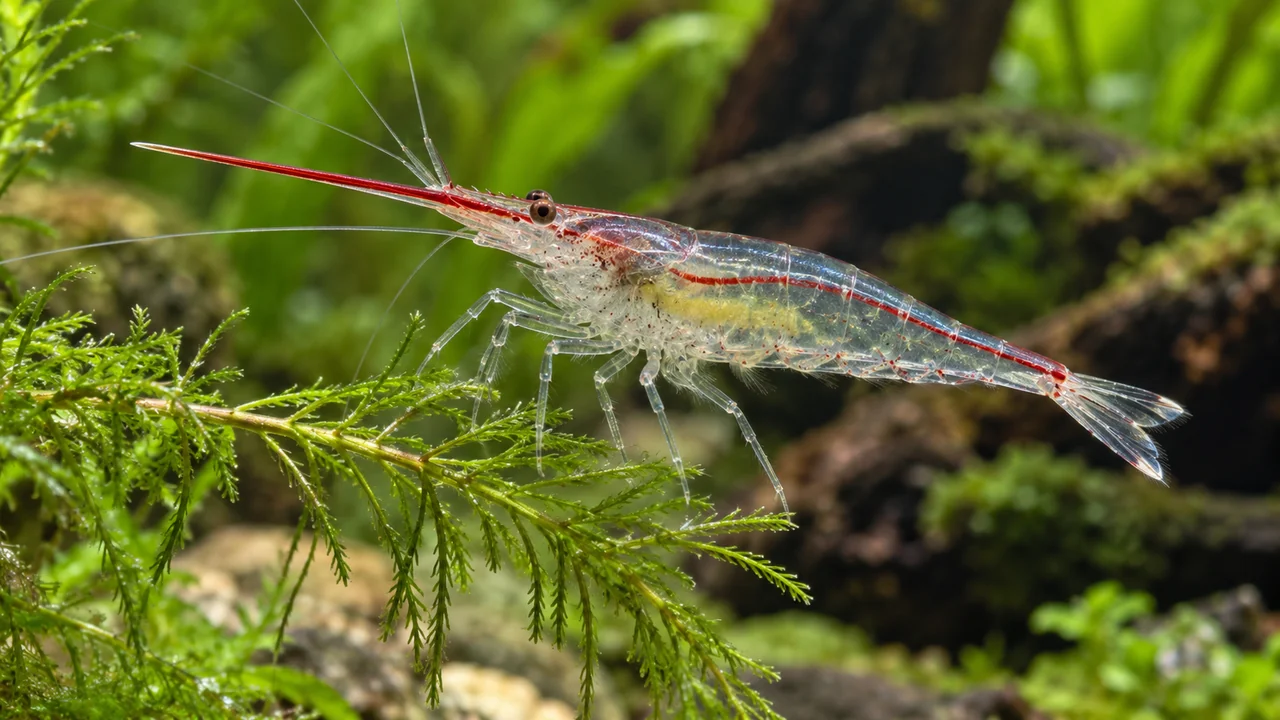
- Identity
- Caridina gracilirostris; a long red rostrum and transparent body are useful cues, but similar trade shrimp still require reliable identification.
- Adult scale
- Around 3–4 cm body length, with conspicuous additional rostrum and antenna reach.
- Aquarium plan
- A dedicated aquarium around 100 litres or larger with an open swimming lane, feeding surfaces and protected intakes.
- Adult water
- About 24–27°C in stable, prepared water; a dedicated modestly brackish plan around 10 ppt follows specialist advice, rather than an automatic soft-water template.
- Minerals and pH
- Use a consistent balanced salt/mineral preparation and measure salinity; for the brackish plan, a stable roughly neutral-to-alkaline pH around 7–8 is more useful than a generic bee-shrimp GH/KH target.
- Larval evidence
- Heerbrandt & Lin (2006) obtained successful development with 15 ppt, 27°C and suitable microalgal food; this is a tested rearing treatment, not an adult care prescription.
The long red rostrum is only part of the identity
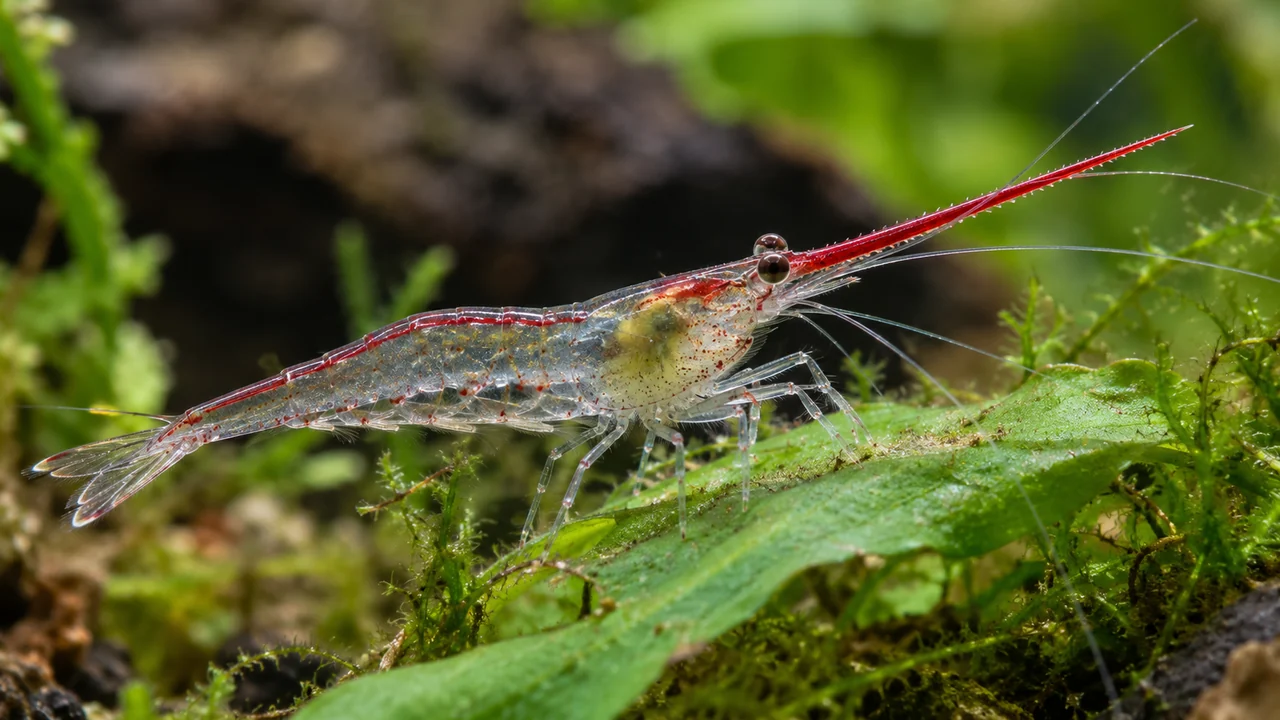
Caridina gracilirostris has an elongated, largely transparent body and an exceptionally long narrow red rostrum. Fine red markings may continue along the body, while the legs and antennae remain delicate. The rostrum is part of the animal’s head, not a separate antenna or a predatory spear.
Red Nose and Pinocchio are trade names, so check the supplier’s scientific identity rather than applying this care sheet to any long-nosed shrimp. Similar species and uncertain labels complicate comparisons. Handle carefully with a suitable container and avoid snagging the projecting rostrum in coarse mesh. Keep the whole animal in mind when checking openings and neighbours.
Estuarine context and space to move
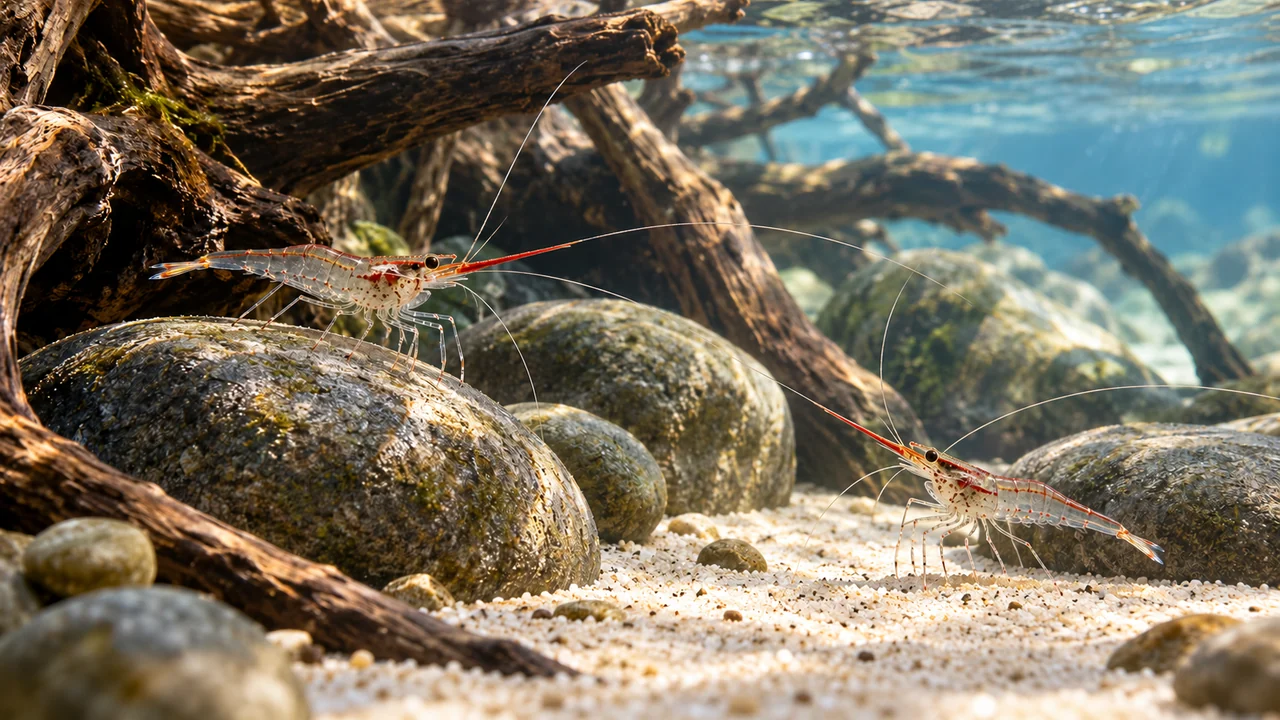
The species is associated with tropical lowland and estuarine waters in the Indo-Pacific region. A specialist account by taxonomist Werner Klotz emphasises brackish habitats and open-water activity rather than a tiny, purely freshwater planted container. Broad historical range accounts should not be used to assign a precise origin to an unidentified retail shrimp.
Plan a dedicated aquarium around 100 litres or larger, with a clear lane and accessible surfaces. This practical recommendation follows that specialist account, not a universal experimentally tested minimum. Use smooth structure, protected equipment and places to withdraw. Filling every gap with wood and leaves removes useful movement space for a slender, active animal.
Adult salinity deserves an honest separate decision
Adults and later juveniles can be acclimatised to freshwater in published rearing work, while Klotz advises a brackish adult setup and questions routine long-term care in small freshwater aquaria. These are not the same claim. The evidence for freshwater acclimatisation does not establish that every adult population will thrive indefinitely in any freshwater community.
For a dedicated adult setup, a stable modestly brackish plan around 10 ppt at about 24–27°C is a defensible specialist-led approach. Match the actual stock’s starting water and change salinity gradually with a measured plan. Do not add salt abruptly to a mixed aquarium, or pretend that one larval experiment proves an exact lifelong adult optimum.
Measure the water you are actually preparing
Use a balanced appropriate aquarium salt mix rather than table salt or a freshwater GH-only powder. Prepare replacement water outside the tank, verify temperature and salinity with suitable calibrated equipment, and maintain a stable roughly neutral-to-alkaline pH around 7–8 in the brackish plan. These are working aquarium aims, not experimentally established survival limits.
At that salinity, a generic bee-shrimp hardness recipe is inappropriate. Mineral balance follows the chosen mix and source water; a freshwater GH/KH table cannot replace salinity measurement. Evaporation leaves salts behind, so replace evaporated water appropriately rather than repeatedly adding fully salted water. Salinity, conductivity and a guessed spoonful per bucket are not interchangeable measurements.
Structure that suits both water and feeding
Provide aged smooth wood and rock without sharp traps, with an open area and visible resting positions. Select any plants for the actual salinity: a plant grown in freshwater is not guaranteed to tolerate the brackish plan. Do not allow failing vegetation to become a hidden waste source.
Use mature biological filtration, guarded intakes and good surface exchange. Keep ammonia and nitrite undetectable and maintain the equipment through acclimatisation. A freshwater filter moved suddenly to different salinity should not be assumed instantly equivalent. The aquarium should be established for its intended water before livestock is expected to adapt to it.
Picking food and swimming are not a complete ration
Offer appropriately sized complete shrimp food alongside mature edible surface growth. The animal may pick at fine material and use different parts of the aquarium, so check consumption rather than assuming a clean-looking transparent body is well fed. Small portions at observable stations make assessment easier.
Avoid treating it as a guaranteed algae-control tool or supplying only vegetable scraps. Remove excess food and inspect the body and gut where visible over repeated observations. Neither a dusting of powder nor a permanently dirty tank demonstrates good nutrition. Feeding the adult shrimp and supplying tiny planktonic larvae require different foods and methods.
For freshwater adult feeding variety, Nettle Shrimp Food and Pure Shrimp Meal Shrimp Food provide different supplementary portions to assess for acceptance. Neither replaces the balanced adult ration or the separate larval-rearing plan.
Moulting, companions and the projecting nose
Maintain stable water and an adequate varied diet through moulting. Leave a freshly moulted shrimp protected rather than moving it for inspection. Review recent salinity or temperature changes, contamination and food before adding supplements for a suspected mineral deficiency.
Choose companions around the actual brackish water, adult size and delicate appendages. Avoid large mouths, persistent nippers and predatory crustaceans. Do not use this shrimp as a reason to move established freshwater animals into a salted aquarium. A dedicated setup gives more control over observation, feeding and any later larval project.
What the 2006 larviculture study actually found
Heerbrandt and Lin tested larval rearing and reported their best treatment at 15 ppt and 27°C with a mixed microalgal food. In that treatment larvae passed through six zoeal stages to postlarvae in about 15 days, with the reported freshwater acclimatisation occurring at 69 days after hatching. Those results belong to the stated experiment, not a guaranteed home timetable.
The important distinction is a planktonic larval phase requiring a controlled nursery rather than miniature shrimp immediately grazing in the adult aquarium. A practical rearing attempt needs appropriate saline water, genuinely suitable tiny food, protection from filtration losses and a planned transition. Do not move larvae to freshwater simply because a postlarval shape appears, or transfer the experiment’s stocking density into an untested home container.
Limited botanicals and useful first checks
Modest prepared wood or leaves can provide surfaces if compatible with the established water plan. They do not replace complete food, create a larval diet or turn a freshwater community into a suitable nursery. Keep decomposition controlled and the open lane usable.
For losses after maintenance, compare measured salinity, temperature and replacement-water preparation. For poor feeding, check food placement, competition and water quality. For damaged rostra, examine handling, gaps and neighbours. Preserve reliable identification and records so that future observations can be compared with the right species rather than another shrimp sharing a common name.
For an optional prepared leaf edge in the freshwater adult arrangement, Dried Jackfruit Leaves (Artocarpus heterophyllus) – Blackwater Leaf Litter offers a broad-leaf choice to place where food and waste remain inspectable.
Further reading and sources
Identity and natural-history sources are distinguished from aquarium husbandry. Recommended care is not a set of experimentally established survival limits; breeding conditions may differ from adult maintenance.
- Heerbrandt & Lin (2006) — Larviculture of Red Front Shrimp — Original experiment; publisher abstract consulted. Larval treatment, postlarval timing and later freshwater acclimatisation are explicitly separated from adult maintenance and guaranteed home outcomes.
- Werner Klotz / Practical Fishkeeping — Rednose Shrimp — Taxonomist-authored specialist account emphasises brackish adult habitat, space and larval development; stronger freshwater-longevity assertions are not presented as controlled experimental limits.