Shrimp · Crystal Red & Crystal Black Bee Shrimp
Crystal Red & Crystal Black Bee Shrimp — Caridina logemanni: Habitat and Care
One species profile for the familiar red-and-white and black-and-white selections. Build a stable soft-water colony around mature grazing surfaces, measured mineral preparation and a feeding routine that supports both adults and tiny juveniles.
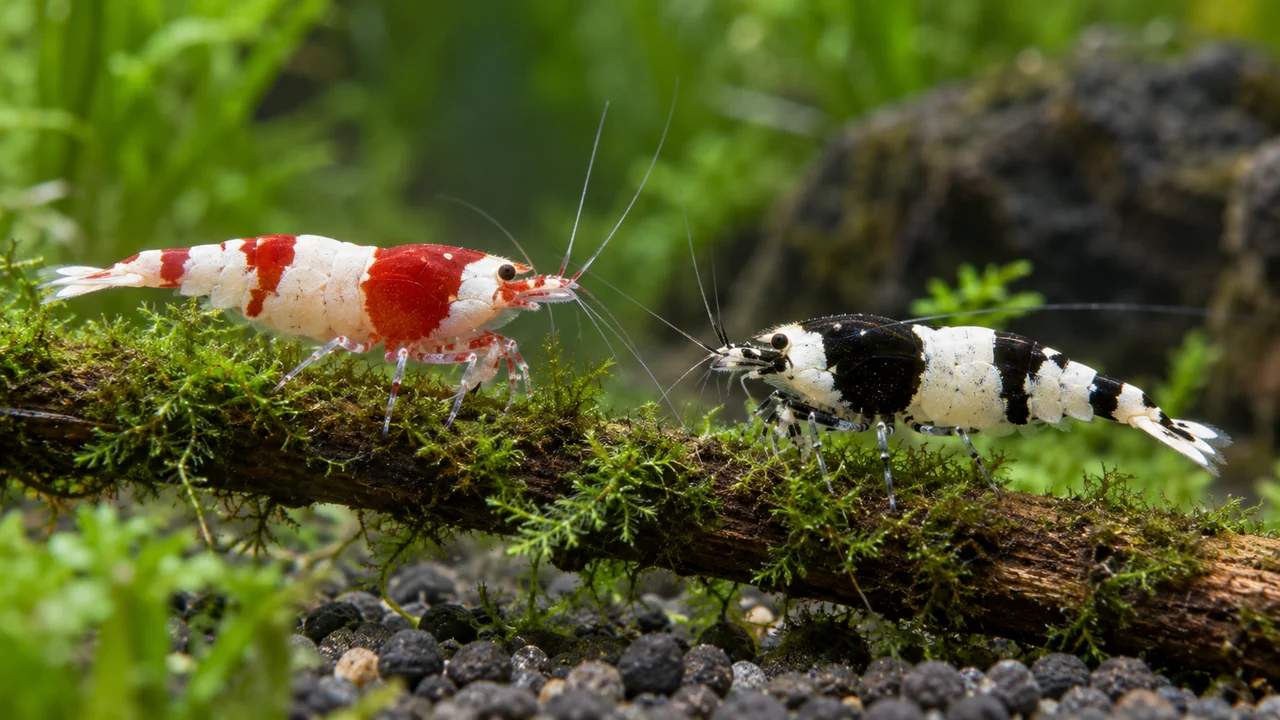
- Identity
- Caridina logemanni, described in 2014; Crystal Red and Crystal Black are selected colour forms, not two species.
- Adult size
- Commonly around 2.5–3 cm, with mature females generally fuller-bodied than males.
- Aquarium
- A mature colony aquarium around 45 × 30 cm or larger offers useful grazing area and stability; this is a practical plan, not a universal biological minimum.
- Working water
- About 20–23°C, pH 6.0–6.5, 4–6°dGH and low carbonate hardness around 0–2°dKH, matched to the established line.
- Substrate
- Active soil can support a low-carbonate system but is not obligatory when an inert setup maintains suitable water reliably.
- Development
- Young complete development in freshwater and emerge as miniature benthic shrimp; no marine larval nursery is required.
One species profile, two familiar selections
Crystal Black and Crystal Red describe selected bee-shrimp appearances: contrasting pale areas with black or red colour. They are not two scientific species, and a high white grade does not establish a separate taxon. Wild C. logemanni is not simply a show-grade Crystal Black collected from a stream.
The 2014 description distinguished C. logemanni from related shrimps previously grouped loosely under cantonensis labels. Older Caridina cf. cantonensis names remain useful search history but should not be presented as proof that the species are identical. A modern commercial pattern can also involve hybrid ancestry; preserve breeder records rather than authenticating every bee-patterned shrimp from colour alone.
The stream origin is not a domestic grade chart
The original species material came from Hong Kong hill streams. These are freshwater habitats, distinct from the warm alkaline ancient lakes associated with Sulawesi Cardinal Shrimp. Field measurements help explain the species’ soft-water association but do not automatically prescribe the exact conditions of a captive line selected over many generations.
Ask how the actual colony has been maintained, then plan a stable compatible system. A colour grade is not a water-chemistry instruction. Do not buy a mixed shipment and assume every red-and-white shrimp has identical ancestry, acclimatisation needs or breeding records. The scientific identity and the stock history should remain linked but separate pieces of information.
A measured soft-water working plan
Around 20–23°C, pH 6.0–6.5, 4–6°dGH and low carbonate hardness near 0–2°dKH is a practical plan for an established soft-water Crystal colony. This is a selected maintenance framework, not the complete tolerance range of every wild or domestic population. Confirm the incoming line’s conditions and avoid abrupt changes to achieve these figures.
Suitable purified water with a balanced shrimp mineral preparation can simplify repeatability where tap water is hard or variable. General hardness, carbonate hardness and conductivity describe different things: a conductivity reading alone cannot establish the calcium-to-magnesium balance or buffering. Prepare replacement water outside the aquarium, measure it and make predictable changes rather than dosing powders onto the animals.
Active soil is a tool, not an entrance requirement
An active substrate can help maintain a lower pH and consume carbonate buffering. Its behaviour depends on the particular product, source water and age. Some fresh soils release nitrogen compounds during establishment, so a dark substrate and clear water do not demonstrate that a tank is ready for shrimp.
An inert substrate can also work when suitable water is prepared and remains stable. Do not add carbonate-rich rock to a deliberately low-carbonate system without understanding the effect, or repeatedly force high-KH tap water through an exhausted soil. Check the actual trend. Replacing a mature substrate is a significant disturbance that should be planned, not a routine reaction to one disappointing brood.
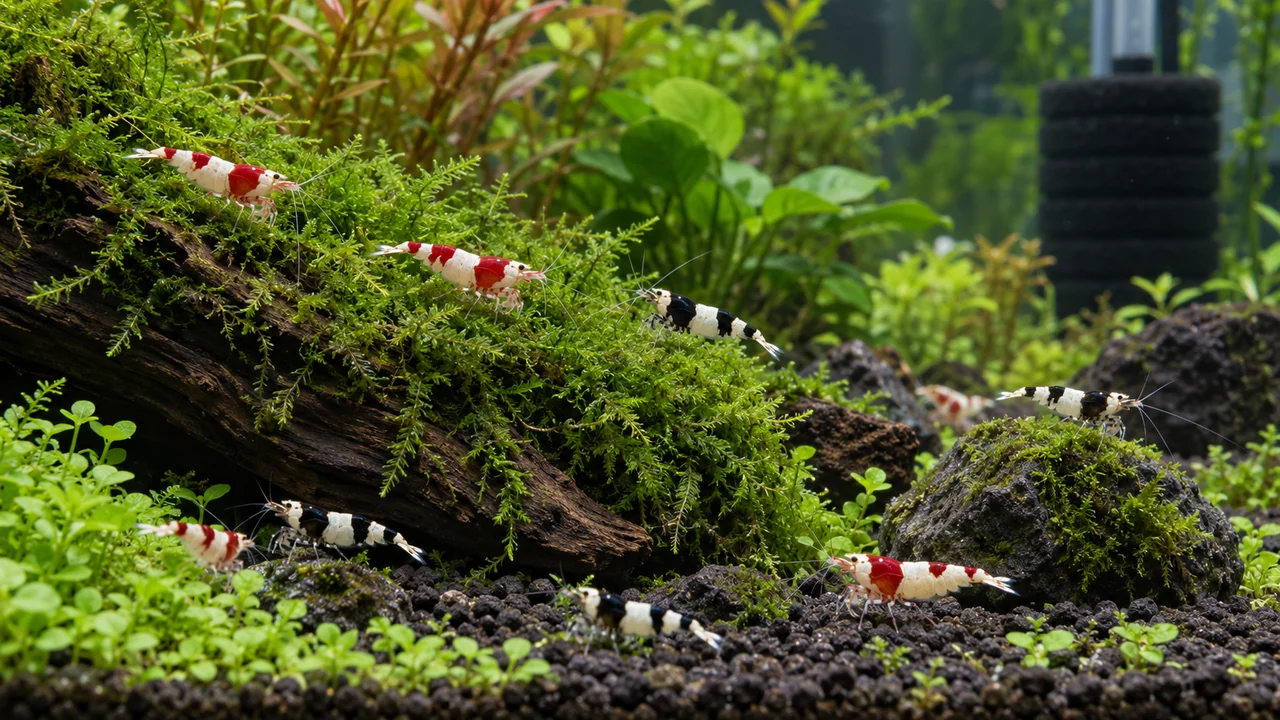
A mature colony with visible feeding surfaces
A colony aquarium around 45 × 30 cm or larger provides a practical starting floor with room for moss, safe wood, small leaves and an open feeding area. Greater water volume usually makes routine maintenance easier, but maturity and stable water still matter. Arrange the tank so shrimp can graze without every surface being shaded or inaccessible.
Use protected filtration, such as an appropriate sponge intake, and gentle circulation with effective gas exchange. Tiny young must not be drawn into equipment. Keep ammonia and nitrite undetectable. Avoid cleaning every surface at once: the biological filter and the grazing layer are useful parts of the system, while excess uneaten food and trapped waste still need removal.
Biofilm, complete food and controlled portions
Adults pick over surfaces for microorganisms and edible material. Supplement that resource with an appropriate complete dwarf-shrimp food and modest variety, including a suitable protein component. Neither an old leaf nor a permanent supply of vegetable scraps guarantees a balanced diet for a growing colony.
Feed small portions where consumption can be observed and adjust to the population and remaining food. Tiny juveniles need accessible fine grazing surfaces; carefully used fine food can help when the established resource is insufficient. A powder cloud is not evidence that they have eaten. Keep food out of inaccessible crevices and remove leftovers before feeding again.
Snowflake Shrimp Food and Bee Pollen Gold™ Shrimp Lollies offer different supplementary feeding formats: a small grazing portion or an observable stick. Choose one at a time around the colony size, retaining the complete feeding and mineral plan.
Moulting and a stable mineral balance
A successful moult depends on more than a bag of mineral food. Assess water preparation, measured hardness, nutrition and changes over time. Leave newly moulted shrimp undisturbed, with fine planting or other cover that does not trap them. A cast shell is not automatically a dead animal.
If losses follow maintenance, compare replacement water and temperature with the aquarium rather than blaming an isolated pH reading. Do not add iodine, calcium or medication without an identified need and appropriate shrimp compatibility. Evaporation removes water but leaves most dissolved minerals behind; routine top-ups and water changes therefore serve different purposes.
Freshwater breeding and honest line records
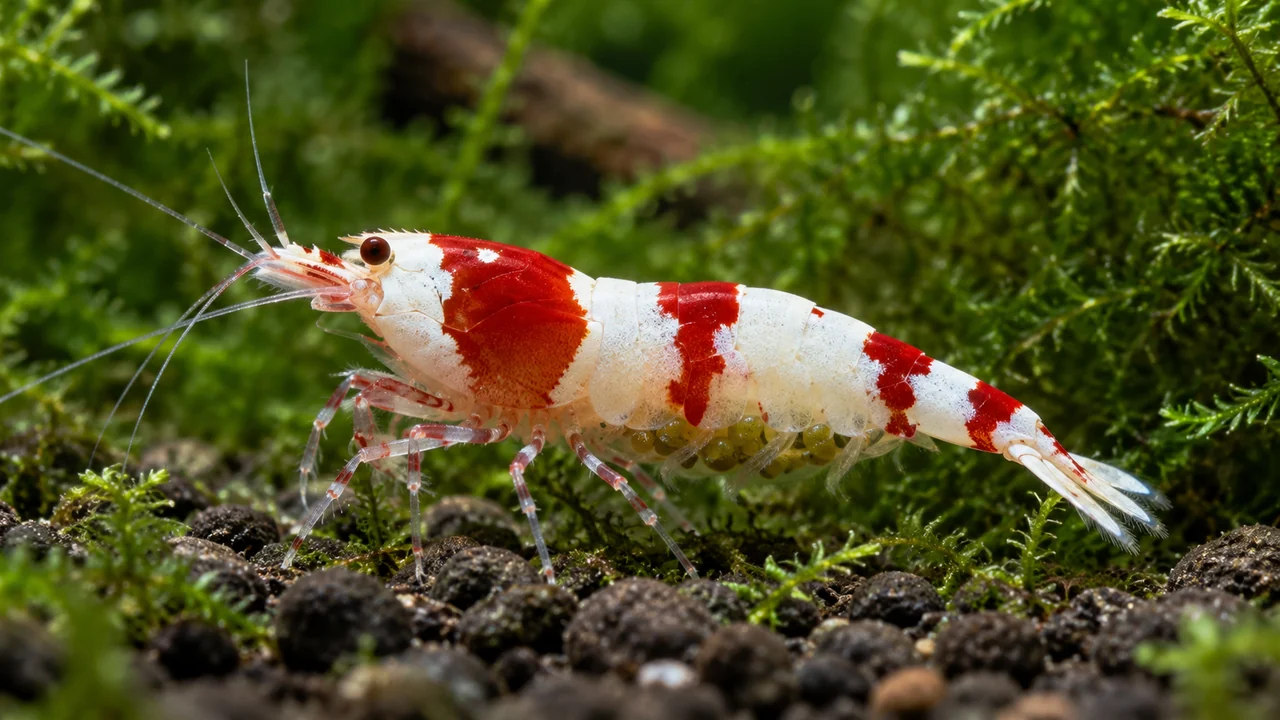
Females carry eggs under the abdomen and release small shrimp able to live on the aquarium floor and surfaces. No saline larval stage is required. Success depends on a mature nursery resource, protected filtration, adequate food and stability; a berried female alone is not proof that every young shrimp will survive.
Keep Crystal Red and Crystal Black breeding records if colour selection matters. Mixing related bee and tiger lines can produce hybrids and obscure their identities. Do not predict a fixed ratio of colours or grade from two attractive parents without reliable line information. Remove neither a guarding female nor every cast and leaf simply to keep the nursery visually pristine.
Companions and proportionate botanical use
A shrimp-focused aquarium is the most controllable arrangement for keeping and observing young. Many fish that ignore adults still eat juveniles. Avoid predatory crustaceans and do not promise universal safety from a nano-fish label. Suitable non-predatory snails may share the tank when their mineral needs also fit.
Prepared leaves and wood provide cover and additional surfaces, not a guaranteed treatment or breeding stimulant. Introduce modest amounts and inspect decay. For declining numbers, check water quality, food access, intake guards and predators before purchasing another supplement. Clear observations usually reveal more than continually changing substrate, minerals and food together.
For a limited botanical area, compare whole Dried Bodhi Leaves (Ficus religiosa) – Aquarium Leaf Litter with small portions of Broken / Crushed Mulberry Leaf Pieces. The crushed format is useful where feeding and removal are easiest to observe on a separate patch.
Another option for a separately managed grazing patch is Premium Lubao Bags. Introduce it independently of new leaf additions, following the product directions and checking the aquarium response.
Further reading and sources
Identity and natural-history sources are distinguished from aquarium husbandry. Recommended care is not a set of experimentally established survival limits; breeding conditions may differ from adult maintenance.
- Klotz & von Rintelen (2014) — To “bee” or not to be — Original description of Caridina logemanni and C. mariae, based on morphology and genetic comparisons; domestic selection and hybrid ancestry are separate questions.
- Garnelenhaus — Bienengarnele — Specialist husbandry and colour-form context; broad reported limits are distinguished from the narrower working plan here.
- Garnele-Online — Caridina logemanni — First-hand breeder account with measured soft-water maintenance; one keeper’s results do not establish universal limits.
- Wirbellose.de — Caridina logemanni — Species-specific keeper records consulted as qualified practical experience, not guaranteed breeding triggers.