Shrimp · Tiger Shrimp
Tiger Shrimp — Caridina mariae: Habitat and Care
The natural tiger pattern is a translucent body crossed by narrow dark bars. Keep species identity separate from blue, orange-eyed and hybrid trade names, and build a stable freshwater colony with mature surfaces and complete supplementary food.
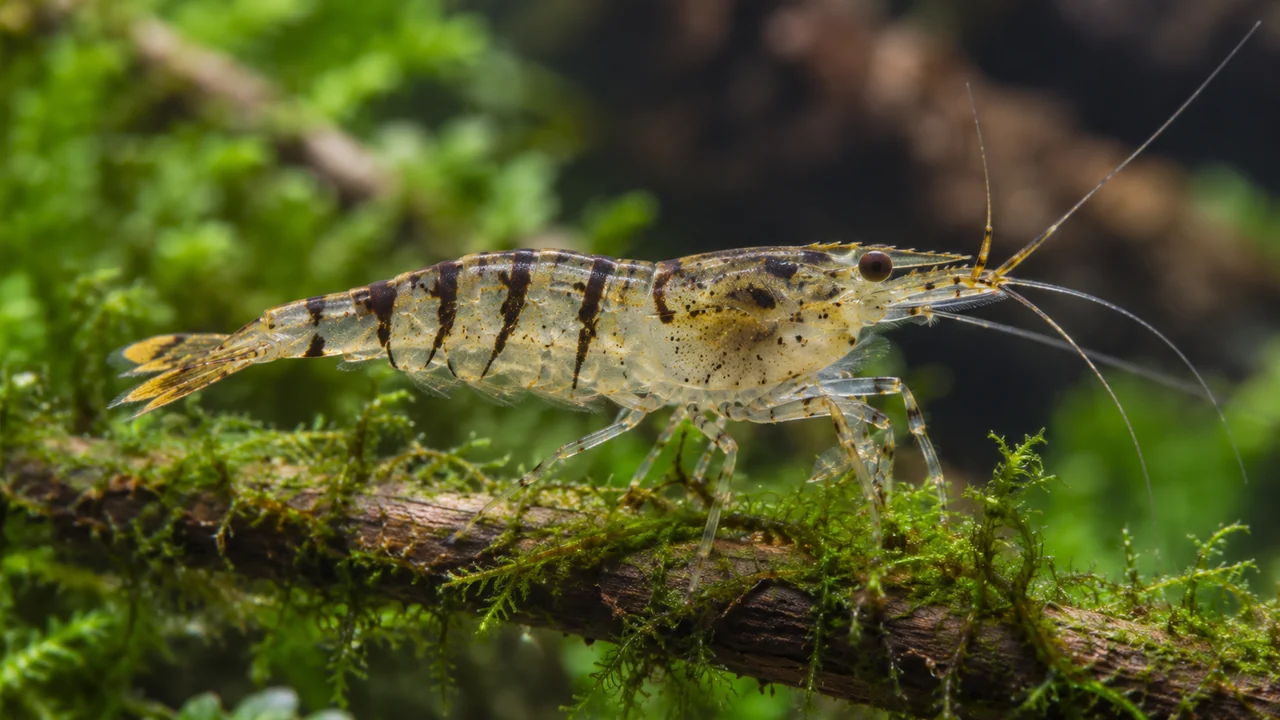
- Identity
- Caridina mariae, described in 2014; not every shrimp with Tiger in its trade name is this species.
- Adult scale
- Usually about 2.5–3 cm; some female size accounts are larger.
- Space
- A mature aquarium around 45 × 30 cm or larger for a small colony, with extensive fine grazing surfaces and protected filtration.
- Maintenance plan
- About 20–24°C, pH 6.2–7.2, 5–10°dGH and 1–4°dKH; match the actual stock rather than forcing a colour form to one recipe.
- Food
- Mature biofilm plus an appropriate complete varied shrimp ration; offer protein as part of the balance, not unrestricted meaty feeding.
- Reproduction
- Direct freshwater development; related bee/tiger crosses can obscure line identity and should be kept separate when provenance matters.
Look at the transparent body and the bars
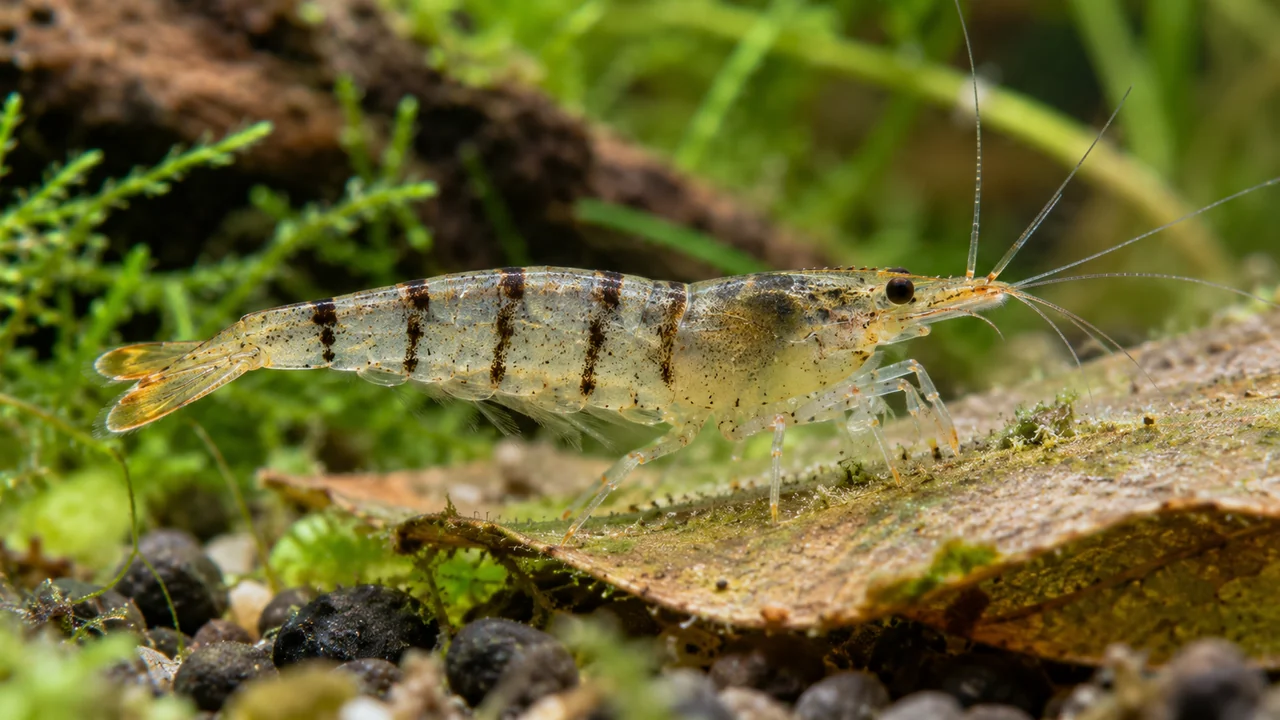
The natural-looking Tiger Shrimp has a translucent pale body with narrow dark markings across the rear carapace and abdomen. The head and tail may carry warm yellow or orange tones. This is a different presentation from the broad opaque colour blocks of selected Crystal Bee Shrimp.
The accepted identity is Caridina mariae. Older cf. cantonensis Tiger labels belong to trade history rather than proof of synonymy. Some blue and orange-eyed selections have been associated with tiger stock, but a trade name alone cannot certify a pure wild-species lineage. Do not confuse Tangerine Tiger or every hybrid Tibee with reliably identified C. mariae.
Southern Chinese streams, not one aquarium colour
The original description concerns material from southern China and Hong Kong, including Guangdong stream systems. Clear freshwater, stream surfaces and seasonal variation provide the relevant ecological context. A single natural-water measurement is not an instruction to recreate the lowest conductivity ever reported in a small home aquarium.
Wild biology and domestic selection must remain separate. A blue colour, altered eye colour or broadened stripe does not demonstrate a new species or a proven collection site. Preserve supplier and breeding information, and obtain stock from a known maintained colony where possible. Unknown ancestry should remain unknown rather than being filled in from a photograph.
A different working plan from a Crystal colony
Around 20–24°C, pH 6.2–7.2, 5–10°dGH and 1–4°dKH is a useful maintenance plan within published tiger-shrimp guidance. Some established lines are maintained softer or harder; that does not justify sudden adjustment of newly acquired shrimp. Check the actual colony’s conditions before choosing source water and substrate.
Prepare replacement water consistently and distinguish mineral content from carbonate buffering. A TDS meter can show a trend but cannot replace hardness measurements or identify the dissolved substances. Avoid continually correcting small pH movements with chemicals. Stable, suitable water and predictable feeding are more valuable than matching the display colour to a supposedly compulsory parameter sheet.
Choose the substrate around the water plan
An inert substrate can suit a stable tiger colony. Active soil is an option when its buffering behaviour fits the intended low-carbonate system, but it is not an obligation attached to the word Caridina. New substrate must be established before shrimp are introduced, with nitrogen waste assessed rather than guessed from appearance.
Use a practical colony floor around 45 × 30 cm or larger, with moss, safe aged wood and fine planting. Leave an open feeding patch and access for maintenance. Avoid combining a strongly acidifying soil and carbonate-rich decoration without understanding the resulting changes. The system should be coherent rather than a collection of products sold for different shrimp types.
Surface feeding needs a complete nutritional plan
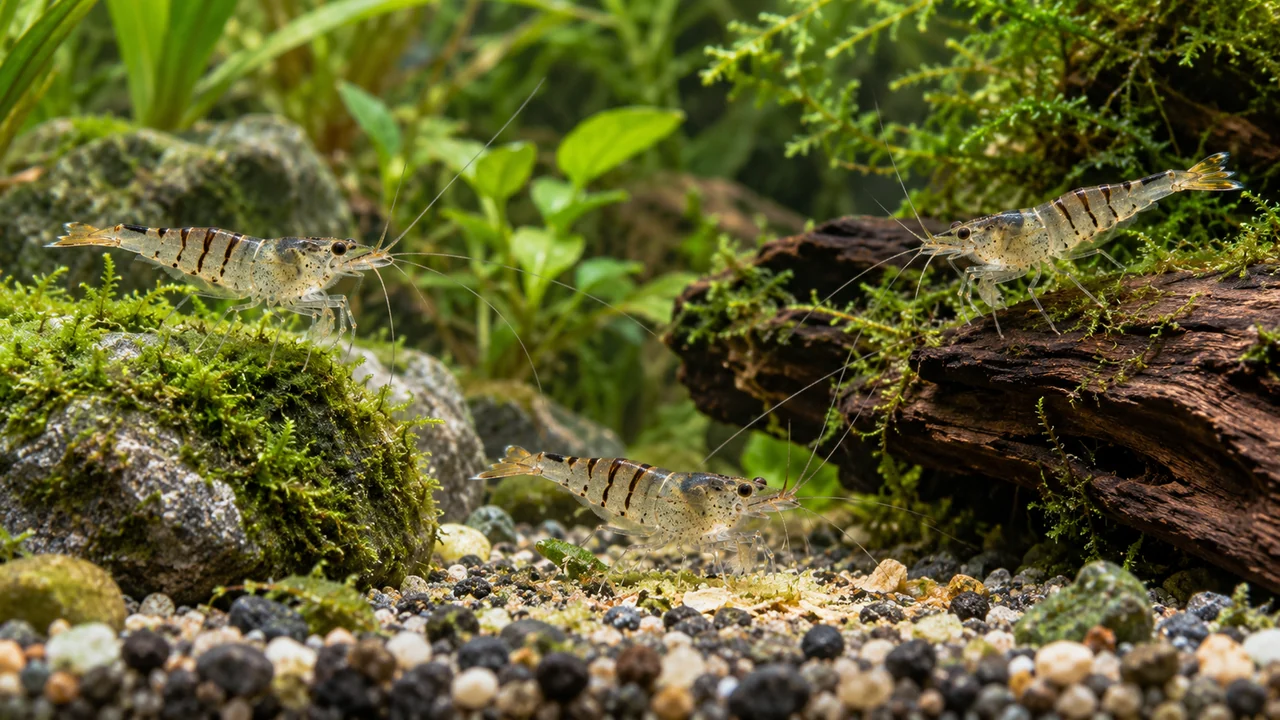
Tiger Shrimp repeatedly pick small edible material from moss, leaves and other surfaces. Mature biofilm is especially useful to the young, but the apparent presence of green growth does not prove that every nutrient is supplied. Supplement with a balanced shrimp food and appropriate modest variety.
Provide a suitable protein component without leaving large rich portions to rot. Observe consumption and adjust to colony size. Vegetables and leaves can contribute, but neither should become the entire ration. If food is untouched, investigate water, stress and freshness before adding a second portion. Fine foods for juveniles should reach their surfaces without turning the aquarium into an unmeasured powder suspension.
For supplementary variety, compare a small portion of Blue Spirulina Shrimp Food with a very small amount of Premium Natural Bee Pollen. Observe collection and leftovers while retaining the complete shrimp ration.
Protected filtration and steady moulting conditions
Use mature biological filtration, protected intakes and gentle movement with reliable gas exchange. Keep ammonia and nitrite undetectable. Clean accumulated waste in accessible areas without stripping every grazing surface or replacing the entire filter medium at once.
Mineral balance and nutrition support moulting, while sudden temperature or concentration changes can disturb the colony. Review measured values and recent maintenance if repeated problems appear. Do not conclude from an isolated cast or pale individual that a specific additive is missing. Top up evaporation with suitable water without repeatedly concentrating minerals, and maintain a separate matched water-change routine.
A colony is not a predation-proof community
A group gives useful opportunities for observation and breeding, provided food and floor area support it. A shrimp-focused arrangement is easier to manage than a busy community. Small fish can eat young even when adult shrimp remain visible, and a peaceful species label is not a guarantee for every life stage.
Avoid crayfish and other obvious predators. Consider mineral requirements before choosing snail companions. If the colony stops recruiting, inspect intake guards, food surfaces and possible predators rather than assuming the adults are infertile. Moving shrimp continually between incompatible community tanks is unlikely to clarify the problem.
Freshwater young and the hybrid question
Females carry eggs and release miniature shrimp that continue development in fresh water. They do not need the brackish larval system required by species such as Pinocchio Shrimp. Nursery surfaces and fine accessible food matter immediately; a female carrying eggs does not remove those requirements.
Related bee and tiger shrimps can cross, so keep lines separate when maintaining identity or selection records. A hybrid may be attractive without being evidence for a wild species’ colour. Record the actual parents and descendants, and avoid fixed inheritance promises based only on an orange eye or a blue body. A breeding label is useful only when the records travel with the shrimp.
Leaves as habitat, not a chemistry shortcut
A modest amount of prepared leaf litter provides sheltered edges and additional surfaces. Keep it proportionate to the system and preserve maintenance access. Do not add large quantities to force a pH change, cure a disease or compensate for an immature filter.
For unexplained losses, check water quality, recent changes, contamination and food together with the timing. For poor juvenile survival, inspect grazing resources and filtration. Preserve the settled system while correcting the demonstrated issue rather than switching simultaneously to a new soil, mineral mix and food programme.
The optional leaf patch can use Dried Longan Leaves – Natural Aquarium Leaf Litter or Dried Arjuna Leaves (Kumbuk) – Natural Aquarium Leaf Litter, selected for the space available rather than as a reason to alter the chosen water chemistry.
Further reading and sources
Identity and natural-history sources are distinguished from aquarium husbandry. Recommended care is not a set of experimentally established survival limits; breeding conditions may differ from adult maintenance.
- Klotz & von Rintelen (2014) — To “bee” or not to be — Original description of Caridina logemanni and C. mariae, based on morphology and genetic comparisons; domestic selection and hybrid ancestry are separate questions.
- Garnelenhaus — Tigergarnele — Specialist identity, selection and husbandry account; experimental, field and normal aquarium conditions remain distinct.
- Shrimpfarm Frankfurt — Caridina mariae Tiger — Breeder-maintenance context; trade lines are not authenticated here by colour or a shop label.