Shrimp · Sulawesi Cardinal Shrimp
Sulawesi Cardinal Shrimp — Caridina dennerli: Habitat and Care
A tiny red, white-spotted rock grazer from Lake Matano needs warm, stable, mineral-balanced alkaline water. Its care differs fundamentally from a soft acidic bee-shrimp aquarium, and current field reports matter when discussing conservation.
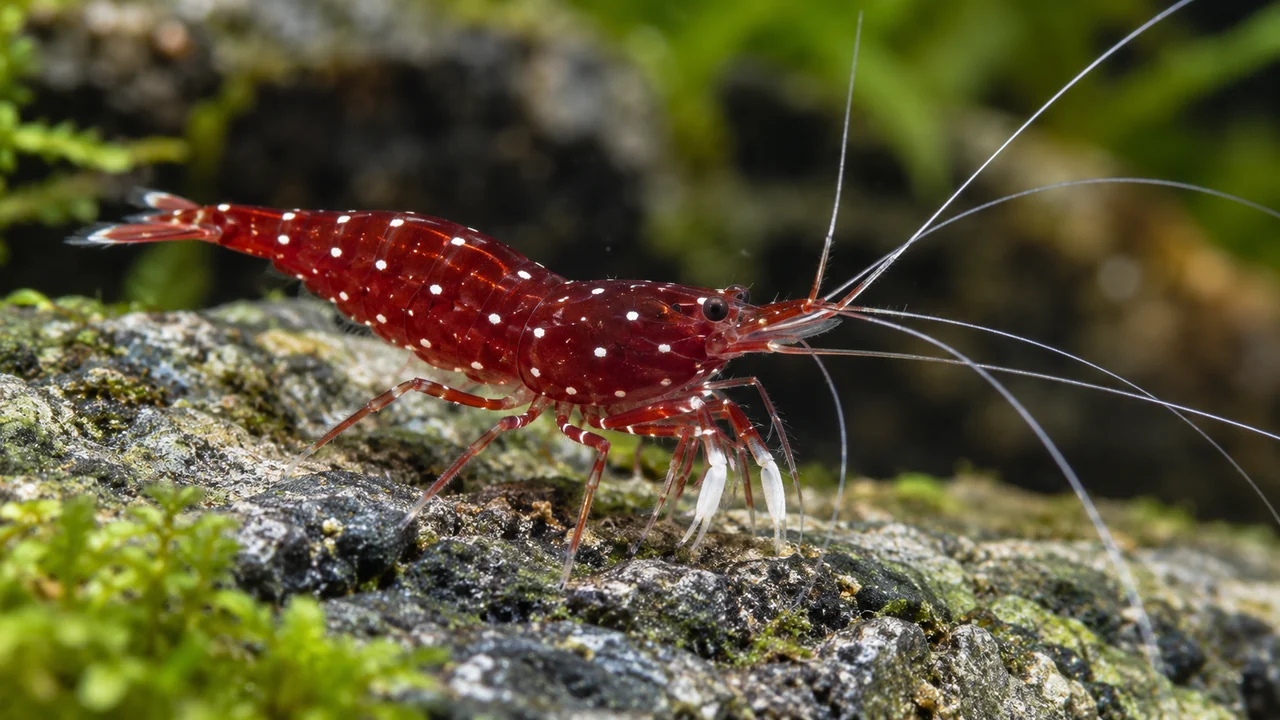
- Identity
- Caridina dennerli, endemic to Lake Matano; not the marine cardinal cleaner shrimp or every Sulawesi shrimp.
- Adult size
- Approximately 2–2.5 cm overall, with females generally fuller beneath the abdomen.
- Aquarium
- A mature species-focused aquarium around 60 × 30 cm or larger, with plentiful accessible rock surfaces and protected filtration.
- Working conditions
- About 27–29°C, pH 7.8–8.5, approximately 4–8°dGH and 3–5°dKH, using a consistent suitable mineral preparation.
- Habitat and food
- Clear water, mature rocky grazing surfaces and carefully measured supplementary food; no compulsory deep leaf bed or acidic active soil.
- Reproduction
- Direct freshwater development with miniature juveniles; no brackish larval stage.
- Conservation
- IUCN’s 2018 assessment is Critically Endangered, Possibly Extinct in the Wild; Sulawesi Keepers reported surviving wild shrimp in 2024.
Small white dots and conspicuous feeding feet
The deep red to burgundy body of Caridina dennerli carries small white spots rather than the broad red-and-white blocks of a Crystal Bee Shrimp. White antennae and bright white parts of the front feeding legs are characteristic. These small picking appendages must not be confused with the large filtering fans of Bamboo or Vampire Shrimp.
The name Cardinal Shrimp is also used for unrelated marine animals. This profile concerns the small freshwater Lake Matano species described in 2009. Identify the complete animal and retain stock records; Sulawesi describes a region with many different shrimps, not a single interchangeable care type. A bright red colour alone cannot authenticate the species.
Lake Matano is a rocky, clear-water setting
The original description records C. dennerli among rocks and boulders in Lake Matano, from shallow water to deeper rocky areas. It belongs to a distinctive ancient-lake fauna rather than an acidic forest-stream assemblage. Published lake measurements vary with site and sampling context, so one number should not be presented as the chemistry of every occupied crevice.
In an aquarium, preserve the relevant functions: warm clear water, stable mineral balance and extensive mature grazing surfaces. A dark leaf-litter floor is not a necessary sign of a natural setup for this species. It can instead conceal food and waste, while acidifying soil may work against the chosen alkaline system.
Prepare a coherent warm mineral system
About 27–29°C, pH 7.8–8.5, 4–8°dGH and 3–5°dKH is a practical maintenance framework drawn from published specialist keeping and natural-water context. It is not a survival envelope or a demand to change established stock abruptly. Successful keeper accounts also differ, making consistency and the incoming colony’s conditions important.
A suitable Sulawesi mineral preparation with purified source water can make replacement water repeatable. Follow its actual preparation instructions, dissolve it appropriately and measure the result before use. Do not interchange bee-shrimp GH-only salts, table salt and an alkaline Sulawesi formulation. Conductivity is a useful trend, but it cannot identify all the minerals present or substitute for every relevant test.
A mature rock garden with visible routes
A species-focused aquarium around 60 × 30 cm or larger gives useful room for an initial colony and stable equipment. Build secure rock surfaces with accessible shaded crevices, then allow productive films to establish. Maturity is demonstrated by a stable system and suitable surfaces, not a fixed number of days on a calendar.
Keep substrate shallow enough to maintain and leave routes to inspect the colony. Cover intakes against juveniles and provide circulation with reliable surface exchange. Warm water makes gas exchange especially significant. Avoid assuming that a densely stocked aquarium or a powerful filter guarantees either adequate food or oxygen at the occupied rock faces.
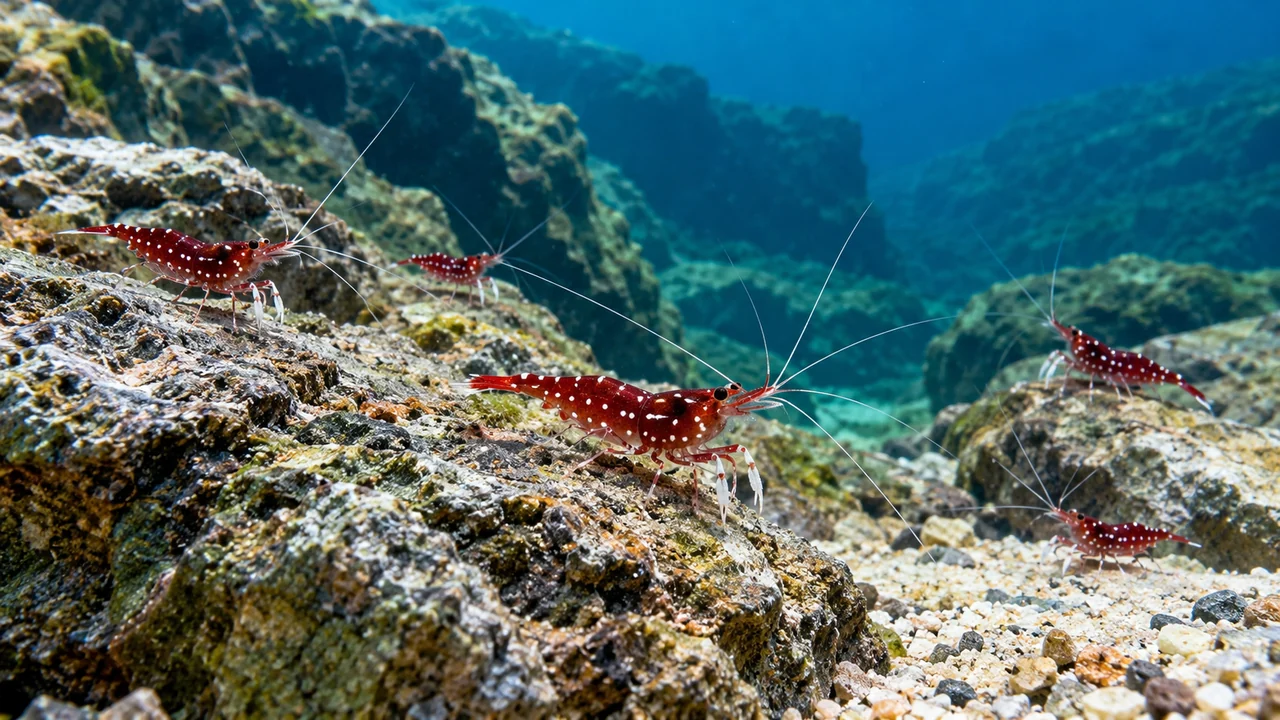
Watch the white feet at work
The shrimp pick small edible material from the surface film. Mature rock is therefore an important resource, but it should be assessed alongside body condition, colony size and recruitment. A green coating is not automatically nutritionally complete, and a cleaned display with shiny new rocks is not ready merely because the heater reads correctly.
Offer appropriate complete fine shrimp food in small measured portions where the colony can use it. Pre-wetting suitable powder can help it reach surfaces rather than floating away. Increase the dose only when observation supports it. Excess feed can accumulate between rocks and harm water quality; the answer to a hidden colony is not an indiscriminate blanket of food.
If the colony accepts a separate grazing supplement, a small accessible fragment of Premium Natural Spirulina Tablets can be assessed alongside its complete fine food. Keep the warm mineralised water plan unchanged and confirm that the animals actually collect the portion.
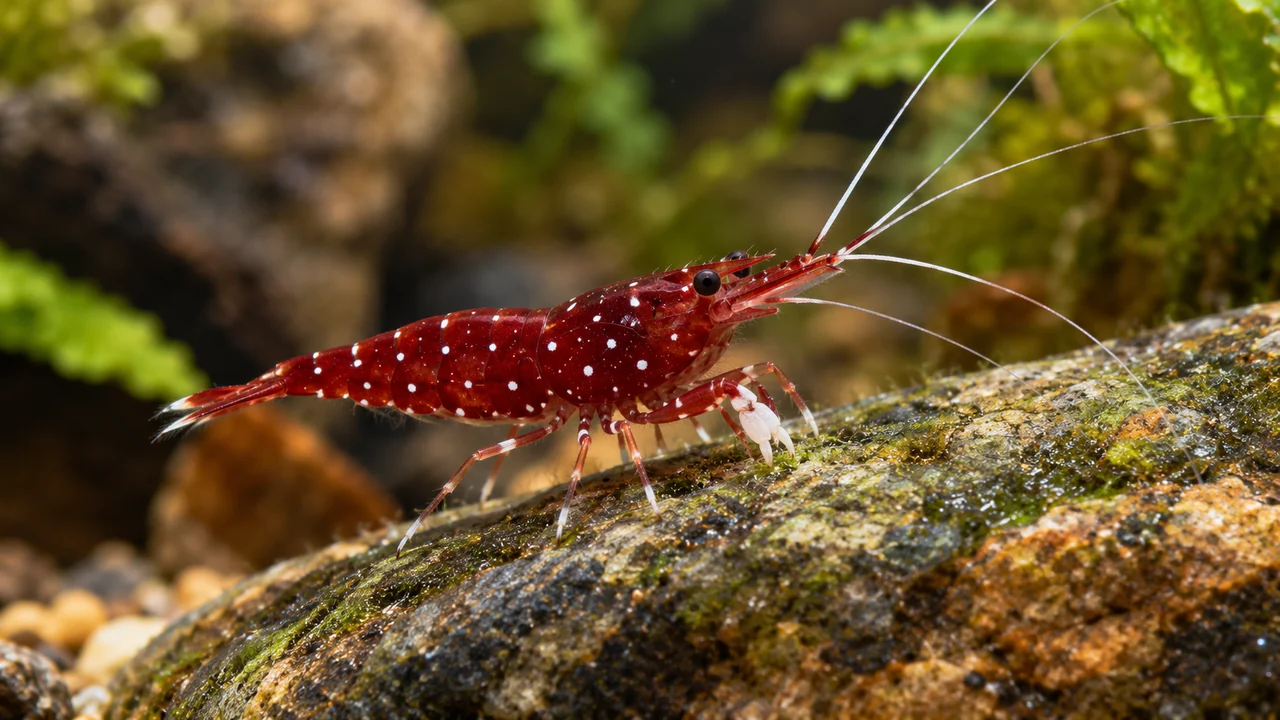
Moulting and maintenance without sudden changes
Maintain a consistent mineral routine and varied adequate food, with undetectable ammonia and nitrite. Make predictable temperature-matched changes and inspect the actual trend in conductivity and hardness. Evaporation concentrates dissolved minerals, so appropriate top-ups serve a different role from replacing old aquarium water.
For moulting losses, check recent changes, the mineral preparation, food and contamination rather than immediately adding a supplement. Keep protected retreats and avoid picking up occupied rocks repeatedly. The old shell may remain after a normal moult. A sudden loss of several shrimp warrants prompt equipment and water checks, not a reflex change to acidic water because they belong to Caridina.
A small colony and direct freshwater young
Females carry relatively large eggs for the animal’s size, and young continue as small benthic shrimp in freshwater. There is no need for a brackish larval tank. Fine established grazing surfaces and protected filtration are particularly important to the new juveniles.
Do not promise a fixed brood size or timetable from one female. A stable shrimp-focused setup is easier to observe than a community with fish waiting around every crevice. Other Sulawesi animals should not be added simply because they share an island name; assess food, water and predation independently. Increasing colony size also increases the need for accessible surfaces and controlled feeding.
Conservation: distinguish the assessment from later sightings
The IUCN assessment published in 2018 lists the species as Critically Endangered, Possibly Extinct in the Wild. That dated assessment must not be rewritten as proof that no wild individuals exist now. Sulawesi Keepers’ 2024 annual report describes surviving shrimp and a small locality where they remained visible on rocky shores.
Those observations do not mean the conservation problem is solved. The report describes serious pressure from invasive fish and deteriorating habitat. Choose traceable captive-bred stock and keep responsible records. An aquarium colony is not automatically an authorised conservation programme, and release into the lake should not be proposed casually as a solution.
Botanicals are optional, not the foundation
A small prepared leaf or modest aged wood can add a surface if it fits the established system. The core habitat here remains clear, warm, alkaline water and rock. Do not build a deep decomposing layer, heavily stain the water or force acidity in the name of a general botanical recipe.
For reduced grazing or breeding, review the surface resource, food, temperature and maintenance trend. If shrimp remain hidden, assess disturbance and predators before dismantling the rockwork. Protect what is already stable while correcting the demonstrated problem. This species deserves its own plan rather than a warmer version of the Crystal Bee aquarium.
Further reading and sources
Identity and natural-history sources are distinguished from aquarium husbandry. Recommended care is not a set of experimentally established survival limits; breeding conditions may differ from adult maintenance.
- von Rintelen & Cai (2009) — Sulawesi Caridina revision — Original description, diagnostic white feet/spots and Lake Matano rocky habitat; field measurements are not universal aquarium limits.
- IUCN (2018) — Caridina dennerli assessment — Dated Critically Endangered / Possibly Extinct in the Wild assessment, explicitly distinguished from subsequent observations.
- Sulawesi Keepers — Annual Report 2024 — First-hand field report, page 13, documents surviving C. dennerli in 2024 and continued severe habitat/predator pressure.
- Peter Baert / Sulawesi Keepers — keeping and breeding experience — Named first-hand aquarium account, with measured water conditions and its own limitations; not a requirement to copy experimental feeding or every piece of equipment.