Snails · Assassin Snail
Assassin Snail — Anentome helena: Habitat and Care
A handsome predatory snail needs a deliberate feeding and compatibility plan. Use Anentome, retain Clea as a historical alias, and recognise that commercial assassin snails are not all securely identified as the Java species.
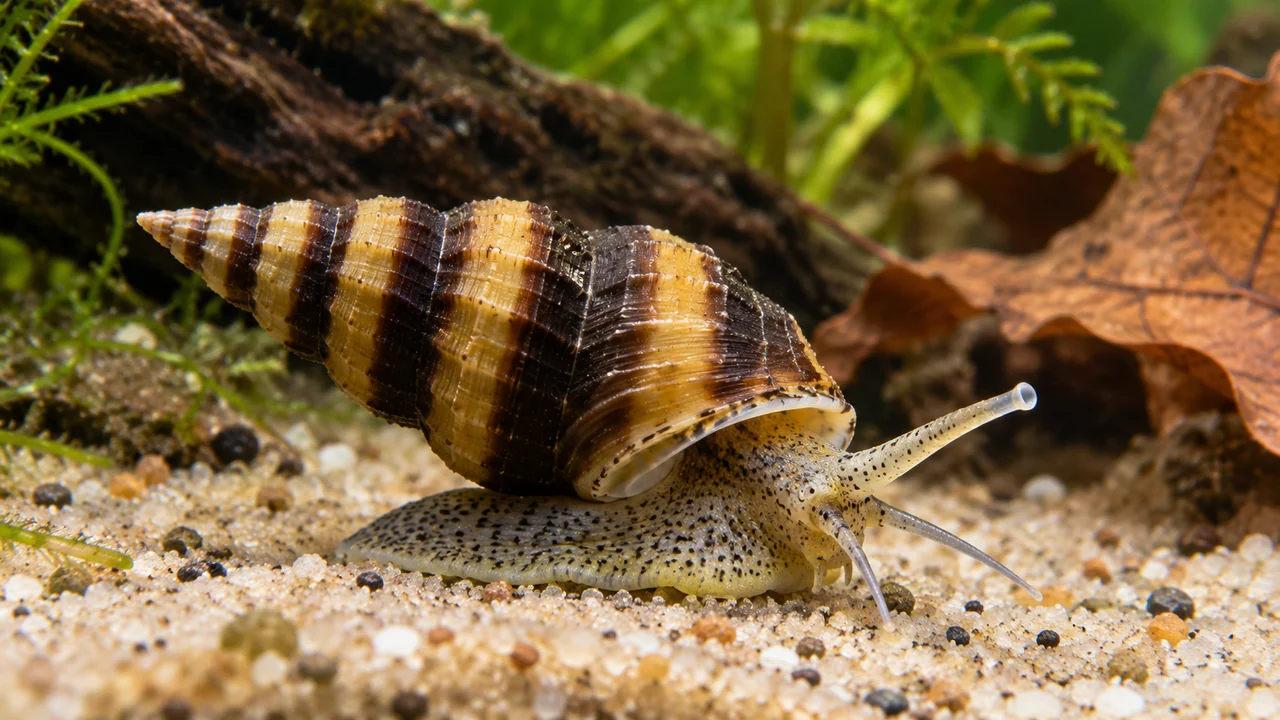
- Identity
- Anentome helena; historical Clea helena. Trade animals may represent other members of an unresolved species complex.
- Adult scale
- Usually about 2–3 cm shell length in trade; published captive stock averaged about 24 mm.
- Space
- A mature 40–60 cm aquarium around 30–50 litres is a practical dedicated setup, with accessible sand and feeding stations.
- Maintenance plan
- 22–26°C; pH 7.0–8.0; a moderate GH 6–15°dGH / KH 3–8°dKH working plan, not experimentally defined species limits.
- Diet
- Predator and scavenger: appropriate complete animal-based sinking food; ornamental snails are at risk.
- Breeding
- Separate sexes; attached capsules produce crawling freshwater juveniles, not a saline planktonic stage.
A familiar name with a real identification problem
Anentome is the accepted genus used here; Clea helena remains useful when searching older publications and aquarium records. The familiar trade animal has a ribbed, conical shell with yellow and dark brown bands, a speckled foot, narrow tentacles and an extended siphon. A banded shell is not proof that an animal is the true species originally described from Java.
Strong and colleagues' 2017 anatomical and molecular study found several distinct lineages within material called helena. Their sampled trade animal did not establish an identity with the Java species. Accordingly, the care below concerns the commonly kept assassin-snail trade form under this name; geographical claims and captive studies should not be mistaken for verified information about every lineage.
Freshwater assassin snails assigned to this complex occur in South-East Asian rivers, lakes, ponds and canals. Published Cambodian records include the Tonle Sap system, while the original helena name is tied to Java. These regional records must be read with their identification limits: they do not prove one widespread, uniform species with a single habitat recipe.
Provide sand and an observable feeding area
A dedicated aquarium is often the simplest way to enjoy this animal without sacrificing ornamental snails. Plan roughly 40–60 cm of frontage and around 30–50 litres for a modest starting group, allowing for filtration and maintenance rather than treating this as a proven minimum. Larger communities need their own compatibility assessment.
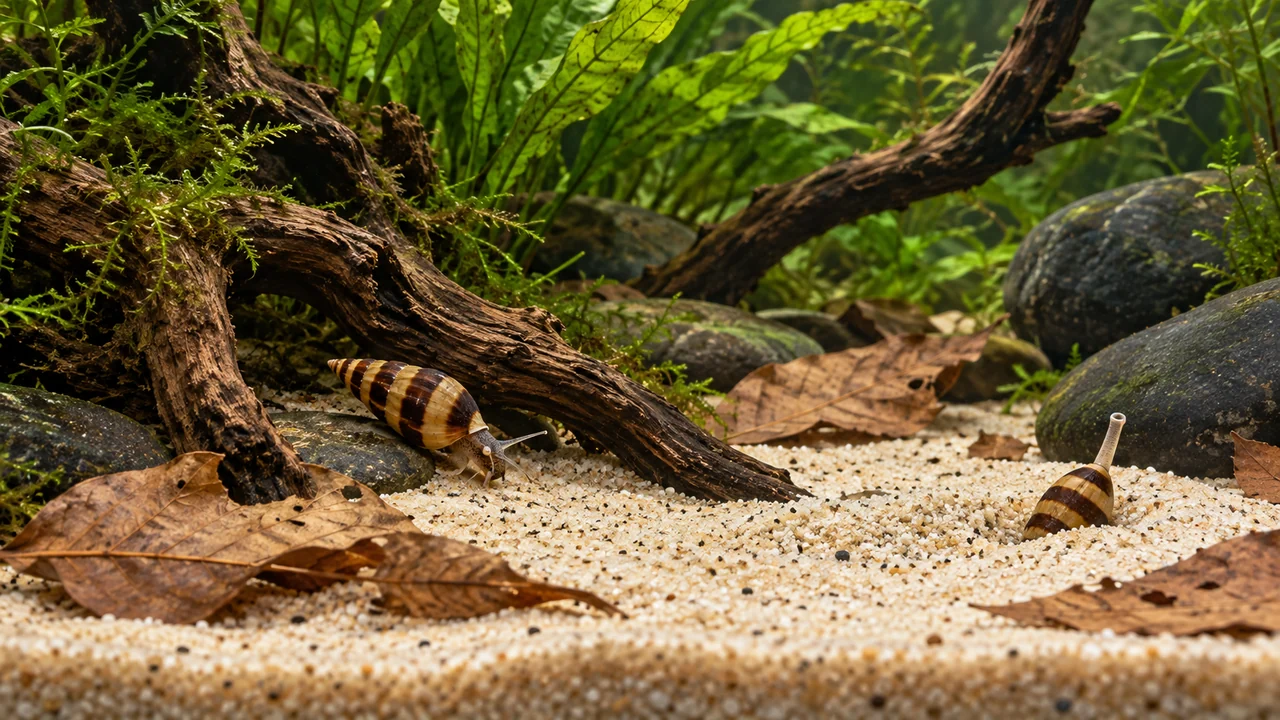
Use fine sand or smooth fine gravel with accessible open patches. These snails may bury themselves while searching or waiting for food. Secure wood and stones so burrowing cannot dislodge them; leave passages broad enough for the full adult shell. Plant around the edges and retain a visible feeding position so leftovers and new juveniles can be checked.
A practical maintenance plan, not a predation experiment
Keep adult trade animals around 22–26°C in stable freshwater, with pH around 7.0–8.0. GH 6–15°dGH and KH 3–8°dKH are a moderate-mineral working plan for shell support and buffering, not measured tolerance limits from the taxonomic study. Match established source water carefully rather than rapidly adjusting a newly arrived snail to a preferred number.
Maintain biological filtration, surface movement and undetectable ammonia and nitrite. A predator eating rich food still contributes waste. Research on feeding rates or survival at unusual temperatures is not a reason to run the aquarium at those extremes. Avoid using salt or a strong acid treatment as an assumed part of routine assassin-snail care.
Feed a predator rather than a cleaning tool
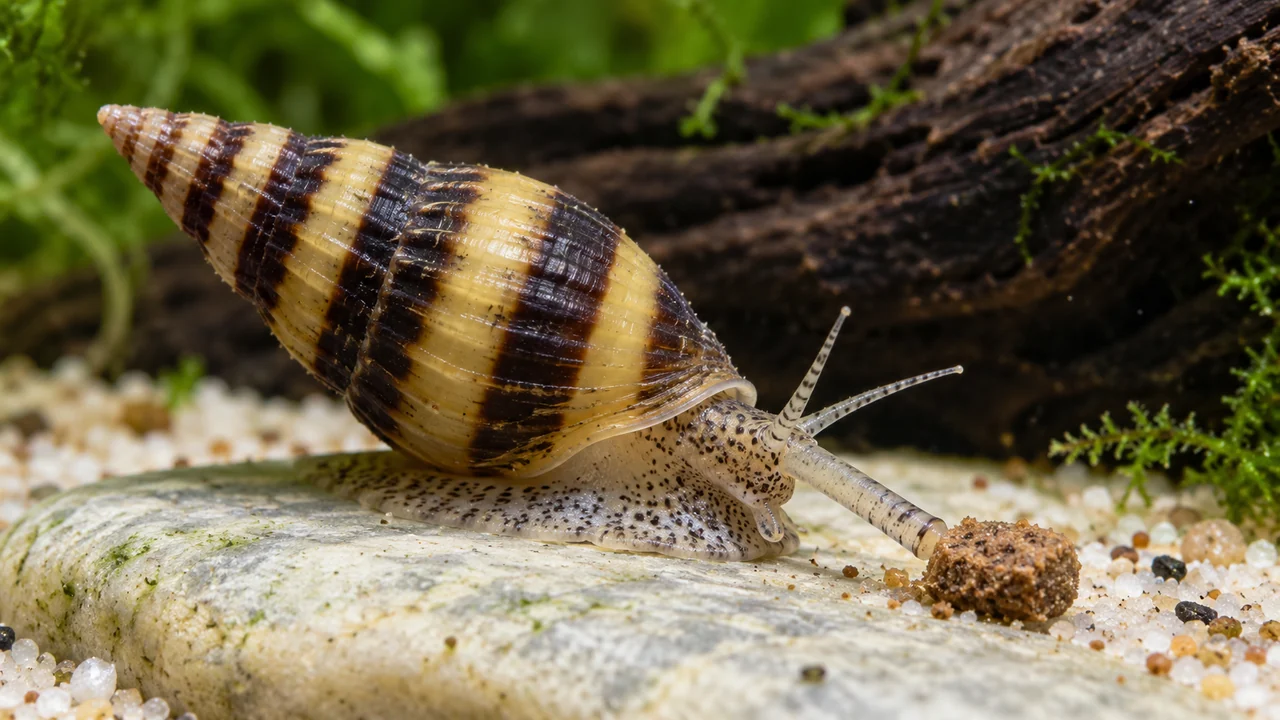
This is not an algae-control substitute for a nerite. Offer an appropriate complete sinking carnivore or omnivore food containing animal ingredients, in portions the snails actually use. Suitable thawed aquatic foods can add variety, but a few pieces of meat alone do not establish a balanced long-term diet. Remove uneaten food before it decays beneath the wood.
Published captive work showed that diet affected growth. The presence of a siphon near a pellet is worth observing, but monitor actual consumption and condition over time. If unwanted snails are reduced, the assassin still needs care and food. Do not add a predator to an overfed aquarium as a way to avoid correcting the feeding that supports the original population.
For supplementary animal-ingredient variety, Pure Shrimp Meal Shrimp Food offers a protein-forward grazing cube to assess in a small accessible portion. Confirm actual consumption alongside the complete carnivore or omnivore ration; it is not an algae-only feeding plan or a guarantee that ornamental snails are safe.
Ornamental-snail risk is part of the choice
Do not combine this predator with nerites, ramshorns, rabbit snails or mystery snails you wish to preserve. Size and an operculum do not make an ornamental snail universally safe from attack. Eggs and small juveniles can also be exposed. Keeping a valued breeding population separately is more dependable than relying on one keeper's peaceful observation.
Mobile healthy dwarf shrimp are not the same kind of target as a slow snail, but an absolute shrimp-safe guarantee is inappropriate. Weak animals, newly moulted shrimp and eggs deserve particular caution, and trade-line identity remains uncertain. For an important shrimp colony, separation avoids making its safety depend on an untested predator. Fish must also leave the snail's siphon and foot alone.
Egg capsules and young in freshwater
Sexes are separate and cannot reliably be chosen by a simple difference in shell banding. Captive animals deposit small capsules on firm surfaces. The young emerge as crawling snails, and development can be completed in freshwater. This differs fundamentally from the veliger biology of the two nerites in this group.
Coelho, Dinis and Reis reported hatching after about 52 days at 25°C in their experimental captive stock. That is a study result, not a universal timetable or a reason to copy intensive laboratory stocking densities into a display. Tiny juveniles may remain hidden in substrate; do not conclude that breeding failed simply because none is visible immediately.
Protect shell development
Monitor the advancing shell margin as well as the worn apex. Poor new growth, erosion and physical breaks are different problems. Check water minerals, pH, feeding access and handling history rather than attributing every pale mark to a single deficiency. The patterned shell is a living structure, not an expendable hunting accessory.
Use consistent replacement water and a measured mineral adjustment where needed. Adding calcium blindly while KH and pH swing is not a complete solution. Existing damage may remain even when conditions improve. Avoid prising the operculum open or applying improvised coatings, and do not transfer a stressed snail between very different water recipes repeatedly.
Botanicals without concealed waste
A light scattering of prepared leaves around wood can create cover and texture. Keep sand and the feeding station visible; a thick bed of decomposing litter can hide uneaten protein food and small dead animals. Tint is an appearance, not evidence that this predator needs acidic blackwater or that filtration is unnecessary.
Select materials with broad safe openings and keep maintenance access. Check the underside of moved leaves for attached capsules before transferring plants or hardscape to another aquarium. Responsible containment matters because released predatory snails can affect native molluscs; never discard animals, eggs or aquarium material into natural waters.
For low cover around the open sand, compare Dried Mango Leaves – Natural Aquarium Leaf Litter with a broad Coconut Nut Pod – Natural Three-Quarter Coconut Hide shelter. Check the actual opening and keep the feeding position visible so protein-rich leftovers do not disappear beneath the structure.
Practical checks before adding more animals
For inactivity or repeated withdrawal, check temperature, oxygenation, ammonia, nitrite, recent medicines and harassment. Observe whether food is available when the snail becomes active. An apparently empty substrate may contain hidden animals, so count cautiously before increasing the population or deciding that a treatment has removed them all.
For unwanted reproduction, reduce surplus feeding without starving the animals you intend to keep, inspect accessible surfaces and arrange responsible rehoming. Avoid chemical snail-killers in a mixed invertebrate aquarium. The useful outcome is a manageable, well-fed predator in a suitable home, not a promise that every other snail will disappear on a schedule.
Further reading and sources
Scientific identity and field observations are separated from practical aquarium advice. The care plan is a husbandry recommendation, not a measured survival envelope; commercial names do not certify species identity. Numerical maintenance bands and suggested aquarium dimensions are BBA planning recommendations informed by the sources, not guarantees or wild-site measurements.
- Strong et al. (2017) — Quid est Clea helena? — Primary anatomical/molecular species-complex study; accepted genus and the limits of applying trade observations to true Java A. helena.
- Coelho, Dinis & Reis (2013) — captive diet and development — Primary captive-stock experiment: diet, separate sexes and direct juvenile development; historical identification is qualified by the later revision.
- Australian freshwater mollusc key — Anentome helena — Diagnostic shell, siphon, proboscis and species-complex context.
- Ottawa Valley Aquarium Society — keeper observations (2009) — First-person husbandry account, not taxonomic verification or a guarantee of community safety.
- Ng and colleagues (2020) — Tonle Sap freshwater mollusc checklist — Primary survey of rivers, lake margins, ponds and canals; explicitly qualifies assassin-snail identification pending revision of the complex.