Snails · Malaysian Trumpet Snail
Malaysian Trumpet Snail — Melanoides tuberculata: Habitat and Care
A small burrowing grazer can become a large population when food is abundant. Understand brood-pouch reproduction, look beyond the cleaning-crew label and keep the substrate accessible rather than expecting snails to remove waste.
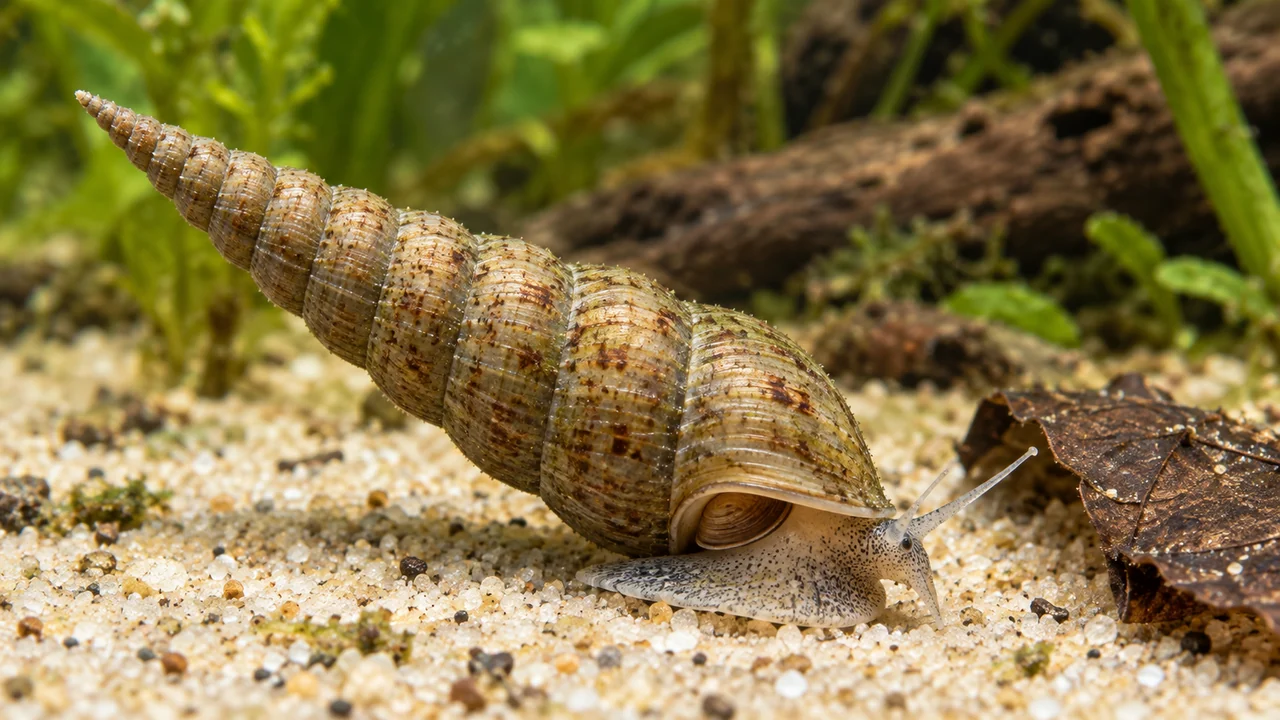
- Identity
- Melanoides tuberculata (O. F. Müller, 1774); Thiaridae. Pattern and shell form vary between populations.
- Adult scale
- Usually around 2–3 cm shell length; some specimens grow larger.
- Space
- A mature 30–40 cm aquarium around 20–40 litres suits a modest starting colony; future population and filtration capacity matter.
- Maintenance plan
- 22–26°C; pH 7.0–8.0; GH 6–15°dGH / KH 3–8°dKH as a moderate-mineral working plan.
- Food and substrate
- Microalgae, detrital material and appropriate supplementary food; fine sand supports burrowing.
- Young
- Internal brood pouch and crawling young; parthenogenesis occurs in many populations, so one animal may found a colony.
More than a tiny pointed shell
Melanoides tuberculata is a thiarid snail with a tall tapering shell, many whorls and an operculum. Typical aquarium animals are tan or brown with fine darker marks, but shell form and pattern vary. It differs from the shorter, boldly banded assassin snail and the much larger, strongly ribbed Tylomelania rabbit snails.
The native range spans African and Asian regions, with numerous introductions elsewhere. The common name Malaysian does not define its whole distribution. USGS describes a bottom-dwelling animal occupying many permanent-water habitats and sometimes brackish water. Broad ecological tolerance explains successful introductions; it is not a recommendation to expose aquarium animals to the most extreme laboratory conditions they have survived.
Sand is habitat, not a waste-disposal system
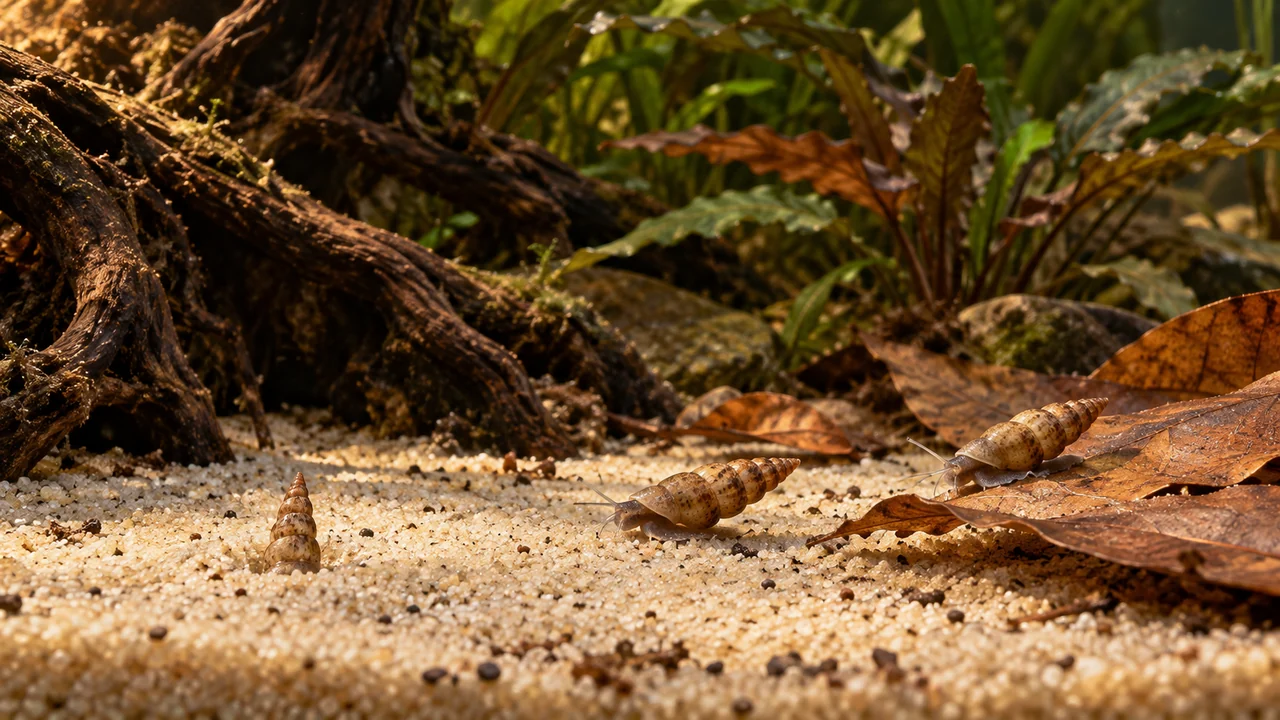
Use fine sand or smooth fine gravel with an open, inspectable area. Snails can move through the upper substrate, often becoming more visible after dark. Their activity redistributes particles; it does not export nitrogen, remove all trapped organic matter or guarantee that deep substrate remains oxygenated. Siphoning, sensible feeding and appropriate planting remain necessary.
A mature 20–40 litre aquarium with 30–40 cm of frontage can support a modest initial colony when water and food are managed. This is a practical layout choice rather than a measured minimum. Do not pour a deep layer of food-rich soil into a small aquarium merely because burrowing snails are present. Secure stones independently of loose substrate.
Keep a stable moderate-mineral plan
For ordinary tropical keeping, 22–26°C is a practical working range within the much broader conditions reported for the species. Aim for stable pH around 7.0–8.0 and moderately mineralised water. GH 6–15°dGH and KH 3–8°dKH are useful planning bands, not a claim that every geographical lineage shares an experimentally proven optimum.
Use a mature filter, maintain surface exchange and keep ammonia and nitrite undetectable. Condition replacement water and check its temperature and mineral consistency. Reports of brackish or hypersaline tolerance are not a reason to add salt to a freshwater community. Likewise, survival at a low pH does not prove that shell growth remains satisfactory there over the long term.
Burrowing behaviour and observation
Daytime concealment can be normal, especially when food is available in the substrate. Check the aquarium after lights-out to see where animals gather and whether feeding areas are accessible. A few visible snails on glass do not reveal the total population, and a quiet sand surface does not mean the colony has disappeared.
If many suddenly climb towards the surface together, investigate oxygenation, temperature, ammonia, nitrite and recent disturbance. This behaviour can be a useful warning, but it is not a precise test for one particular water problem. Measure before deciding what to change. Do not treat an occasional daytime climber as proof that the whole substrate must be replaced.
Feed the aquarium rather than the population boom
Microalgae, soft organic particles and suitable prepared foods can all contribute to the diet. Observe whether the intended fish and shrimp receive their portions, then adjust leftovers. Food vanishing beneath the sand has not disappeared from the system: the snails convert some of it into growth and their own waste.
A rapidly expanding colony should prompt a review of excess feeding, dying plant tissue and inaccessible accumulations. Reduce waste gradually while keeping the aquarium's intended animals properly fed. There is no need to deliberately starve an established community or introduce a predator as the first response. A light, observable snail population is easier to manage than a large hidden one.
If supplementary feeding is needed for a deliberately managed group, compare a small portion of Botanical Grazing Pellets with Snowflake Shrimp Food. Offer one at an observable patch and account for food already reaching the substrate from the other inhabitants.
Internal young and parthenogenesis
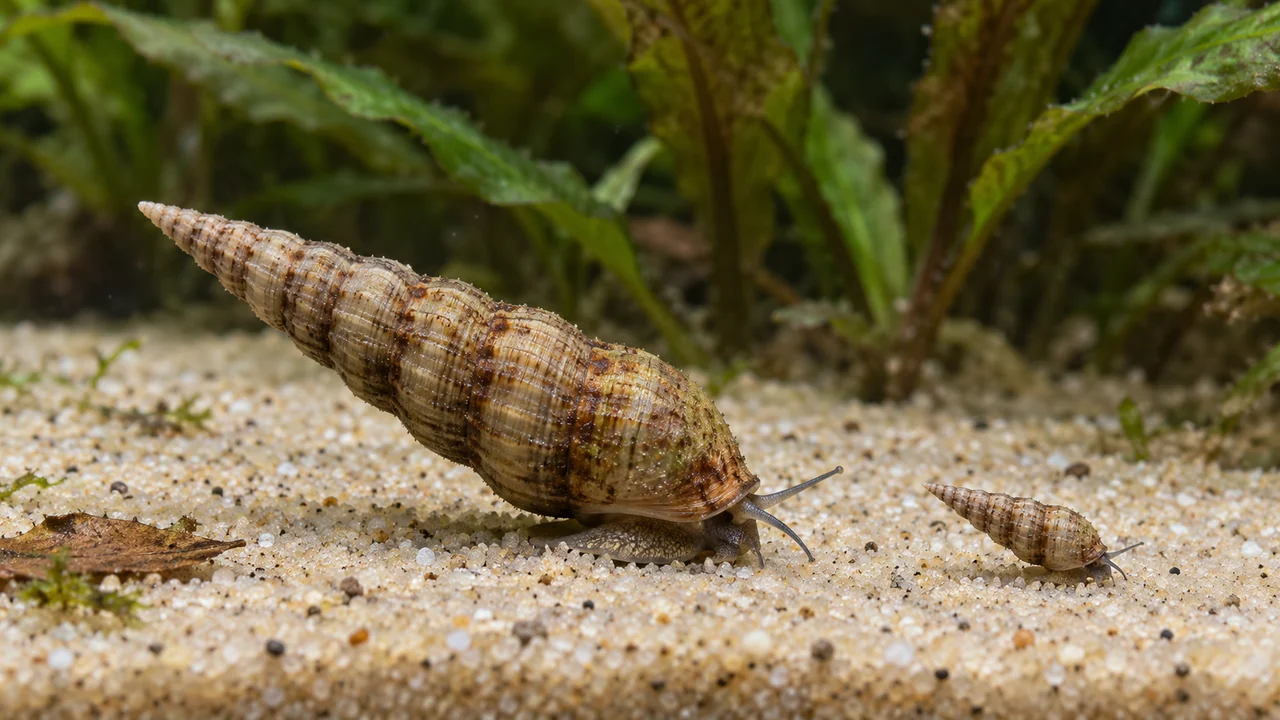
Developing young are retained in a brood pouch, and the mother releases small crawling snails. Many populations reproduce by parthenogenesis, so a single female can establish a colony without a recently introduced male. Other populations include sexual reproduction. Calling every individual a self-fertilising hermaphrodite gives the wrong explanation.
This is not the pink aerial clutch of Pomacea, nor the capsule-and-veliger life cycle of a nerite. Population growth depends on conditions and resources; a fixed monthly multiplication promise is misleading. Inspect plants, substrate and equipment before moving them between aquariums, and quarantine new material where appropriate if you wish to avoid an unplanned colony.
Shell condition and suitable companions
Look for sound new growth at the shell opening, allowing for wear on an older apex. Erosion calls for checks of pH, mineral preparation, diet and possible damage. Moderate water hardness and appropriate food are more useful than assuming that a scavenger can maintain its shell from any available residue.
Peaceful fish and shrimp with compatible conditions can share the aquarium, but snail-eating fish, crayfish and assassin snails create an obvious risk. Do not buy this species as disposable live food unless you are prepared to manage that separate welfare and feeding decision. Its operculum does not make it immune to predation or unsuitable medication.
Light botanicals and accessible maintenance
A few prepared leaves around roots can provide additional grazing texture. Leave routes to inspect the substrate and remove visible waste. Dense overlapping litter can hide uneaten food, making it harder to judge why the population is growing. The colour of the water cannot tell you whether feeding is excessive or buffering adequate.
Match botanical additions to the mineral plan rather than pushing the aquarium towards an acidic blackwater extreme. Snails do not make a large new organic load harmless. If clouding or poor oxygenation follows an addition, check water and remove the problematic material rather than adding more scavengers.
For scattered surface texture, compare prepared Dried Banana Leaf Pieces – Natural Aquarium Leaf Litter with selected material from BBA Leaf Litter & Substrate Variety Mix – 1 L Seasonal Botanical Blend. Keep most of the sand available for inspection, rather than covering a growing population with a deeper litter bed.
Containment and sensible problem-solving
Remove surplus animals gently during routine maintenance and arrange responsible rehoming where possible. Avoid chemical controls that can harm other invertebrates or leave a large mass of decomposing animals hidden in the substrate. Inspect a removed object before discarding it; small snails can remain attached in crevices.
Never release snails, aquarium plants or substrate into natural waters. Introduced populations can have ecological and parasite-related consequences, although aquarium colour or appearance cannot diagnose infection. For normal care, wash hands after maintenance, avoid using wild-collected animals casually and respond to actual water-quality measurements rather than exaggerated claims that this snail is either indestructible or inherently disastrous.
Further reading and sources
Scientific identity and field observations are separated from practical aquarium advice. The care plan is a husbandry recommendation, not a measured survival envelope; commercial names do not certify species identity. Numerical maintenance bands and suggested aquarium dimensions are BBA planning recommendations informed by the sources, not guarantees or wild-site measurements.
- USGS — Red-rim melania species profile — Institutional ecology, feeding, brood-pouch reproduction and sexual/parthenogenetic populations. Extreme tolerance observations are not care targets.
- US Fish and Wildlife Service — red-rim melania risk summary — Institutional synthesis of identity, reproduction and introduction risks.
- Water Research Commission — freshwater laboratory culture methods — Institutional culture at 27°C with sand, aeration, filtration and supplementary food; a laboratory method, not an aquarium stocking rule. Its brief egg-laying summary does not override brood-pouch evidence.