Snails · Mystery Snail
Mystery Snail — Pomacea diffusa: Habitat and Care
A large, active apple snail needs deliberate feeding, sound shell growth and a safe route to air. Distinguish diffusa from bridgesii and plant-eating apple snails, and understand why UK guidance differs between Great Britain and Northern Ireland.
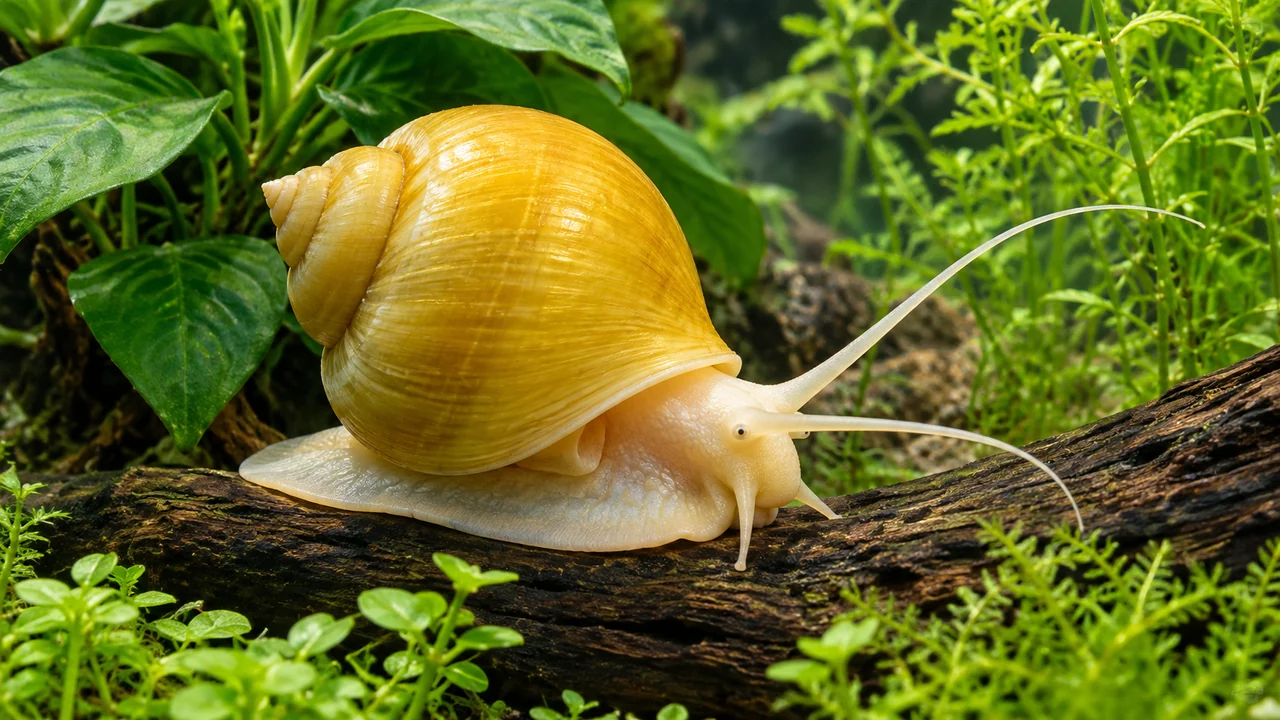
- Identity
- Pomacea diffusa Blume, 1957; historically P. bridgesii diffusa. P. bridgesii is a distinct species, not simply a modern synonym.
- Adult scale
- Plan for roughly 4–6 cm shell height and the extended foot and tentacles.
- Aquarium plan
- Around 60 cm frontage / 50–60 litres is a practical starting arrangement for one adult with room for filtration, feeding and an air gap.
- Maintenance plan
- 22–26°C; pH 7.2–8.2; GH 8–15°dGH and KH 4–8°dKH as a moderate-to-hard, buffered working plan.
- Breathing and young
- Gill and lung; surface access plus secure humid air space. Egg clutches are laid above water.
- UK distinction
- GB plant-pest restrictions were lifted; Northern Ireland retains Pomacea quarantine restrictions. Never release animals or eggs.
Which mystery snail is it?
Pomacea diffusa is the name used for the familiar spike-topped mystery snail, including many captive gold, ivory, blue and other colour selections. It was described as a subspecies of bridgesii, but P. bridgesii and P. diffusa are now treated separately. Repeating the older label on a shop tank does not establish which animal is present.
The shell is globose with a raised spire and relatively angular shoulders. Other apple snails, including P. canaliculata and P. maculata, can be confused in trade and have different size and feeding implications. Neither gold colour nor a common name verifies the species. Use a knowledgeable source and a proper identification account; general apple-snail pest photographs are not evidence that every mystery snail is canaliculata.
The native range is tropical South America, including Bolivia, Peru and the Amazon system of Brazil. Freshwater rivers, ponds and wetlands provide vegetation, sediment and grazing surfaces. Introduced populations elsewhere do not expand that native range, and a field record of warm, oxygen-poor water is not a recommended home-aquarium condition.
Give an adult room and a safe surface route
Plan for a shell around 4–6 cm high plus the moving foot and extended tentacles. Around 50–60 litres and 60 cm of frontage is a practical starting arrangement for one adult in a lightly stocked home, not a proven minimum or a stocking formula. Filtration and accessible feeding space must accommodate the animal's substantial food intake and waste.
Use smooth secure wood, low stable stones and planting around open routes. Keep passages broad enough for the whole shell, not just its opening. Provide a secure cover with a ventilated humid air gap and accessible water surface. Protect heater and filter hazards and close cable gaps without sealing away the animal's access to air.
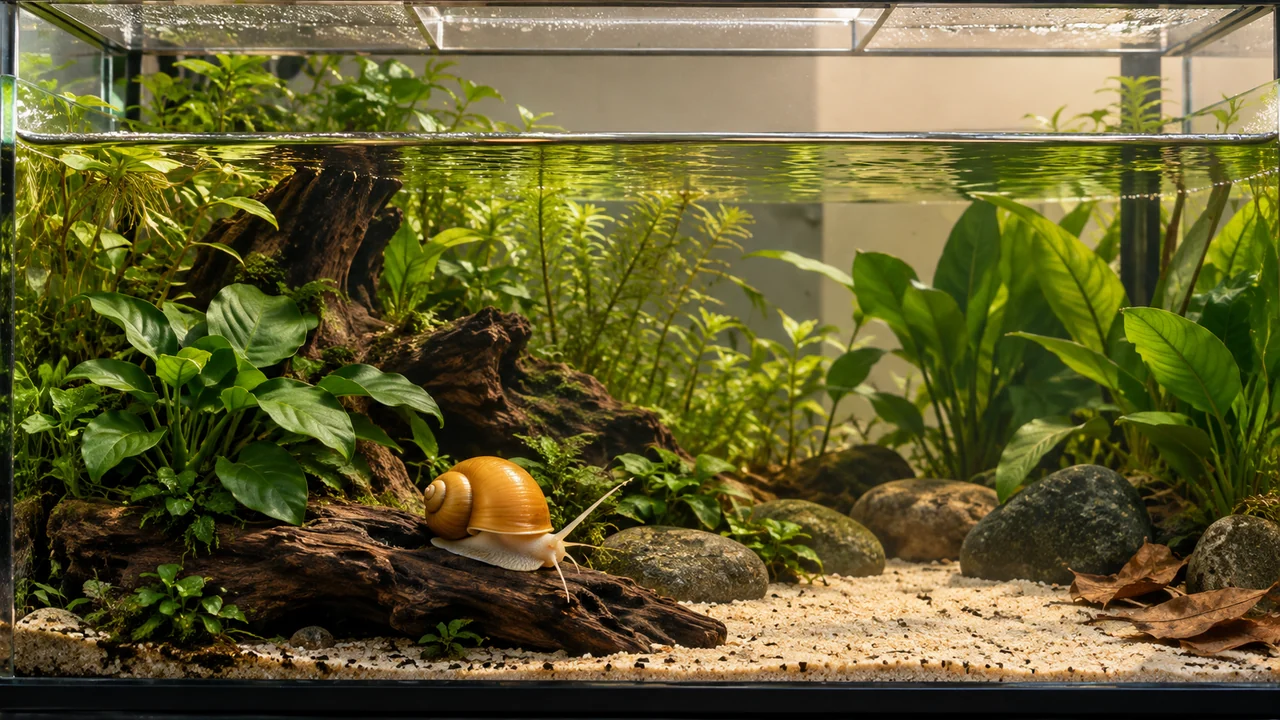
Air breathing does not replace water care
Pomacea has both a gill and a lung and can extend a siphon to obtain air. Surface visits can be normal; they do not mean it is a land snail or that it can remain dry. Equally, the ability to breathe air does not make ammonia, nitrite or a dirty aquarium acceptable.
A practical maintenance plan is 22–26°C, pH 7.2–8.2, GH 8–15°dGH and KH 4–8°dKH. These are selected shell-friendly husbandry values, not the full range of field observations or a universal breeding optimum. Use conditioned, consistently prepared water, maintain biological filtration and check temperature, oxygenation and recent maintenance if behaviour changes abruptly.
Feed the snail deliberately
Offer suitable complete sinking snail or invertebrate food, with appropriate softened vegetables as variety. Pomacea diffusa generally favours softer decaying material and attached growth over healthy robust plants, but that does not mean it cannot touch delicate or weakened growth. Most importantly, a planted aquarium can contain a hungry mystery snail if no suitable food is provided.
Feed at a visible position and check consumption, especially with quick fish or shrimp nearby. Remove uneaten portions before they foul the water. Leaves, algae and vegetables alone should not be assumed to provide a complete diet. Adjust portions to the individual and its growth instead of supplying a large permanent pile because the animal is labelled a scavenger.
For supplementary variety, Bee Pollen Gold™ Shrimp Pellets provide a treat-pellet option, while Calcium Mineral Grazing Blocks offer a mineral-enriched grazing format. Follow the product directions in an accessible feeding dish, observe consumption and water clarity, and retain the complete diet and measured water-mineral plan.
Shell development and mineral balance
Monitor the newer shell at the aperture for sound formation and compare it with older wear. Pitting or thinning calls for checks of pH, mineral preparation, feeding and physical damage. GH is not a calcium-only reading, and a high number alone does not demonstrate a balanced water recipe or adequate nutrition.
Use a consistent, measured approach if remineralisation or buffering is needed. Old eroded shell normally retains evidence of the damage; new good conditions do not restore its original surface. Do not apply household repair materials or allow the shell to become a handle for pulling an attached animal free. No leaf, liquid tannin or food can guarantee immunity from shell problems.
Companions and botanical arrangement
Peaceful fish and dwarf shrimp can fit when their water needs overlap and they leave the snail able to feed and move. Avoid fin or tentacle nippers, predatory crayfish, snail-eating fish and assassin snails. The adult's size is not a dependable defence, and smaller juveniles may be much more exposed than the parent.
A few prepared leaves and smooth wood add grazing texture and shelter at the edges. Retain the mineral plan instead of turning the aquarium into very soft acidic blackwater. Keep leaves away from hidden food accumulations and preserve a clear route to the surface. Attractive amber water can coexist with sensible minerals, but colour alone proves neither suitability nor cleanliness.
For the modest botanical edge, compare Broken / Crushed Mulberry Leaf Pieces with selected leaves from the Snail Leaf Buffet Pack – 30–80L. Keep the route to the surface clear and use portions that remain easy to inspect beneath a moving adult.
Keep the clutch above the waterline
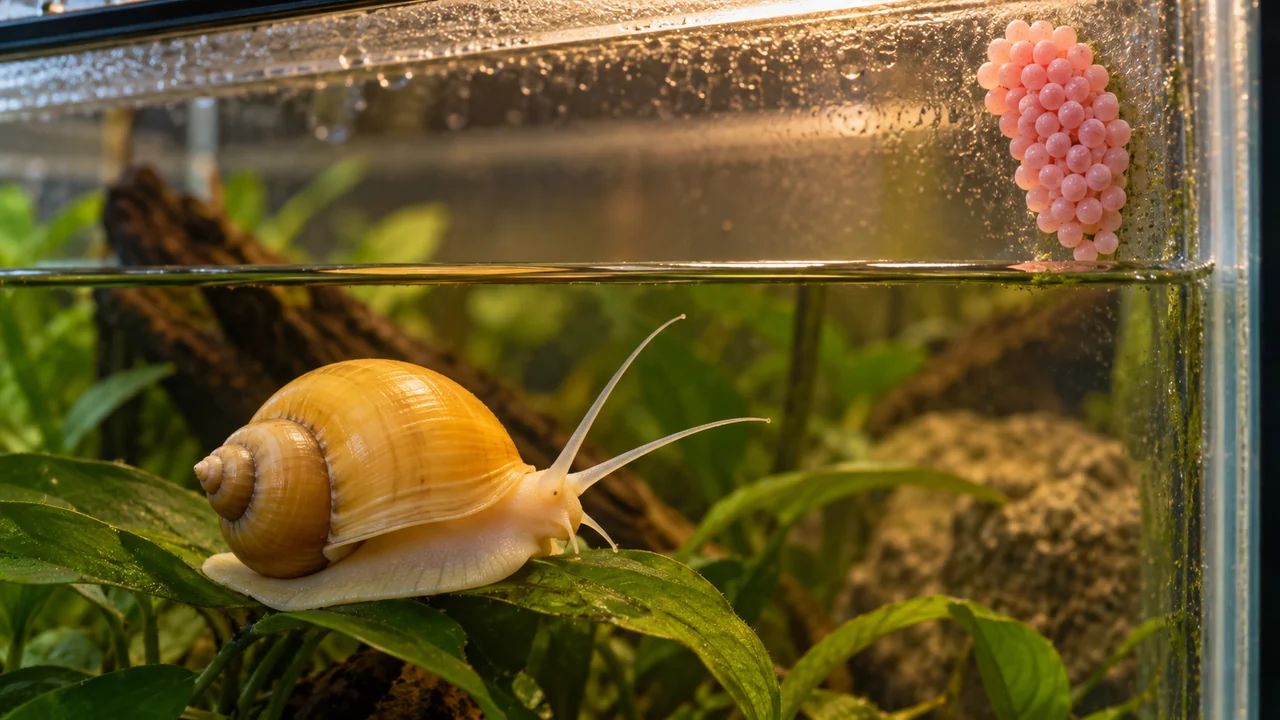
Males and females are separate. Females attach a cluster of eggs above the water, using a suitable surface in the air space. The clutch needs air and appropriate humidity rather than immersion; topping up the aquarium over it can prevent normal development. Plan the waterline, lid and maintenance before attempting to breed.
Young hatch as small snails and enter the water, where they require suitable food, minerals and protected filtration. Do not promise an exact hatch day or apply the clutch size of a giant pest Pomacea to diffusa. A single housed female may already have mated, so separate housing is not proof that every future clutch is infertile. Arrange responsible homes before intentionally raising a large brood.
Great Britain and Northern Ireland are different
Official Defra guidance states that Pomacea is no longer regulated as a GB quarantine plant pest. The trade body's explanation of the change confirms import, sale and keeping in England, Scotland and Wales. This is not permission to release a non-native snail, its eggs or aquarium waste into the wild, and it does not remove other applicable movement requirements.
Northern Ireland retains the Union quarantine-pest position for Pomacea: introduction and spread are prohibited, and sale is not allowed. Do not send animals there from Great Britain on the assumption that a diffusa or mystery-snail label creates an exemption. Check current guidance with DAERA before any proposed movement. These jurisdictional statements were checked for this local package; the 2025-listed Defra factsheet itself records a December 2023 revision.
First checks for floating or inactivity
An air-breathing snail can float, withdraw or rest without being dead. Observe it without forcing the operculum open. Check the water, temperature, access to food, possible harassment and recent treatments; carefully return a stranded or overturned animal to a safe submerged position where it can grip and reach air normally.
Persistent distress, damaged tissue or unmistakable decomposition requires prompt attention, not an attempt to cure everything with extra calcium. Use medicines only after confirming suitability for this invertebrate and the actual dose. Keep a record of new shell, appetite and changes to the aquarium so recurring problems can be traced to conditions rather than a colour-morph label.
Further reading and sources
Scientific identity and field observations are separated from practical aquarium advice. The care plan is a husbandry recommendation, not a measured survival envelope; commercial names do not certify species identity. Numerical maintenance bands and suggested aquarium dimensions are BBA planning recommendations informed by the sources, not guarantees or wild-site measurements.
- US Fish and Wildlife Service (2025 web version) — Pomacea diffusa — Institutional identity, adult dimensions, original Amazon distribution and the distinction from other apple snails; introduced field conditions are not care targets.
- Australian freshwater mollusc key — Pomacea diffusa — Original P. bridgesii diffusa combination, habitat and aerial eggs.
- AppleSnail.net — care and reproduction — Specialist keeper guidance on deliberate feeding, breathing, shell needs and aerial clutches; genus-level examples are not automatically diffusa measurements.
- Defra — Pomacea plant-pest factsheet — Official linked factsheet, listed 2025 and revised December 2023: Great Britain deregulation, Northern Ireland quarantine position and no release; checked via the current official index.
- Invasive Species Northern Ireland — apple snails — Northern Ireland guidance: no sale and prohibition on introduction/spread of Pomacea.
- OATA — apple-snail restriction change (2021) — Original Defra statement reported by the industry body distinguishes GB import/sale/keeping from NI; checked alongside the current official guidance.