Snails · Rabbit Snail
Rabbit Snail — Tylomelania gemmifera: Habitat and Care
A Lake Matano soft-bottom snail needs warm, stable, mineral-balanced water and space for its long shell. Its dark yellow-spotted body and ribbed shell should not be replaced by a generic orange rabbit-snail identity.
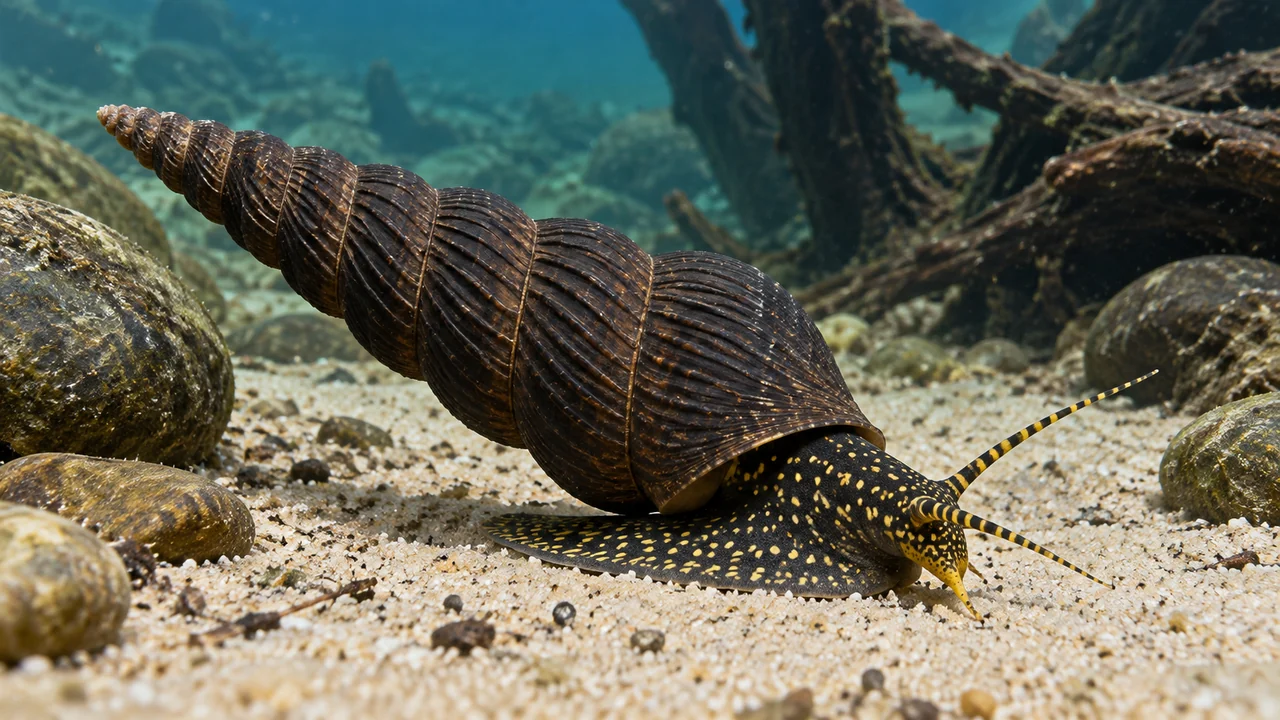
- Identity
- Tylomelania gemmifera (Sarasin & Sarasin, 1897); Pachychilidae. A colour-based rabbit-snail trade label is not species verification.
- Adult scale
- Shells can reach about 8 cm; leave turning space for the full elongated shell.
- Aquarium plan
- An established 80 cm aquarium around 80 litres is a generous starting plan for a small group, not an experimentally defined minimum.
- Maintenance plan
- 27–28°C; pH 7.5–8.2; GH 6–10°dGH and KH 4–6°dKH as a measured working plan, not a claim that lake water is extremely hard.
- Habitat
- Lake Matano, Sulawesi; sand and mud are documented substrates, rather than an exclusively rocky habitat.
- Reproduction
- Separate sexes; females brood shelled embryos internally and release developed young in freshwater.
Start with the described species
Tylomelania gemmifera is an accepted Lake Matano species, originally described as Melania gemmifera. Its tall brown to black shell has conspicuous, relatively widely spaced axial ribs. The scientific review describes yellow spots or blotches on the head-foot, yellow-striped tentacles and a yellow snout. An entirely orange body advertised under a colour name does not by itself establish this identity.
Many Tylomelania species occur in Sulawesi, and the general rabbit-snail label covers different animals. Ask for a traceable source and keep the supplier's identification record. Images and shell comparisons can support recognition, but this article does not claim that every commercial specimen can be authenticated from a single attractive photograph.
A soft-bottom lake snail needs open floor
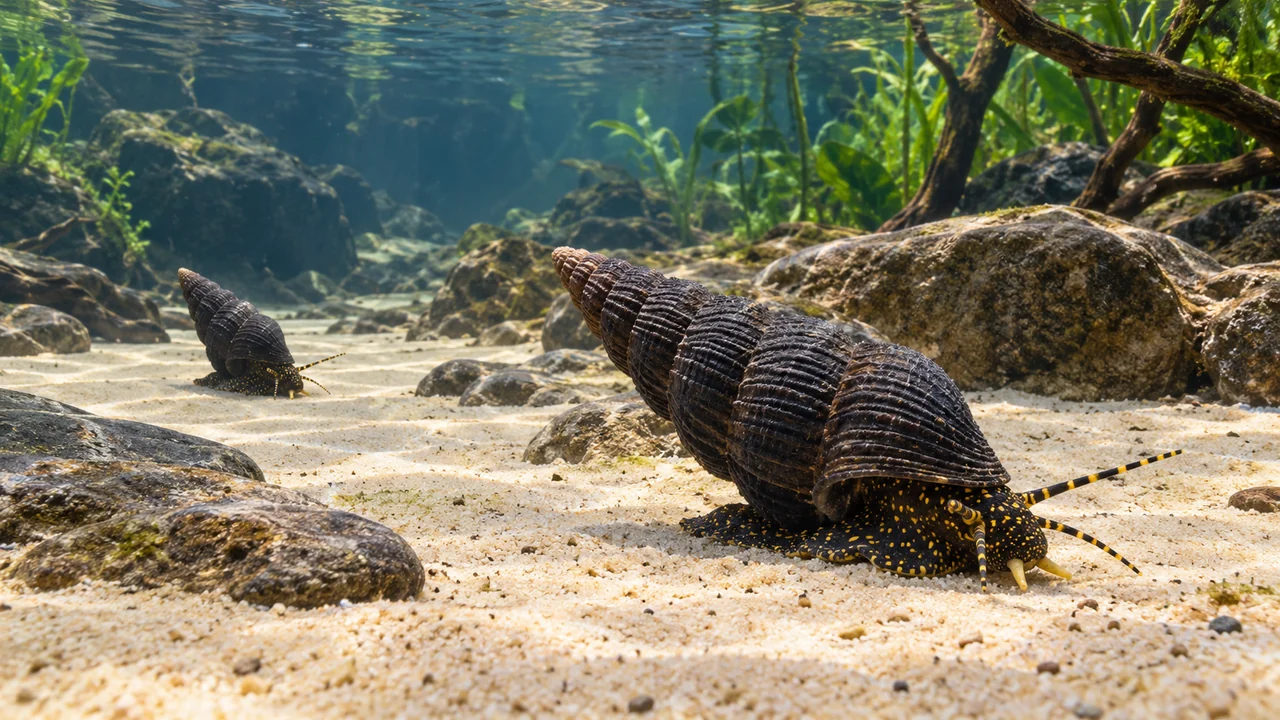
The 2007 morphological review records gemmifera on sand and mud in Lake Matano. It explicitly separates the species from similar snails in Mahalona and Towuti. A warm rock pile alone therefore misses an important part of the habitat. Provide a broad fine-sand area with mature surface growth and room to manoeuvre the long shell.
For a small group, an established aquarium around 80 cm long and 80 litres is a useful, generous starting plan. That recommendation allows access and feeding space; it is not a measured species threshold. Keep stones low and secure, use broad passages and leave the front easy to inspect. A heavily carpeted floor or narrow crevice maze can make movement and maintenance unnecessarily difficult.
Warm water with measured minerals
Plan a steady 27–28°C, pH around 7.5–8.2 and a consistent mineral recipe. GH 6–10°dGH and KH 4–6°dKH are a moderate working plan within published keeping advice, not an instruction to make the water extremely hard. The alkaline appearance of Sulawesi care charts should not be confused with unlimited calcium or salt dosing.
Measure the prepared water before use and match replacements carefully. If using RO, add a suitable freshwater mineral preparation according to its instructions and check what it produces. Keep biological filtration and oxygenation effective: warm water makes attention to gas exchange particularly worthwhile. Maintain undetectable ammonia and nitrite and avoid sudden large shifts when introducing animals or correcting a reading.
Watch feeding at the sand surface
The short snout works across surfaces while the foot moves the substantial shell. Mature biofilm and microalgal growth provide useful feeding opportunities, but an aquarium should not rely on these alone. Place suitable complete sinking snail food in an accessible patch, and observe whether each animal reaches and uses it rather than assuming that a tablet has fed everyone.
Offer appropriate vegetable material in small portions as variety, not as the entire nutritional plan. Remove uneaten food and keep the feeding area inspectable. Slow movement does not mean the snail needs no food or that it can live indefinitely on a few leaves. A clean sand surface with dispersed natural growth differs from a layer of rotting leftovers.
For supplementary feeding variety on the visible sand patch, compare Nettle Shrimp Food with a suitably portioned Premium Natural Spirulina Tablets tablet. Confirm that each rabbit snail reaches and eats the food while retaining the complete sinking ration and warm mineral-balanced water plan.
Shell wear and new growth tell different stories
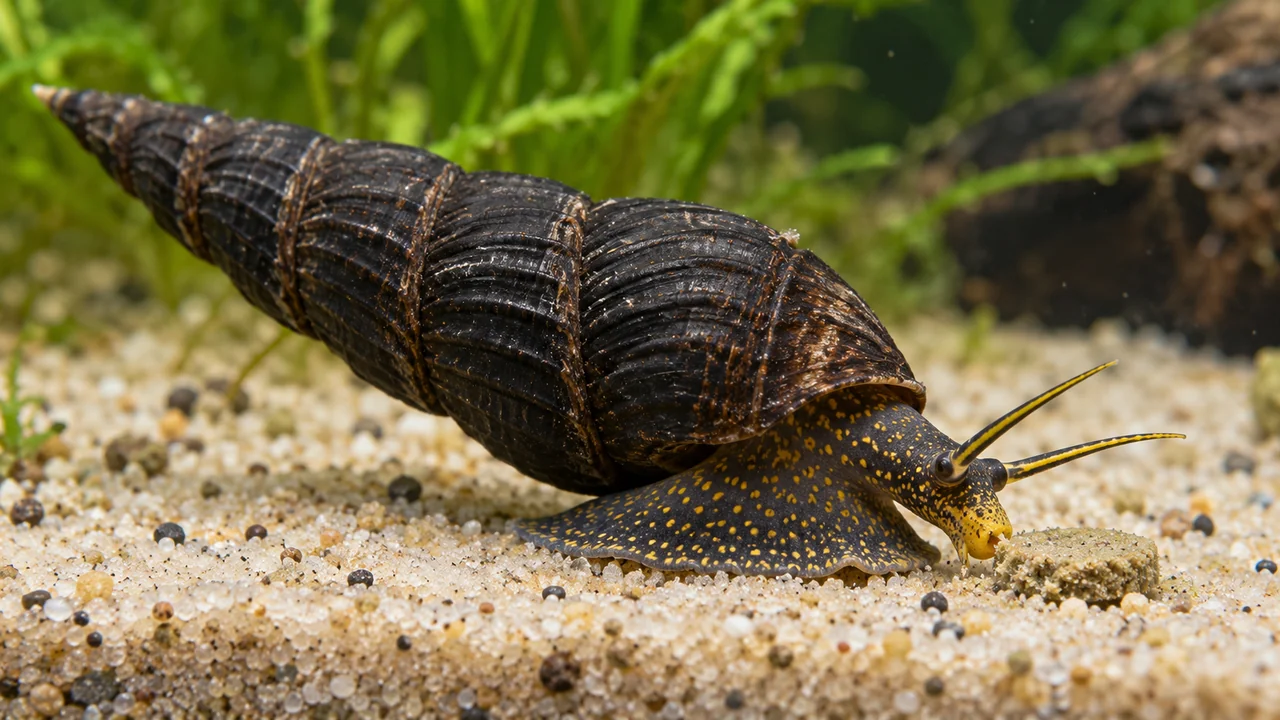
The scientific description notes erosion of older upper whorls in adult specimens. An old worn apex alone is therefore not proof of a recent aquarium failure. Inspect the fresh margin and compare changes over time. Active pitting, thinning or weak new shell still warrants checks of water chemistry, nutrition and physical damage.
Do not abrade old shell or try to restore its appearance with household products. Maintain suitable water and a balanced diet, and assess whether another inhabitant is damaging the snail. Mineral-rich water does not mean repeatedly adding unmeasured supplements. Existing damage can remain visible while later growth improves; no botanical product guarantees that an old shell becomes pristine.
Companions and movement
This snail is not a hunter of healthy fish or shrimp, but compatibility must include temperature and water needs. Selected peaceful warm-water inhabitants can fit; a cool community or a very acidic soft-water shrimp colony may not. Check that faster feeders leave usable food and that fish do not repeatedly nip the foot or tentacles.
Avoid snail-eating fish, crayfish and assassin snails. Keep shell-sized turning spaces rather than using the young animal's current size as the permanent design limit. A small group can be maintained when floor area and food support it, but no mandatory social minimum is inferred from seeing animals together. Mixed rabbit-snail shipments also complicate breeding and identity records.
Brooded embryos and developed young
Sexes are separate, and external appearance is not a dependable way to select a breeding pair. Females retain developing shelled embryos internally. The primary review documents embryos within brood pouches; this is not a species that scatters an aerial pink clutch or requires nerite-style planktonic larvae to be raised at sea.
Developed young can begin life in freshwater near the adults, provided food, water and protection are suitable. Do not promise a baby every fixed number of weeks, infer brood output from the number of embryos in a preserved female, or assume a newly purchased female was unmated. Use protected filter inlets and observe small juveniles carefully before moving sand or siphoning the feeding area.
Botanicals in a mineral-balanced arrangement
Sparse prepared leaves and a few broad pieces of wood can diversify the aquarium without covering the sand. Place them where they can be lifted and inspected, and keep their role modest. A deep, dark, decomposing forest floor is not required to make a Lake Matano snail feel at home.
Water tint does not replace measurements. If botanical additions shift the intended water plan or create excessive organic demand, adjust the material and maintenance rather than adding more to chase an image. Robust plants can be placed around the open floor; check actual feeding behaviour rather than promising that every plant will remain untouched in every aquarium.
Practical problems and responsible sourcing
For persistent inactivity, first check heater operation, temperature, oxygenation, ammonia, nitrite, food access and recent chemical exposure. A large snail can be hidden behind the wood, so inspect gently before assuming it has died. Do not drag an attached animal by its shell or force an operculum open to test it.
Keep a simple record of feeding and new shell growth. Seek traceable captive stock where available because this is a lake-restricted animal, not an unlimited generic cleaning supply. Do not attach a current conservation category to an unverified colour form, release unwanted snails or mix geographical stocks casually. An honest identity and a stable, observable aquarium are more valuable than a dramatic label.
Further reading and sources
Scientific identity and field observations are separated from practical aquarium advice. The care plan is a husbandry recommendation, not a measured survival envelope; commercial names do not certify species identity. Numerical maintenance bands and suggested aquarium dimensions are BBA planning recommendations informed by the sources, not guarantees or wild-site measurements.
- von Rintelen, Bouchet & Glaubrecht (2007) — Malili Tylomelania revision — Primary review, species account pp.31–34: shell, yellow markings, Matano-only range, soft substrates and brooded embryos. The accessible author-deposited full paper was consulted.
- Aquagear — T. gemmifera Yellow Antenna keeping — Commercial warm alkaline maintenance, food and mineral guidance; its ranges and summary fields differ, so selected BBA working values are explicitly recommendations.
- B-Aqua — Tylomelania gemmifera — Secondary husbandry and source links support roomy soft-bottom planning. Conflicting colour/diet statements are not preferred over the original species description.