Snails · Horned Nerite
Horned Nerite — Clithon corona: Habitat and Care
A tiny horned surface grazer needs mature food-bearing surfaces and shell-friendly water. Distinguish a useful trade description from an exact species identification, and separate adult freshwater keeping from veliger development.
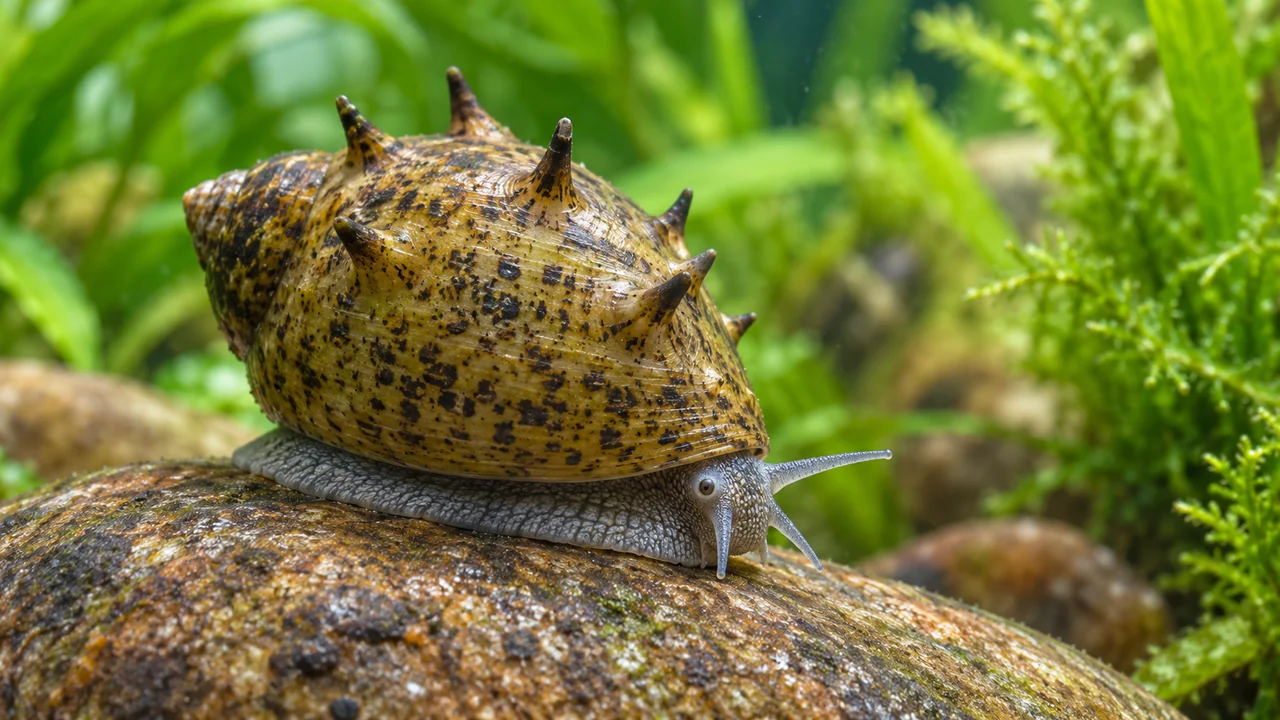
- Identity
- Clithon corona (Linnaeus, 1758); Neritidae. Other Clithon species also enter the horned-nerite trade.
- Adult scale
- Institutional shell range about 7–21 mm; shell projections vary and can be broken.
- Space
- A mature 30–40 cm aquarium around 20–30 litres can house a small number if food and stability are adequate; do not stock to a snail-per-litre formula.
- Maintenance plan
- 22–26°C; pH 7.0–8.0. GH 6–12°dGH and KH 4–8°dKH are a moderate-mineral working plan, not measured species limits.
- Diet
- Attached algae and biofilm; confirm acceptance of suitable supplements.
- Young
- Veliger development; egg capsules do not imply routine freshwater breeding.
Identify more than a horned shell
Clithon corona is a small nerite with a rounded shell and an operculum. The shell may bear projecting spines, but their length and survival vary. Kerr's Mariana checklist describes dark shells and often-broken projections, while commercial horned nerites are offered in several colours and patterns. Appearance should be considered alongside provenance and a proper identification source.
Other Clithon species are also sold as horned nerites, including animals labelled diadema. A yellow-and-black pattern or a row of spikes alone does not establish C. corona. This guide describes the named species and gives a practical adult plan; it does not certify a mixed shop shipment or turn every colour name into a separate species.
Small size still needs a mature aquarium
Begin with an established aquarium containing visible grazing growth. A 20–30 litre aquarium with roughly 30–40 cm of usable length can suit a small number under careful management; that is a planning recommendation, not a demonstrated minimum. The smaller the water volume, the more easily overfeeding or an unnoticed dead animal can alter conditions.
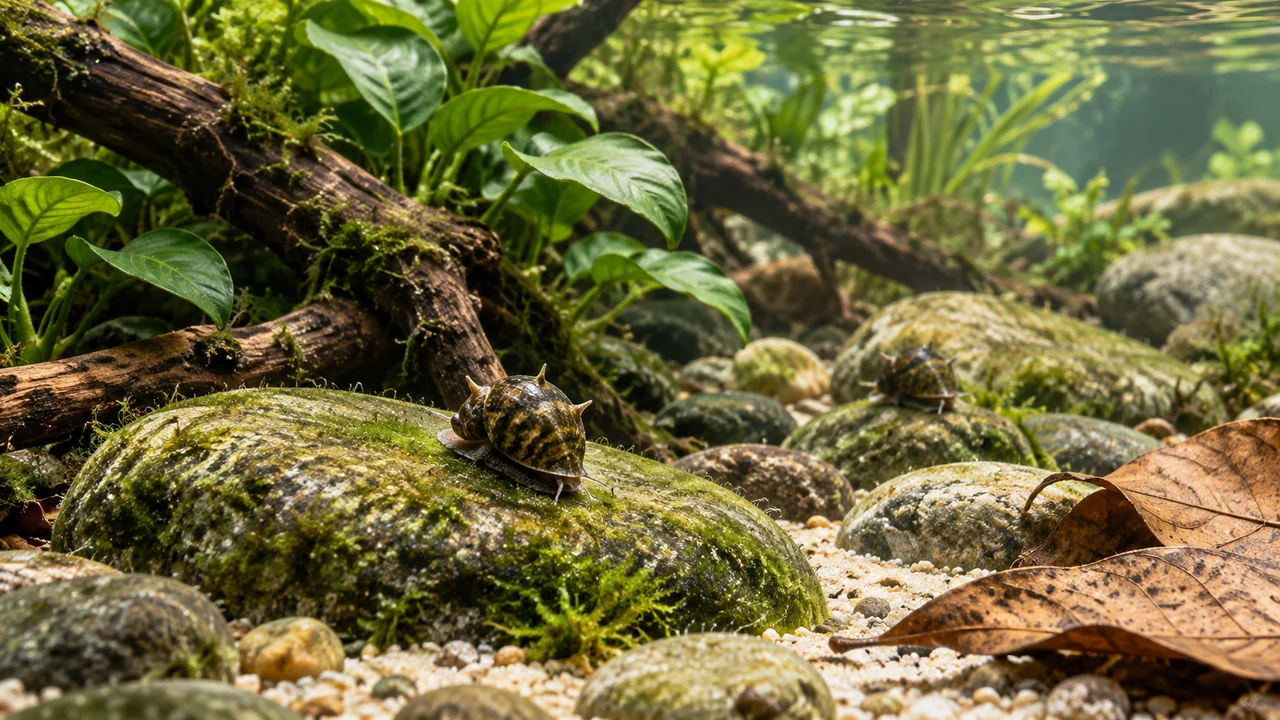
Arrange smooth pebbles, stable wood and plant edges with space around them. Keep the filter inlet safe and retain oxygenated moving water over feeding surfaces. Cover openings and check above the waterline during maintenance. Small size makes it easier to miss an escaped animal, not more acceptable to leave large gaps around cables.
Water that supports new shell
Plan 22–26°C and pH 7.0–8.0 for steady adult freshwater keeping. Commercial Clithon guidance includes 22–28°C and KH above 3°dKH. A moderate working plan of GH 6–12°dGH and KH 4–8°dKH leaves a useful buffering margin; those selected values are husbandry choices rather than experimentally established boundaries for every population.
Check the supplier's water and adjust deliberately, using conditioned replacement water with a consistent mineral recipe. Do not use pure unmineralised RO water. Monitor ammonia and nitrite, and maintain filtration and surface exchange. Acidity intended for specialist fish or bee shrimp should not be imposed on the nerite just to achieve a darker botanical appearance.
Projections, wear and the living shell edge
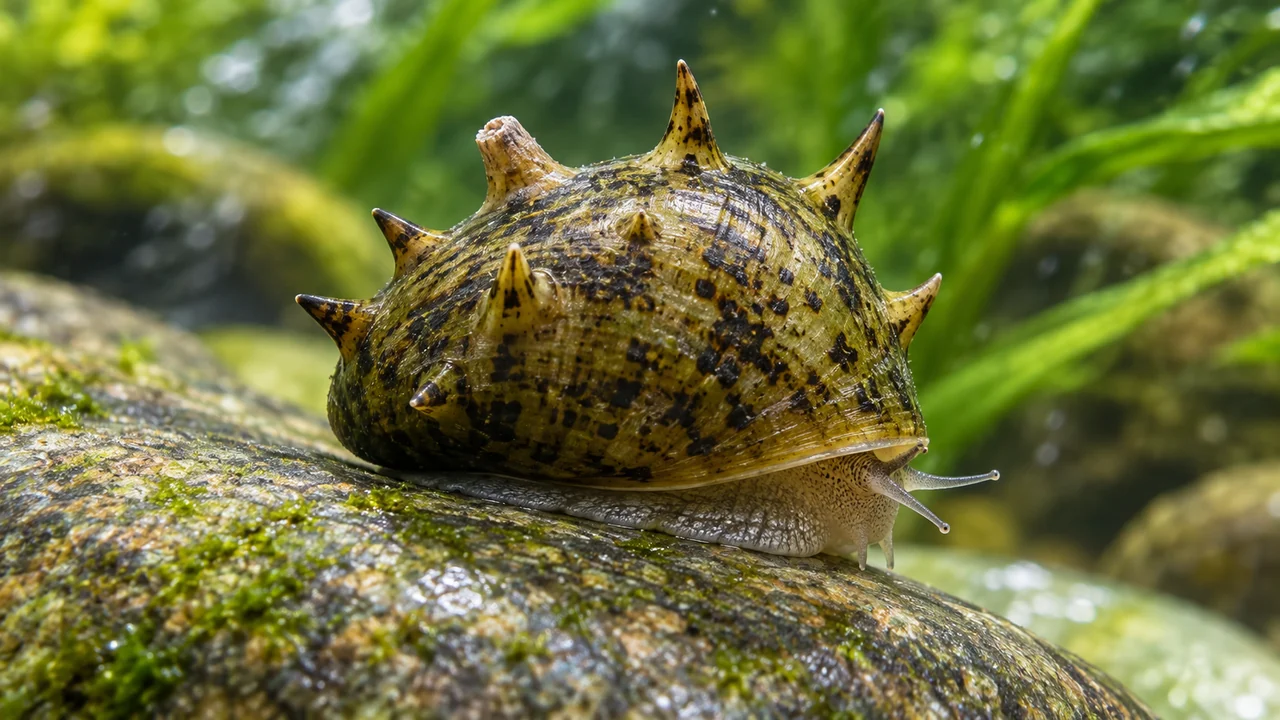
Shortened or absent horns are not enough to diagnose illness or assign another species. Projections can be worn or broken, and natural descriptions include imperfect specimens. Assess the overall shell shape and surface rather than expecting a perfectly symmetrical crown. Avoid handling that catches a spine against a net or hard container edge.
Look separately for active erosion: spreading white pits, thinning surfaces or poorly formed new growth. Check pH, calcium-bearing mineral preparation, feeding and possible physical damage. Old loss of shell does not simply grow back as an undamaged original surface. Improve conditions for subsequent growth without applying household glues or forcing the animal out of its shell.
A grazer needs food before purchase
These small snails work across attached films on hard surfaces. Leave some algae-bearing stones and side glass available rather than cleaning every surface simultaneously. A clear aquarium can still be mature, but a newly assembled display without growth is a poor starting point for an animal that may not immediately recognise prepared food.
Trial a suitable snail supplement on an accessible stone and watch for actual use. Offer small portions and remove uneaten material. Do not assume that a large wafer feeds a whole group if none of the snails touches it. Rotate naturally matured surfaces if needed, while avoiding contamination and sudden changes to the water or lighting regime.
A small portion of Blue Spirulina Shrimp Food can be assessed as a supplementary grazing trial where this animal accepts prepared food. Observe actual use rather than assuming a cube feeds the snail, and retain the established food-bearing surfaces throughout.
Choose gentle companions
Peaceful small fish and dwarf shrimp may be suitable when their water requirements overlap and food remains available. Assess actual behaviour: repeated pecking at the tentacles or foot can prevent normal grazing even without a spectacular injury. Dense stocking by competing algae grazers can also leave little food for a nerite.
Do not house valuable horned nerites with assassin snails, snail-eating fish or crayfish and expect the spines to guarantee safety. A small shell and operculum provide protection, not immunity. Nor does being harmless to another animal prove that the aquarium is suitable: food, temperature, minerals and escape prevention still require attention.
Follow the life cycle beyond the white capsule
Clithon corona develops through a veliger stage. Its recorded habitats include fresh and brackish streams and intertidal areas in the western tropical Pacific. Females can attach capsules to aquarium surfaces, but ordinary adult freshwater care should not be sold as a reliable route to a colony of miniature horned snails.
The marine-connected larval phase is a separate rearing problem, involving appropriate salinity, tiny suspended food and later settlement. The available checklist is not a complete aquarium breeding protocol, so no universal salt concentration or hatch timetable is prescribed here. Do not salt the display aquarium simply because capsules appear, and do not promise breeding success from a botanical addition.
Keep botanicals light and inspectable
Wood and a few prepared leaves can add shaded grazing surfaces around the stones. Keep their role supplementary: a bed of fresh leaves does not instantly provide the mature food film a new nerite needs. Leave enough open area to inspect the animals, watch supplementary feeding and siphon visible waste.
Measure water chemistry instead of judging it by tint. Leaf decomposition can increase biological demand even when the water looks attractive. If clouding, poor surface exchange or uneaten food develops, reduce the organic load and correct the practical cause. Do not add more leaves to conceal sparse grazing growth or unstable water.
For a limited botanical edge, compare an individual Dried Beech Leaves (Fagus sp.) – Natural Aquarium Leaf Litter leaf with a small portion of Broken / Crushed Mulberry Leaf Pieces. Keep the stones and glass available for normal grazing, and choose a position that can be inspected and cleaned.
First checks when something changes
For a stationary animal, check water and recent maintenance before assuming starvation or death. Look for a secure grip, a closed operculum and a safe resting position without prying anything open. Place an overturned snail upright on a stable surface if it cannot right itself, avoiding contact with the fragile projections.
If several animals suddenly climb out or withdraw, check oxygenation, ammonia, nitrite, temperature and any recent medication or spray exposure. Some climbing is normal exploration; a changed group pattern deserves investigation. Retain a simple feeding and maintenance record so a problem can be traced to actual events rather than guessed from a single photograph.
Further reading and sources
Scientific identity and field observations are separated from practical aquarium advice. The care plan is a husbandry recommendation, not a measured survival envelope; commercial names do not certify species identity. Numerical maintenance bands and suggested aquarium dimensions are BBA planning recommendations informed by the sources, not guarantees or wild-site measurements.
- Kerr (2013), University of Guam — aquatic-snail checklist — Institutional account of identity, shell, distribution and veliger development; not an aquarium nursery protocol.
- MolluscaBase — Clithon names — Accepted C. corona and historical C. brevispina; other horned Clithon are not automatically synonyms.
- Garnelio — green horned Clithon keeping — Commercial mature-tank, food, temperature and KH advice. The page also uses Clithon sp.; its stock label is not treated as taxonomic certification.