Snails · Military Helmet Nerite
Military Helmet Nerite — Neritina pulligera: Habitat and Care
A low dark shell belongs to a specialist surface grazer, not an animal that can live on a spotless aquarium. Plan mature stones, suitable minerals and a food supply; freshwater egg capsules do not promise freshwater breeding.
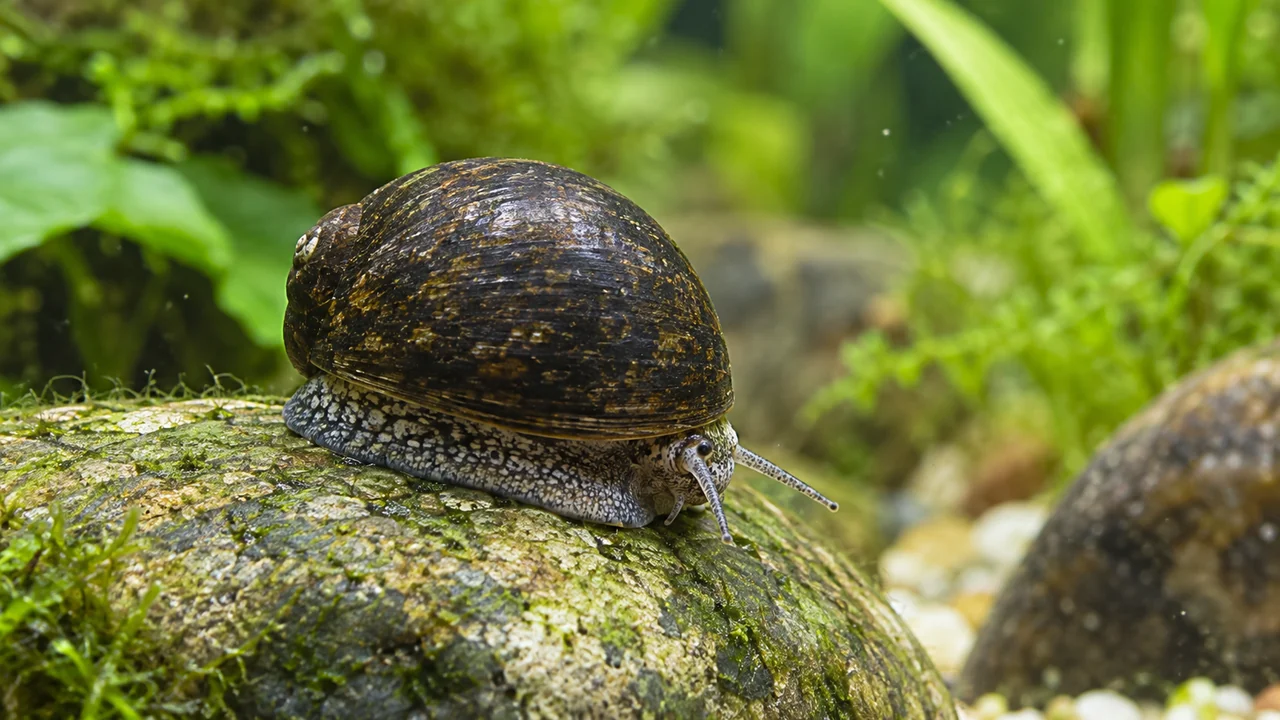
- Identity
- Neritina pulligera (Linnaeus, 1767); a neritid. The date is sometimes incorrectly given as 1758.
- Adult scale
- Commonly around 2–3 cm shell size; the institutional description includes specimens up to 4 cm.
- Practical space
- An established aquarium around 60 cm long / 54 litres is a useful starting plan for a lightly stocked setup, not a biological minimum.
- Maintenance plan
- 22–26°C; pH 7.0–8.2; moderate mineral content, with a practical GH 6–12°dGH and KH 4–8°dKH starting plan.
- Food
- Mature attached algae and biofilm, with supplementary food acceptance checked individually.
- Reproduction
- Separate sexes and planktonic veligers; routine completion in an ordinary freshwater aquarium is not expected.
A helmet-shaped grazer from connected waters
Neritina pulligera has a rounded, dark brown to charcoal shell whose final whorl largely hides the spire. The broad foot holds it against a surface; an operculum closes the opening when the animal withdraws. It is not a ramshorn and does not have the tall tower of a trumpet snail. A dark shell alone, however, does not identify every nerite sold under a helmet label.
Kerr's institutional checklist places it widely in the Indo-western Pacific and describes rocky, flowing fresh to brackish rivers, particularly near the sea. That connection helps explain the life cycle. It does not mean an established freshwater adult should suddenly be put into salt water, nor that every advertised black nerite has the same provenance.
Give grazing space time to mature
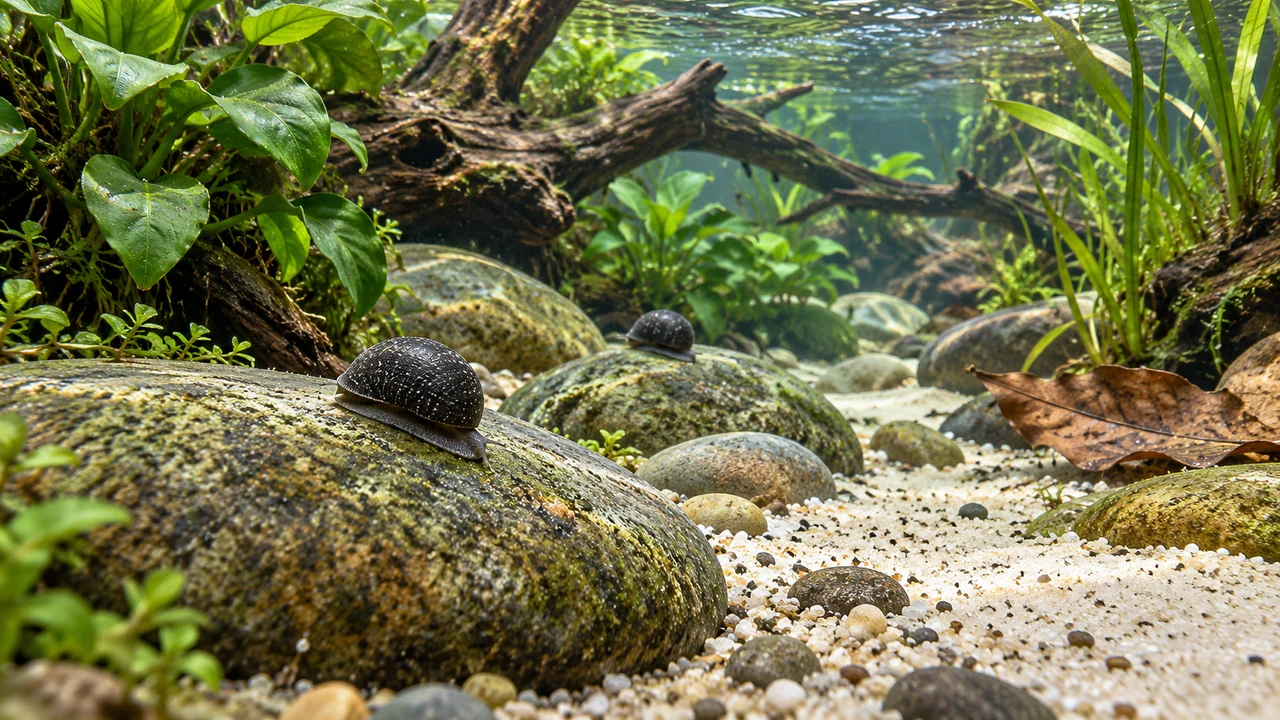
Choose an aquarium with established growth on stones, wood and glass before buying the snail. Around 54 litres with a 60 cm frontage is a practical starting arrangement for one or a few lightly stocked animals; the useful food-bearing surface matters more than the number printed on the tank. A freshly scrubbed larger aquarium can still offer too little to eat.
Use stable rounded stones, secure wood and planting around an accessible foreground. Maintain useful flow and surface movement without making every surface a turbulent jet. Fit a cover and inspect cable gaps because nerites can leave the water. Never pull a firmly attached snail sideways off glass: wait for it to release or move the object supporting it safely.
Choose shell-friendly water rather than an extreme tint
A sensible adult maintenance plan is 22–26°C and pH 7.0–8.2, within the broader published trade guidance. GH around 6–12°dGH and KH around 4–8°dKH provide a moderate-mineral starting plan; these selected working bands are not experimentally proven species thresholds. Check the source aquarium and avoid abrupt changes when moving an animal.
GH indicates calcium and magnesium together, while KH describes buffering; neither is a complete calcium analysis. Use properly prepared replacement water and verify the resulting measurements. Ammonia and nitrite should remain undetectable. Good oxygenation and steady filtration support both the snail and its food-bearing surfaces; tolerance of a river margin is not permission to neglect aquarium waste.
Watch the foot and feeding surface
The snail rasps attached growth while its broad foot moves over the stone. Brown diatom films and other suitable soft surface growth are useful resources. A clean-looking path is evidence of grazing, but it cannot tell you how much nutrition remains elsewhere. Watch activity and access to food rather than expecting it to polish an entire aquarium indefinitely.
Offer suitable sinking snail food or an algae-bearing feeding stone and check whether this particular animal uses it. Some transported nerites initially ignore prepared foods. A tablet lying untouched is not proof of feeding. Maintain mature grazing surfaces while trialling small portions, and remove leftovers. Do not deliberately foul the water or leave vegetable pieces decomposing in an attempt to grow more algae.
When trialling prepared food, a small fragment of Premium Natural Spirulina Tablets is one supplementary option to place where feeding can be seen. Confirm that this nerite actually rasps it, retain mature grazing surfaces and remove the portion if it remains unused.
Shell growth is a continuing requirement
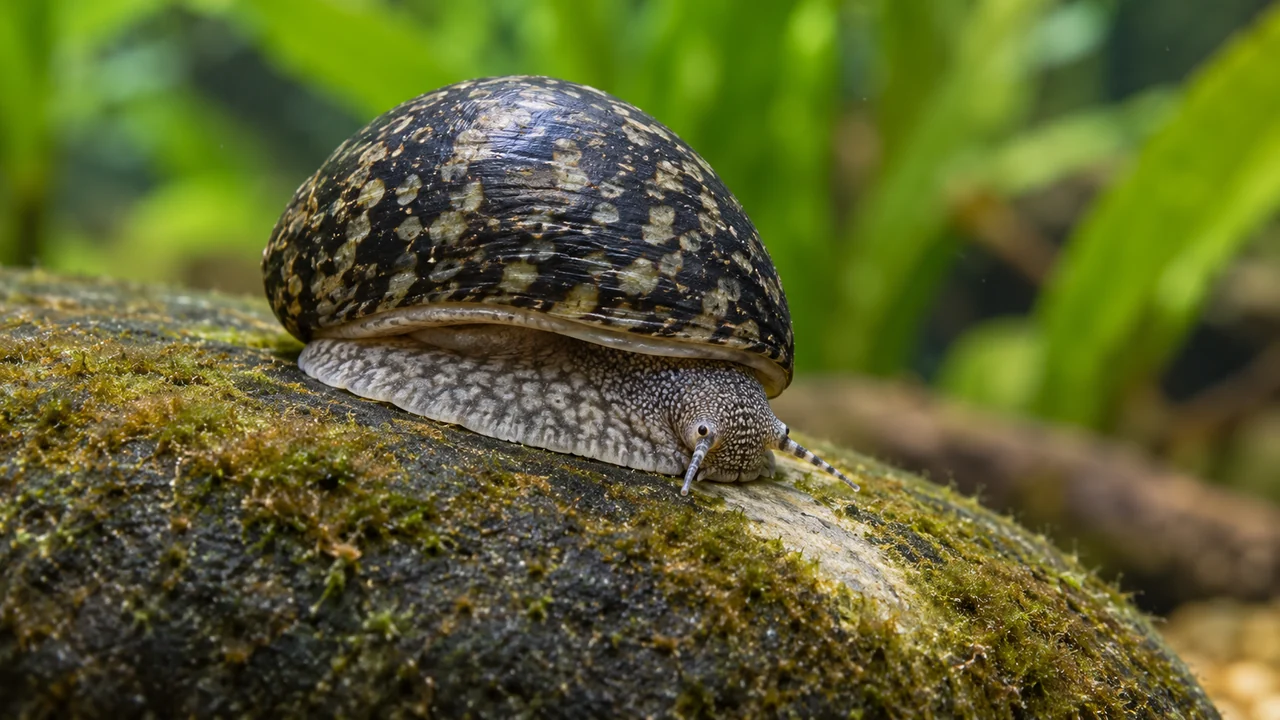
Inspect the newly forming shell edge as well as the oldest tip. Pitting, whitening and a rough dissolving surface warrant checks of pH, mineral preparation, food and recent changes. Existing erosion usually remains visible; improved conditions support later growth rather than restoring the original appearance of an old damaged shell.
A measured mineral adjustment is more useful than adding several unknown supplements. Crushed coral or other calcareous material can alter alkalinity and hardness, so use it only as part of a monitored water plan. A calcium-bearing diet and suitable water complement one another. Neither a leaf nor a branded food can guarantee protection against every shell problem.
Companions must leave the animal able to feed
Peaceful fish and suitably matched dwarf shrimp can share the aquarium when they neither bite the foot nor monopolise all grazing and supplementary food. Compare their temperature and mineral needs first. A warm, very soft bee-shrimp recipe is not automatically suitable simply because both animals are small invertebrates.
Avoid snail-eating fish, predatory crayfish and assassin snails. A shell is not a promise of safety from persistent attacks. Stock lightly enough that several grazers are not competing over the same diminishing film. If the snail repeatedly withdraws when neighbours approach, provide separation rather than assuming that a quiet animal is merely resting.
Egg capsules are not a freshwater population boom
Males and females are separate, and females may attach small hard capsules to solid surfaces. Kerr describes a planktonic veliger stage; a capsule is therefore not equivalent to a fully formed miniature snail. Ordinary freshwater maintenance does not reliably complete the life cycle, even when capsules are conspicuous on wood or glass.
Accounts of saline larval development should not be converted into an invented home recipe with a fixed salt dose and guaranteed hatch date. Larval nutrition, salinity and settlement require a dedicated, documented project. Keep adult freshwater care stable instead of adding salt to a community aquarium because eggs have appeared.
Botanicals as extra surfaces
A few prepared leaves and broad pieces of wood can diversify the grazing area and create shaded edges. Retain plenty of exposed stone and glass; a thick layer of litter is not a substitute for established attached growth. Position leaves where their condition can be inspected and food cannot disappear into inaccessible pockets.
Botanical tint does not demonstrate suitable pH or minerals. Check measurements after additions and keep the shell-friendly water plan intact. If leaves accumulate waste, thin them and improve access rather than interpreting darker water as a better habitat for this grazer.
A prepared Dried Guava Leaves – Natural Aquarium Leaf Litter leaf is one option for the small shaded margin beside established stones and glass. Keep its role as extra structure; a fresh leaf is not an instant replacement for mature grazing films.
When a nerite stops moving
Check temperature, ammonia, nitrite, oxygenation, recent treatments and food availability before making several changes at once. A resting or tightly closed snail is not automatically dead. If it is upside down and cannot regain a grip, place it upright on a stable submerged surface without forcing the operculum open.
Check escape routes and the surroundings if the animal disappears. Avoid copper-containing treatments unless specifically confirmed safe for the actual product and dose. Keep handling brief and gentle, and investigate persistent inactivity, damaged tissue or unmistakable decomposition promptly. More food will not correct a water-quality or poisoning problem.
Further reading and sources
Scientific identity and field observations are separated from practical aquarium advice. The care plan is a husbandry recommendation, not a measured survival envelope; commercial names do not certify species identity. Numerical maintenance bands and suggested aquarium dimensions are BBA planning recommendations informed by the sources, not guarantees or wild-site measurements.
- Kerr (2013), University of Guam — aquatic-snail checklist — Institutional account of identity, shell, distribution and veliger development; not an aquarium nursery protocol.
- Australian freshwater mollusc key — Neritina pulligera — Taxonomic and identification context; historical synonym lists require comparison with current usage.
- Garnelio — Neritina pulligera husbandry — Commercial keeping experience: 22–28°C, KH above 3, mature food-bearing aquarium and 54-litre recommendation. The narrower BBA plan is editorial advice, not a field measurement.