One of the things I like most about paludariums is that the same natural material can play completely different roles only a few centimetres apart. A pod underwater is not experiencing the same environment as the same pod sitting at the wet edge. A leaf resting on drained land behaves differently from one permanently submerged.
A woody piece bridging water and land has a completely different job from a piece lying loose in the litter. That is why I would never choose a botanical for a paludarium simply by asking: “Is this aquarium-safe?”
The better question is: Where is it going, and what do I expect it to do there?
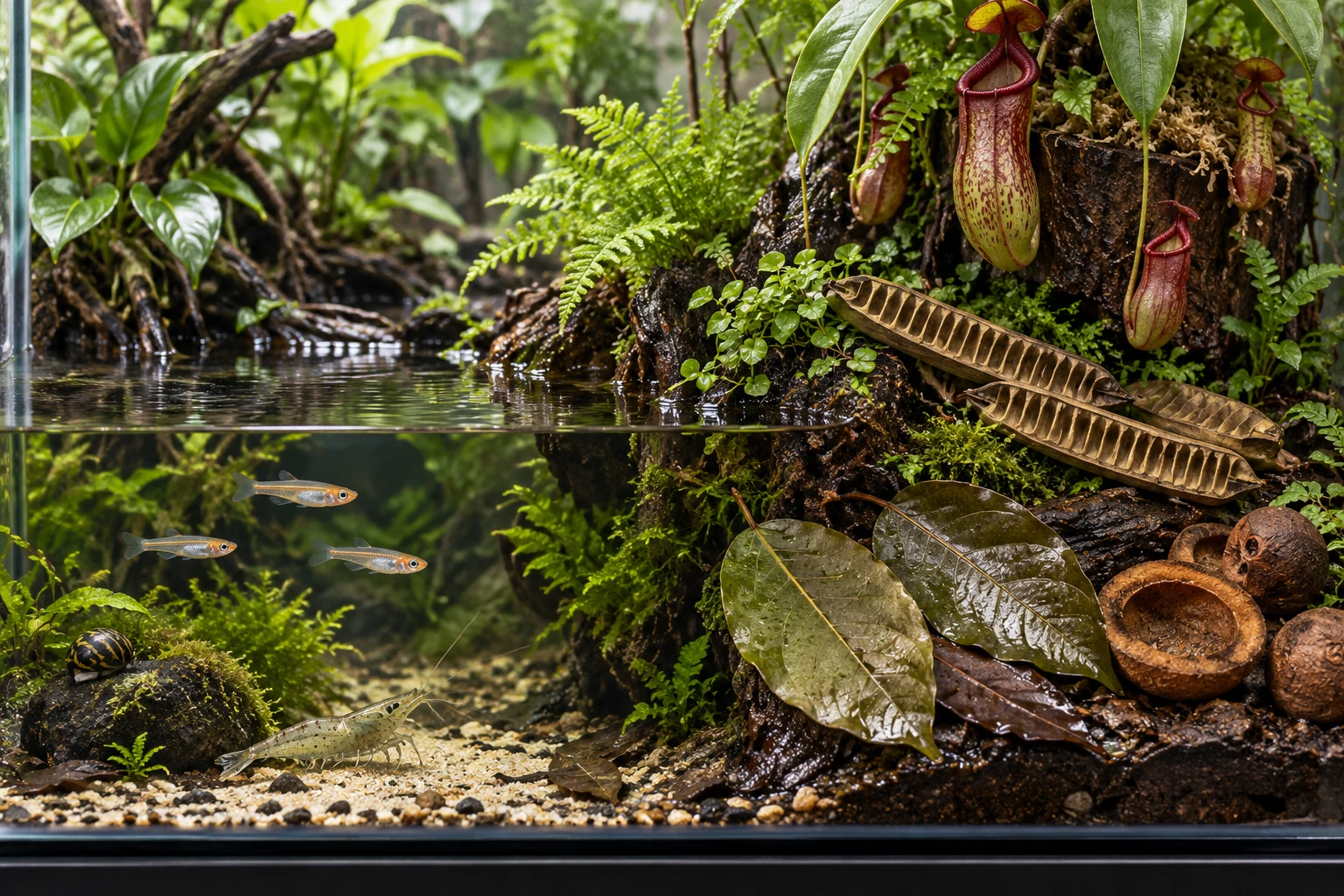
Material, zone and function belong together
For me, these are the three things I would always think about together: What is the material? Which moisture zone will it live in?
What job am I asking it to perform? A botanical may look perfect in a photograph but still be the wrong choice for the role. A lightweight piece may be beautiful underwater but float until it becomes waterlogged.
A hollow pod at the wet edge may collect splash water. A broad leaf on damp land may work perfectly as litter. A woody piece above the waterline may look excellent but still need secure support if an animal is going to climb over it.
The name of the botanical does not make those decisions for you. The position does.
I would divide the paludarium into four practical moisture zones
You do not have to build four perfectly separated bands. Real paludariums blend gradually. But these four zones make it much easier to think about what the material is actually experiencing.
That is already much more useful than treating every botanical as though it lives in one generic “paludarium condition”.
1. Continuously submerged
- Condition
- The piece stays underwater. Here I am thinking about:
- What I check
- waterlogging;
- sinking or floating;
- softening;
- openings and cavities;
- aquatic access;
- gradual breakdown;
- debris collecting where I cannot see it.
2. Wet edge or splash zone
- Condition
- The piece may be partly immersed, repeatedly splashed or constantly damp. Now I care about:
- What I check
- drainage;
- trapped water;
- stability while wet;
- changing water level;
- animal routes between water and land.
3. Damp but drained land
- Condition
- The botanical stays humid but is not permanently submerged. Here I am watching:
- What I check
- drainage underneath;
- decomposition;
- debris accumulation;
- whether the piece can still be lifted and inspected;
- whether animals can move around or beneath it.
4. Drier or elevated structure
- Condition
- The material sits higher above the wettest part of the enclosure. Now its job may be:
- What I check
- cover;
- a route;
- visual structure;
- an elevated natural element.
- Further checks
- And the questions become:
- What I check
- Is it secure?
- Could it shift?
- Could it fall?
- Does repeated misting change it?
- Is it actually strong enough for the intended animal use?
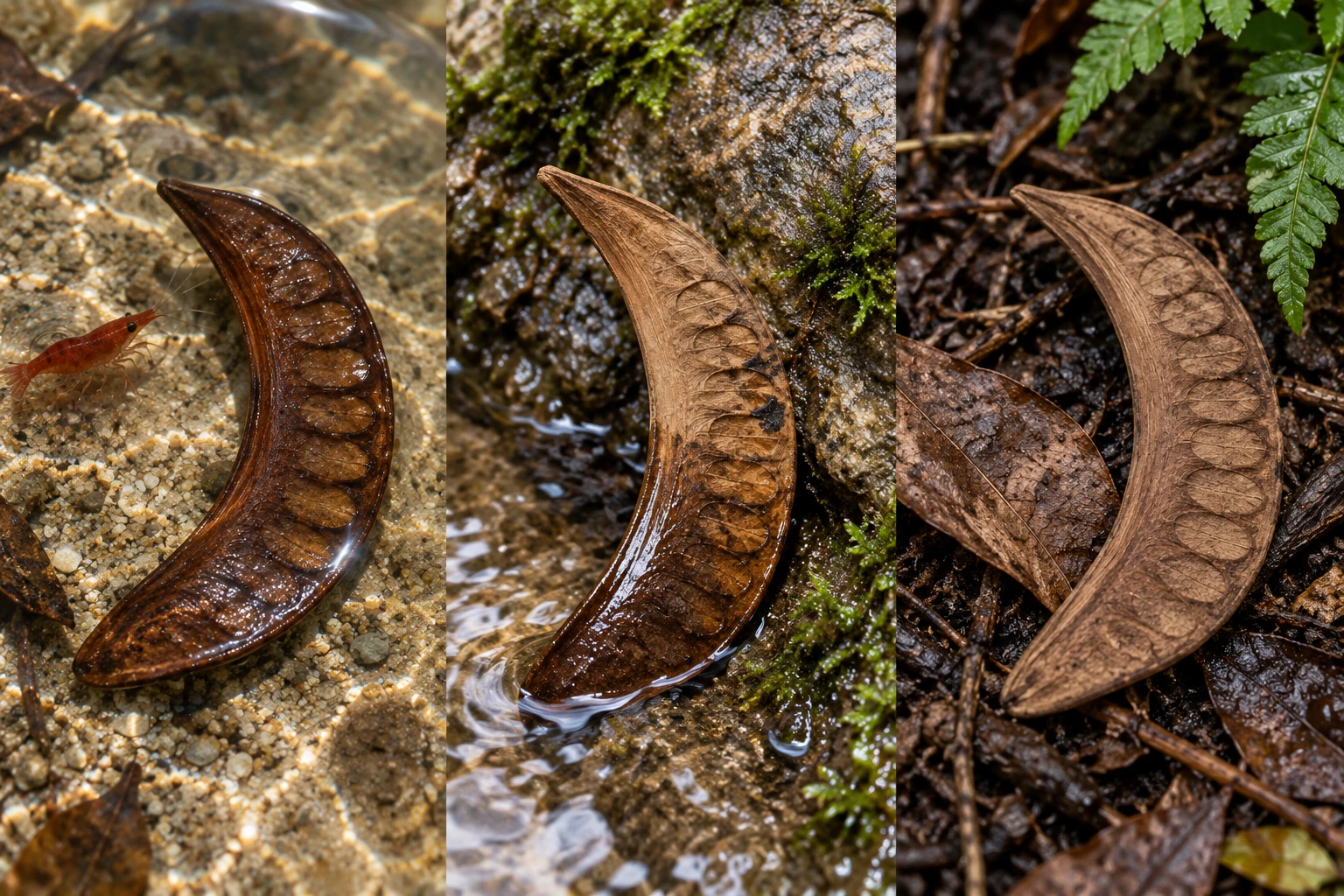
Underwater: expect the material to change
A dry botanical does not remain the same after submersion. It may become heavier. It may darken.
It may soften. It may release colour. A piece that floated initially may later settle.
A rigid opening can become softer or slightly change shape as the material ages underwater. That is why I would not judge a submerged botanical only by how it looked on the day I placed it. I want to know what it becomes after water has been through it for a while.
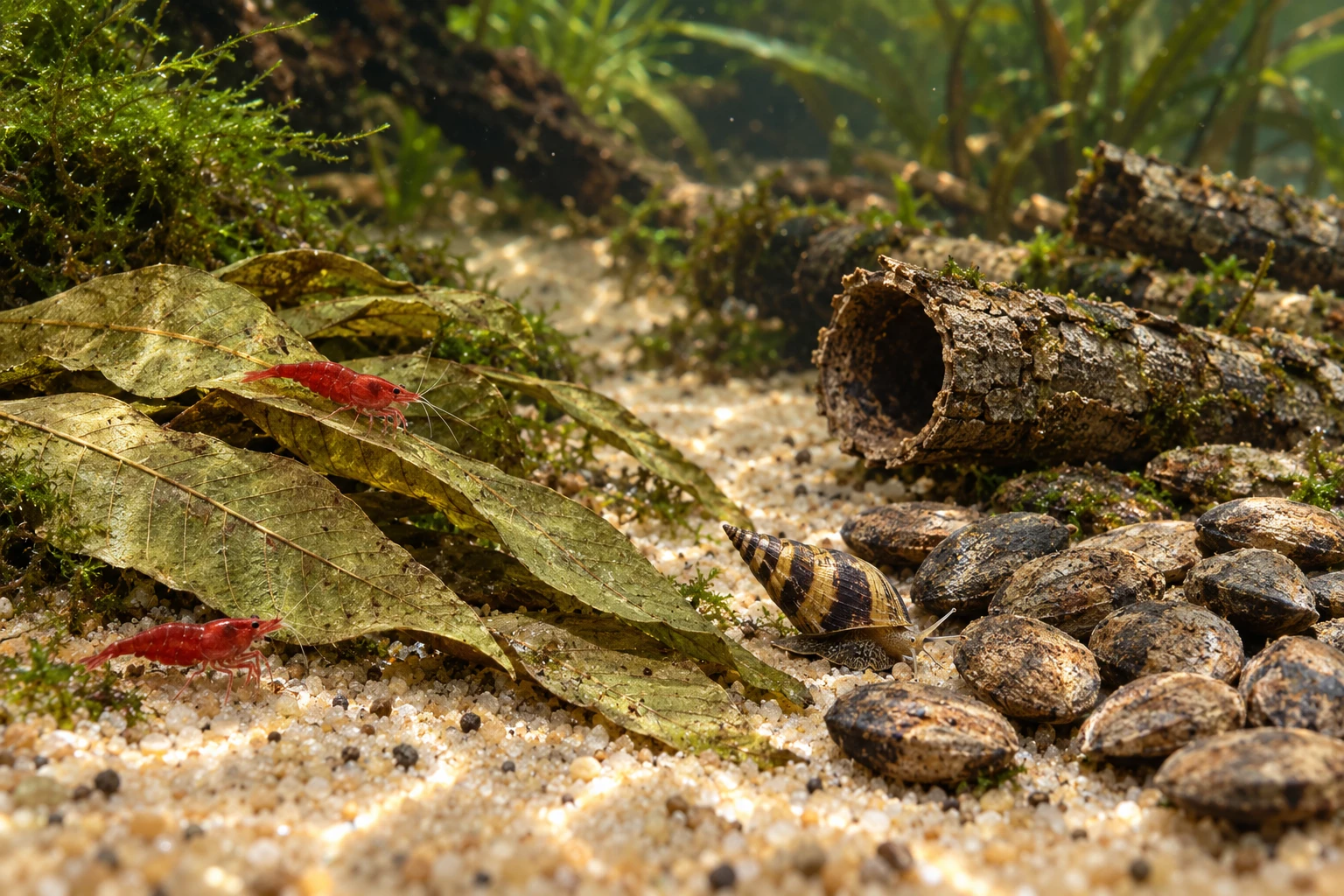
A cavity underwater needs to remain usable
If fish or invertebrates can enter a hollow piece, I would keep checking it. Can they still get out? Has debris collected inside?
Has softening changed the opening? Has a rough edge appeared? Has the piece moved into a different position?
For related access checks, read Openings, Sharp Edges and Trapping Risks.
The wet edge is probably the most interesting zone
This is where the same material can behave in ways that do not happen fully underwater or fully on land. A piece may be: wet underneath,
drying on top, splashed several times a day, partly immersed,
then exposed again. That creates a very different environment. And visually, this is where a paludarium can become really beautiful.
Roots crossing the waterline. Leaves caught at the bank. Pods resting partly in water.
Bark and woody pieces linking the edge to the land. But I still want that beauty to remain inspectable.
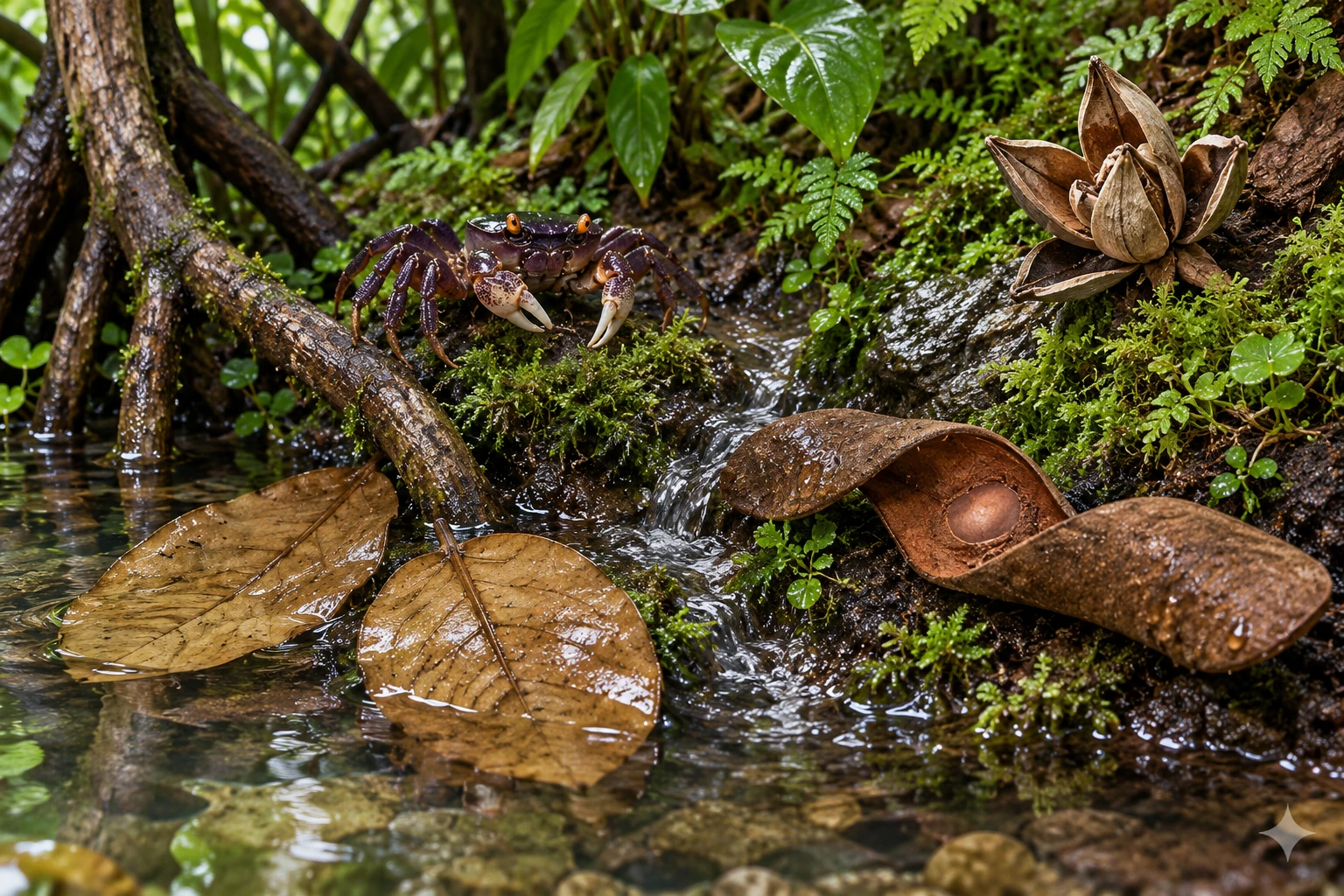
Hollow pieces at the edge deserve special attention
A hollow pod or cupped botanical can catch water. That is not automatically good or bad. The important questions are:
Is the water supposed to stay there? Can it drain? Can I inspect it?
Can debris collect inside? Can an animal enter and leave safely? A tiny water-filled cavity is not the same thing as the filtered aquatic section of the paludarium.
Its volume, circulation, oxygen exchange and refresh rate can be completely different. So I would treat it as its own small feature, not as a miniature aquarium.
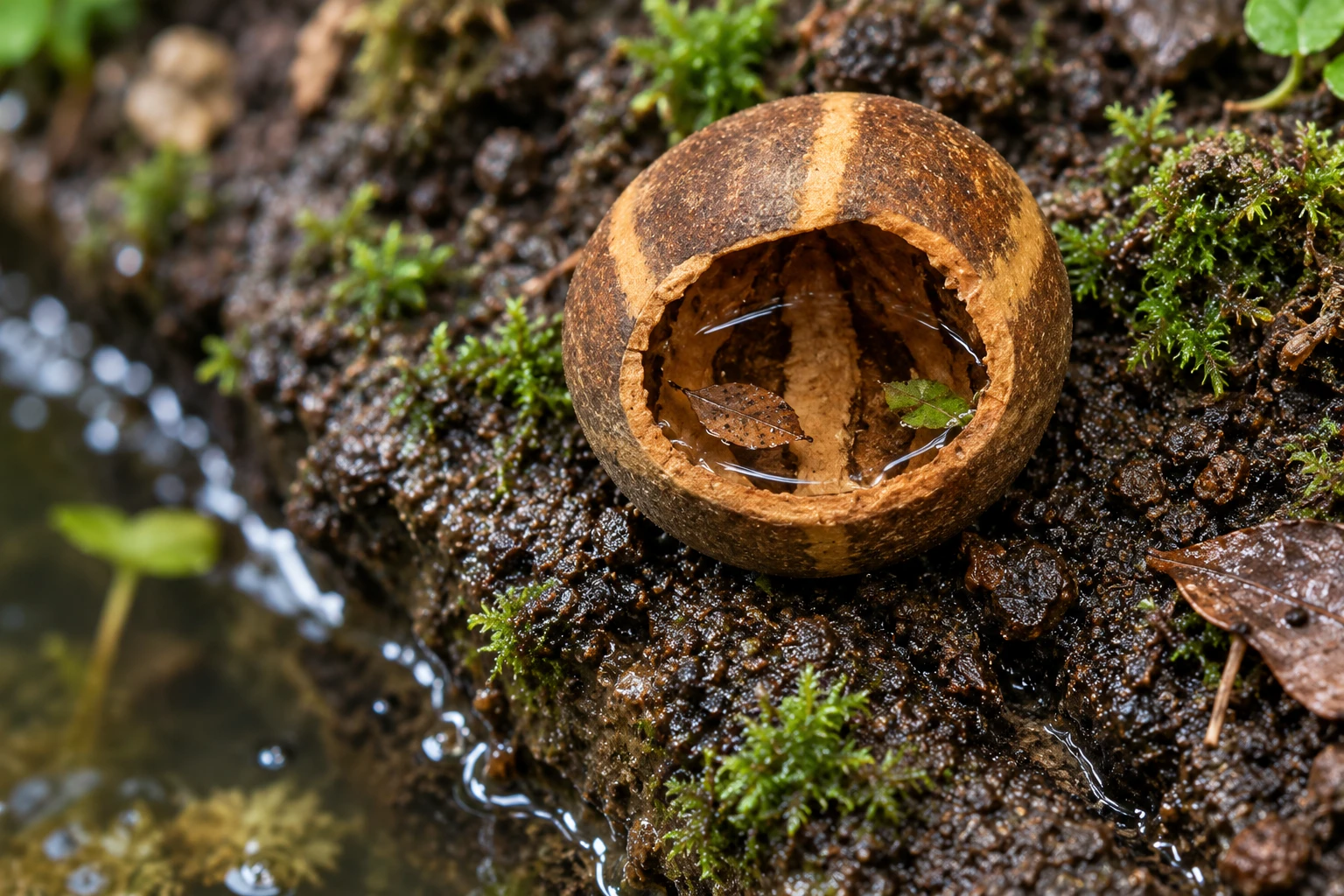
Damp land: natural litter works beautifully if the ground can still breathe
On the terrestrial side, leaves and botanicals can create a completely different kind of habitat. Here I like:
- loose litter;
- seed pods;
- bark;
- husks;
- textured natural pieces;
- woody fragments.
They can make the land section feel much more convincing than bare substrate. But the ground still has to drain. A large flat piece may keep the area underneath much wetter than the surrounding substrate.
A thick pod may trap debris. A hollow piece may collect material that is difficult to remove. So I like natural litter to look loose enough that I can still lift pieces, inspect underneath and maintain the zone.
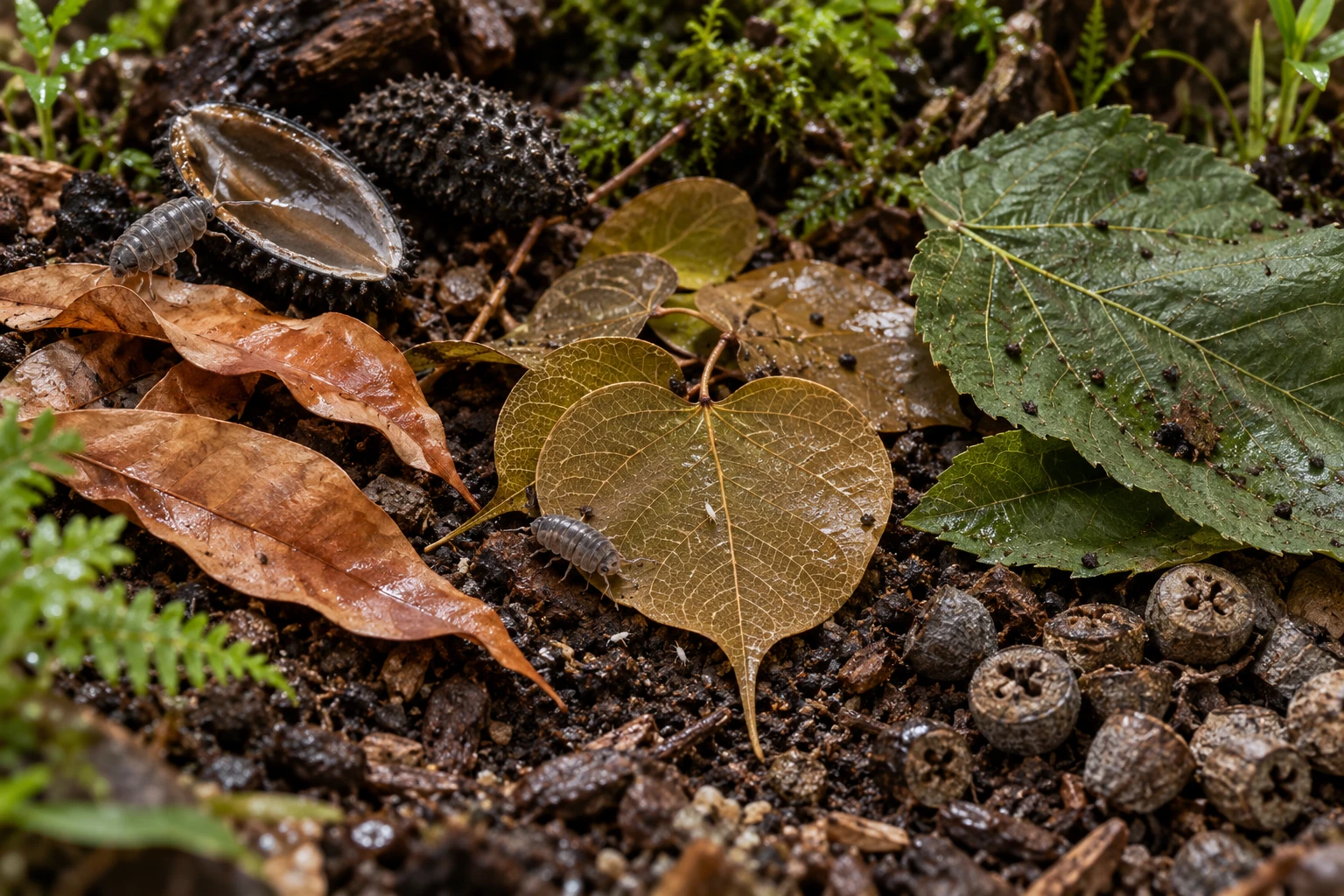
The role of a botanical can change as the piece changes
This is something worth accepting from the beginning. A piece may start life in the paludarium as a rigid shelter. Later it softens.
Now it is better used as open structure. Later again it becomes part of the litter. That is not necessarily failure.
Natural materials change. The mistake would be insisting that the botanical must keep performing the same role after its physical condition has changed. I would rather change the role.
Above the waterline, stability becomes the first question
A botanical that is completely safe lying on the substrate may be a terrible structural element if suspended above water. Once a piece is elevated, I ask:
- What supports it?
- Can it roll?
- Can it fall into the water?
- Will an animal push against it?
- Will climbing change its position?
- Does misting soften the contact point?
- Can I remove it later without dismantling everything?
A natural piece should never be treated as load-bearing simply because it looks strong while dry.
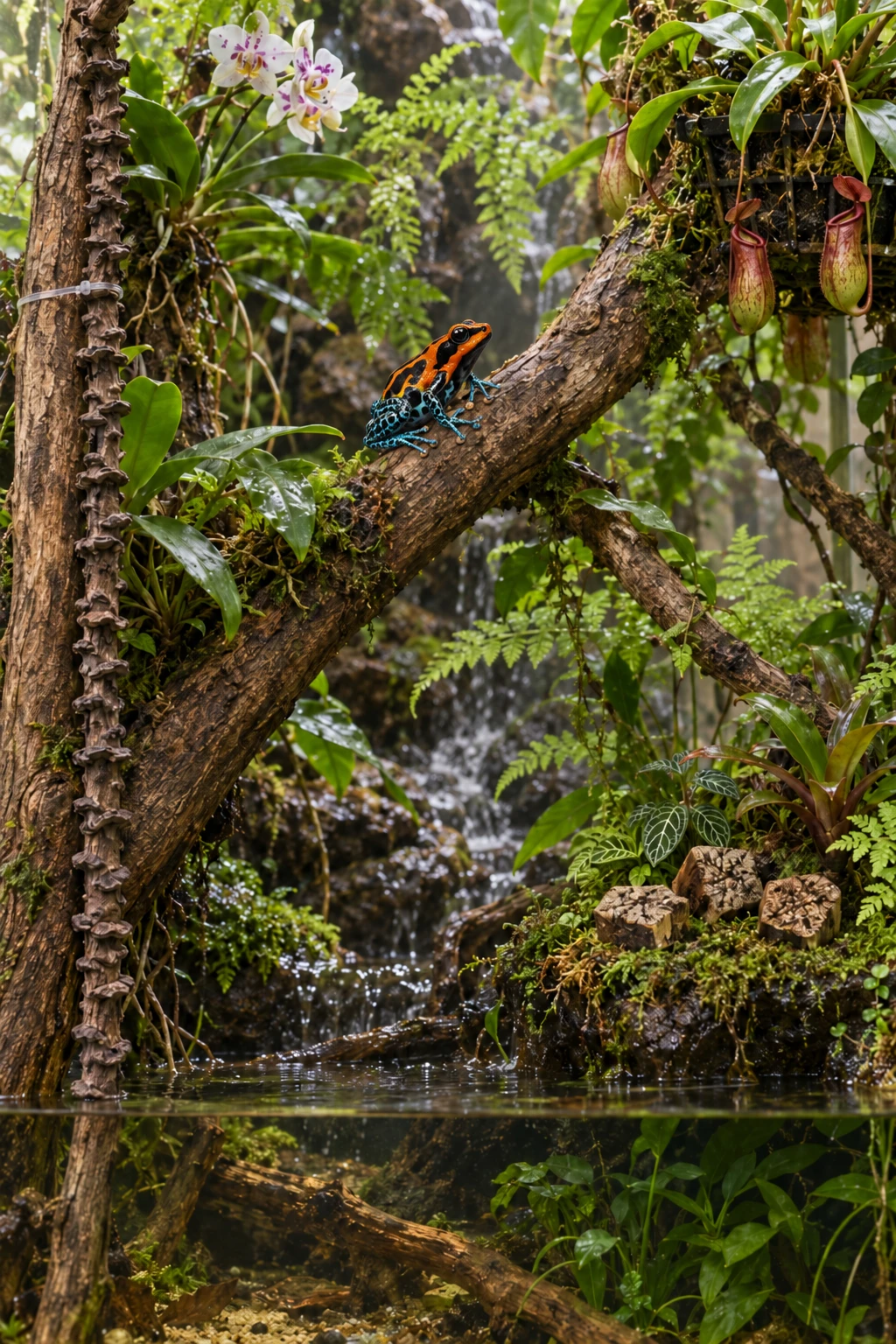
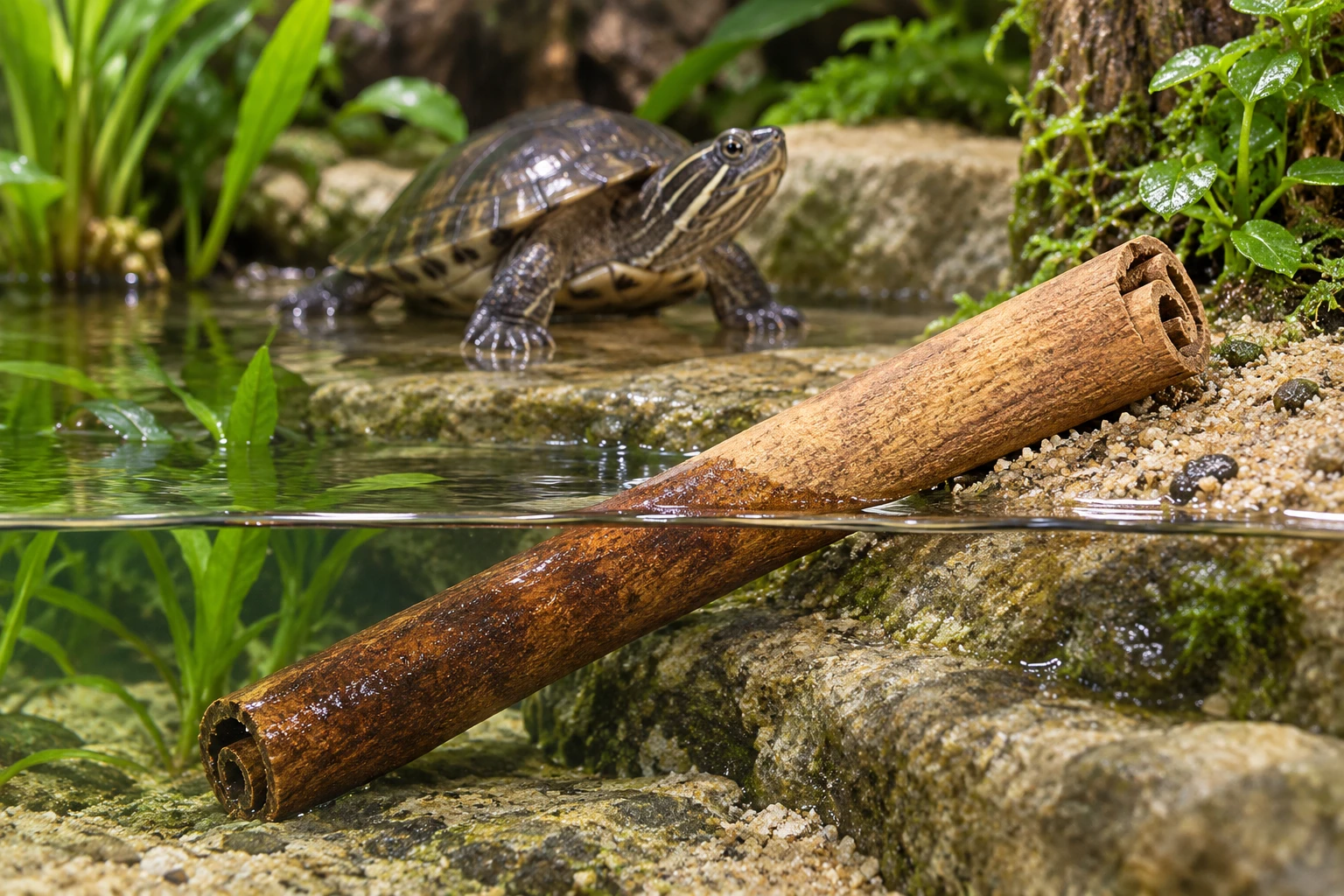
Wetting and drying can change different parts of the same piece differently
This is one of the most interesting paludarium-specific effects. Imagine a branch crossing the waterline. The lower end stays wet.
The upper end remains much drier. The submerged part may become heavier and softer. The elevated section may remain comparatively firm.
The whole piece can therefore begin behaving differently across its own length. That matters at the contact points. A piece that felt solid when installed may loosen later because the wet end changed.
So I would keep checking the actual installed position, not just the overall appearance.
White growth on a damp botanical is something to observe, not instantly name
Damp natural material may develop pale or white surface growth. That does not give me enough information to immediately call it: mould,
fungus, harmless biofilm, or contamination.
I would look at:
- smell;
- drainage;
- spread;
- material condition;
- animal behaviour;
- the surrounding setup.
Exactly the same lesson from the White Film article applies here: appearance is one observation, not the full diagnosis.
Do not choose the botanical first and invent a job for it later
This is one of the ideas I find most useful. Do not begin with: “I own this pod. Where can I put it?”
Begin with: “What does this zone need?” Does the underwater section need cover?
Does the wet edge need a transition piece? Does the land need loose litter? Does the upper area need visual structure?
Do I need a route? A cavity? A shaded surface?
Once I know the job, I can choose a botanical whose shape and current condition actually fit it. That order makes much more sense.
Four examples that explain the idea
Other existing options, including Dried Oak Leaves, Buddha Nut and Natural Volcanic Lava Rock, still need the same checks for placement, access and maintenance.
A pod fully underwater
The pod becomes waterlogged and eventually settles lower. Its surface changes. Its openings may soften. I now judge it as submerged structure, not by how rigid and clean it looked when dry.
A hollow pod at the wet edge
It catches splash water. Now the important question is whether that water is intentional, inspectable and suitable for the animal using that area. Not simply: “It looks natural.”
Leaf litter on drained land
Leaves create a humid, natural surface. But the substrate underneath still needs to drain and remain maintainable.
A woody piece bridging water and land
Now one object serves two zones. It has to handle both moisture change and structural load. That is a much more demanding role than lying loose on the substrate.
What I would inspect before placing any botanical
Before installation, I would ask: Which zone is this going into? What job should it perform?
Then:
- Will it stay wet?
- Can it drain?
- Can it collect stagnant pockets of water?
- Can it roll?
- Can it shift?
- Will an animal climb on it?
- Will an animal enter it?
- Can I inspect it later?
- Can I remove it without dismantling the paludarium?
- What happens if it softens?
Those questions make the decision much more practical.
And after installation, I keep watching the same piece
Natural material is never “finished”. I look for:
- sinking;
- movement;
- softening;
- splitting;
- trapped water;
- debris;
- changed openings;
- blocked drainage;
- altered animal routes;
- instability.
If the current condition no longer matches the original job, I change the job or move the piece. That is much more sensible than pretending the original placement must remain forever.
When I would reposition or remove it
I would act when a botanical:
- becomes unstable;
- blocks drainage;
- develops sharp or broken structure;
- traps debris I cannot reach;
- restricts an animal;
- closes an exit;
- can no longer be inspected;
- changes shape enough that its original role no longer makes sense.
Sometimes the solution is removal. Sometimes it is simply: move it ten centimetres and use it differently.
A simple rule to remember
When choosing a botanical for a paludarium, think about material, zone and function together. If those three things still make sense after the material becomes wet, moves and ages, the placement is probably much stronger.
Material
- Ask
- What is it physically?
Zone
- Ask
- How wet will it actually be?
Function
- Ask
- What job am I asking it to perform?
Frequently asked questions
Can aquarium botanicals be used on the land section of a paludarium?
Some can, depending on the material, drainage and intended role. Aquarium suitability alone does not automatically decide terrestrial use.
Can the same pod be partly underwater and partly above water?
Yes, but each part of the pod may experience different moisture and physical conditions. Check stability and how the material changes across the waterline.
Is water collecting inside a hollow pod a problem?
Not automatically. But it should be intentional or at least inspectable. A small retained pool should not be treated as equivalent to the main filtered water zone.
How often should I replace paludarium botanicals?
There is no fixed timetable. Replace, reposition or change the role when the actual condition no longer suits the job.
Is white growth on a damp botanical mould?
You cannot reliably identify every surface growth from appearance alone. Look at drainage, smell, spread, material condition and the rest of the paludarium.
Source book
Amazonian Paludariums: Where Rainforest Meets Water
Further reading about connected water, wet-edge, land and canopy habitats.
The complete educational system
Go deeper with the five-book BBA series.
Your first successfully paid BBA website order containing at least one physical product includes all five guides. Individual guides are also available for £3, or as the fixed five-guide collection for £10.