A naturalistic terrarium is not simply a box filled with leaves, pods and branches. The materials only become useful when they have a job. A leaf may create loose surface cover.
A pod may break up an open floor or create overhead shade. A piece of bark may separate a damp area from a drier one. Wood may provide raised structure or a route through the enclosure.
And the same object can be useful in one position and completely wrong in another. That is why I would never start by asking: “Can I use aquarium botanicals in a terrarium?”
I would start with: “What animal is this enclosure for, what conditions exist in this part of the enclosure, and what do I need this material to do?”
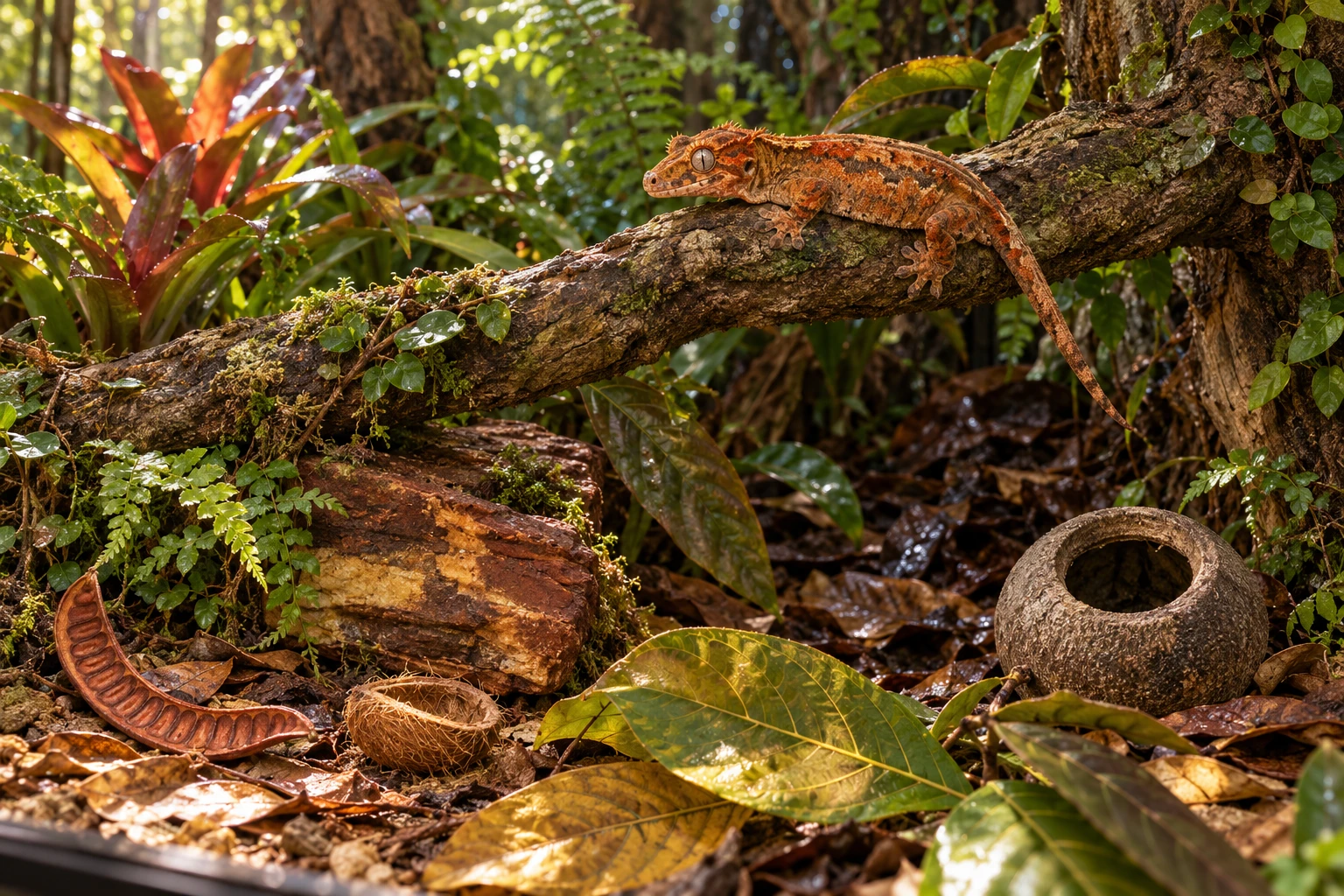
Start with species, then material, moisture and function
For me, four things belong together:
- Species
- Material
- Moisture
- Function
The animal tells me how the enclosure will actually be used.
Does it walk across the surface? Burrow? Climb?
Push under litter? Rest beneath cover? Investigate cavities?
The material tells me what I am working with. A flexible leaf behaves differently from a hard pod. A broad piece of bark behaves differently from loose litter.
Moisture changes all of them again. And finally there is the job. Is the material there as:
- loose litter;
- open cover;
- visual texture;
- raised structure;
- a shaded surface;
- or an enclosed cavity?
The name of the botanical does not decide that job for me.
Leaf litter is more than decoration
A good leaf-litter layer can completely change how the floor of a terrarium feels. It can break up bare substrate. Create shadow.
Add texture. Give small animals places to move between and beneath individual leaves. Make an open enclosure feel more complex without filling it with hard structure.
But there is a big difference between: a light scatter of leaves and
a deep litter layer. Those two arrangements behave differently. A deeper layer can:
- hold more moisture;
- hide more of the substrate;
- collect more debris;
- create more covered space;
- make inspection harder.
So I do not think in terms of one universal litter depth. I look at the animal, airflow, drainage, humidity and how easily I can still inspect the enclosure.
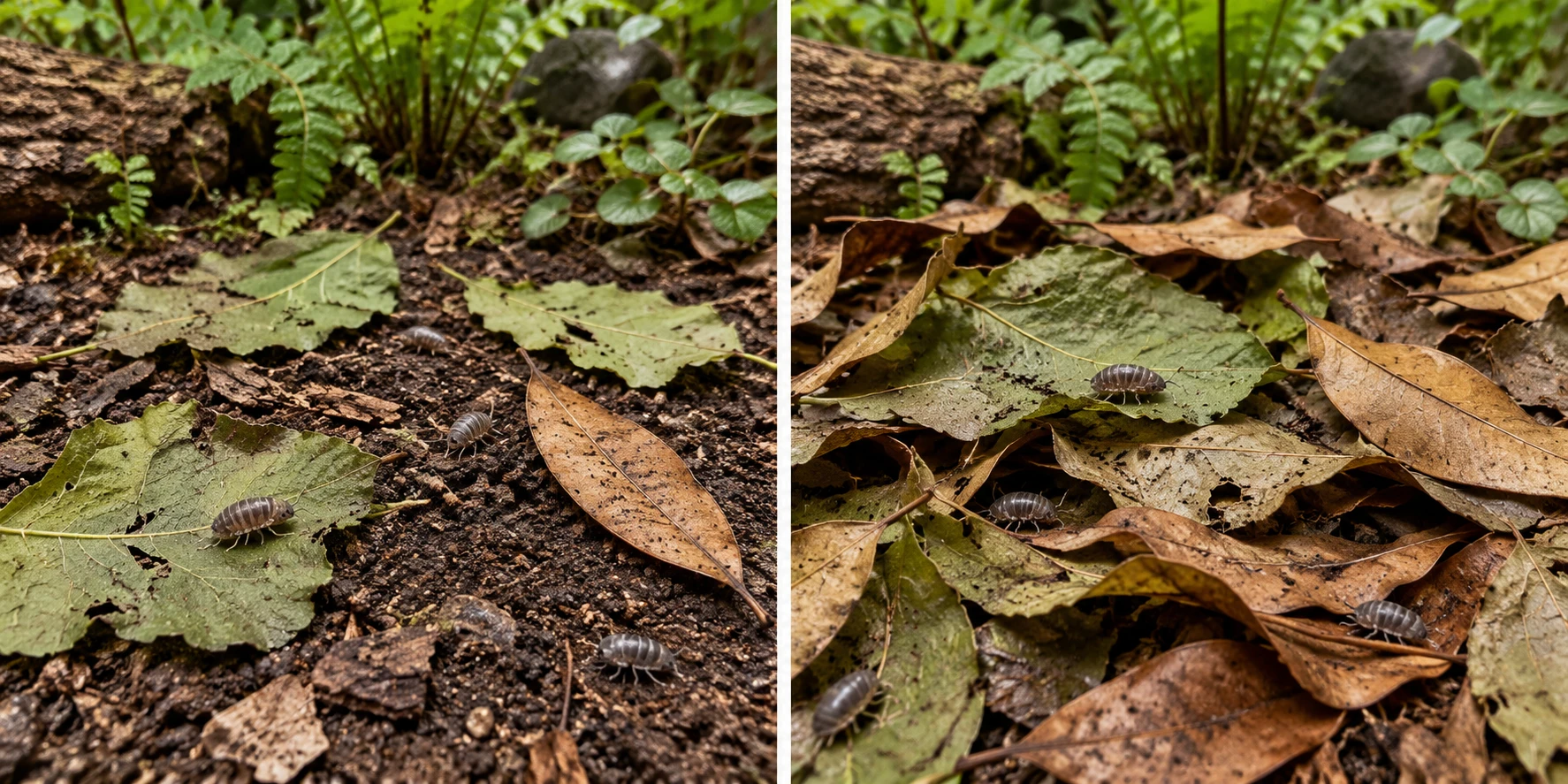
Leave some ground visible
I like litter that looks natural, but I do not need every centimetre of substrate hidden. Open areas are useful. They let me see:
- drainage;
- waste;
- substrate condition;
- animal tracks and activity;
- where water is collecting.
They also create contrast. A terrarium often looks more natural, not less, when litter is unevenly distributed. Heavy here.
Sparse there. Caught under wood. Collected beside a plant.
That is much closer to how loose natural material behaves than an evenly spread decorative carpet.
A large leaf creates a different space from many small leaves
Scale matters. One large rigid leaf can create a substantial shaded area underneath. A loose group of smaller leaves creates many small gaps and routes.
Neither is automatically better. They simply create different environments. That is why I want the litter mix to make sense at the scale of the animal using it.
A very small occupant experiences the underside of one broad leaf very differently from a larger reptile walking straight over it.
Pods do not have to be hides
This is an important distinction. A pod can be useful simply because of its shape. It can provide:
- surface complexity;
- overhead cover;
- a visual break;
- a route around or underneath;
- a different texture in the litter.
The animal does not need to crawl inside it for the pod to have a purpose. In fact, sometimes I would deliberately use a hollow piece as open structure while not presenting the cavity as a hide at all. That can be the better use.
An opening changes the question
The moment an animal can enter a cavity, I become much more interested in the shape. Now I want to know:
- How large is the entrance?
- What happens inside?
- Is there a usable exit?
- Can waste or substrate collect there?
- Will dampness remain trapped?
- Can I inspect the interior?
- Does softening change the route?
- Could the animal become wedged?
A hollow object is not automatically dangerous. But it is also not automatically a suitable refuge simply because it looks like a cave. That decision belongs to the animal and the actual piece.
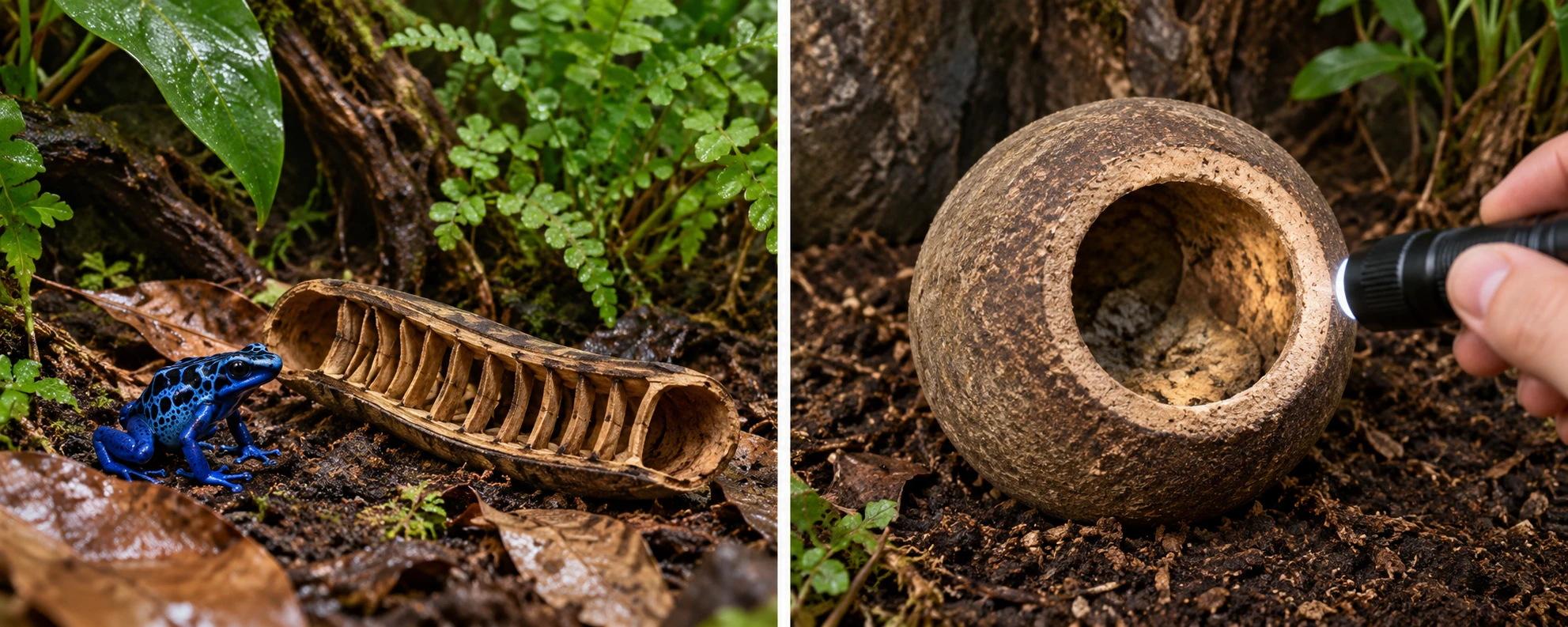
Open structure is often easier to manage
I generally find open structure easier to read. If the animal moves: around it,
under it, beside it, I can usually see both the animal and the condition of the material.
Deep enclosed cavities are different. They create hidden space. That is not automatically wrong, but it means I need stronger confidence in:
- internal clearance;
- moisture;
- stability;
- access;
- inspection.
The more enclosed the structure becomes, the more questions I want answered.
Wood has to be judged in position
Wood is one of the strongest visual tools in a naturalistic terrarium. It can create:
- height;
- climbing routes;
- shade;
- attachment points;
- visual structure;
- connections between different parts of the enclosure.
But the word wood does not tell me whether a particular piece is safe as structural support. I want to know:
- how it is fixed;
- where the weight goes;
- whether it can roll;
- whether digging can undermine it;
- whether repeated misting changes the contact points;
- whether the animal can push or climb hard enough to move it.
A branch lying decoratively on the substrate and a branch carrying an arboreal animal are doing completely different jobs.
Moisture changes natural materials
A dry leaf does not behave exactly like a damp leaf. A dry pod does not behave exactly like one sitting against wet substrate. Wood that feels rigid today may behave differently after repeated misting.
That is why I think about where the object is positioned, not only what the object is. I would divide the enclosure roughly into:
Drier areas
- What changes
- Materials may remain firmer but can become brittle.
Humid areas
- What changes
- Pieces may stay damp for long periods and dry slowly.
Damp or moisture zones
- What changes
- Water may collect underneath broad leaves, bark and pods. Drainage becomes much more important.
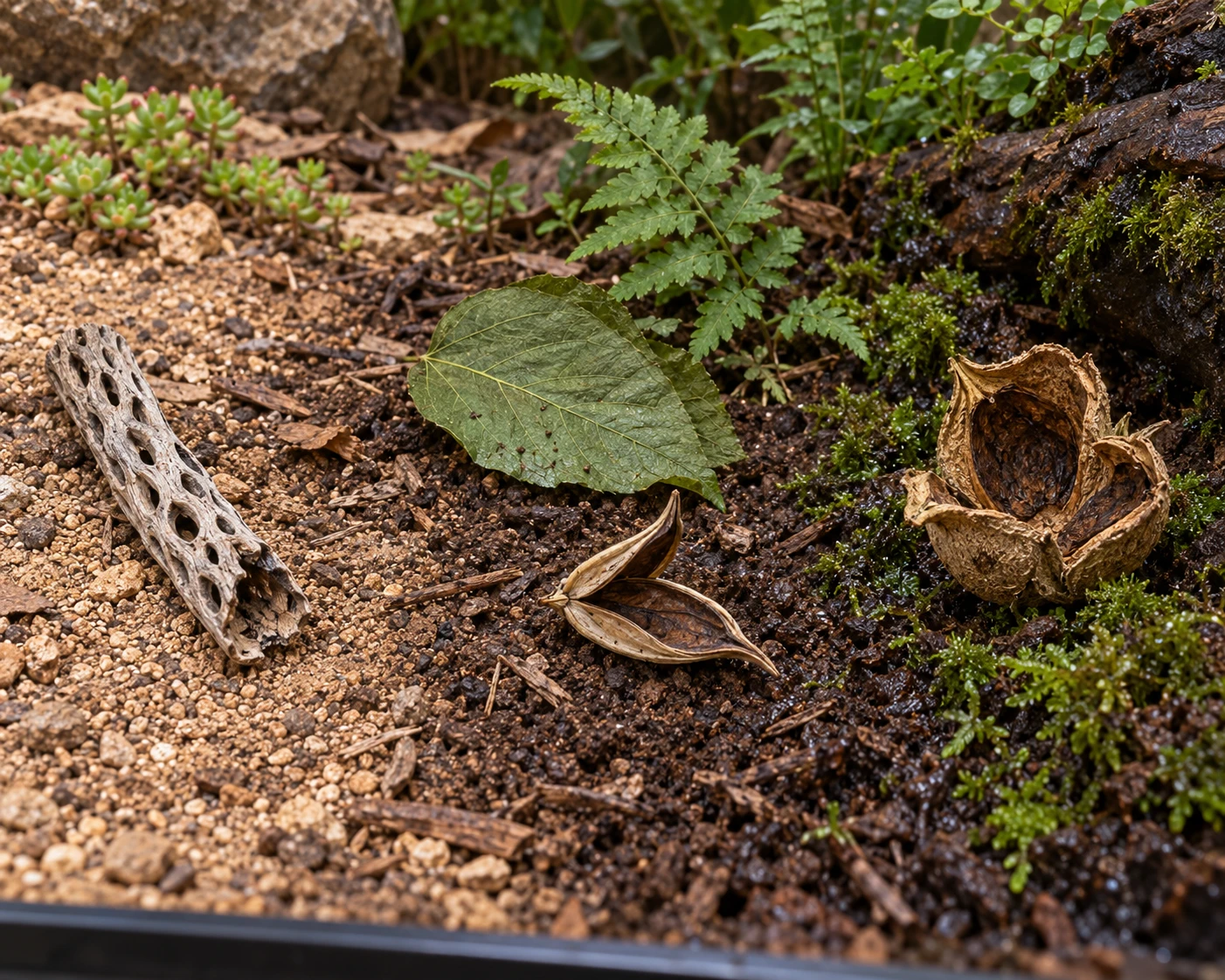
One broad leaf can create its own micro-zone
This is a lovely example of how natural material changes the enclosure. A large leaf lying over substrate can make the area underneath it:
- darker;
- less exposed to airflow;
- slower to dry;
- more humid than the open substrate beside it.
The whole terrarium may have one general humidity reading, but the space under that leaf can behave differently. That local difference may be exactly what I want. Or it may be too wet.
The only way to know is to look under the material and understand what is happening there.
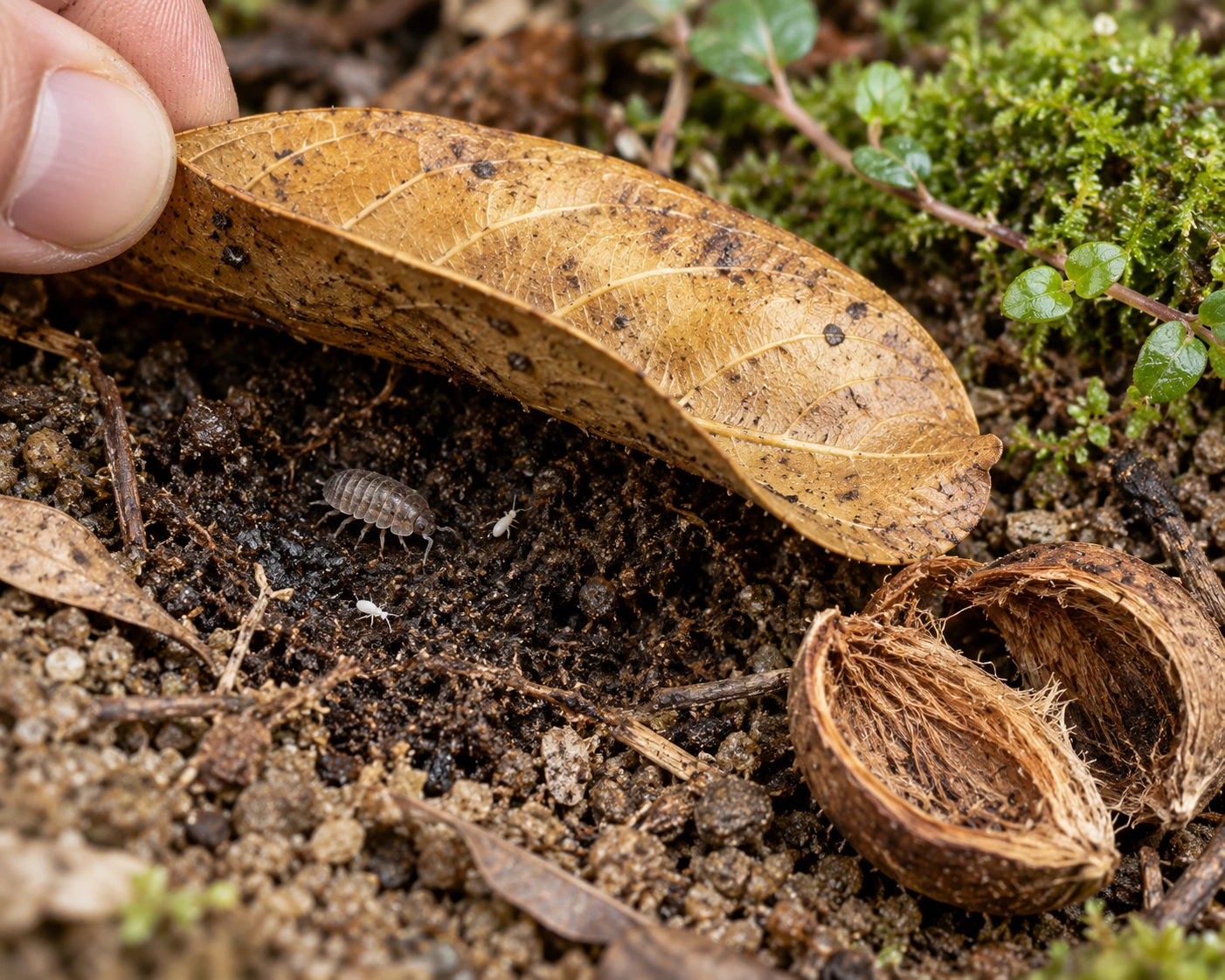
Lift things occasionally
Naturalistic does not mean “never touch anything”. During maintenance I would occasionally lift accessible pieces. Look underneath.
Check:
- moisture;
- waste;
- trapped water;
- substrate condition;
- decomposition;
- animal access.
If one part of the enclosure is hidden forever because I wanted it to look untouched, I have probably made the system harder to manage than it needs to be.
Natural material is supposed to change
Leaves break down. Pods soften. Wood darkens.
Edges change. Pieces become incorporated into the litter. That is not automatically a problem.
The question I care about is: Does the material still perform the job I gave it? A pod may start as firm open structure.
Later it softens. Now it may work perfectly well as part of the litter. That is not failure.
It is simply a different stage of the material.
Change the role when the material changes
The current condition matters more than the original appearance. We do not have to throw something away the moment it stops behaving exactly as it did when new. Sometimes we can change the role.
Rigid structure → loose cover Pod shelter → open litter element Raised bark → ground-level texture
But if the piece becomes:
- unstable;
- sharp;
- inaccessible;
- unsuitable for the animal;
- difficult to inspect;
then it is time to reposition or remove it. The role follows the condition.
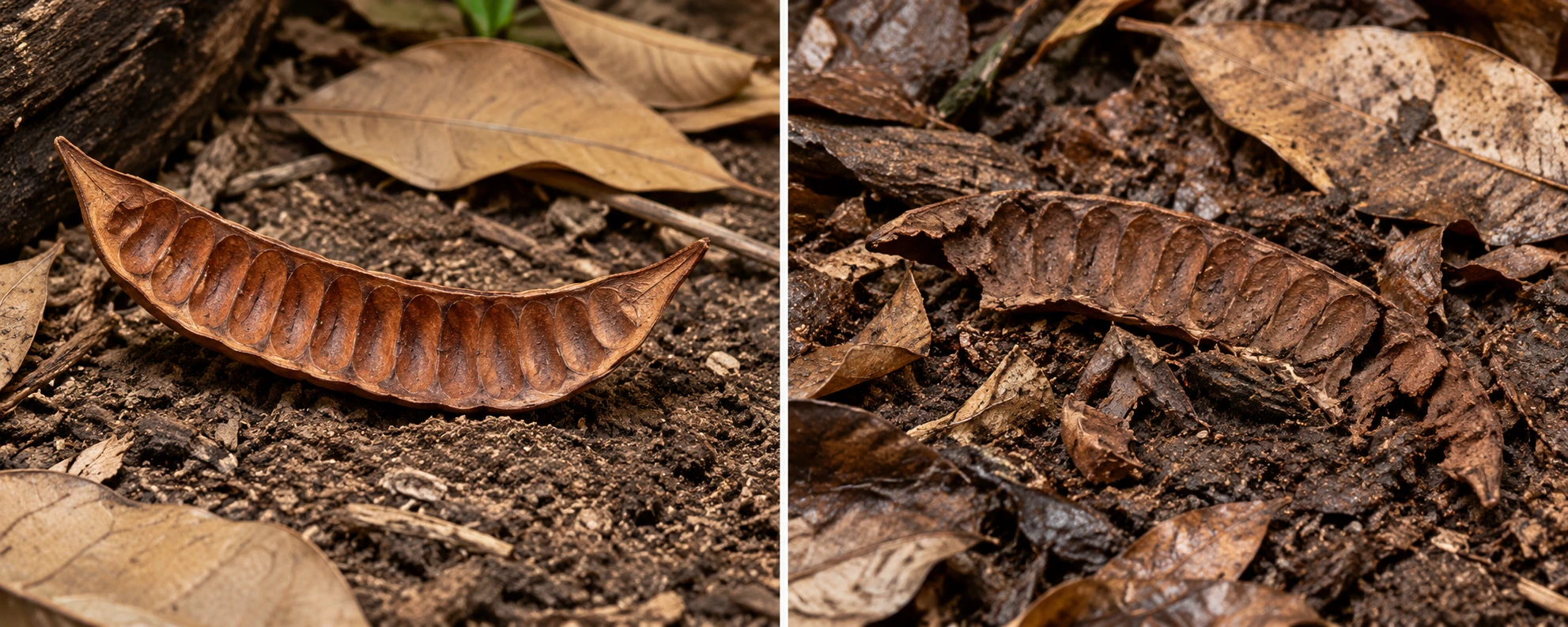
Bioactive does not mean maintenance-free
This is another myth worth killing early. Isopods, springtails and other small invertebrates can interact with decaying natural material. That does not mean every leaf is automatically food for them.
It does not mean every pod “feeds the clean-up crew”. And it certainly does not mean they will solve every accumulation problem for you. A bioactive enclosure still needs:
- inspection;
- drainage checks;
- waste management;
- stable structure;
- observation.
Biology helps. It does not remove the keeper.
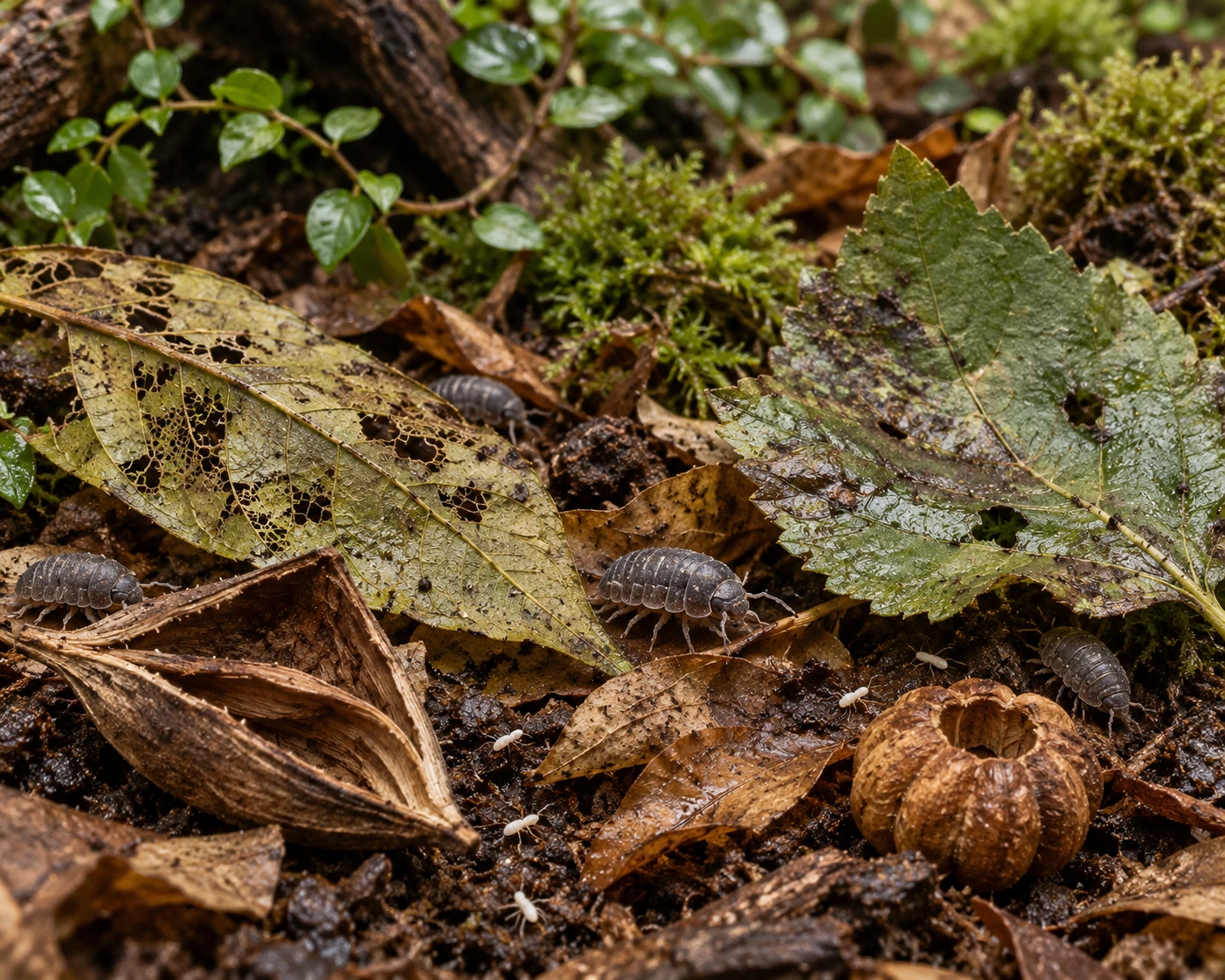
Small invertebrates experience the enclosure differently
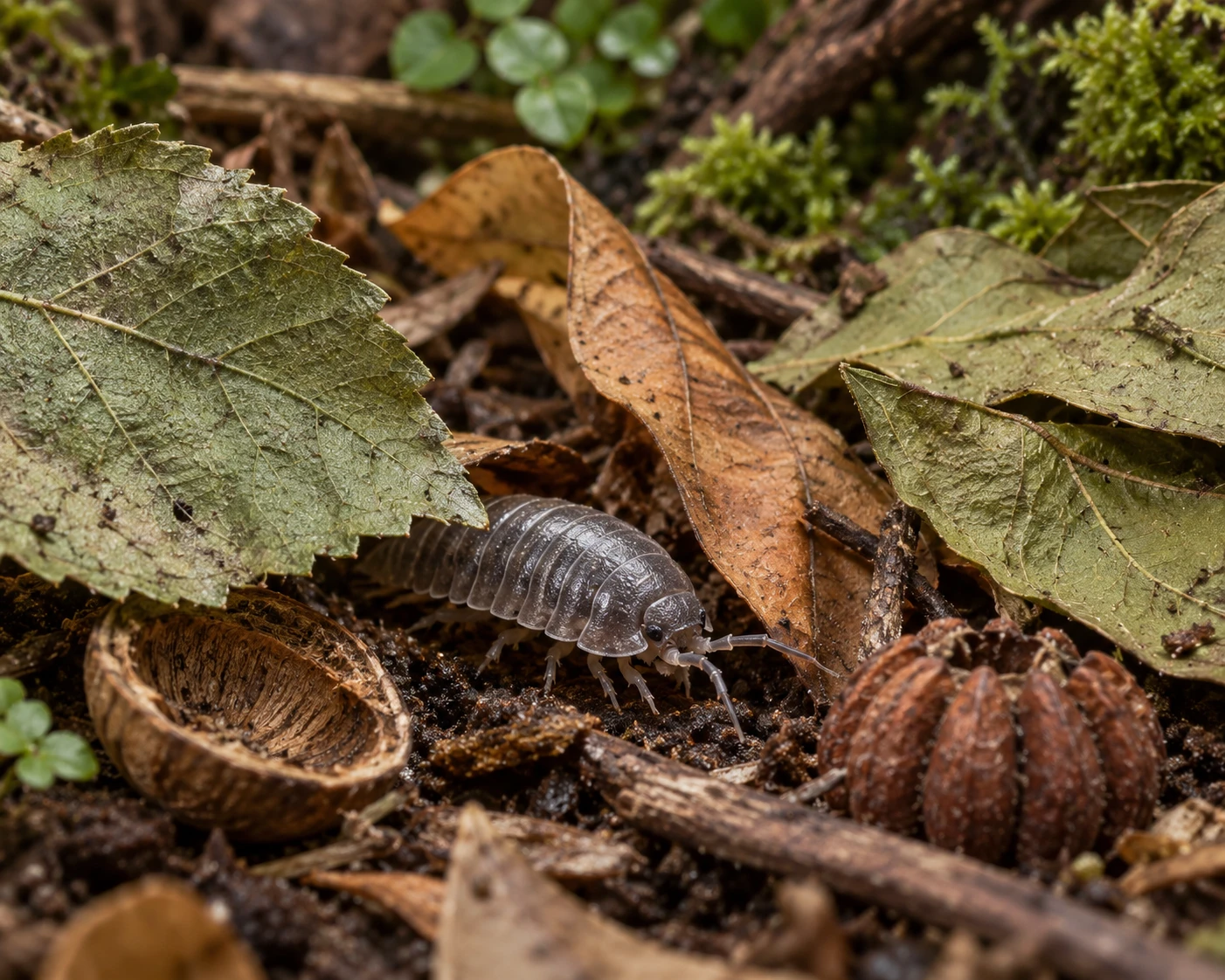
One reason leaf litter works so well in many naturalistic systems is scale. A large reptile may see a leaf as floor texture. An isopod sees:
edges, gaps, undersides,
moist contact areas. A springtail experiences an even smaller world. That is why I like material variety rather than one uniform layer.
Different shapes create different micro-spaces.
White growth on damp material is something I observe before I name
Damp natural material may develop pale surface growth. Again, I would resist immediately calling every example: mould,
fungus, biofilm, or contamination.
Instead I look at:
- smell;
- moisture;
- drainage;
- how far it is spreading;
- the condition of the material;
- animal behaviour;
- the rest of the enclosure.
One small pale patch on a damp piece and a rapidly spreading change in a poorly drained zone are not the same situation.
Do not reach for chemicals because something looks white
If a surface changes, first understand the environment. Is that area permanently wet? Can air move around it?
Is the material decomposing? Is waste collecting there? Has drainage failed?
Treating the colour alone may completely miss the real problem. And generic household chemicals have no place in a terrarium simply because a natural piece developed a pale surface.
Four examples I would recognise immediately
Leaf litter over drained substrate
- What I observe
- A loose leaf layer covers only part of the floor. Other substrate stays visible. I can inspect both the litter and the open ground.
- That is a perfectly sensible naturalistic arrangement.
A pod used as open cover
- What I observe
- The pod creates shade and visual structure. I am not offering the cavity as a hide. The animal can move around and beneath it while the structure stays easy to inspect.
A broad piece holding more moisture underneath
- What I observe
- The exposed substrate nearby dries faster. Under the leaf or bark, the ground stays damper. That local moisture difference is real and needs to suit the animal rather than simply being labelled “good humidity”.
A structural piece begins to break down
- What I observe
- The material still looks natural, but it is no longer rigid enough for the job I originally gave it. So I change the role. Reposition it.
- Use it as litter. Or remove it. I do not keep depending on yesterday's condition.
What I would inspect before placing anything
Before a natural material goes into the enclosure, I would ask:
- Is it identified?
- What animal will live with it?
- What is the intended job?
- Will this area be dry, humid or damp?
- Can water collect inside or beneath it?
- Are there sharp or broken surfaces?
- Can the animal enter the piece?
- Can I inspect the cavity?
- Can it roll or shift?
- Can I remove it later?
- What happens when it softens?
That checklist is much more useful than asking only: “Is this natural?”
What I watch during maintenance
Once the material is installed, I keep watching it. I look for:
- movement;
- decomposition;
- splitting;
- new sharp edges;
- moisture trapped underneath;
- debris;
- changed animal access;
- loss of stability;
- hidden areas becoming impossible to inspect.
If something changes, I do not automatically remove the entire naturalistic setup. I adjust the specific problem.
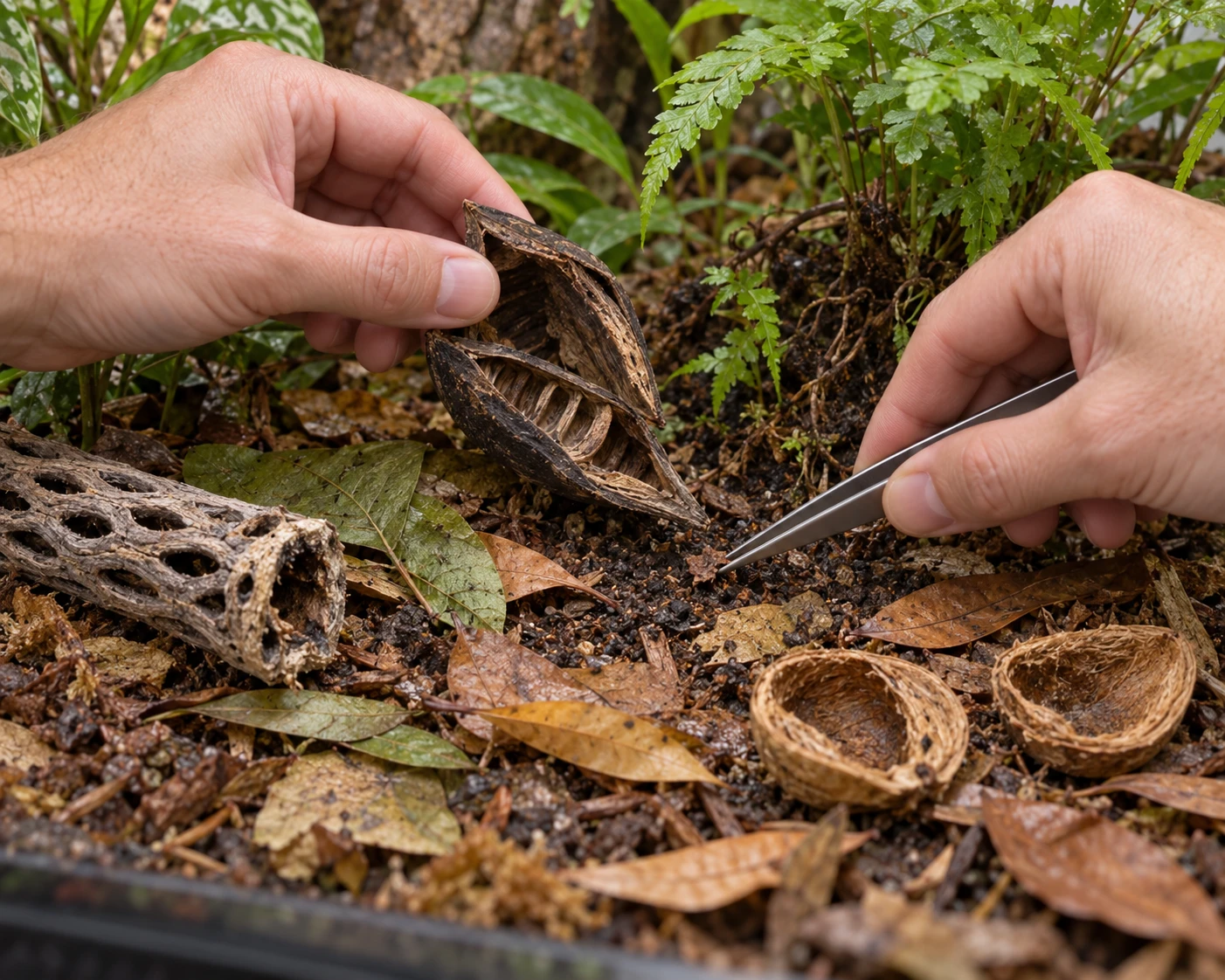
The species still comes first
This is where the two terrarium articles meet. A botanical arrangement that is excellent for one animal may be useless or inappropriate for another. Do not choose a material only because:
- it looks natural;
- another keeper uses it;
- it photographs well;
- it is popular;
- it is sold for aquariums.
Start with what the animal actually needs. Then choose the material that fits that need.
A simple rule to remember
For every terrarium botanical, I think about four connected questions.
Species
- The question
- Who is using it?
Material
- The question
- What is it?
Moisture
- The question
- How wet will it actually stay?
Function
- The question
- What job does it need to perform?
Frequently asked questions
Can aquarium botanicals be used in terrariums?
Sometimes. Aquarium use does not automatically prove terrestrial suitability. Judge the real material, the animal, moisture level and intended function.
Do isopods and springtails eat botanical litter?
They may interact with decaying natural material, but do not treat every botanical as guaranteed food or use it as a substitute for appropriate species care.
Is white growth on terrarium botanicals mould?
You cannot reliably identify every pale surface growth from appearance alone. Check drainage, smell, moisture, spread and material condition.
How often should I replace leaf litter and pods?
There is no fixed schedule. Judge the actual condition and whether the material still performs the role you gave it.
Are hollow pods safe as terrarium hides?
Not automatically. A hollow piece needs suitable entrance size, internal clearance, exit, stability and inspectability for the animal using it.
Source book
Naturalistic & Bioactive Reptile Terrariums
Further reading about species-first naturalistic and bioactive enclosure design.
The complete educational system
Go deeper with the five-book BBA series.
Your first successfully paid BBA website order containing at least one physical product includes all five guides. Individual guides are also available for £3, or as the fixed five-guide collection for £10.