Snails · Pagoda Snail
Pagoda Snail — Brotia pagodula: Habitat and Care
A sculptured river snail needs mature feeding surfaces, clean oxygenated water and food that reaches it. A pagoda-shaped trade shell deserves identification care, while livebearing biology should not become a promise of easy, prolific breeding.
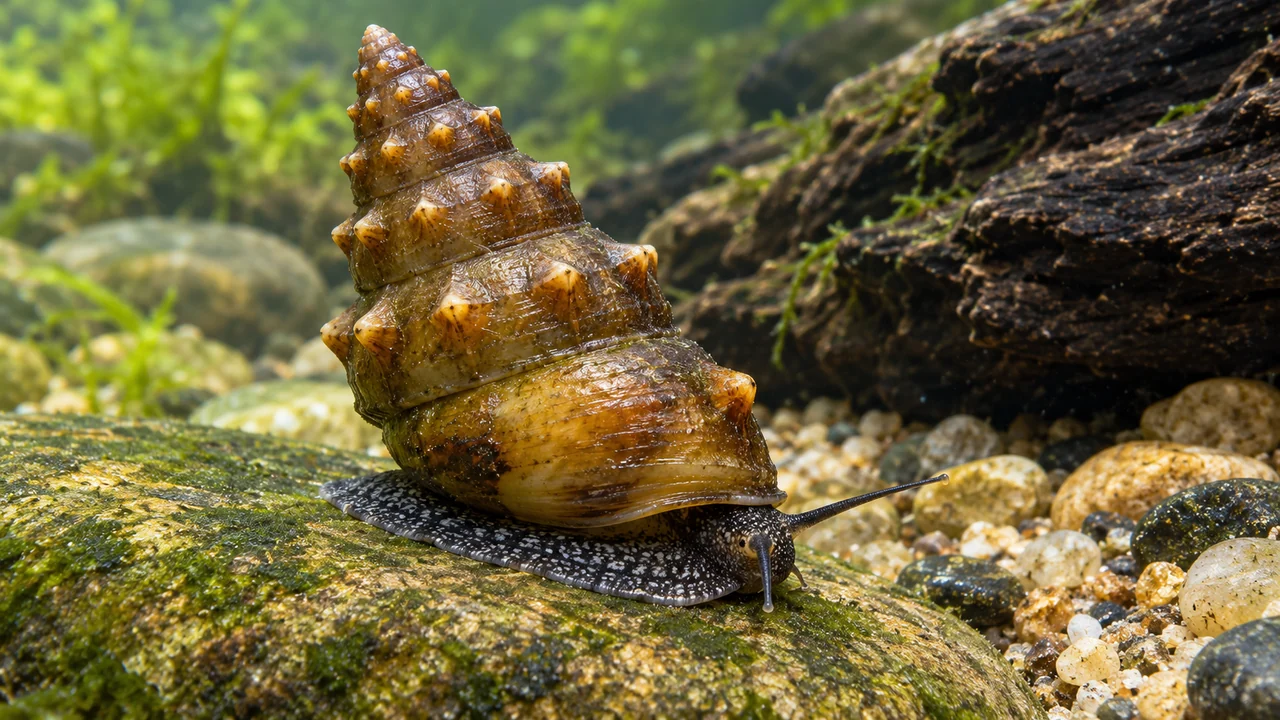
- Identity
- Brotia pagodula (Gould, 1847), Pachychilidae; the type species of Brotia. Similar nodulose trade shells need checking.
- Adult scale
- Allow roughly 5 cm shell length and turning room; some commercial size figures combine uncertain stock or whole-animal measurements.
- Aquarium plan
- A mature aquarium at least around 60 cm long / 50–60 litres is a useful starting arrangement for a modest group, not a scientific stocking threshold.
- Published maintenance
- 20–26°C, pH 6.5–8 and GH 5–30°dGH are broad trade guidance. Use stable, buffered mineral-bearing water rather than targeting the acidic or hardness extremes.
- Feeding
- Attached films plus appropriate complete supplementary food; being a grazer does not ensure enough food exists.
- Reproduction
- Separate sexes and internal brooding; developed young can be born in freshwater. Output and birth intervals should not be guaranteed.
A river snail with pagoda shoulders
Brotia pagodula has a conical shell whose whorl shoulders carry conspicuous nodules or projections. The name Melania pagodula occurs in older literature. It is a pachychilid river snail, not a horned nerite and not a marine Pagodula whelk. Similar-looking sculptured shells occur elsewhere in the aquarium trade, so the common name alone is not an identification certificate.
Taxonomic work separates species using shell, embryonic shell and anatomy, not merely the number of spikes visible in a shop photograph. Record the supplier's identification and source where possible. Shell wear, age and individual variation can change the appearance of the shoulders; an animal with blunt projections is not automatically a different species or an unhealthy specimen.
Provide a clear, flowing river arrangement
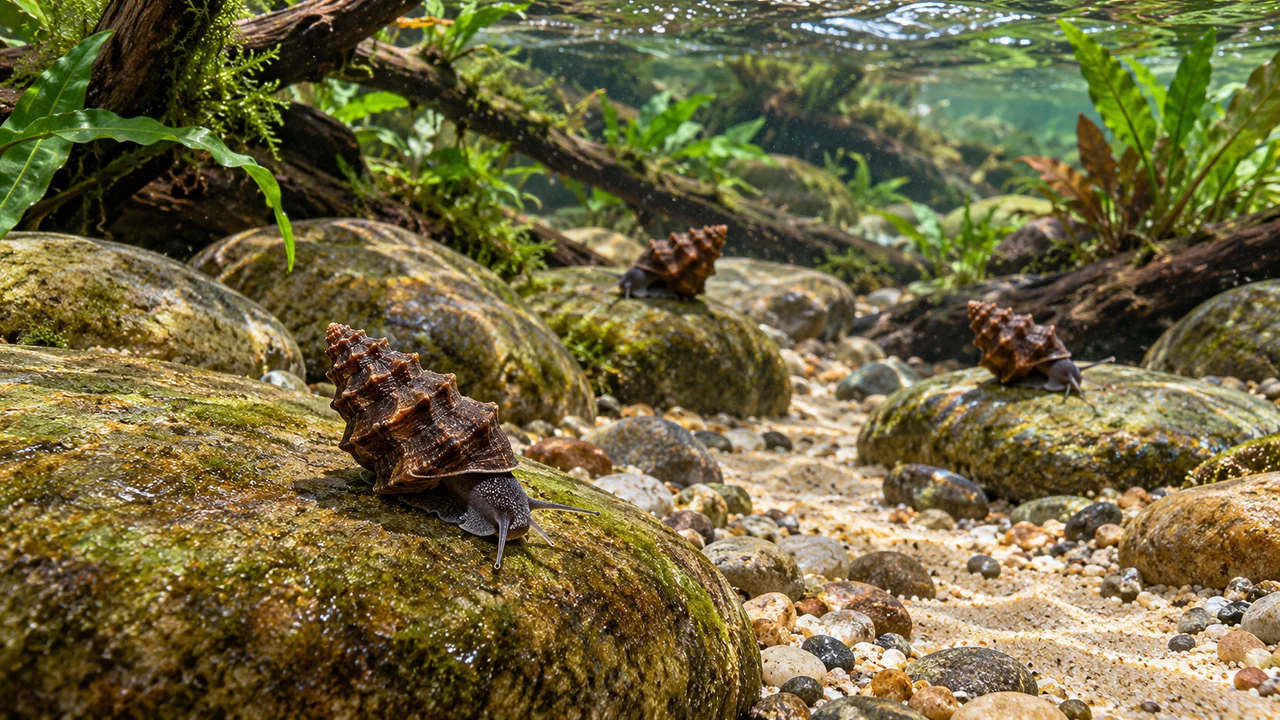
Aquarium stock is associated with the Moei river region on the Thailand–Myanmar border and the wider Salween drainage. That is a freshwater river context, distinct from the coastal salinity question for Faunus. Use clean, well-oxygenated water moving over mature feeding surfaces, with nearby areas where animals can rest away from the strongest flow.
A mature 50–60 litre aquarium with around 60 cm of frontage is a practical starting arrangement for a modest group. This is a planning recommendation, not a measured minimum or a snail-per-litre formula. Secure rounded stones and wood, retain sand or smooth fine gravel between them and leave visible access for feeding and waste removal.
Use care guidance without inventing wild limits
Published keeping advice includes 20–26°C, pH 6.5–8 and GH 5–30°dGH. These broad commercial bands are not equivalent to a measured river range or proof that every endpoint is optimal. For routine keeping, choose a stable position within suitable stock conditions, retaining adequate minerals and buffering for shell growth rather than chasing low pH or maximum hardness.
Monitor KH as the buffering part of the plan; the sources consulted do not establish one validated species-specific KH optimum. Do not compensate for an unknown reading by adding several mineral products at once. Prepare replacement water consistently, maintain filtration and surface exchange, and keep ammonia and nitrite undetectable. Strong current cannot compensate for water carrying accumulated waste.
Make supplementary feeding observable
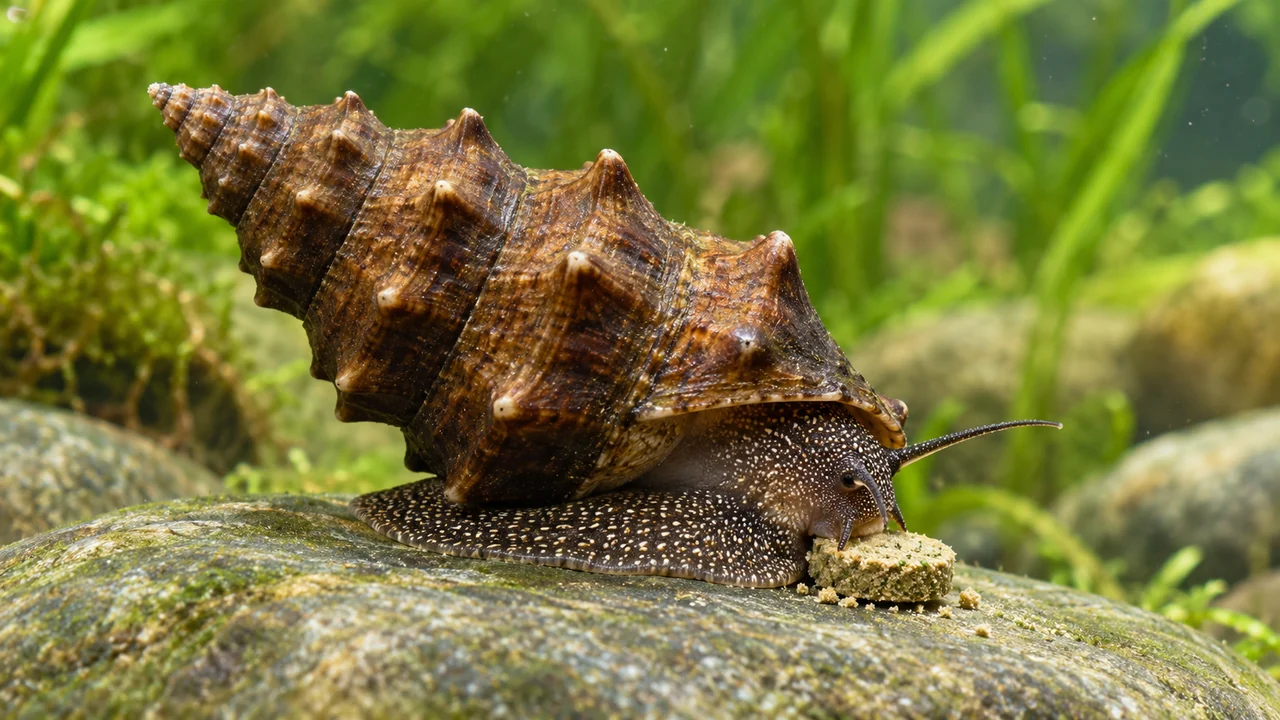
Mature surface films and plant-associated organic material provide feeding opportunities. Add an appropriate complete sinking snail food and confirm consumption. Suitable softened vegetables can add variety, but they are not evidence that the whole diet is balanced. A group of apparently busy animals may still compete over an inadequate food supply.
Use several accessible positions if other bottom feeders take the first portion. Observe the slower snail rather than concluding that the aquarium is fed because a tablet disappears. Remove leftovers before they collect beneath stones. Reports of food shortage and transport-related weakness make this an animal to feed deliberately, not a decorative replacement for a scraper or a waste-disposal device.
For supplementary variety, Nettle Shrimp Food offer a plant-forward option, while the Shrimp Snail Pleco Food & Botanical Bundle provides several food and botanical components to select from separately. Use only a small chosen portion and watch the slower snail feed before neighbours remove it.
Shell sculpture needs gentle handling
Keep the full adult shell in mind when choosing gaps, nets and containers. Projections can catch, and a conical shell can become wedged even where the animal's head fits. Let an attached snail release rather than pulling against its foot. Move it in a suitable container with enough support for the shell when necessary.
Distinguish worn old projections from fresh erosion at the growing margin. Poor new growth warrants checks of pH, mineral preparation, diet and physical damage. Existing losses may remain visible after conditions improve. Calcium-bearing water and food work together; neither a leaf nor a supplement can guarantee perfect reconstruction of a previously damaged shell.
Internal brooding and freshwater young
Brotia has separate sexes, with embryos retained internally in a specialised brood pouch. Developed juveniles can enter the freshwater aquarium rather than requiring an aerial egg clutch or a marine veliger nursery. Sex is not reliably assigned by counting projections or comparing the colour of two shells.
The primary anatomical studies are more dependable for this reproductive strategy than generic claims of easy mass breeding. Do not apply the brood size of a different Brotia, a laboratory sample or a retail promise of dozens of babies to every animal sold as pagodula. Protect filter inlets and inspect substrate carefully for small young, while keeping species and source records distinct.
Compatibility includes access to food
Peaceful fish and shrimp with compatible water requirements can be considered, but avoid animals that peck at the foot or tentacles. Snail-eating fish, crayfish and assassin snails create predictable risks. Shell projections are not a substitute for choosing suitable neighbours, and being slow does not mean the snail is content to remain permanently withdrawn.
Consider competition as well as direct aggression. A busy group of fish can consume supplementary food before the snail reaches it. If the animals cannot feed normally, use separation or a better feeding arrangement. There is no evidence-based mandatory group number inferred merely from river aggregations or a shop's sales unit.
Botanicals around the grazing structure
Prepared leaves and broad wood can form shaded margins between feeding stones. Keep their role modest and their condition visible. A pile of new leaves does not instantly replace mature grazing growth; a river snail still needs suitable food even in an attractive botanical arrangement.
Preserve water chemistry and oxygenation instead of trying to create an extremely acidic blackwater tank for every species in the library. Keep leaves out of narrow shell traps and places where food cannot be recovered. If clouding, a foul patch or declining activity follows an addition, inspect the actual material and waste load before changing unrelated equipment.
For a shaded edge outside the main flowing grazing area, compare a prepared section of Dried Bamboo Leaves (Bambusa sp.) – Premium Shrimp & Blackwater Botanical with a modest Dried Magnolia Leaves – Natural Aquarium Leaf Litter leaf. Keep occupied stones, shell routes and the feeding positions exposed.
First checks and honest expectations
If the animal fails to settle, review transport condition, temperature, water changes, oxygenation, actual food acceptance and harassment. A stationary snail may rest, but persistent withdrawal or loss of grip should not be ignored. Handle gently and never force the operculum open to test whether it is alive.
Keep records of growth and feeding rather than promising a fixed lifespan or breeding timetable. If commercial identity cannot be confirmed, retain that limitation when sharing observations or offspring. Never release surplus animals into natural waters, and do not interpret a common trade label as evidence that a wild river population is unlimited or secure.
Further reading and sources
Primary taxonomy, natural observations and aquarium keeping advice are distinguished. Numerical keeping bands are attributed recommendations, not universal optima or survival limits. Suggested home dimensions are practical planning choices, not experimentally established minima; commercial names do not authenticate stock.
- Köhler & Glaubrecht (2001) — Brotia systematic anatomy — Primary anatomical/reproductive treatment and type-species context; abstract and accessible indexed passages consulted.
- Harvard MCZ — Köhler & Glaubrecht (2006) revision record — Institutional bibliographic record with figured pagodula specimen on p.204; not claimed as a full reading of the 2006 monograph.
- IUCN — Brotia pagodula account (published 2012) — Species authority, older names and references; dated assessment is not presented as a new conservation review.
- Green Aqua — Pagoda Snail keeping — Commercial river, food and maintenance guidance; inconsistent size, stocking and prolific-breeding claims are not treated as established biological rules.