Snails · Matano Rabbit Snail
Matano Rabbit Snail — Tylomelania patriarchalis: Habitat and Care
A large white-speckled Lake Matano snail needs warm stable water, deliberate feeding and open soft-bottom space. Compare it with the yellow-marked gemmifera without assuming that a rabbit-snail sales label confirms either species.
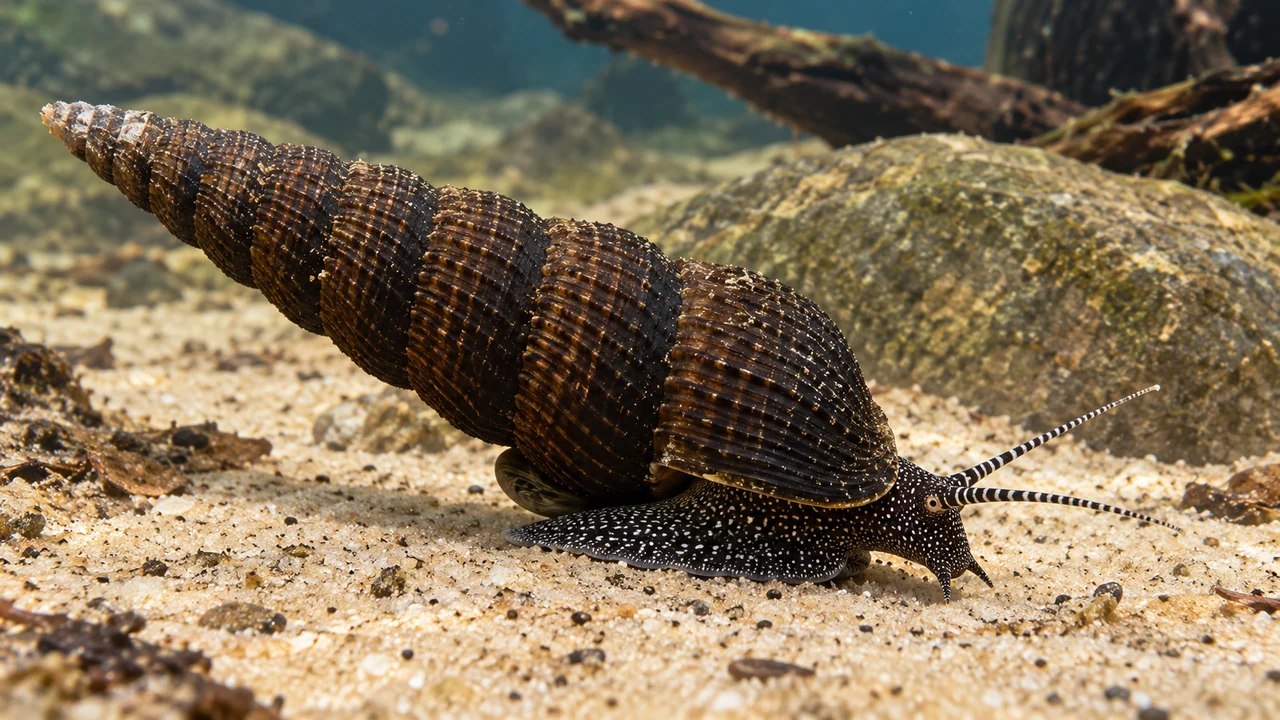
- Identity
- Tylomelania patriarchalis (Sarasin & Sarasin, 1897); dark head-foot with white markings, distinct from yellow-marked gemmifera.
- Adult scale
- The primary revision records shells to 117 mm: plan for a potentially 10–12 cm elongated shell, not just the small animal in the shop.
- Aquarium plan
- An established aquarium around 90 cm long / 100 litres is a useful roomy starting design for a modest group; it is not an experimentally established minimum.
- Published maintenance
- 25–30°C, pH 7–8.5, GH 6–14°dGH and KH 3–10°dKH in named-stock trade guidance; choose stable warm alkaline conditions within an appropriate mineral plan.
- Habitat and food
- Lake Matano sand and mud; mature surfaces plus suitable complete supplementary food.
- Young
- Separate sexes; shelled embryos brooded internally and developed juveniles released in freshwater, not eggs laid on aquarium stones.
A large Matano species with white markings
Tylomelania patriarchalis was originally described as Melania patriarchalis. The tall light-to-dark brown shell has variable axial ribbing, while the head-foot bears white dots or blotches and the tentacles show white stripes. The primary review records shells reaching 117 mm, considerably more than many animals offered for sale. The full growing shell needs to inform the home aquarium.
This is not the same profile as T. gemmifera, whose described head-foot markings are yellow. Both are associated with Lake Matano, but sharing a lake does not erase their differences. Commercial rabbit-snail names can refer to several species or unidentified forms, so neither black colour nor a long shell alone authenticates patriarchalis.
Soft-bottom space remains central
The scientific review records this species on sand and mud, with a depth distribution extending from shallow water into deeper lake areas. That observation explains why a rocky Sulawesi display should still retain usable soft bottom. It does not mean that an aquarium must reproduce lake depth or that all rabbit snails are equivalent hard-surface grazers.
For a modest group, a mature aquarium around 90 cm long and 100 litres is a useful roomy starting design. This is a practical choice, not a scientifically proven minimum. Provide broad fine-sand areas, low stable stones and sparse wood with wide routes. Keep turning spaces clear for the adult shell, and avoid dense carpets or narrow holes that make movement and observation difficult.
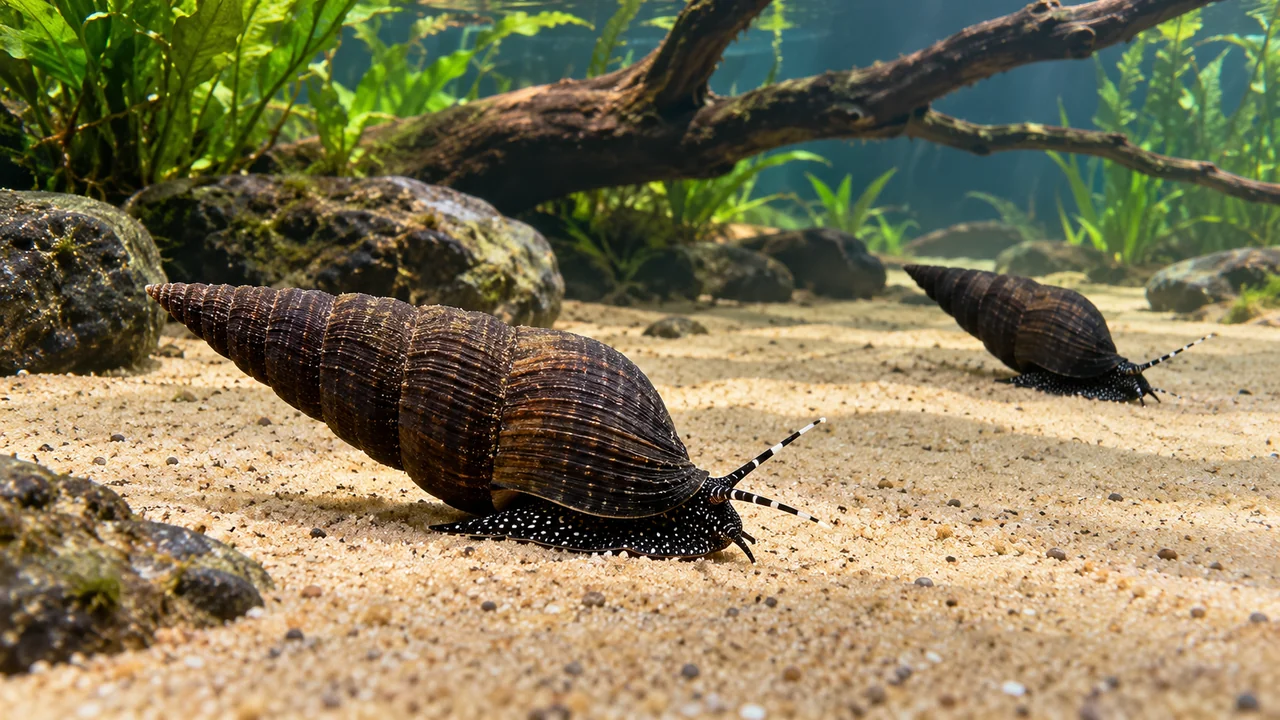
Warm water without excessive mineral dosing
Named-stock aquarium guidance gives 25–30°C, pH 7–8.5, GH 6–14°dGH and KH 3–10°dKH. These are keeping recommendations rather than simultaneous measurements from one wild site. Select a stable warm, mildly alkaline point appropriate to the stock; do not interpret a Sulawesi label as a demand for the highest hardness obtainable.
Measure prepared replacement water and keep the recipe consistent. GH and KH answer different questions, and a conductivity reading cannot replace either. Effective filtration and gas exchange matter especially in a warm aquarium. Keep ammonia and nitrite undetectable, avoid abrupt shifts and use a suitable freshwater remineralisation approach where necessary rather than adding marine salt for shell growth.
Confirm food reaches the snail
The animal moves over soft bottom and surface growth, but its size makes deliberate feeding important. Provide an appropriate complete sinking snail food at an observable position. Suitable softened vegetables and naturally available surface growth can add variety; neither a clean-looking aquarium nor a scattering of old leaves proves that the nutritional supply is adequate.
Offer food where the slow feeder can reach it before faster neighbours remove it. Use more than one feeding spot if needed and remove leftovers. Watch condition and new shell rather than judging nourishment by a brief photograph of a head near a pellet. Do not describe it as a filter feeder or assume that it can subsist on whatever a community leaves behind.
For supplementary variety at separate visible feeding spots, compare Blue Spirulina Shrimp Food with a small portion of Bee Pollen Gold™ Shrimp Pellets. Check that each large Matano snail collects the food before faster neighbours do, while retaining its complete sinking ration and warm mineral plan.
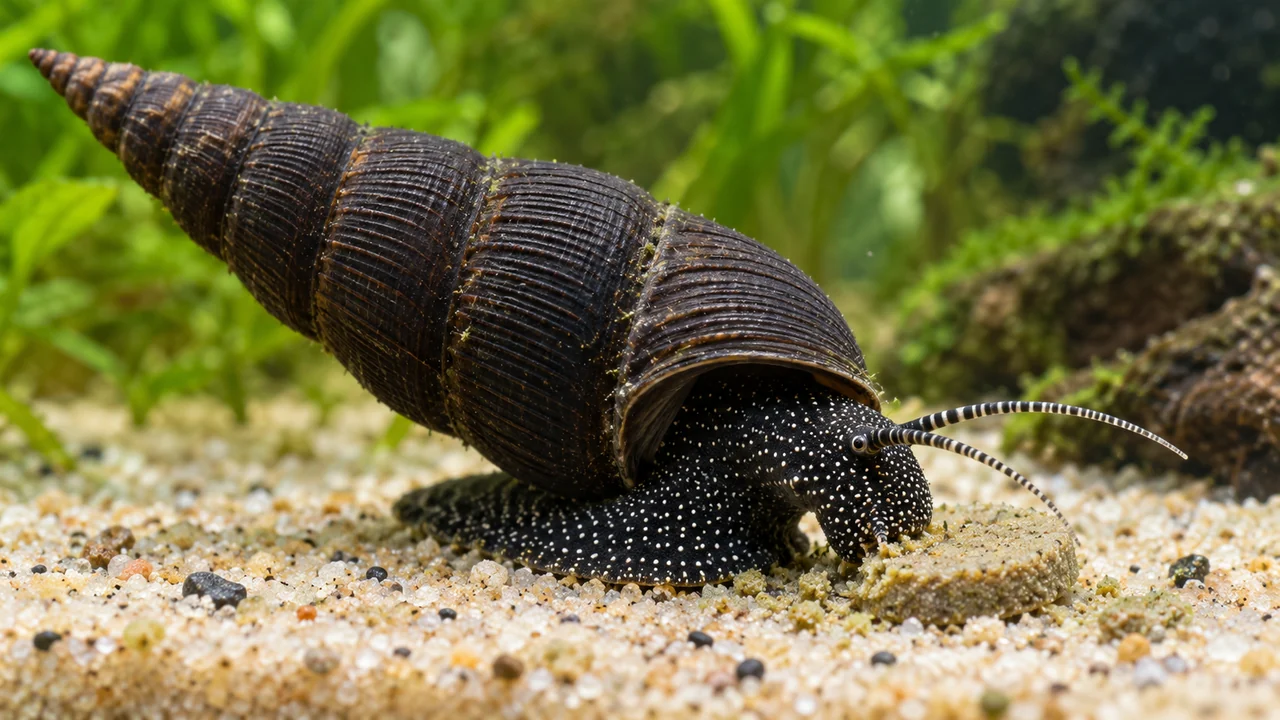
White markings and variable shell structure
The white dots and striped tentacles provide a useful comparison with gemmifera's yellow markings, but use the whole animal and source record. The primary revision describes considerable variation within patriarchalis, including shell and feeding-structure differences. A single rib count or colour photograph is not a complete identification method for an unknown import.
Older apical whorls may be eroded; distinguish that history from deterioration of the newer margin. Check pH, minerals, diet and physical damage if new growth is poor. Do not polish, coat or abrade the shell to improve its appearance. Better care supports subsequent growth but does not automatically recreate an undamaged old surface.
Brood-pouch reproduction, not an external clutch
Males and females are separate, and shell size is not a dependable way to select a pair. Females retain developing shelled embryos internally. The scientific account documents brood-pouch embryos, with developed young able to enter freshwater rather than passing through a marine veliger stage or emerging from eggs attached to stones.
Brood-pouch counts in preserved females are not a promise of a fixed number of babies at each birth. Aquarium intervals also depend on stock and conditions, so no universal monthly schedule is guaranteed. Protect filter inlets and inspect sand before siphoning. A newly arrived female may already have mated, and a mixed rabbit-snail shipment complicates reliable breeding records.
Companions need the same warm plan
Suitable neighbours must tolerate the actual temperature and mineral regime and leave the snail able to feed. Selected peaceful warm-water fish or shrimp can be considered, but a cool community or an acidic soft-water shrimp setup is not automatically suitable. Compare the species' requirements independently instead of using a shared Sulawesi or invertebrate label.
Avoid snail-eating fish, crayfish and assassin snails, as well as persistent tentacle nippers. Shell size is not guaranteed protection. Assess feeding competition and turning space after the animals grow, not just on the day of purchase. A modest group may be manageable with adequate space, but sightings of neighbours together in the lake do not establish a mandatory aquarium group minimum.
Botanicals should not conceal the soft floor
A little prepared wood and a light scattering of leaves can provide shaded margins and additional surfaces. Leave the main sand area accessible for movement and maintenance. A deep leaf layer can hide food and small juveniles while making it harder to judge whether a large adult is feeding normally.
Keep the water plan suitable for shell growth rather than chasing an extremely acidic blackwater appearance. Tint is not a mineral measurement. If an addition creates clouding, poor oxygenation or concealed waste, address the specific material and organic load. No botanical is presented as a cure for erosion, a guaranteed breeding trigger or a replacement for complete food.
Practical checks and traceable stock
For unusual inactivity, check heating, oxygenation, ammonia, nitrite, recent treatments and food access. A temporarily resting snail is not necessarily dead, but persistent loss of grip or deteriorating condition deserves action. Handle gently, support the long shell when moving and never force the operculum open or drag an attached animal by its shell.
Prefer a traceable source and keep records of identity, food and growth. The article concerns the named lake species, not every rabbit snail sold under a colour name. Do not claim a current conservation category from an unrelated trade page or release surplus animals. Responsible containment and clear records are more useful than a dramatic but unverified label.
Further reading and sources
Primary taxonomy, natural observations and aquarium keeping advice are distinguished. Numerical keeping bands are attributed recommendations, not universal optima or survival limits. Suggested home dimensions are practical planning choices, not experimentally established minima; commercial names do not authenticate stock.
- von Rintelen, Bouchet & Glaubrecht (2007) — Malili Tylomelania revision — Primary full species account pp.56–58: 117 mm shell, white head-foot markings, variable sculpture, Matano soft substrates and brooded embryos.
- Garnelio — white guinea-fowl Tylomelania keeping — Named-stock commercial temperature, pH, GH and KH guidance; a reported birth interval is not promoted as universal.
- B-Aqua — Tylomelania patriarchalis — Secondary practical discussion of substrate, space and food, distinguished from the original biological description.