Snails · Bladder Snail
Bladder Snail — Physella acuta: Habitat and Care
A small air-breathing grazer with a left-opening shell can become an interesting aquarium resident rather than an automatic disaster. Understand submerged egg masses, self-compatible reproduction and how available food affects a growing population.
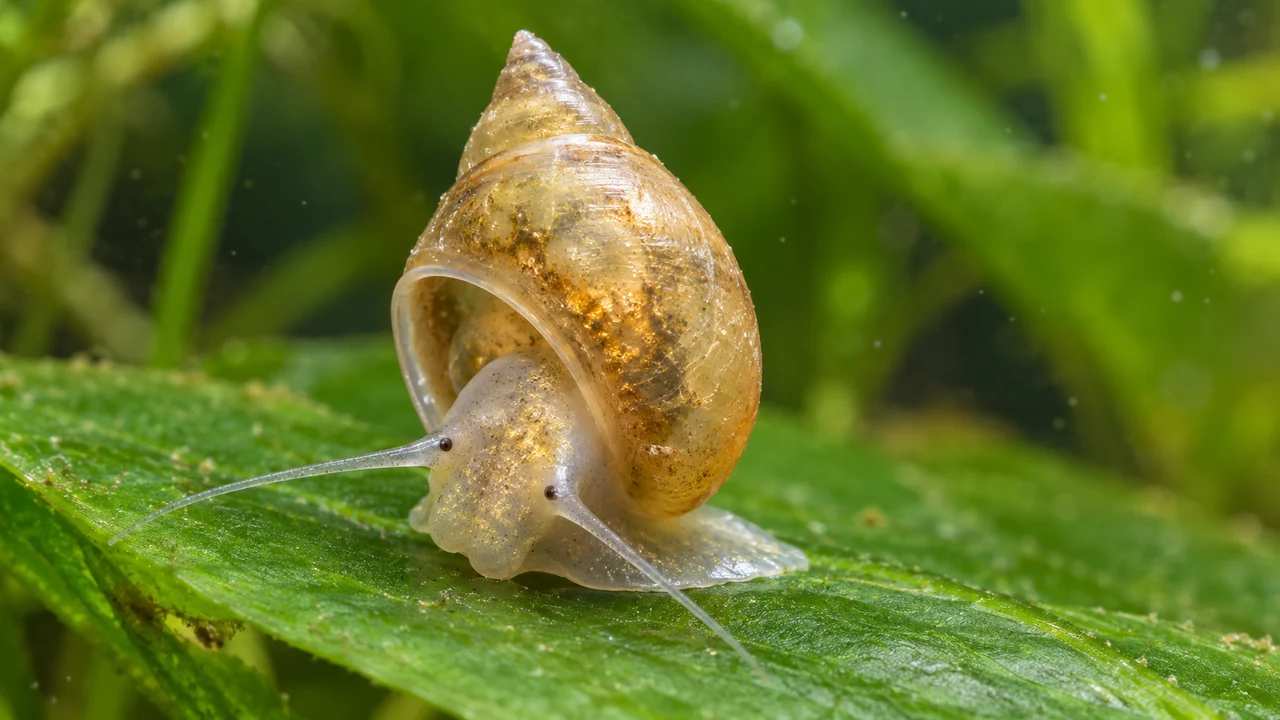
- Identity
- Physella acuta (Draparnaud, 1805); Physidae. Physa acuta remains common in scientific literature.
- Adult scale
- Usually around 8–15 mm shell height; institutional descriptions include specimens to about 16 mm.
- Aquarium plan
- A mature planted aquarium around 30 cm long / 20 litres is a useful deliberate observation setup, not a measured species minimum or permission to keep animals in stagnant jars.
- Care context
- Published keeper bands include 18–28°C, pH 6.5–8.5 and GH 6–35°dGH; use a stable moderate position rather than interpreting tolerance as optimum.
- Shell and breathing
- Thin sinistral shell, threadlike tentacles, no operculum; air is obtained at the surface.
- Young
- Simultaneous hermaphrodite, capable of cross-fertilisation and self-fertilisation; submerged gelatinous egg masses produce crawling young.
Read the opening, not just the shell colour
Physella acuta has a thin, often translucent fawn or amber shell with a large final whorl and a relatively short pointed spire. Golden or mottled mantle markings may be visible through it. The animal has fine threadlike tentacles and no operculum. It differs from a flat-coiled ramshorn and from the long tower of a Malaysian trumpet snail.
Its shell is sinistral: with the apex pointing up and the opening facing you, the aperture is on the left. That is useful recognition, but not proof that every small left-coiled snail is acuta. Institutional identification accounts note similar-looking species, and Physa acuta remains common in research even where current databases use Physella.
A widespread species with an introduced history
Although originally described from France and sometimes called European Physa, modern genetic and fossil evidence supports a North American origin. It has spread widely through human activity, including movement of aquatic plants. A common aquarium occurrence is therefore not evidence that it is native to every country where it appears.
The species occupies vegetated freshwater margins, ponds, ditches and streams. Its ability to tolerate disturbed conditions helps explain its spread, but tolerance should not become a recommendation for a dirty aquarium. For deliberate observation, provide a mature planted home with food-bearing surfaces and manageable water volume rather than an unfiltered, neglected container.
A small home still needs ordinary care
Around 20 litres with roughly 30 cm of frontage is a useful modest observation setup, not a demonstrated biological minimum. Use planting, a little smooth wood, open maintenance access and gentle biological filtration. Protect inlets from tiny juveniles and leave a usable route to the water surface without trapping animals beneath a thick sealed mat of floating plants.
The snail can obtain air through its pulmonary cavity, but air breathing does not remove its exposure to dissolved pollutants. Maintain undetectable ammonia and nitrite, avoid overheating and condition replacement water. Cover preventable escape gaps while retaining ventilation. An animal's presence in warm or stagnant wild waters is not a reason to abandon routine husbandry.
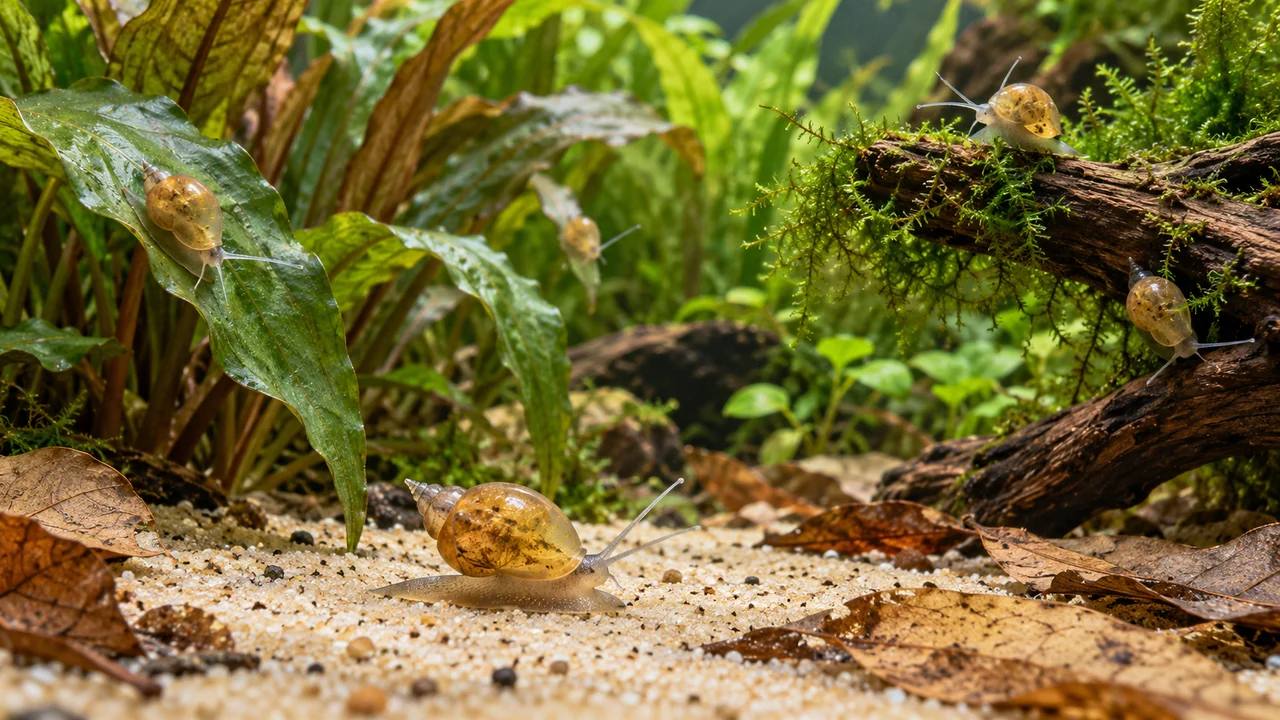
Water guidance is broader than an optimum
Published keeper guidance includes 18–28°C, pH 6.5–8.5 and GH 6–35°dGH. These broad bands describe keeping experience, not a species-wide optimum or a demand to use their extremes. A moderate, stable freshwater aquarium usually avoids the need to manipulate conditions specifically for this snail. Shell-friendly near-neutral to mildly alkaline water is preferable to deliberately very acidic conditions.
Measure KH so buffering is understood rather than guessing from GH or water colour. No precise universal KH optimum is established here. Scientific cultures at defined temperatures or pH are experiments, not automatically complete aquarium recommendations. Keep replacement water consistent and investigate new shell condition, food and actual measurements before adding minerals to solve an assumed deficiency.
A grazer contributes to the food web
Physella works over algae, diatoms, soft detrital material and suitable food residues. It can help process small organic particles, but that processing produces snail growth and waste rather than making nutrients disappear. Do not assume it will remove every unwanted alga, restore a neglected filter or keep excess feeding harmless.
For a deliberately maintained colony, observe food availability and use small amounts of appropriate complete supplementary food where needed. Remove leftovers and assess the intended fish and shrimp separately. A population surge should prompt a review of excess feed and dying plant material; it is not a reason to starve all inhabitants or blame every damaged leaf on the snail.
For a deliberately maintained colony needing extra food, a very small amount of Premium Natural Bee Pollen or a selected component of the Shrimp Snail Pleco Food & Botanical Bundle can provide supplementary variety. Observe use and the overall food supply; the mixed pack is a choice of separate portions, not a single addition to empty into the aquarium.
A thin shell without a closing door
The absence of an operculum is normal, not evidence that a trapdoor has been lost. Handle with particular care because a thin shell can be crushed easily. If moved during maintenance, use a suitable wet support or container rather than squeezing the animal between hard tools.
Assess the newer shell margin when checking growth. Erosion or weakening warrants review of pH, mineral balance, food and physical injury, but an attractive transparent shell should not be mistaken for one that must become opaque. Do not coat it or apply a household repair. Calcium-bearing water and suitable food complement each other without guaranteeing that an old damaged section will regain its original appearance.
Submerged egg masses and self-compatible reproduction
Physella acuta is a simultaneous hermaphrodite. Individuals can cross-fertilise and can also self-fertilise, so one apparently isolated animal may establish a population. This is not the same mechanism as the parthenogenesis found in many Melanoides populations, and there is no need to invent separate male and female shell colours.
Eggs are laid in gelatinous masses under water on suitable surfaces such as plants or glass. Young develop into small crawling snails rather than requiring marine larvae or a dry aerial clutch. Development and population growth depend on conditions and food; do not promise a fixed hatch day or weekly multiplication rate for every aquarium. Inspect plants and equipment before transferring them if an unplanned colony is undesirable.
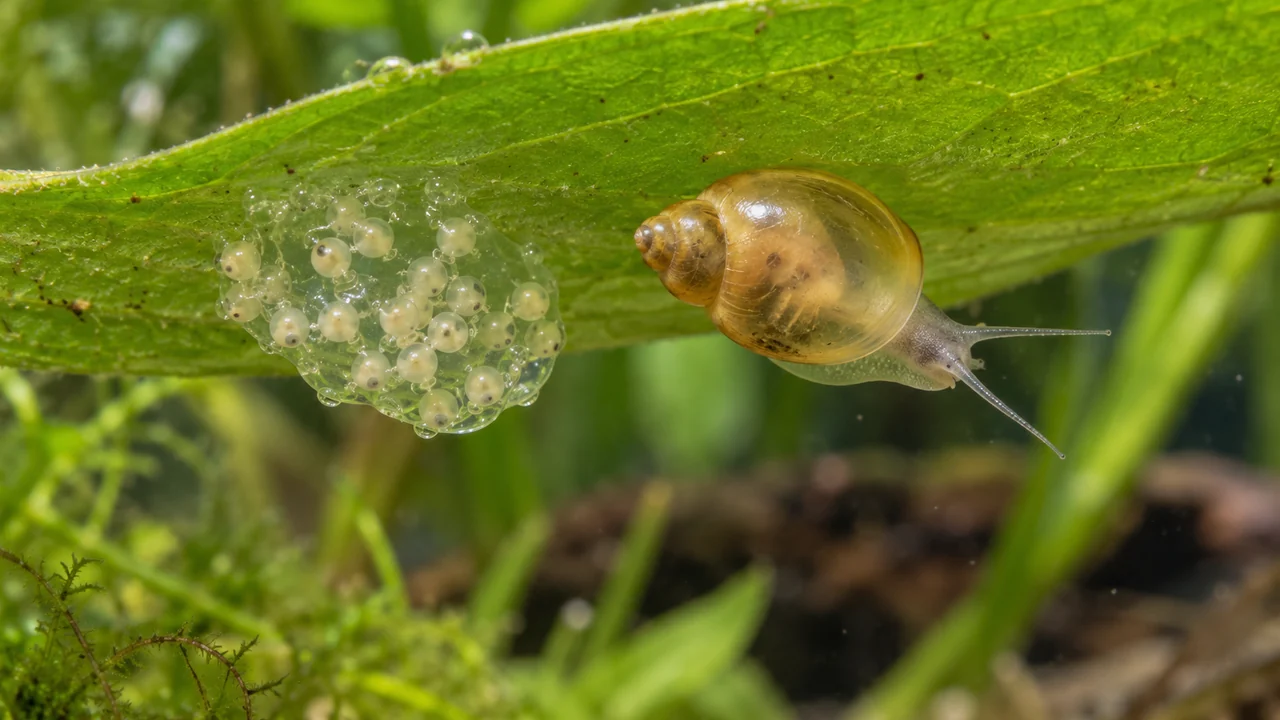
Companions, leaves and population balance
Peaceful fish and shrimp with compatible conditions can share an aquarium, while snail-eating fish, crayfish and assassin snails create obvious risks. A small population does not automatically endanger shrimp or healthy fish. Likewise, an absolute promise that it can never affect any delicate or weakened plant tissue would overstate the evidence.
A light layer of prepared leaves around roots can offer surfaces and sheltered movement, provided food waste remains visible and water quality stays sound. Do not add a thick decomposing litter bed just to feed more snails. Keep the chosen pH and mineral plan, and use the balance of food and population as an observation rather than a claim that every snail is either essential or a pest.
For a light prepared leaf layer, compare Dried Cinnamon Leaves – Natural Aquarium Leaf Litter with a small selected portion of the larger Ceylon Cocoa (Cacao) Leaves – Natural Aquarium Leaf Litter. Retain exposed floor and judge the amount around the observed population rather than trying to create a permanent pile of food.
Manage changes without exaggerated pest claims
If numbers rise sharply, reduce surplus feeding and remove accessible excess animals gently while continuing to nourish the aquarium properly. Avoid chemical snail-killers that can harm other invertebrates or leave many dead animals concealed in the setup. A new predator is not the first necessary response to a correctable feeding problem.
Never release snails, egg-bearing plants or substrate into natural waters. Wash hands after maintenance and avoid casual movement of wild animals, but do not diagnose disease or parasites from a common name. For unusual surface gathering or inactivity, check water quality, oxygenation, temperature and recent treatments. Respond to actual observations instead of treating an air-breathing snail as an indestructible alarm device.
Further reading and sources
Primary taxonomy, natural observations and aquarium keeping advice are distinguished. Numerical keeping bands are attributed recommendations, not universal optima or survival limits. Suggested home dimensions are practical planning choices, not experimentally established minima; commercial names do not authenticate stock.
- USGS — Acute bladder snail species profile — Institutional identification, shell scale, North American origin evidence and self-compatible reproduction; historical and current generic usages distinguished.
- Freshwater Gastropods of North America — Physa acuta — Specialist scientific account of habitat, nomenclatural debate, cross-fertilisation and selfing; not a fixed home population forecast.
- Australian freshwater mollusc key — Physa acuta — Institutional diagnostic details and similar-shell species; chirality alone does not establish exact identity.
- MolluscaBase — Physidae list — Current accepted Physella acuta usage and Physa historical combination.
- MARE 2000 — Physella acuta keeping — Commercial temperature, pH and GH advice used as broad guidance, without transferring unsupported disease-safety or extreme-tolerance claims.
- Mondal and colleagues (2024) — plant diet and fecundity — Primary diet/competition experiment including Physella acuta; demonstrates resource-dependent reproductive results, not a fixed home-aquarium output or universal feeding guarantee.