Snails · Black Devil Snail
Black Devil Snail — Faunus ater: Habitat and Care
A smooth dark tower shell belongs to a large grazer from coastal river systems. Separate the adult freshwater or brackish keeping decision from the much less certain marine-associated larval phase, and provide real food rather than a cleaning-crew label.
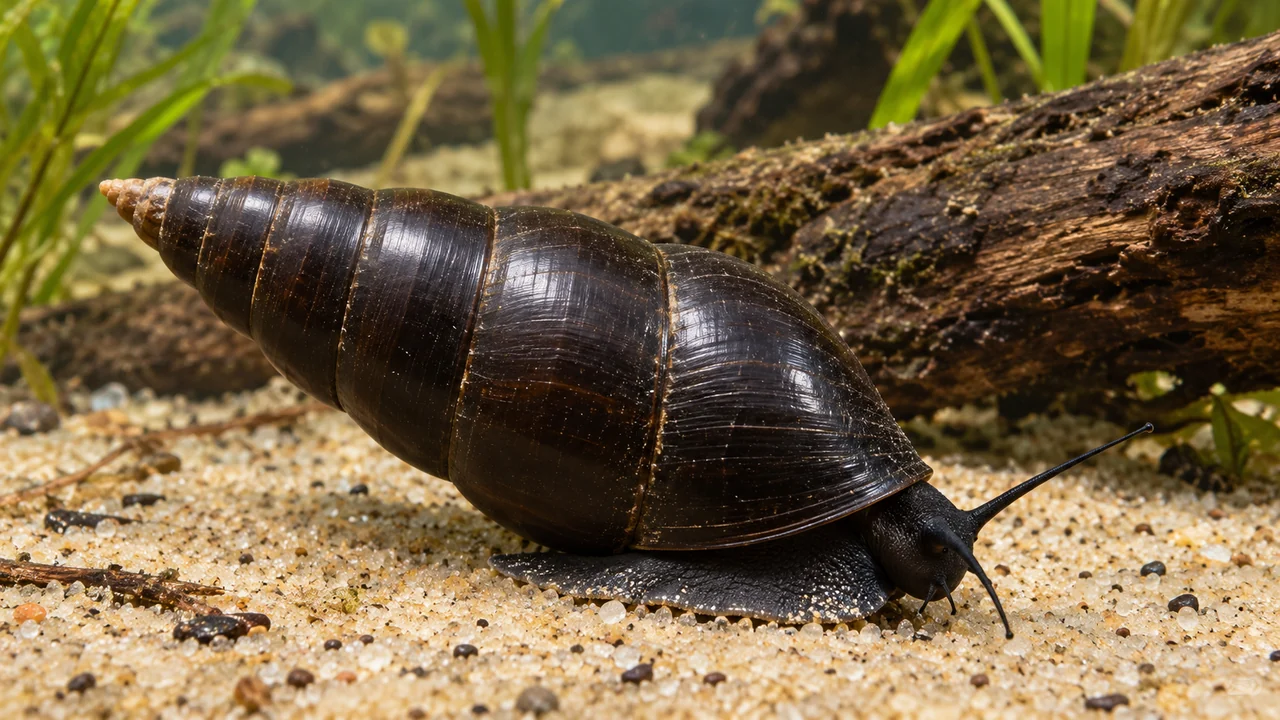
- Identity
- Faunus ater (Linnaeus, 1758); Pachychilidae. Smooth dark shell, not a ribbed Tylomelania rabbit snail.
- Adult scale
- Frequently around 5–6 cm; scientific accounts include shells reaching about 9 cm.
- Aquarium plan
- A mature 60–80 cm aquarium around 60–80 litres gives a lightly stocked adult useful open floor and maintenance access; this is a planning choice, not a proven minimum.
- Maintenance
- Published adult trade guidance: 23–30°C, pH 6.5–8.5, KH above 3°dKH and GH up to 22°dGH. Use the established stock conditions, with shell-friendly buffering.
- Food
- Attached growth and suitable complete sinking food; observe individual acceptance and consumption.
- Young
- Egg-laying, with a marine-associated larval phase suggested by scientific accounts; no established simple freshwater nursery protocol is assumed.
A smooth cone from coastal waters
Faunus ater has a thick dark brown to almost black shell with numerous shallow whorls and a smooth surface. Adults may have a worn or truncated old tip. The large final whorl and notched aperture differ from the heavily ribbed shell of a rabbit snail. The common name Devil Spike does not mean the shell should be covered in spines.
The species was originally described as Strombus ater, while Faunus melanopsis is an historical synonym. Modern studies place it in Pachychilidae. Its distribution centres on the Indo-West Pacific, including coastal South-East Asia, northern Australia and the Papuan region. An empty shell reported from another continent is not evidence of an established native population there.
Read river-mouth observations in context
Field accounts describe lower rivers, mouths, drainage channels and other coastal waters with variable fresh and saline influence. The Singapore study recorded a brackish pond and an adjoining tidally influenced drain. Those readings describe particular places and dates; they are not instructions to alternate aquarium salinity abruptly or reproduce a tidal cycle in a small community.
Adults are kept in freshwater and in appropriately managed brackish systems. Establish which conditions the actual stock has been maintained in before purchase. Keep a stable, deliberate plan rather than adding a handful of salt because a river mouth appears in the habitat description. A brackish setup also requires compatible inhabitants, suitable filtration and measured marine-salt preparation; evaporation is replaced with freshwater.
Allow the whole shell to turn
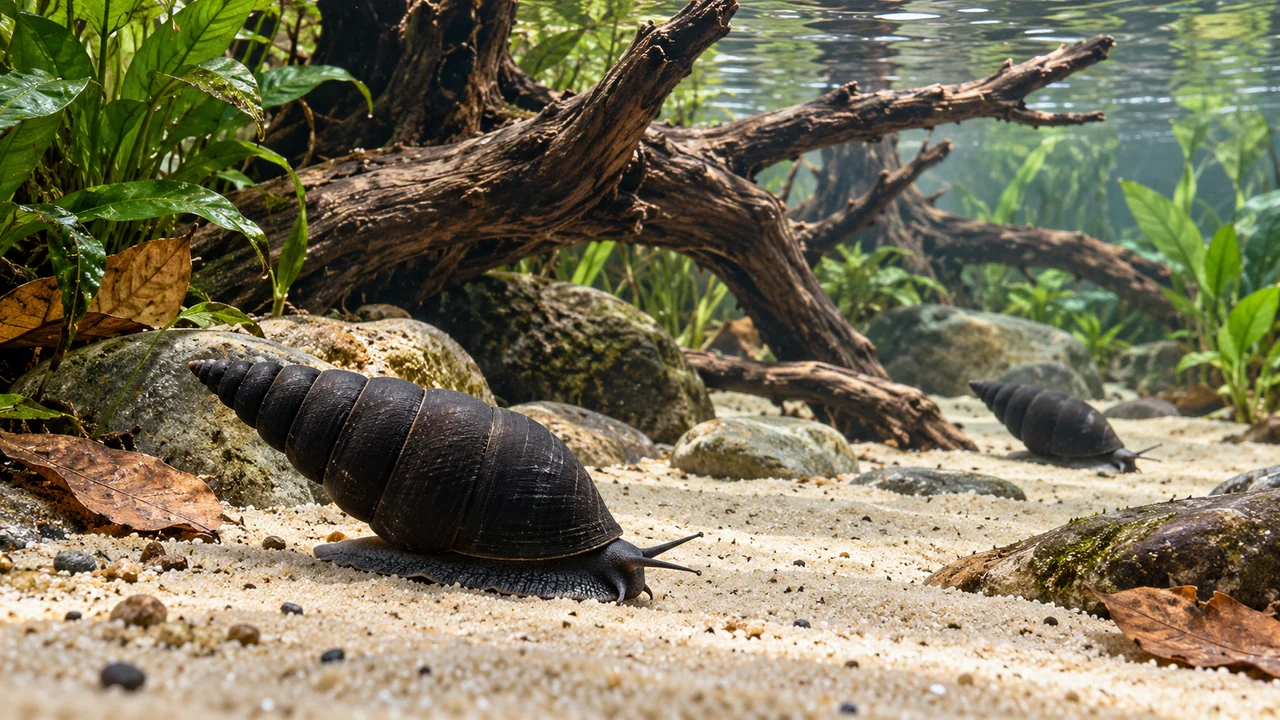
A mature aquarium around 60–80 cm long and 60–80 litres is a useful starting design for a lightly stocked adult. This is an arrangement recommendation, not an experimentally measured minimum. The point is to provide feeding surfaces, room for a shell that may approach 9 cm and access to inspect it without dismantling the aquarium.
Use fine sand or smooth fine gravel, stable low stones and open spaces around wood. Avoid narrow holes that admit the head but trap the expanding shell. Retain a cover and inspect gaps around pipes. A broad food station near the front is helpful: a large snail disappearing beneath leaves is harder to monitor than one that can feed in view.
A buffered adult maintenance plan
Published trade guidance spans 23–30°C, pH 6.5–8.5, KH above 3°dKH and GH up to 22°dGH. That is commercial maintenance experience, not a laboratory demonstration that every combination is equally suitable. For an ordinary freshwater arrangement, work within established stock conditions and prefer neutral to mildly alkaline, consistently mineralised water over deliberate acidic blackwater extremes.
Measure GH and KH separately and use consistently prepared replacement water. A maximum GH figure is not a target to chase, and GH does not measure calcium alone. Maintain effective biological filtration, gas exchange and undetectable ammonia and nitrite. Higher temperatures increase the need to watch oxygen supply and food demand; they are not a shortcut to more activity.
Observe feeding instead of assuming it
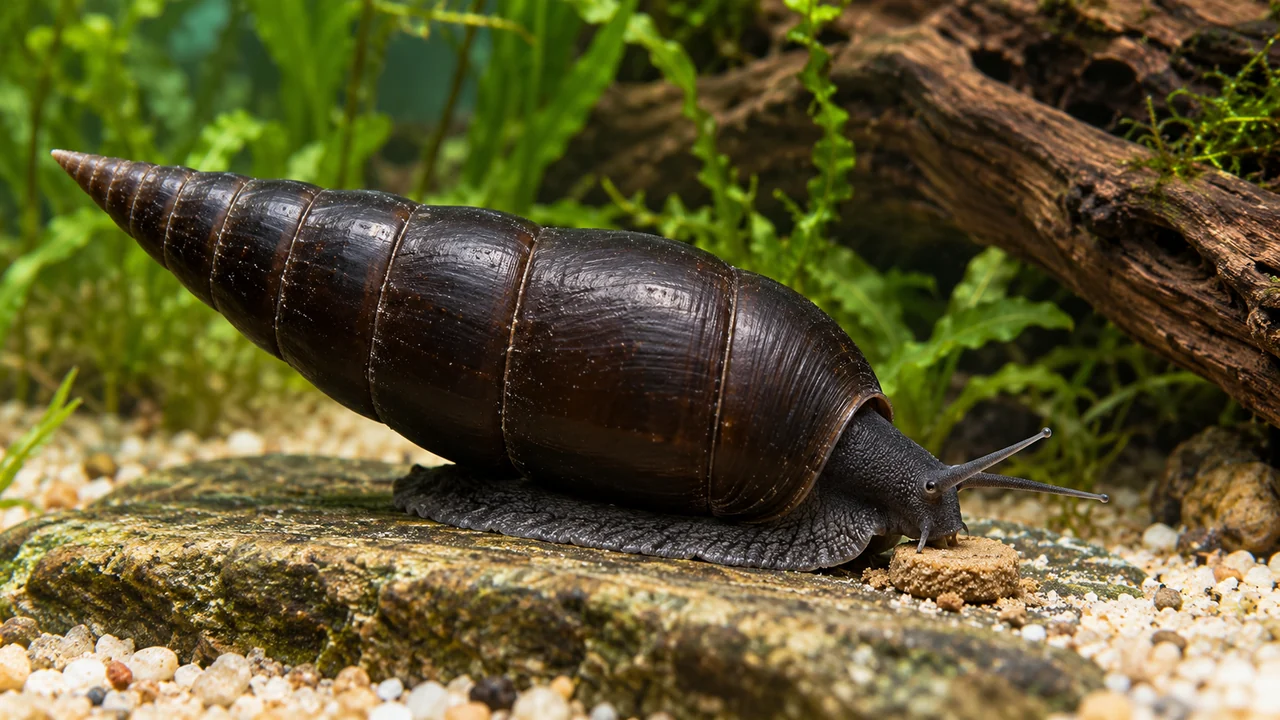
The broad snout and strong feeding structures suit work over attached surface growth. Offer mature stones and wood alongside an appropriate complete sinking snail food. Check that food is actually eaten; a pellet placed near a withdrawn animal is not evidence of a meal. Small amounts of suitable softened vegetable material can provide variety, but incidental algae and old leaves should not be assumed to supply everything.
Use an accessible feeding patch and remove leftovers. Some keepers report damage to tender planting, particularly where food is inadequate; avoid an absolute plant-safe promise. If the snail loses condition, examine competition and acceptance of the offered food rather than simply adding a larger pile that decomposes unseen behind the wood.
For supplementary feeding variety, compare a small portion of Pure Shrimp Meal Shrimp Food with Snowflake Shrimp Food. Offer the selected food where this slower snail can reach it, confirm acceptance and keep the complete sinking ration as the nutritional foundation.
The reproductive question remains separate
Faunus is egg-laying rather than a livebearing trumpet snail. Scientific accounts associate its dispersal with a possible marine larval phase, and aquarium accounts do not establish routine completion in freshwater. The 2023 review also makes clear that detailed reproductive knowledge remains limited. These distinctions are more useful than promising either automatic breeding or a complete guaranteed protocol.
Do not copy the brood-pouch guidance for Melanoides or Tylomelania, and do not salt the adult community aquarium to try to hatch an unverified clutch. A serious rearing attempt would need confirmed identity, observed eggs and larvae, documented salinity and appropriate microscopic food. None of those requirements is replaced by a marketing label or a botanical addition.
Shell growth and companions
Inspect the newer shell edge as well as older wear. Pitting, weak growth and physical chips have different causes, so check water chemistry, food and handling together. An old truncated apex may predate purchase; it does not alone prove a current deficiency. Better conditions support later growth rather than restoring the original worn surface.
Choose peaceful fish and shrimp whose water needs genuinely overlap with the selected freshwater or brackish plan. Avoid shell-crushing fish, crayfish, persistent tentacle nippers and assassin snails. Do not assume that the adult shell makes it invulnerable. Faster bottom feeders can also leave it short of food without any obvious attack.
Use botanicals without burying the floor
A few prepared leaves and broad pieces of wood can add shaded texture and extra grazing surfaces. Keep the long shell's routes open and the feeding area visible. Dense overlapping litter can conceal uneaten food and obstruct inspection, while brown water alone says nothing about whether pH, calcium availability or oxygenation is suitable.
Use botanical material to complement the animal's water plan rather than forcing an acidic forest-stream appearance onto a coastal-water snail. If a new addition creates clouding or excessive decomposition, investigate the material and organic load. Adding more grazers is not a replacement for removing food waste or maintaining the filter.
For the shaded margin beside the long shell’s open routes, compare Dried Arjuna Leaves (Kumbuk) – Natural Aquarium Leaf Litter with Premium Mangrove Leaves – Natural Aquarium Leaf Litter. Keep the prepared leaf patch sparse and accessible rather than treating either choice as a reason to acidify the aquarium.
Practical first checks
For prolonged inactivity, check temperature, salinity where relevant, ammonia, nitrite, oxygenation and recent treatment or cleaning changes. Observe whether the foot can grip and whether an overturned animal can right itself. Reposition gently on a secure submerged surface if needed without pulling an attached snail by its shell or forcing the operculum open.
Record feeding acceptance and new shell growth after introduction. Check nearby dry areas and cover gaps if an animal vanishes. Avoid unverified copper-containing treatments and household sprays around the aquarium. Never release snails or aquarium material into waterways; the wide natural distribution of a coastal species is not permission to introduce it somewhere new.
Further reading and sources
Primary taxonomy, natural observations and aquarium keeping advice are distinguished. Numerical keeping bands are attributed recommendations, not universal optima or survival limits. Suggested home dimensions are practical planning choices, not experimentally established minima; commercial names do not authenticate stock.
- Greķe (2023) — Faunus ater in the Papuan region — Primary review and new observations: identity, range, shell scale, lower-river habitat and limits of reproductive knowledge.
- Lok and colleagues (2011) — Faunus ater in Singapore — Primary field account of a brackish pond and tidal drain; measured specific gravity is not an aquarium recipe.
- Garnelio — Faunus ater keeping — Commercial adult-maintenance, mineral and food guidance, distinguished from wild measurements and nursery evidence.
- Aquarium Glaser (2009) — Faunus ater — Direct aquarium-trade account; marine-development statement is interpreted alongside the more cautious scientific review.