Snails · Freshwater Limpet Nerite
Freshwater Limpet Nerite — Septaria porcellana: Habitat and Care
A cap-shaped neritid holds closely to mature stones and needs an established food supply. Its embedded operculum is not a closing door, and its veliger biology should not be confused with the reproduction of tiny hitchhiking freshwater limpets.
- Identity
- Septaria porcellana (Linnaeus, 1758); Neritidae. Other Septaria and unrelated miniature freshwater limpets are separate animals.
- Adult scale
- Primary revision records shells to about 27 mm; allow around 3 cm of broad cap-shaped attachment surface.
- Aquarium plan
- An established 45–60 cm aquarium around 40–60 litres with many mature stones is a useful dedicated arrangement, not a proven minimum.
- Published keeping guidance
- 24–30°C, pH 7–7.5, KH above 3°dKH and GH up to 14°dGH; these are keeper recommendations, not field or tolerance limits.
- Feeding
- Specialist attached-growth grazer; mature algae and biofilm must be available before introduction.
- Reproduction
- Separate sexes and attached egg capsules; free-living veligers, with no routine closed freshwater breeding protocol established here.
A limpet-shaped snail, not a clam
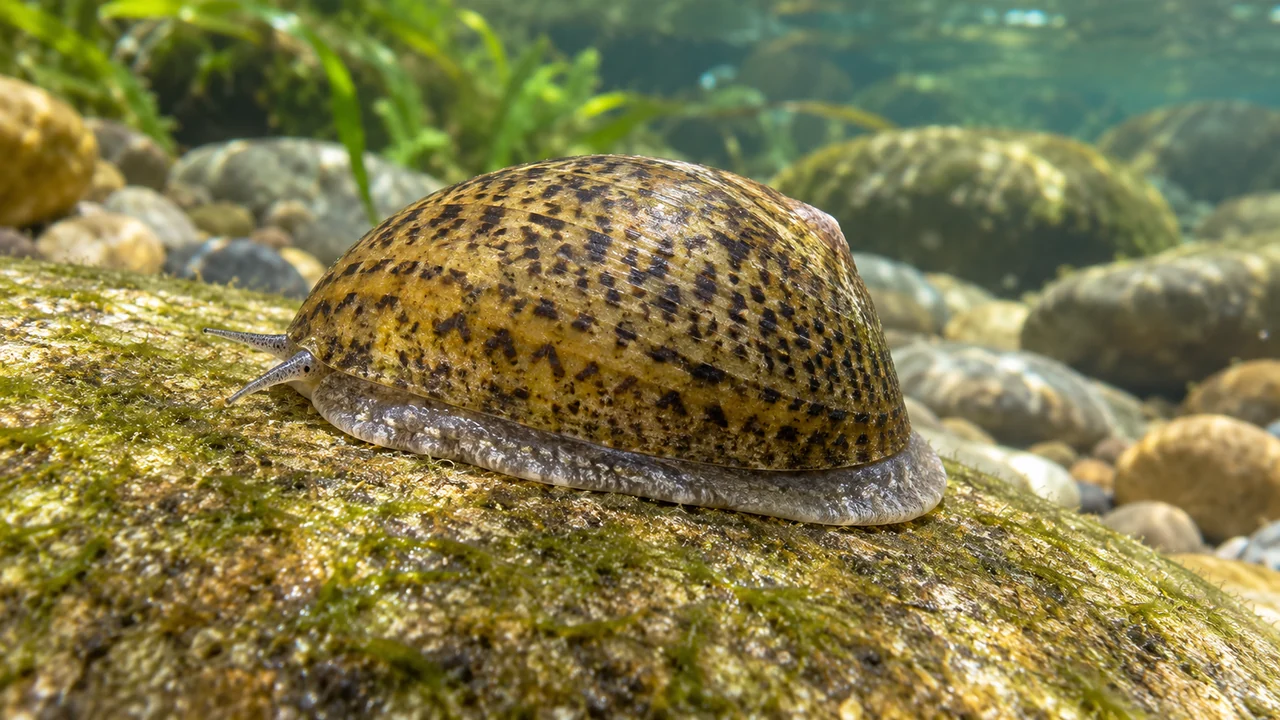
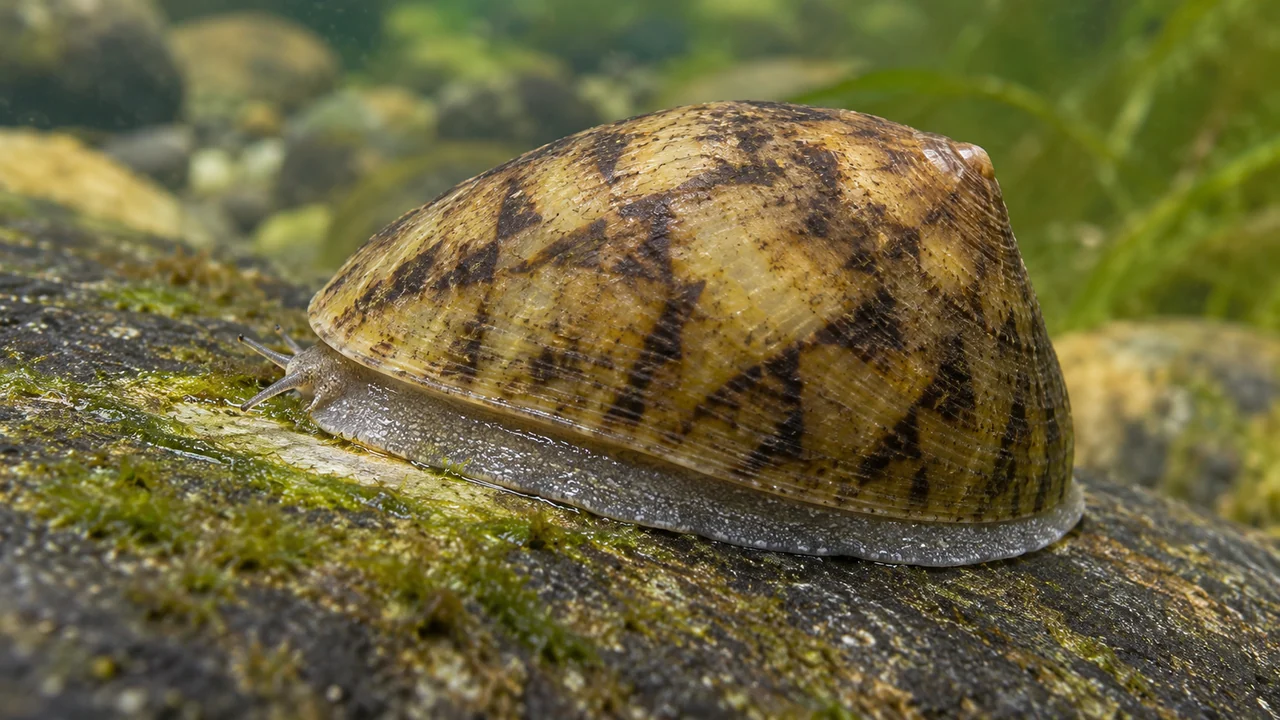
Septaria porcellana has a broad cap-like shell without an exposed spiral tower. The shell can carry a yellow-brown ground with dark geometric markings, while the broad foot holds the animal close to a hard surface. Despite its shape, it is a neritid snail, not a bivalve and not the same as the tiny limpets that sometimes arrive on aquarium plants.
Haynes' revision also corrects older misidentifications among Septaria. Shell pattern alone is insufficient, and old records assigned to porcellana can include other species. The operculum is embedded within the foot and cannot close the animal into the shell like the ordinary trapdoor of a coiled snail. Do not pry beneath the shell to look for one.
Mature stones and usable water movement
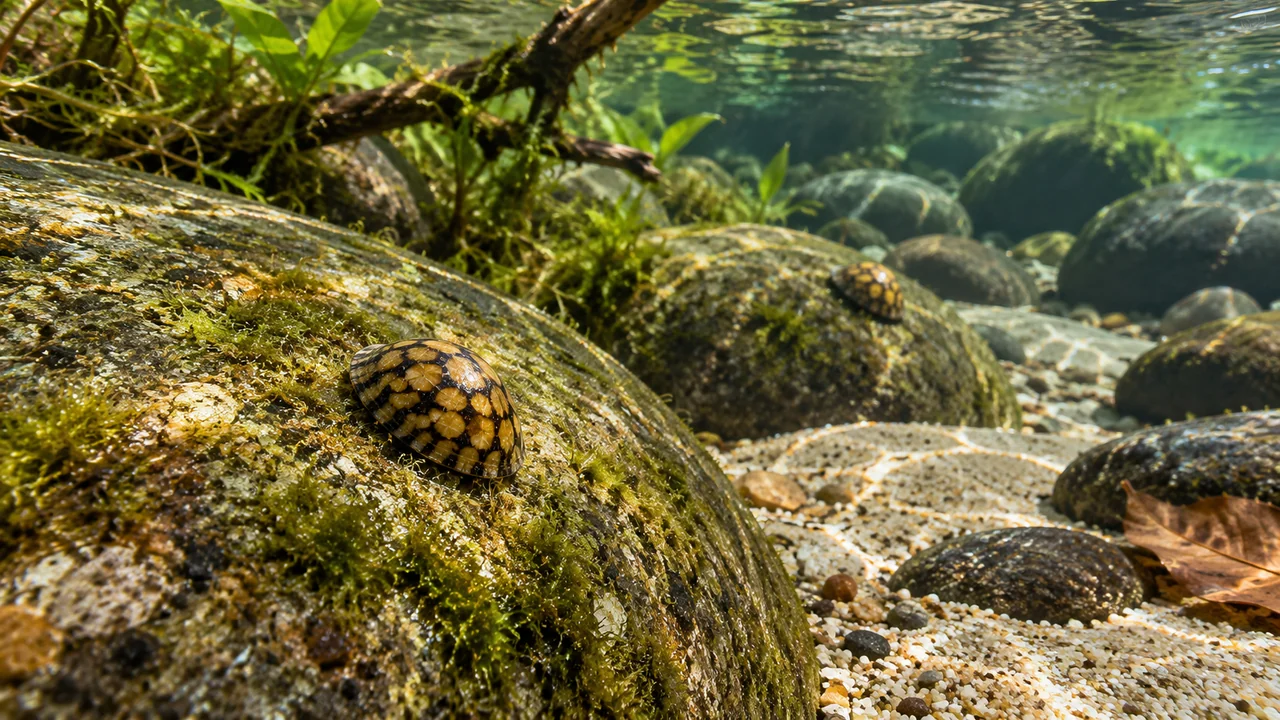
The revision records this species on stones in both still and swift water in coastal river systems, from near the sea to several kilometres inland. Its range includes parts of the Indo-West Pacific; older claims extending every similar Septaria across the whole Pacific need caution. This is a hard-surface grazer, not an animal that requires a deep litter bed.
Prepare a mature dedicated aquarium with broad stones bearing suitable attached growth. Around 40–60 litres and 45–60 cm of frontage gives a useful starting arrangement, not a biological minimum. Retain oxygenated moving water and accessible calm margins rather than aiming a violent jet at every animal. Secure the stones and leave room to inspect both feeding surfaces and the filter.
Food must already be present
Do not buy this snail for a newly assembled or thoroughly scrubbed aquarium. It depends heavily on attached films, and weak transported animals may fail before they establish a feeding routine. Maintain several useful grazing surfaces rather than assuming that a visible patch on one stone will support any number of limpets indefinitely.
Try an appropriate grazer supplement on an accessible surface while checking acceptance. Retail accounts differ over prepared-food use; flakes placed nearby are not proof that the animal can live on them. Keep mature food-bearing stones available during any trial. Avoid treating this as a universal beginner cleaner, and do not let a quiet animal disappear beneath competing fish without confirming that it feeds.
For a carefully observed supplement trial, a small fragment of Premium Natural Spirulina Tablets can be offered on an accessible surface. Prepared-food acceptance is uncertain: keep mature food-bearing stones available, check actual rasping and remove an unused portion.
Attachment calls for gentle maintenance
The shell's low profile and broad foot make the animal look securely armoured, but forced removal can injure it. Leave it on its supporting stone when a safe transfer is necessary, or wait until it moves voluntarily. Do not slide a blade under the shell, twist it off glass or handle it by pulling against the foot.
Keep routes broad and surfaces stable, with no sharp edges beneath the shell margin. Inspect new shell growth for sound formation and distinguish old apex wear from spreading erosion. Check food, pH and mineral preparation if the edge deteriorates; adding calcium without measuring the rest of the water plan is not a diagnosis or a guaranteed repair.
A measured shell-friendly water plan
Published specialist-trade guidance gives 24–30°C, pH 7–7.5, KH above 3°dKH and GH up to 14°dGH. These values are aquarium recommendations rather than a complete experimentally tested species envelope. Use a stable point within the established stock conditions, keeping minerals and buffering adequate instead of pushing towards very soft acidic blackwater.
Maintain conditioned replacement water, biological filtration and effective gas exchange. Monitor GH and KH separately and keep ammonia and nitrite undetectable. At the warmer end of the published guidance, oxygenation deserves particular attention. Neither survival on a flowing stone in nature nor an attractive shell pattern tells you that a particular aquarium has suitable water or enough food.
Egg capsules lead to a different kind of young
Septaria has separate sexes and deposits capsules on solid surfaces. The primary revision describes free-living veligers, not immediately crawling replicas of the adult limpet. It also emphasises how incomplete knowledge of the genus' life histories remains. Observing capsules is therefore not the same as demonstrating successful aquarium reproduction.
Marine dispersal is implicated in the wider distribution, and larvae have been maintained in seawater after acclimatisation in research observations. This does not establish a complete species-specific home protocol with a fixed salt dose, food or hatch date. Do not change the display salinity to chase breeding, and do not transfer the easy freshwater multiplication of miniature hitchhiking limpets to this much larger neritid.
A specialist choice of companions
A species-focused aquarium makes observation and feeding easier. Newly introduced Septaria can be disadvantaged by fish or curious shrimp that disturb them repeatedly, even when those neighbours are not obvious predators. There may be suitable established combinations, but compatible water alone is not proof that a limpet can feed undisturbed.
Avoid assassin snails, snail-eating fish and crayfish. A cap-shaped shell does not eliminate predation risk. If considering a current-loving community, assess the feeding system as well as temperament: fan shrimp need suspended nutrition, while Septaria grazes attached films. They are not interchangeable clean-up animals, and each must have its own food available.
Botanicals at the margins
A little prepared wood and a few leaves can create shaded edges, but retain the mature stone surfaces at the centre of the arrangement. Freshly added leaves do not instantly provide an adequate grazing film. Place organic material where it can be inspected and removed rather than wedged beneath the attached animal.
Keep botanical tint separate from the mineral and pH plan. If an addition creates heavy decomposition or reduces water movement around the stones, correct that practical problem. More brown material is not automatically more natural or more nutritious for a specialist neritid, and no BBA botanical is presented as a shell treatment.
An individual prepared Dried Bodhi Leaves (Ficus religiosa) – Aquarium Leaf Litter leaf can add a shaded margin away from the limpet’s occupied rock. Keep mature grazing stones central and place the leaf where it can be removed without disturbing the attached animal.
When an animal fails to settle
Check transport damage, actual feeding, water chemistry, temperature, oxygenation and disturbance before making multiple changes. Reduced movement or loss of attachment deserves prompt observation; it is not something to solve by repeatedly moving or prodding the animal. Keep the supporting surface stable and avoid forcing an overturned or attached limpet open.
This is a considered specialist purchase, not a guaranteed solution to algae. Prefer an animal with a documented feeding history, an intact foot and a suitable mature destination. If that provision is unavailable, waiting is better than relying on a prepared-food promise. Never release unwanted animals or move aquarium material into natural waterways.
Further reading and sources
Primary taxonomy, natural observations and aquarium keeping advice are distinguished. Numerical keeping bands are attributed recommendations, not universal optima or survival limits. Suggested home dimensions are practical planning choices, not experimentally established minima; commercial names do not authenticate stock.
- Haynes (2001) — revision of Septaria — Primary full revision: porcellana account, embedded operculum, corrected distribution and qualified genus-level veliger observations.
- Garnelio — Septaria porcellana keeping — Specialist-trade temperature/mineral guidance, feeding dependence and transport/community difficulties; not a tested breeding protocol.
- Wirbellose.de — Septaria porcellana — Keeper account of attachment injury, food and sensitivity. Conflicting larger size/easy-community claims are not preferred over the primary revision or assumed universal.