Snails · Spotted Nerite
Spotted Nerite — Vittina natalensis: Habitat and Care
An East African neritid name is often applied loosely to patterned aquarium snails. Keep its identity separate from zebra-style trade labels, provide mature grazing surfaces and shell-friendly water, and avoid treating egg capsules as successful freshwater breeding.
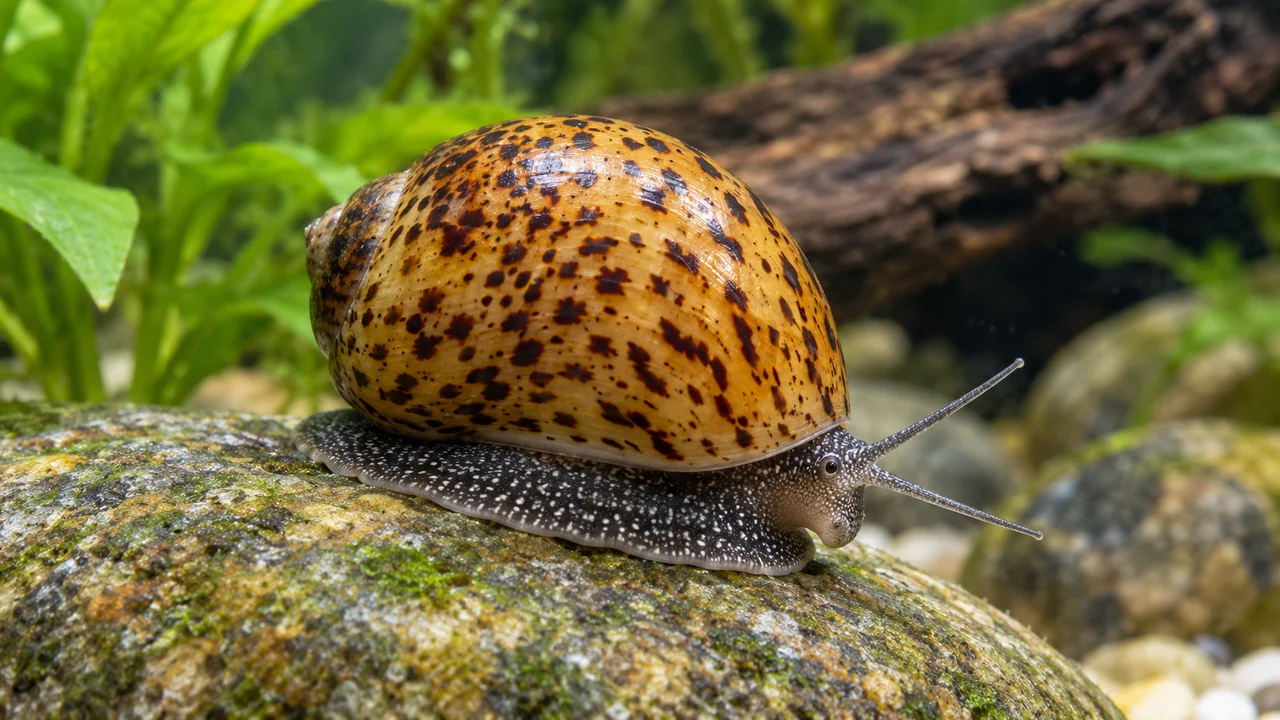
- Identity
- Vittina natalensis (Reeve, 1855); older Neritina natalensis. Spotted and Zebra labels alone do not certify the species.
- Adult scale
- Plan around 2–3 cm shell size; field and museum accounts include specimens around 20–23 mm.
- Aquarium plan
- An established aquarium around 45–60 cm long / 40–60 litres is a useful lightly stocked starting design, not a scientific minimum.
- Published keeping guidance
- 20–28°C, pH 6.5–8.5 and GH 5–30°dGH are broad secondary guidance. Prefer stable neutral-to-alkaline water and measured buffering, not the extremes.
- Food
- Attached growth is the starting resource; verify whether supplementary food is accepted.
- Young
- Separate sexes; nerite capsules and a larval phase do not establish routine completion in a closed freshwater aquarium.
Keep the name separate from the pattern
Vittina natalensis is the accepted combination used here, with Neritina natalensis retained for older records and searches. Current taxonomic-linked databases give Reeve, 1855. The shop labels Zebra, Spotted and Nerite may refer to different animals, and a patterned shell photographed in a sales tank cannot authenticate the whole shipment.
This species is distinct from Clithon corona, whose shell may bear projections, and from the low dark helmet form of Neritina pulligera. Other Vittina also enter the trade. Record source information and identification where possible rather than assigning a scientific name solely because a shell has stripes or dots. The profile's composition is not a substitute for taxonomic examination.
East African distribution, not an invented Asian origin
The Lake St Lucia synthesis places the species along the East African coast and reports historical museum material from the South African system. It includes estuarine associations such as mangroves and reed stems. That evidence differs from generic retail pages that assign every attractive nerite to Indonesia or describe one uniform forest-stream habitat.
The St Lucia account did not record the species in its recent survey, so historical specimens should not be presented as a new observation of a thriving local population. Its coastal associations are useful context for life history and salinity questions, not instructions to subject aquarium adults to rapid salinity changes. Ask how the actual stock is maintained before choosing a freshwater or brackish arrangement.
A mature aquarium before the snail arrives
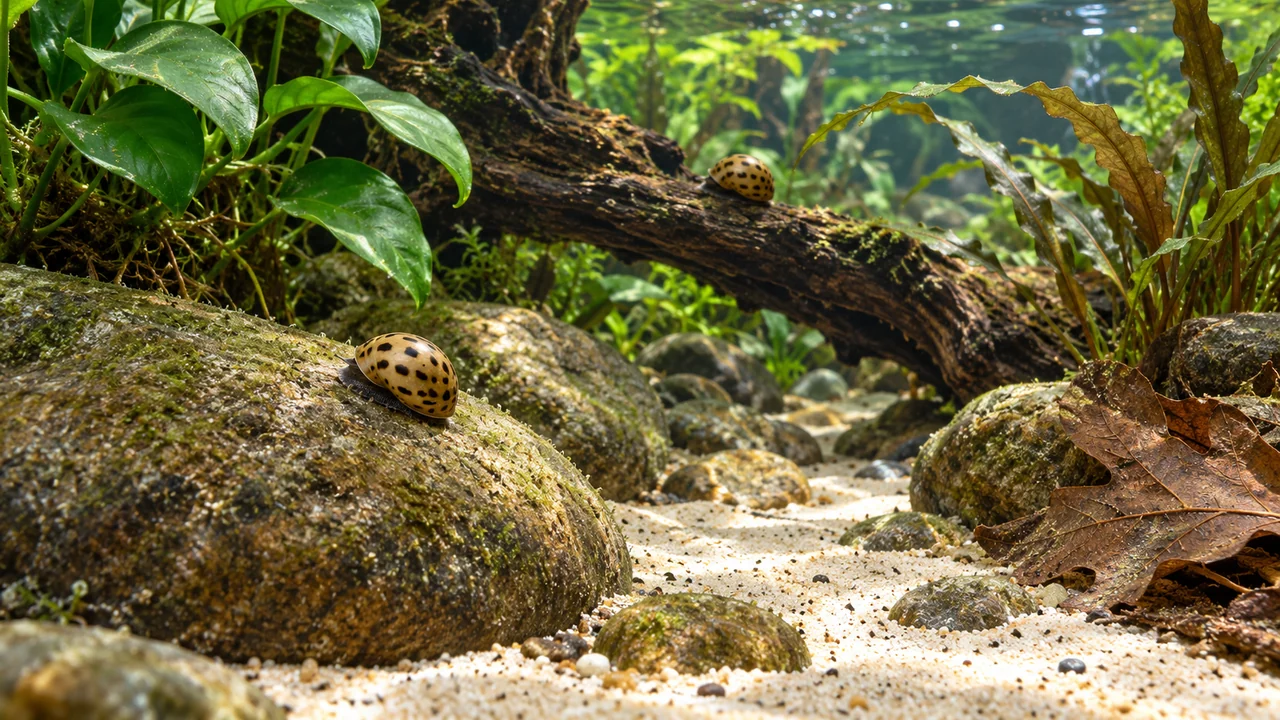
Provide established growth on broad stones, wood and suitable glass surfaces. A 40–60 litre aquarium with roughly 45–60 cm of frontage can provide a useful lightly stocked arrangement; this is a practical planning choice, not a validated minimum. Food-bearing area and competing grazers matter more than counting empty litres.
Use stable low hardscape and leave a clear route for observation. Fit a cover and inspect cable gaps, since nerites may explore around the waterline. Maintain useful filtration and surface exchange without scrubbing every feeding surface at once. A new aquarium can have excellent-looking plants yet offer too little attached food for an animal that ignores prepared diets.
Watch the newer shell edge
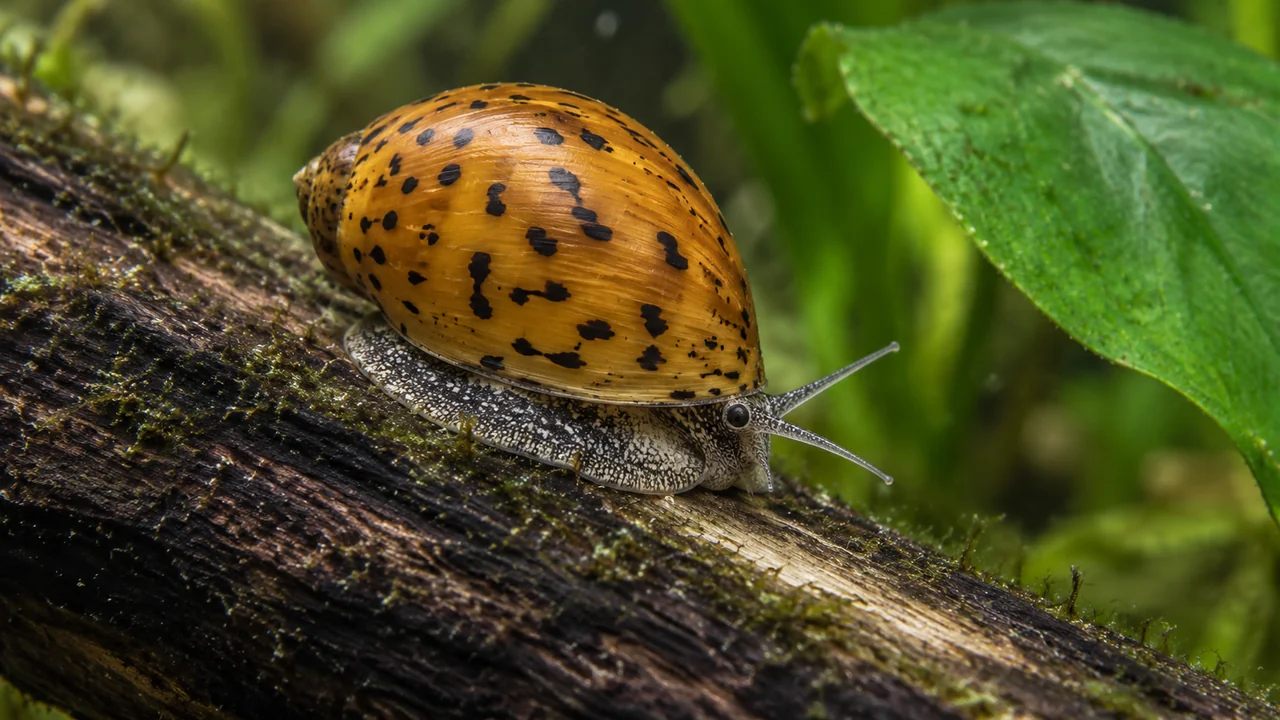
The shell's pattern is attractive, but the growing margin is especially useful for monitoring condition. Look for sound new formation and investigate thinning, pitting or uneven deterioration. Wear on an old apex and fresh damage near the aperture are not the same event. Check handling and possible harassment alongside the water and diet.
Use consistently mineralised replacement water and an appropriate food plan. GH includes calcium and magnesium; KH describes buffering rather than calcium concentration. Do not treat a high value for one as proof that everything else is correct. Existing erosion usually remains visible even when later growth improves, and a botanical additive cannot guarantee a pristine shell.
Use published care bands proportionately
Secondary husbandry guidance spans 20–28°C, pH 6.5–8.5 and GH 5–30°dGH. These are broad aquarium recommendations under a name with trade-identification problems, not a measured optimal envelope for every natalensis population. Choose stable, shell-friendly neutral-to-alkaline conditions appropriate to the actual stock rather than using every extreme interchangeably.
Measure KH and keep buffering sufficient for the selected pH plan. A precise universally validated KH optimum was not established by the primary sources consulted, so it is not invented here. Use conditioned water, effective biological filtration and undetectable ammonia and nitrite. Brackish stock requires its own measured plan and compatible neighbours; casually adding salt to a freshwater community is not the answer to an uncertain label.
A grazer still needs a feeding plan
Attached algal films and other suitable surface growth provide the basic grazing resource. Leave useful patches available and observe actual movement over them. A cleaner-looking stone tells you that grazing has occurred, not that the whole aquarium still contains enough nutrition. Several grazers can exhaust a limited resource without obvious fighting.
Try suitable supplementary snail food on an accessible surface and confirm individual acceptance. Some nerites do not immediately use tablets or vegetables, so keep mature grazing surfaces available while trying small portions. Remove uneaten food rather than leaving it to generate a dirty film. Do not promise complete algae removal, universal plant safety or a balanced diet from discarded fish food alone.
A small portion of Botanical Grazing Pellets is one supplementary option to trial where this individual accepts prepared foods. Confirm actual use, retain mature films and remove leftovers instead of assuming that a disappearing pellet has fed the nerite.
Egg capsules are only one stage
Nerites have separate sexes, and females can attach hard pale capsules to solid surfaces. The aquarium literature associates this named trade group with a free-swimming larval phase and saline development rather than routine production of crawling young in an ordinary freshwater display. That distinction is important even where capsules become visually conspicuous.
The primary distribution account is not a nursery protocol, and uncertain trade identity makes generic salt-and-hatch recipes especially unreliable. No exact salinity, feeding schedule or guaranteed hatch time is prescribed here. Keep adult conditions stable rather than converting the display into a breeding experiment. Compare this with the direct freshwater development of a ramshorn or bladder snail, not merely the colour of the eggs.
Companions and botanical surfaces
Peaceful fish and shrimp can be considered where temperature and water needs overlap and grazing remains adequate. Avoid animals that nip the foot or tentacles, snail-eating fish, crayfish and assassin snails. An operculum is protection, not a guarantee that a valuable ornamental snail can live with a predator.
A few prepared leaves and broad wood can add sheltered feeding texture around the stones. Keep their condition visible and maintain the mineral plan. This is not a reason to make water extremely acidic or smother every grazing surface with litter. If leaves collect hidden food, thin the material and improve access instead of assuming that more organic matter must help the snail.
For the small botanical margin around the stones, compare Dried Oak Leaves – Natural Aquarium Leaf Litter with Dried Longan Leaves – Natural Aquarium Leaf Litter. Use prepared pieces sparingly while keeping the snail’s principal grazing surfaces and the chosen mineral conditions intact.
Practical checks and honest records
For prolonged withdrawal, check temperature, water chemistry, oxygenation, recent medication, feeding and neighbour behaviour. Do not force an operculum open to test the animal. Gently reposition an overturned snail on a stable submerged surface if it cannot regain a grip, and avoid pulling a firmly attached animal sideways off glass.
Keep the supplier's name and water conditions in your record, particularly if breeding or unusual behaviour is observed. Photographs of stripes or spots alone should not be used to generalise across all trade nerites. Never release animals, capsules or aquarium material outdoors, and do not turn an uncertain stock identification into a confident claim about a wild species.
Further reading and sources
Primary taxonomy, natural observations and aquarium keeping advice are distinguished. Numerical keeping bands are attributed recommendations, not universal optima or survival limits. Suggested home dimensions are practical planning choices, not experimentally established minima; commercial names do not authenticate stock.
- OBIS / WoRMS-linked taxon — Vittina natalensis — Accepted combination and Reeve, 1855 authority; direct MolluscaBase detail fetch was restricted.
- Perissinotto and colleagues (2014) — Lake St Lucia gastropods — Primary regional synthesis, East African range, estuarine associations and historical specimens; not a current aquarium breeding study.
- Water Research Commission — freshwater invertebrate guide, Mollusca — Institutional regional taxonomic context under Neritina natalensis; available indexed material consulted, large PDF retrieval was limited.
- Aquaportail — Vittina natalensis — Secondary numerical keeping guidance and trade life-cycle account; conflicting origin and date wording is not preferred over primary/taxonomic evidence.