Shrimp · Caridina typus
Caridina typus — Habitat and Care
A freshwater adult grazer with saline larval development. Separate practical adult care from the controlled nursery studies and avoid identifying it by grey colour alone.
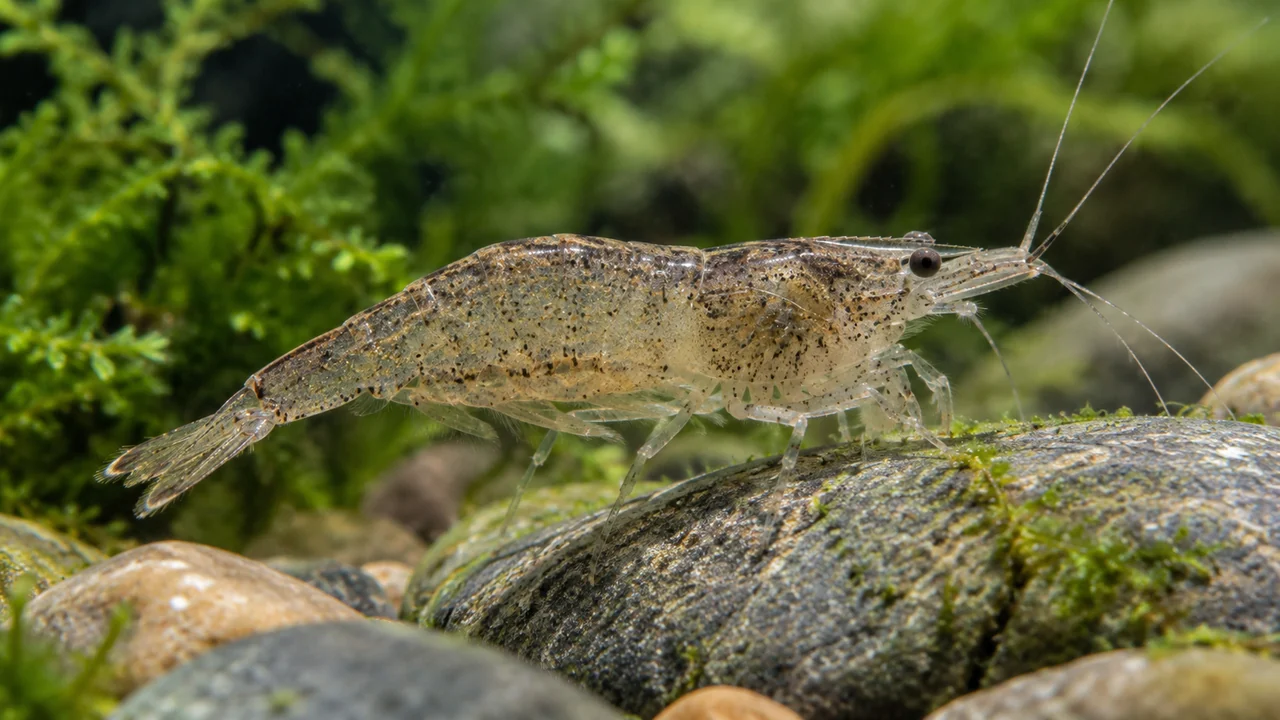
- Identity
- A short-rostrum atyid; the dorsal rostral edge is unarmed. Grey colour alone is insufficient.
- Adult scale
- Allow roughly 3–4 cm, with variation and larger commercial estimates; verify the actual stock.
- Aquarium
- A mature 60 × 30 cm footprint or larger for a small group, with broad grazing surfaces.
- Temperature
- Suggested adult maintenance 23–26°C, rather than the whole experimental larval range.
- Water
- A practical adult starting plan: pH 6.5–7.5 and GH 4–10°dGH, adjusted to established stock.
- Development
- Adults can live in freshwater; successful larval rearing requires a separate saline nursery.
A short rostrum is more useful than a grey label
Caridina typus H. Milne Edwards, 1837 is an accepted species with a wide Indo-West Pacific history. The short rostrum has an unarmed dorsal edge, unlike the conspicuously toothed upper edge of many familiar shrimp. The underside can carry a few teeth. These characters are more useful than calling every grey transparent shrimp this species, but identification still requires the complete animal and appropriate expertise.
Australian Amano Shrimp is a commercial search name, not evidence that C. typus is Caridina multidentata. Older geographically broad records also deserve care as taxonomic work continues to examine regional populations and related forms. Keep a reliable supplier identification and locality information where available rather than inventing a precise collecting site.
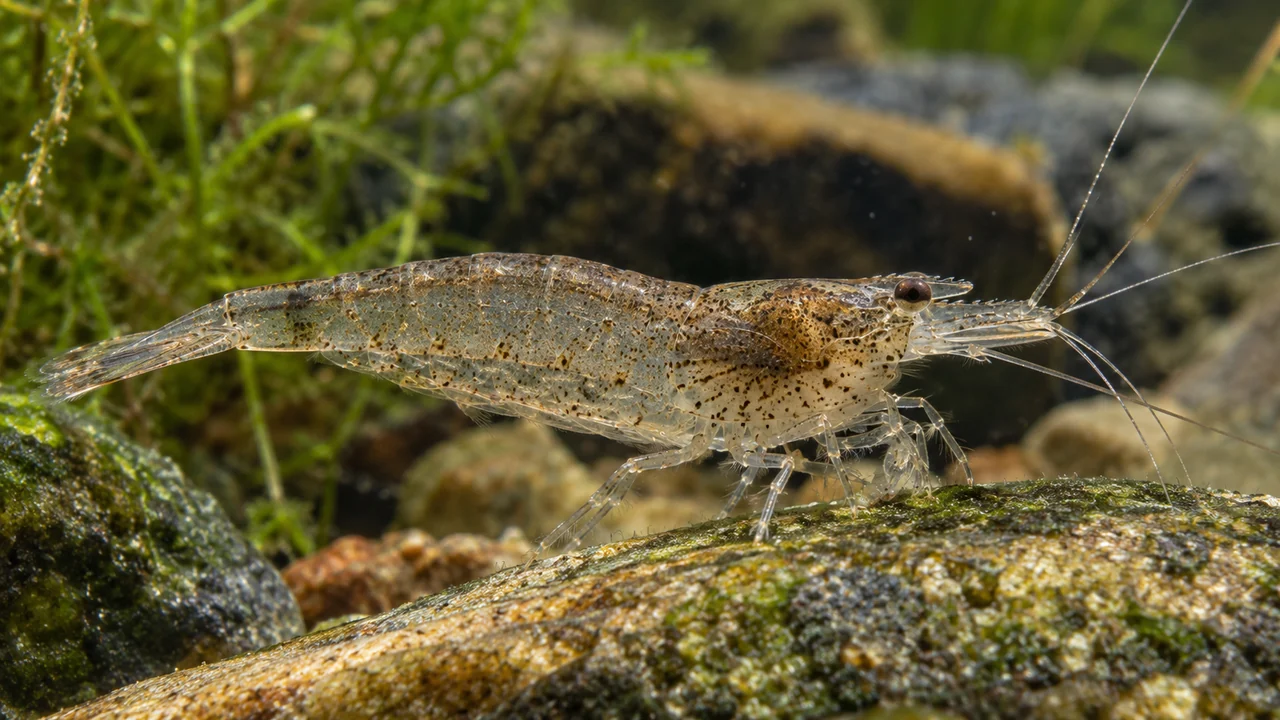
Freshwater reaches within a connected island landscape
Published records span tropical and subtropical Indo-West Pacific regions, including island streams. Adults use freshwater surfaces for collecting food, while the life cycle connects freshwater populations to saline larval environments. A freshwater adult record therefore says little on its own about whether young can complete development in the same water.
For aquarium design, prioritise mature stones, wood and planting with dependable circulation and oxygenation. The natural range does not establish a single universal acidic blackwater condition. Likewise, a nursery experiment using marine-strength water does not justify adding salt to an adult community aquarium.
Provide surfaces and a clear feeding route
A mature 60 × 30 cm aquarium is a sensible starting footprint for a small group, with more room useful for larger stock or a more complex community. This is a practical recommendation for stability and grazing area, not a measured species minimum. Arrange wood and rounded stones so their surfaces remain accessible instead of filling all usable space with decoration.
Protect intakes and leave quieter cover beside the circulating water. Moss and suitable plants provide fine feeding surfaces, while an open patch makes supplementary food easy to observe. Keep a clear siphoning route so uneaten food can be removed without repeatedly disturbing every shrimp.
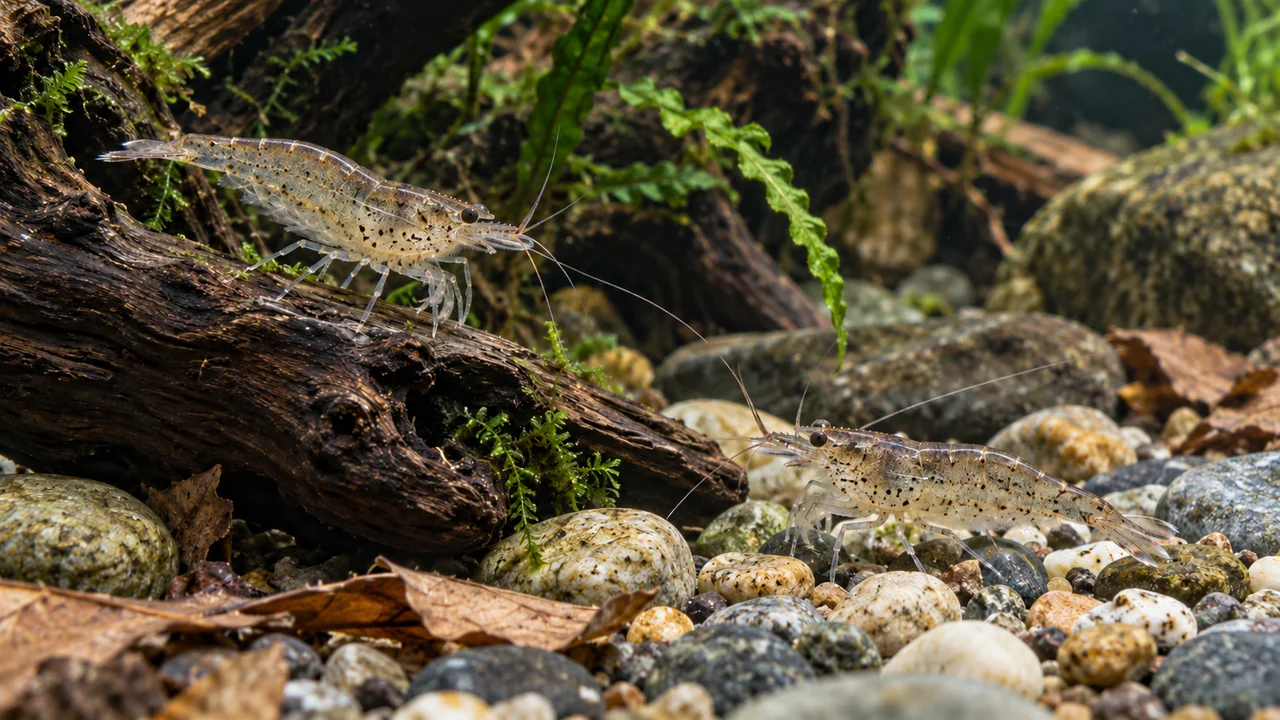
A practical adult plan with an explicit evidence boundary
For established freshwater stock, 23–26°C, pH 6.5–7.5 and GH 4–10°dGH are reasonable adult starting recommendations within commonly reported aquarium conditions. Detailed controlled adult husbandry evidence is weaker than the published larval evidence, so these are not presented as experimentally established optima. Obtain the supplier's measured maintenance water before deciding how to adjust it.
Keep the carbonate plan stable and avoid forcing pH through repeated chemical additions. Dechlorinate replacement water and match it consistently. A mature biological filter, reliable oxygenation and undetectable ammonia and nitrite come before trying to reproduce a single reported field reading. Monitor evaporation so mineral concentration does not creep upwards.
Collecting from surfaces is not a complete feeding plan
Offer a complete shrimp food in modest portions alongside established surface growth. These shrimp collect fine material with small picking appendages; they are not miniature fan feeders that need a permanent cloud of powder. Spread food where the group can reach it rather than letting every portion fall into deep gaps.
Leaf and wood surfaces can support grazing, but a visible film does not establish an adequate energy or protein supply. Observe the abdomen, activity and feeding response over time. Persistent searching in a clean new tank, loss of condition or poor access should prompt a feeding review. Overfeeding to make the aquarium look mature creates waste rather than a balanced ecosystem.
For additional grazing variety, Snowflake Shrimp Food or Botanical Grazing Pellets can be offered in a small observed portion. These are supplementary choices for adult surface collectors, separate from the balanced ration and larval feeding.
Moulting and community choices
Provide accessible cover for freshly moulted animals and avoid sudden changes in temperature or mineral composition. An empty shell can be a normal moult; recurring incomplete moults require examination of the whole maintenance and feeding routine. Do not treat every problem by adding an unmeasured mineral supplement.
Peaceful adult behaviour does not eliminate predation risks from fish or larger crustaceans. Judge companions by adult size and feeding behaviour, and protect small animals from intakes. A shrimp-focused aquarium makes it easier to see whether all individuals feed. Larvae are especially vulnerable and should not be expected to survive community filtration and fish predation.
Freshwater adults and saline larvae are different tasks
Kondo and colleagues tested larvae across five temperatures and five salinities in 2021. Their results showed that the lowest tested salinity, 4.25 ppt, did not produce juveniles. Higher-salinity performance differed between C. typus and the other species studied. The results should not be compressed into a generic claim that a little aquarium salt enables breeding.
Nakahara and colleagues separately reared larvae with the microalga Tetraselmis tetrathele in 2005. A 25.5 ppt treatment gave the best result for C. typus among that study's tested conditions. These are controlled nursery findings, not a complete household recipe or an adult salinity recommendation. Successful rearing needs a separate saline nursery, suitable food, water management and a planned transition after metamorphosis.
Use leaves as habitat, not as a breeding shortcut
A small amount of prepared leaf litter adds surfaces and sheltered routes. Place it where food and waste remain inspectable, with enough movement of water to prevent stagnant accumulations. Aged wood is similarly useful when it contributes accessible grazing space rather than blocking the floor.
Neither darker water nor a particular pod can replace the saline stage required by larvae. Keep botanical additions proportionate to filtration and oxygen supply. Adults can be maintained in an attractive freshwater planted aquarium without pretending that its appearance completes the species' entire natural life cycle.
For the limited botanical margin, compare Dried Oak Leaves – Natural Aquarium Leaf Litter with Premium Mangrove Leaves – Natural Aquarium Leaf Litter. Place either where the group can collect from the surface and where leftovers can be inspected.
Check identity, food and water before changing the recipe
If animals stop collecting food, check oxygenation, filter operation and recent water changes, then test nitrogenous waste and examine access to food. Do not transfer experimental high-temperature larval treatments to adults in an attempt to stimulate activity. A nursery result and a maintenance recommendation answer different questions.
For breeding failures, first establish that the identification is sound and that the intended larval environment was actually provided. Commercial naming and the absence of a fully verified home rearing protocol remain real limitations. The published experiments support a saline larval requirement; they do not guarantee success from copying a salinity number alone.
Further reading and sources
Identity and natural-history sources are distinguished from aquarium husbandry. Recommended care is not a set of experimentally established survival limits; breeding conditions may differ from adult maintenance.
- 2020 Solomon Islands Caridina revision — C. typus treatment — Primary systematic treatment supporting the short, dorsally unarmed rostrum and identification context.
- Kondo et al. (2021), larval temperature and salinity responses — Primary larval experiment; no juvenile completion at the lowest 4.25 ppt treatment. Adult care must not be inferred from all larval test temperatures.
- Nakahara et al. (2005), larval rearing with Tetraselmis tetrathele — Primary rearing study; 25.5 ppt was the best tested C. typus treatment in that experiment, not a universal guarantee.
- Garnelio — Australian Amano / Caridina typus — Commercial adult-maintenance context only. Primary studies take precedence over inconsistent trade descriptions of larval development.