Shrimp · Lanchester's Glass Shrimp
Lanchester's Glass Shrimp — Macrobrachium lanchesteri: Habitat and Care
A transparent long-armed prawn needs a verified identity and a realistic feeding and predation assessment. A dedicated aquarium is often easier to manage than a dwarf-shrimp community.
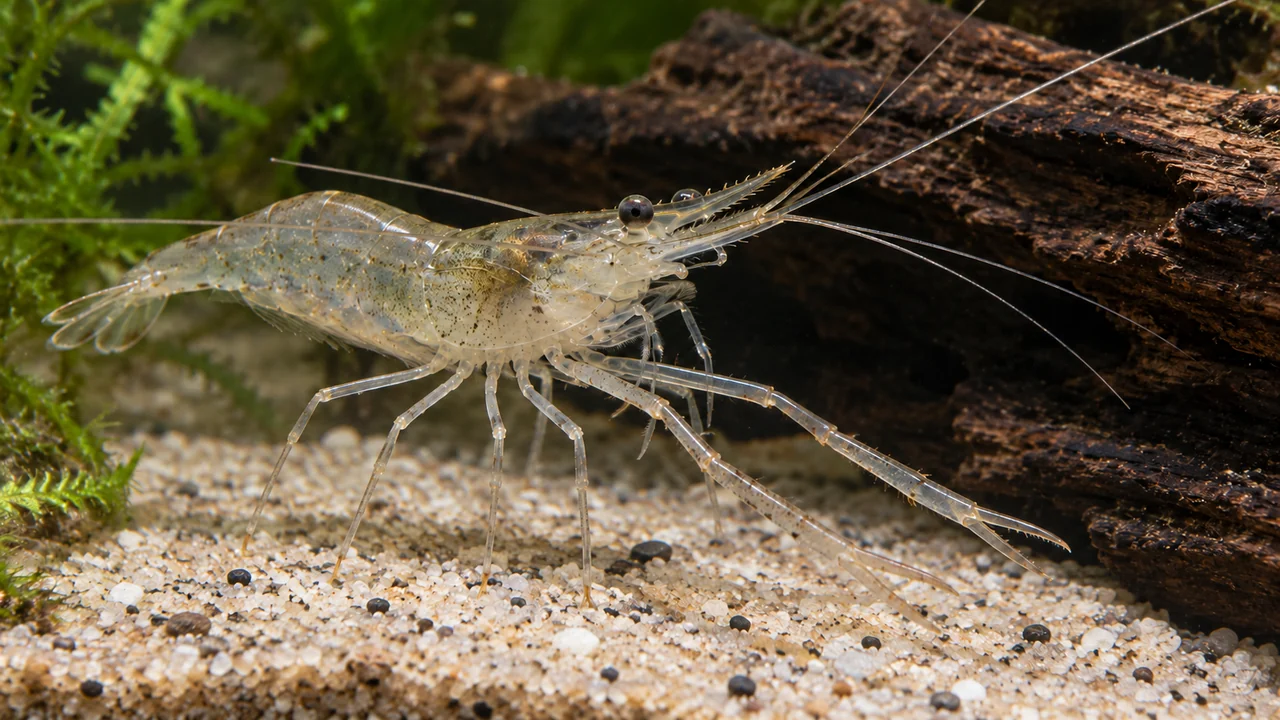
- Identity
- Macrobrachium lanchesteri (De Man, 1911); generic Ghost or Glass Shrimp labels are insufficient.
- Adult allowance
- Allow for roughly 6–8 cm animals in aquarium planning; published trade estimates and sex comparisons vary.
- Aquarium
- A species-focused footprint around 80 × 35 cm or larger, with separate retreats and feeding positions.
- Temperature
- Suggested maintenance 24–27°C, with reliable oxygenation.
- Water
- A practical freshwater plan: pH 6.5–7.5 and GH 6–12°dGH; match established stock.
- Feeding and breeding
- Omnivorous and opportunistic; freshwater larval rearing is reported, but not every translucent prawn shares this life cycle.
The 2024 revision changes how a trade name should be read
Macrobrachium lanchesteri is a recognised species, but Glass Shrimp and Ghost Shrimp are names applied to many unrelated prawns. The 2024 revision by Chaowvieng and colleagues used morphology and molecular evidence to examine lanchesteri-like animals and describe two additional species. A transparent body and long arms are therefore not enough to certify an aquarium purchase.
The accepted name is Macrobrachium lanchesteri, historically described in Palaemon. The revision documents variation within the species as well as differences from close relatives. Obtain a traceable supplier identification. If that evidence is absent, retain an honest Macrobrachium sp. or qualified trade label rather than assuming this guide establishes the identity of every feeder shrimp.
Read the whole prawn, including its arms
The animal has a projecting rostrum and elongated second walking legs ending in chelae. Their proportions and fine features matter in identification; they should not be imagined as oversized crayfish claws. The revision shows that rostral form and arm robustness vary, so a single exaggerated feature is not a reliable universal sex or species test.
The species is associated with mainland South-East Asian freshwater, including Thai type material. Historical accounts describe standing and slower waters such as ponds and related habitats. Those older records predate the modern separation of similar species, so not every old locality or breeding account can be treated as a newly verified record of the narrowly identified species.
Design around separation rather than a crowded glass box
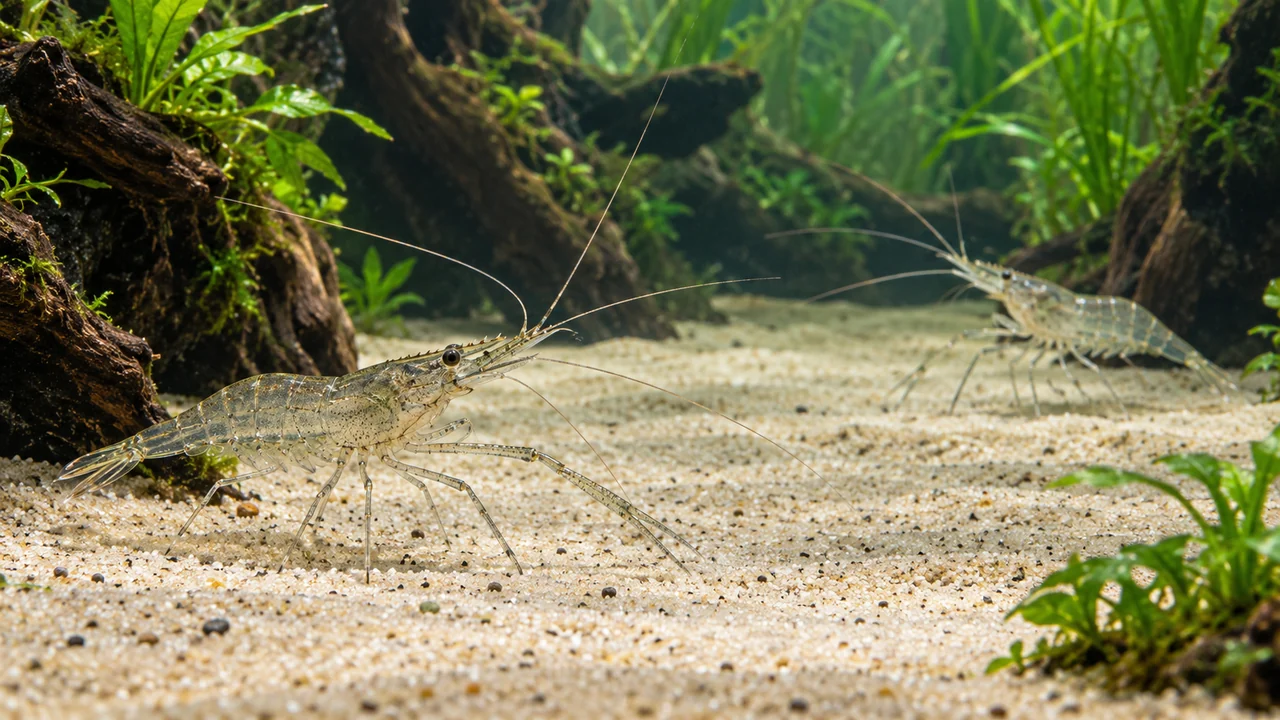
A species-focused aquarium around 80 × 35 cm or larger provides a useful planning footprint, especially when several animals are intended. This is a practical recommendation for separation and adult allowance, not a universal minimum derived from a stocking trial. Plan for substantial prawns rather than buying small transparent juveniles as permanent dwarf-shrimp companions.
Build several broad retreats and break direct lines of approach with secure wood, plants and stones. Leave space around each shelter entrance so an animal is not forced past another to feed. Fit a secure cover and protect equipment openings. A dense decorative wall that leaves one feeding patch can concentrate conflict instead of providing usable territory.
Freshwater maintenance with stable oxygen and minerals
A practical adult starting plan is 24–27°C, pH 6.5–7.5 and GH 6–12°dGH, adjusted to the conditions of identified established stock. These are maintenance recommendations, not experimentally established physiological boundaries. They sit within published aquarium accounts without adopting their widest survival claims as everyday targets.
Use dechlorinated water, a mature biological filter and dependable gas exchange. Larger portions of animal food make waste control important. Keep a route for removing leftovers from shelters and test ammonia and nitrite if activity changes. Avoid abrupt mineral changes, particularly around moulting, and do not add salt solely because another ghost-shrimp species has saline larvae.
Feed an opportunistic omnivore deliberately
Provide a complete suitable sinking crustacean food, complemented by appropriately sized frozen or other safe invertebrate foods and some plant-based material. These prawns are not algae-only cleaners. A fish-food crumb occasionally reaching the floor is not a complete feeding plan, especially where dominant animals can seize it first.
Deliver portions to separate accessible positions and observe who actually eats. Remove deteriorating food before it damages water quality. Regular feeding can reduce competition, but it cannot guarantee that an opportunistic prawn will ignore fish fry, small shrimp or vulnerable companions. Do not advertise hunger as the only condition under which predation can occur.
Pure Shrimp Meal Shrimp Food is a protein-forward supplementary option to assess at separate feeding positions, alongside the complete crustacean ration. A strong feeding response does not make smaller tankmates safe.
Claws, moults and a realistic compatibility assessment
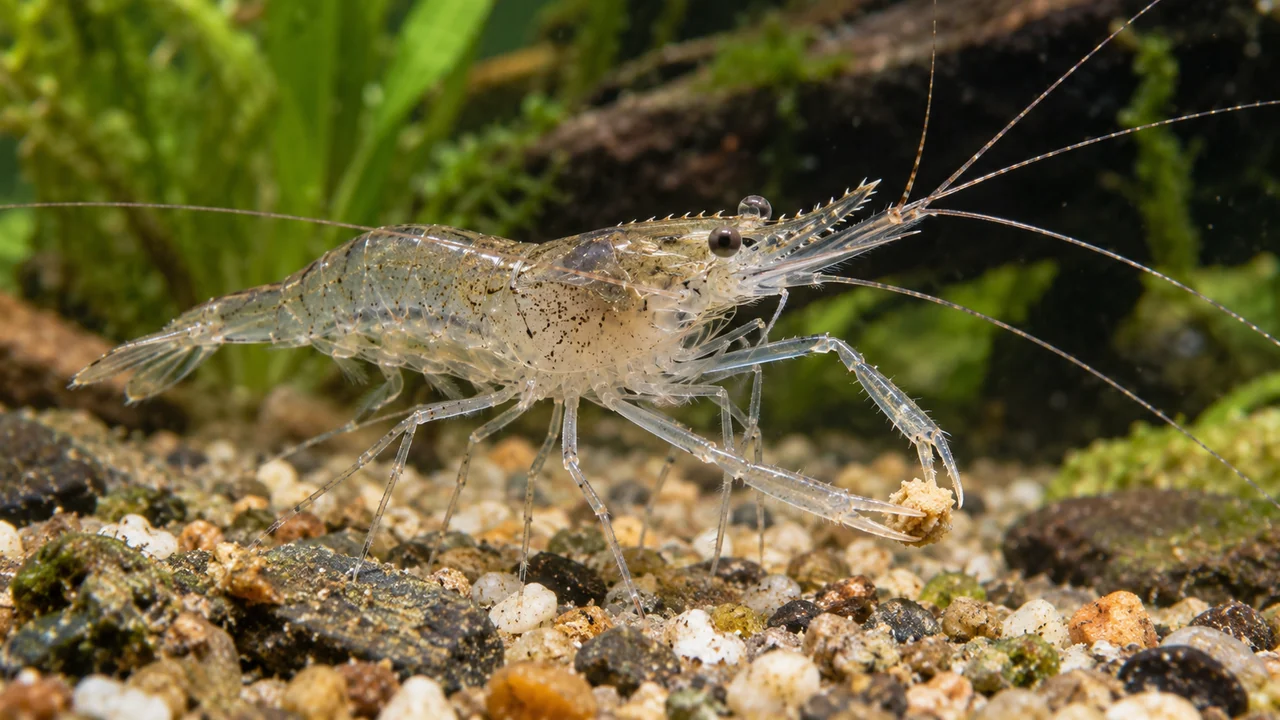
Treat small fish, fry and dwarf shrimp as potentially vulnerable. A translucent appearance does not mean harmlessness, and a larger shrimp may also be at risk during a soft moult. The safest practical arrangement is often a dedicated aquarium where behaviour and feeding can be observed without relying on a promise of community compatibility.
Provide several retreats and be ready to separate animals if one persistently excludes another from food or shelter. Soft newly moulted prawns need quiet space. Do not pull an animal from its retreat simply to check that it is alive after every moult; use feeding records and observation while maintaining good water quality.
Freshwater breeding is reported, but identity comes first
Females carry eggs beneath the abdomen. Historical and aquarium accounts report development through free-swimming larval stages in freshwater, rather than hatching as fully formed miniature adults. This is different from a direct-developing Neocaridina colony and should be planned as a nursery project with appropriate fine food and protected filtration.
The modern revision makes stock identity especially important when interpreting older breeding records. A complete, independently validated practical protocol for every commercial lanchesteri-labelled population is not established here. Do not promise a fixed development period or copy a generic ghost-shrimp salinity recipe. Obtain the breeder's observed history and prepare a separate nursery before relying on successful recruitment.
Botanicals create boundaries, not a safety guarantee
Aged wood and a restrained amount of prepared leaves provide surfaces and low visual barriers. Broad structures can help divide the aquarium into usable areas, but check that a whole prawn can enter and reverse out of each shelter. Long appendages and a growing body make narrow decorative openings a poor choice.
Leaf litter does not neutralise territorial behaviour or make small companions safe. Keep enough exposed floor to assess feeding and remove waste. Maintain the chosen freshwater chemistry rather than turning every long-armed prawn aquarium into an acidic botanical display.
For a scattered botanical boundary, BBA Leaf Litter & Substrate Variety Mix – 1 L Seasonal Botanical Blend provides mixed material to sort into a small accessible patch. Choose pieces around the adult prawn and leave the broad shelter entrances clear.
When aggression or losses appear
Check whether one animal controls all food, whether shelters have usable entrances and whether a vulnerable moult or size difference explains the interaction. Separate a persistent aggressor rather than adding more companions to distract it. For inactivity or losses, inspect oxygenation, ammonia, nitrite and spoiled food before changing chemistry.
The principal scientific limitation is the identity of commercial glass prawns following the 2024 revision. The principal husbandry limitation is transferring old breeding observations to unverified stock. Both can be stated honestly while still giving useful adult care: adequate separation, complete food, clean stable water and a conservative view of predation risk.
Further reading and sources
Identity and natural-history sources are distinguished from aquarium husbandry. Recommended care is not a set of experimentally established survival limits; breeding conditions may differ from adult maintenance.
- Chaowvieng et al. (2024), taxonomic revision of lanchesteri-like prawns — Primary revision including two new species, morphological variation and molecular evidence. Transparency alone cannot identify the species.
- FAO — historical freshwater prawn biology account — Institutional historical treatment of habitat and freshwater larval development; predates the 2024 separation of similar species.
- Wirbellose.de — Macrobrachium lanchesteri keeper records — Attributed aquarium observations on adult allowance, feeding and freshwater breeding. Community-safety claims and exact timelines are not treated as guarantees.