Shrimp · Atyoida pilipes
Atyoida pilipes — Habitat and Care
A small island-stream shrimp with different feeding-hand forms: plan current, surface food and a separate saline larval stage rather than copying a large fan-shrimp recipe.
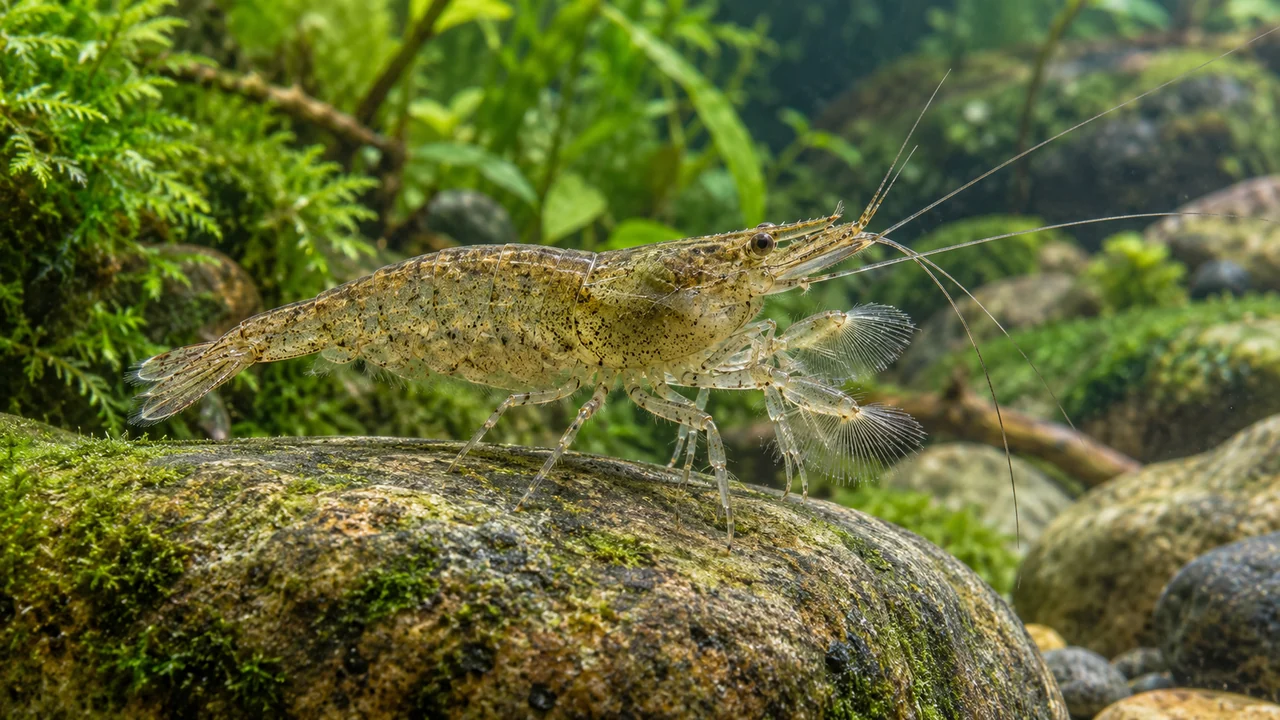
- Adult scale
- Usually described at roughly 3–4 cm; allow for larger individuals in aquarium accounts.
- Aquarium
- A mature 60 × 30 cm footprint for a small group, with several feeding positions.
- Temperature
- A practical starting range of 23–26°C, rather than the much warmer larval experiments.
- Water
- Suggested maintenance: pH 6.8–7.8, GH 6–12°dGH, KH 3–8°dKH; match established stock.
- Food
- Fine suspended complete food plus productive surfaces; hand form affects how food is collected.
- Reproduction
- Amphidromous: freshwater adults and saline larval development are different husbandry tasks.
A small shrimp with more than one feeding arrangement
Atyoida pilipes is an accepted species described by Newport in 1847. Mini Fan Shrimp and Green Lace Shrimp are useful search names, but they do not establish the identity of every animal sold under them. It is not the Hawaiian Atyoida bisulcata, and a small brown filter-feeding shrimp is not automatically a young Bamboo Shrimp. Look for a traceable scientific identification alongside photographs of the complete animal.
Its most useful distinction is not a fixed colour. Published descriptions recognise different forms of the small chelae, or feeding hands. Broad atyoid hands are associated mainly with females, while palm-bearing ortmannioid hands occur mainly in males. The association is not absolute: do not sex an individual confidently from one photograph or turn these observations into a universal claim that every animal changes sex.
Island streams, current and different feeding positions
Natural records concern tropical island streams across the western and central Pacific. Clear, flowing reaches, stones, gravel and stream vegetation offer a mixture of exposed surfaces and quieter margins. The ecological setting is an active stream, not a stagnant bowl or a requirement for a uniformly dark, acidic display.
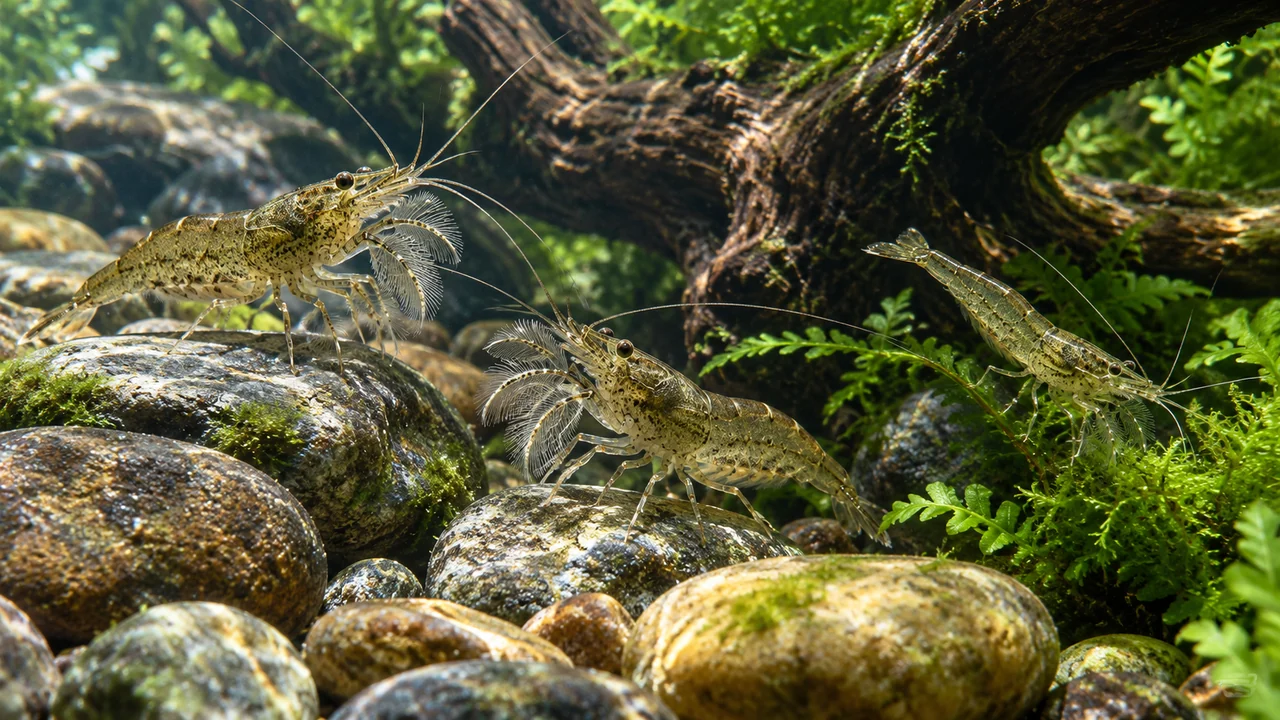
Different feeding structures help explain why animals need not occupy identical positions. Filtering is valuable where suitable particles pass, while sweeping and collecting from surfaces can also be normal. Provide a choice of current-facing perches and sheltered grazing patches. A shrimp picking from a surface is not, by that action alone, proof of starvation; assess body condition, food access and repeated behaviour together.
Build a usable stream-style aquarium
For a small group, a mature aquarium around 60 × 30 cm provides room to separate feeding stations and maintain stable water. This is a practical layout recommendation, not a scientifically established minimum volume. Use rounded stones and secure aged wood, with plants anchored outside the strongest flow. Leave a route for siphoning settled waste without dismantling every refuge.
An outlet should carry food towards occupied surfaces without sweeping shrimp off them. Keep oxygenation reliable, protect pump intakes and provide quieter shelter immediately nearby. A powerful pump in an otherwise bare new tank does not create a functioning feeding habitat. Examine the animals after changes to outlet direction rather than judging suitability from pump capacity alone.
A working water plan for adults
A reasonable adult starting plan is 23–26°C, pH 6.8–7.8, GH 6–12°dGH and KH 3–8°dKH, adjusted to the established conditions of the actual stock. These are selected aquarium recommendations within reported keeper ranges, not experimental adult tolerance limits. Supplier accounts differ, so obtain their measured water information before purchase rather than chasing a number after introduction.
Use dechlorinated water, regular modest changes and a fully functioning biological filter. Check ammonia and nitrite whenever feeding or behaviour changes unexpectedly. Top up evaporation appropriately so minerals do not accumulate unnoticed. Abrupt correction of pH or hardness is a poor substitute for preparing replacement water consistently.
Food has to reach both fans and surfaces
Offer a suitably fine complete shrimp food in small portions where the flow will carry it to filtering animals. A separate portion can settle on an accessible grazing surface. Fine particles must contain useful nutrition; cloudy water, miscellaneous detritus and strong filtration are not a balanced diet. Watch actual collection before adding more.
Palm-bearing feeding hands can sweep as well as filter, making productive surfaces particularly useful. Keep a record of feeding response and the abdomen's condition, and reduce uneaten food before it accumulates. Repeated searching in every part of a clean aquarium, poor condition or failure to intercept food calls for a feeding adjustment. Simply increasing powder can damage oxygen conditions before improving nutrition.
Moulting, group life and companions
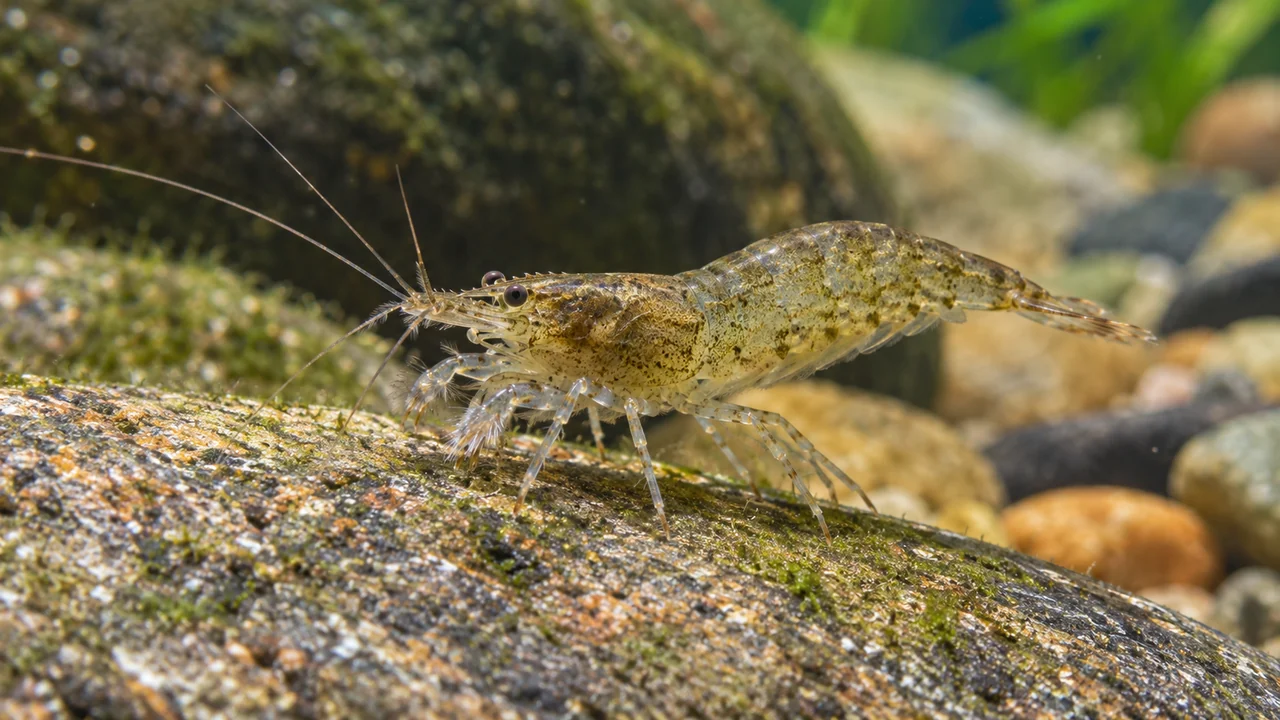
Several animals can use a well-arranged aquarium, provided each can reach food and a retreat. Offer sheltered gaps large enough for the whole body, without sharp pinch points. A freshly moulted shrimp needs quiet cover; repeated disturbance or predatory tankmates make this vulnerable period harder regardless of how attractive the display looks.
Choose peaceful companions that do not harass shrimp or monopolise every feeding surface. Small fish may still eat larvae, and larger mouths can threaten adults. A species-focused aquarium makes nutritional observation easier. Stable minerals, clean water and a complete diet matter more than adding calcium products whenever a moult is seen.
Freshwater adults do not imply freshwater breeding
The life cycle is amphidromous: adults occupy fresh water, while larvae require a different environment during development. Eggs or newly hatched larvae in an adult aquarium are therefore not evidence that a self-sustaining freshwater colony will follow. Do not add marine salt to the adult display in an improvised attempt to save a brood.
Tanaka, Hamasaki and Dan tested early larvae across several temperatures and salinities in 2024. High salinities and warmer treatments supported more early development, but no larvae reached the juvenile stage in that experiment. It does not provide a complete successful rearing recipe. A deliberate breeding project needs a separate nursery, suitable suspended food and a defensible protocol rather than treating an experimental treatment as a guaranteed method.
Use botanicals without blocking the food route
A modest amount of prepared leaves can provide sheltered surfaces, while aged wood offers perches and grazing area. Place material so it cannot collapse against a pump intake or bury the clear path between an outlet and feeding position. Plants and a few accessible leaves are more manageable than a deep bed that traps every powder feed.
Biofilm is useful habitat, but its appearance does not establish a complete nutritional supply. Remove decaying accumulations that impede flow and introduce new organic material gradually. Tannin tint is optional; it is neither an oxygen measurement nor a reason to abandon the adult water plan.
A prepared section of Dried Bamboo Leaves (Bambusa sp.) – Premium Shrimp & Blackwater Botanical can add a sheltered collecting surface outside the strongest flow. Size it to the aquarium and keep it clear of intakes and feeding stations.
First checks when an animal stops feeding
Check whether food actually arrives, whether the shrimp can hold position, and whether another animal blocks access. Then test water quality and inspect the filter and oxygen supply. A recently moulted animal may shelter, but persistent withdrawal, loss of condition or repeated escape attempts deserves investigation rather than a larger dose of food.
Identity and rearing evidence remain separate limitations. Feeding-hand variation should not become a confident photographic sex diagnosis, and the available larval experiment did not complete metamorphosis. Keep these uncertainties in the care record while still providing a practical adult aquarium with visible feeding opportunities.
Further reading and sources
Identity and natural-history sources are distinguished from aquarium husbandry. Recommended care is not a set of experimentally established survival limits; breeding conditions may differ from adult maintenance.
- Integrative Micronesian atyid revision, Diversity 16 (2024), 200 — Primary taxonomy and the non-absolute association between sex and chela form.
- Chace (1983), The Atya-like Shrimps of the Indo-Pacific Region — Original systematic treatment and feeding-hand terminology; not a modern complete aquarium breeding protocol.
- Tanaka, Hamasaki & Dan (2024), early larval temperature and salinity study — Primary experiment: early larval performance; no successful juvenile completion in the tested conditions.
- Garnelio — Mini Fan Shrimp husbandry — Commercial maintenance account, used as aquarium guidance rather than taxonomic authority.
- msjinkzd — Green Lace Shrimp keeper account (2010) — Attributed first-hand aquarium observations; distinguishes surface collection from an automatic starvation diagnosis.