Shrimp · Blue Leg Poso Shrimp
Blue Leg Poso Shrimp — Caridina caerulea: Habitat and Care
A Lake Poso endemic with a translucent body, blue appendages and a warm alkaline maintenance plan: its habitat is not an acidic leaf-litter stream.
- Natural origin
- Lake Poso, Sulawesi; not a generic name for every blue Sulawesi shrimp.
- Adult scale
- Typically around 2–3 cm total length in aquarium accounts; published carapace measurements are not total body length.
- Aquarium
- A mature 60 × 30 cm footprint or larger, with accessible rock and wood surfaces.
- Temperature
- Practical maintenance around 28°C, commonly 27–29°C.
- Water
- A keeper-based starting plan: pH 7.8–8.3, GH 5–7°dGH, KH 3–5°dKH.
- Reproduction
- Large eggs and freshwater juvenile development; no obligatory marine nursery like Amano Shrimp.
Look beyond a blue trade name
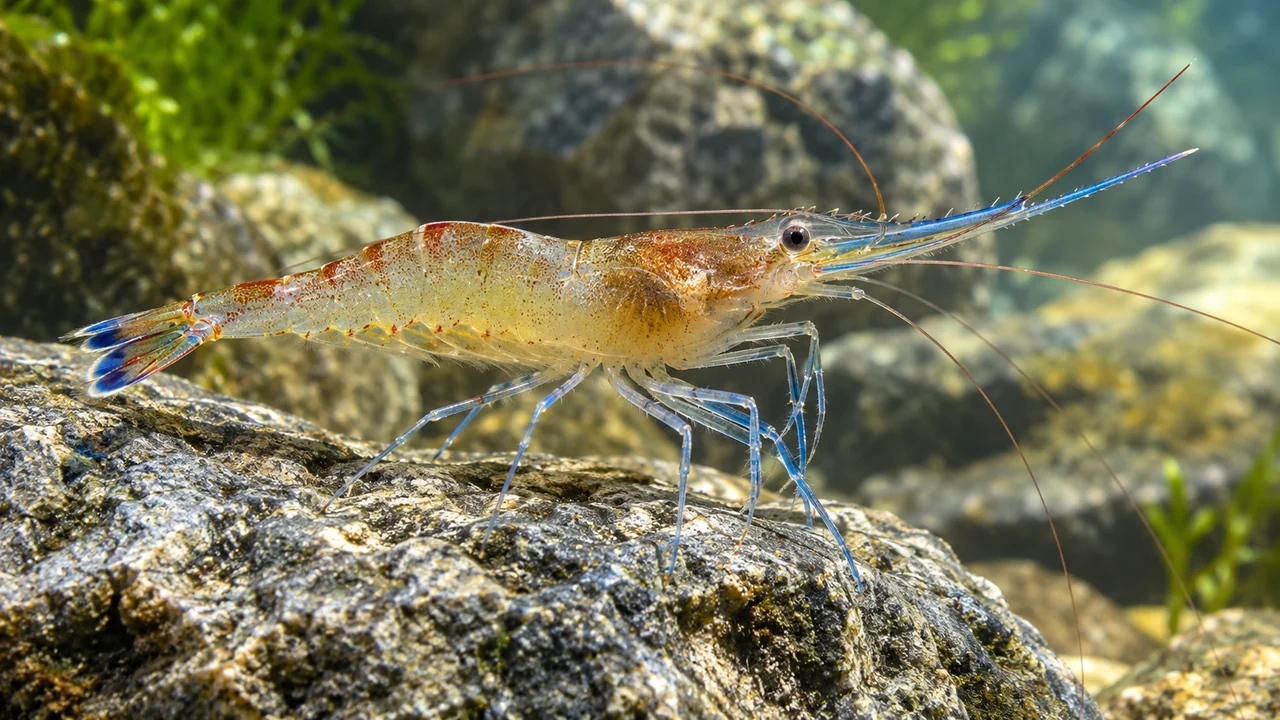
Caridina caerulea was described by von Rintelen and Cai in 2009. The description distinguishes a predominantly translucent yellowish or reddish animal with blue legs and rostrum, reddish antennae and blue patterning towards the tail fan. It is not an opaque electric-blue Neocaridina. Lighting and individual variation can alter the apparent intensity, so use the full animal and provenance rather than one colour patch.
The long slender rostrum and body proportions matter alongside the appendages. Earlier lake-shrimp records included animals under broader identifications, but this does not make every C. ensifera-labelled shrimp C. caerulea. Buy traceable stock and keep the distinction between a documented Lake Poso species and a loosely applied Sulawesi trade label.
Lake Poso is the habitat reference
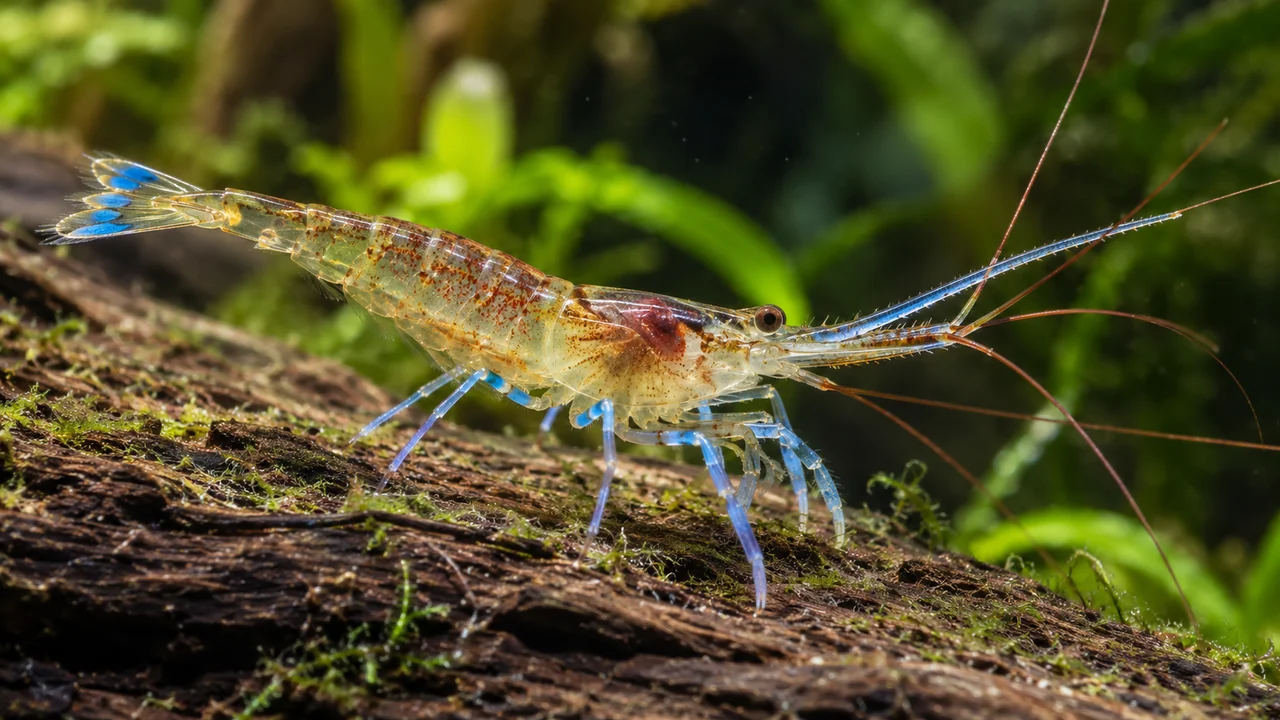
The original species account places C. caerulea in Lake Poso, rather than its surrounding rivers. It records the shrimp mainly on hard substrates such as wood and rocks, with some observations on plants. Animals tend to remain associated with surfaces rather than behaving like an exclusively open-water shrimp.
This is a warm lake with a different chemical context from an acidic peat-swamp stream. A deep bed of decomposing leaves and a pH-lowering substrate would not reproduce the central habitat features. Build accessible mature surfaces, steady warmth and a consistent mineral plan instead of copying another Caridina guide because the genus matches.
Arrange a mature rock-and-wood aquarium
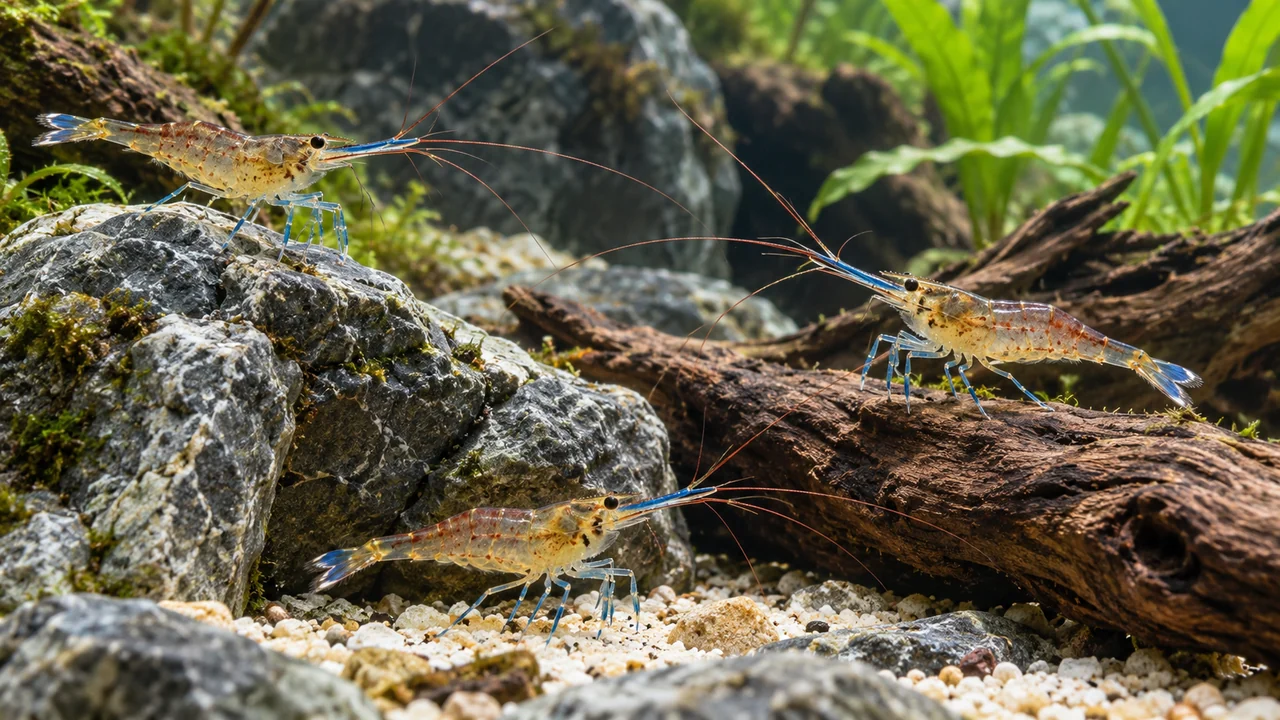
For a small colony, a mature aquarium around 60 × 30 cm offers a useful working footprint, not an experimentally determined minimum. Arrange secure rocks and aged wood so their surfaces receive gentle circulation and can be inspected. Include retreats without creating narrow traps, and leave a visible feeding area.
Planting is optional and must tolerate the chosen warm alkaline conditions. A bare newly assembled rock display still lacks established grazing surfaces. Cycle the filter fully and allow the habitat to mature before stocking. Warm water holds less oxygen than cooler water, making reliable gas exchange and a guarded, functioning filter particularly important.
A warm alkaline plan, not a blackwater recipe
Around 28°C, with a working range of 27–29°C, is a practical maintenance recommendation supported by specialist Sulawesi keepers. A starting chemistry plan of pH 7.8–8.3, GH 5–7°dGH and KH 3–5°dKH reflects published aquarium experience. These values are not a measured map of every microhabitat or proof that one mineral product suits all Sulawesi species.
Prepare replacement water outside the aquarium, checking the resulting chemistry rather than relying on a salt label alone. Keep the heater and thermometer reliable and maintain oxygenation in hot weather. Avoid acidic active substrates that work against the intended carbonate and pH conditions. Do not correct the display abruptly with alternating acid and buffer additions.
Small surface grazers still need complete food
The shrimp pick over mature rock and wood surfaces. Supply a complete food suitable for small grazing shrimp in restrained portions, distributing it where animals can collect it. The natural association with hard surfaces does not mean a clean stone aquarium can feed a colony indefinitely.
Observe feeding rather than measuring success by how much powder disappears between rocks. Too much fine food can accumulate out of sight and increase oxygen demand. Keep feeding access and maintenance access together: an arrangement that cannot be cleaned or inspected will eventually make nutritional and water-quality problems harder to separate.
A small portion of Blue Spirulina Shrimp Food is one supplementary grazing option to assess on an accessible feeding surface. Check acceptance before increasing it; it does not replace the complete food or establish the correct Lake Poso water conditions.
Moulting and choosing companions
A stable mineral plan and secure shelter help animals through moulting. If problems recur, examine replacement water, feeding, temperature and possible contamination rather than automatically increasing hardness. A cast shell is normal; progressive losses or animals remaining exposed and inactive are reasons to investigate promptly.
Species-focused housing makes feeding and breeding easier to observe. Fish may prey on small shrimp, while unrelated Sulawesi species do not automatically share identical requirements. Quarantine new arrivals and maintain line records. Never use the island name as a universal compatibility guarantee.
Freshwater reproduction with a mature nursery surface
The original description records relatively few large eggs, consistent with abbreviated development rather than an obligatory marine larval phase. Young can grow in freshwater under suitable colony conditions. This differs from Amano Shrimp and should not prompt routine salt addition to a Lake Poso aquarium.
Protect intakes and retain fine accessible surfaces for young animals. Do not turn egg counts from a small descriptive sample into a promised brood yield, or promise a fixed hatch timetable. Success depends on the actual stock, nutrition and stability. Captive breeding is valuable, but the presence of eggs alone does not establish that every juvenile will survive.
Keep botanicals proportionate to the lake setting
Aged wood is particularly relevant because the species is recorded on hard woody surfaces. A small amount of prepared leaf material may add grazing area in an aquarium, but a deep acidic litter bed is not a requirement. Keep the floor open enough to inspect trapped food and maintain the warm-water oxygen supply.
The published 2013 IUCN assessment listed C. caerulea as Vulnerable. That dated assessment should not be confused with a new population survey or with the status of a different Lake Matano shrimp. Seek responsibly sourced, traceable captive-bred stock where available, and never release aquarium animals or water into natural habitats.
When a Poso colony becomes inactive
First confirm actual temperature, gas exchange and filter operation, followed by ammonia, nitrite and the prepared-water chemistry. Check whether food reaches the shrimp and whether recent additions have introduced decaying organic material. Do not assume inactivity proves the water needs more tannins or a lower pH.
The main evidence boundaries are clear: the original description supports species identity and habitat; named keepers support an aquarium maintenance plan. Neither establishes a universal breeding yield or an exact condition for every Sulawesi shrimp. Preserve that distinction when adjusting the colony.
Further reading and sources
Identity and natural-history sources are distinguished from aquarium husbandry. Recommended care is not a set of experimentally established survival limits; breeding conditions may differ from adult maintenance.
- von Rintelen & Cai (2009) — radiation of Sulawesi lake Caridina — Primary description, C. caerulea account: identity, Lake Poso substrates and egg observations; carapace length is not total body length.
- Sulawesi Keepers — Damiano Ferraioli aquarium account — Named first-hand keeper describes Blue Leg Poso alongside other separately identified Sulawesi stock, warm conditions and mineral preparation.
- Flowgrow — Caridina caerulea — Secondary specialist maintenance context; older gaps in breeding information are not evidence that breeding is impossible.
- IUCN — Caridina caerulea assessment (2013) — Dated conservation assessment, Vulnerable; not presented as a fresh population census.