Shrimp · Pearl Shrimp
Pearl Shrimp — Neocaridina palmata: Habitat and Care
Pearl and Blue Pearl trade lines need careful naming. Build a stable freshwater colony while distinguishing selected appearance from a verified Neocaridina identity.
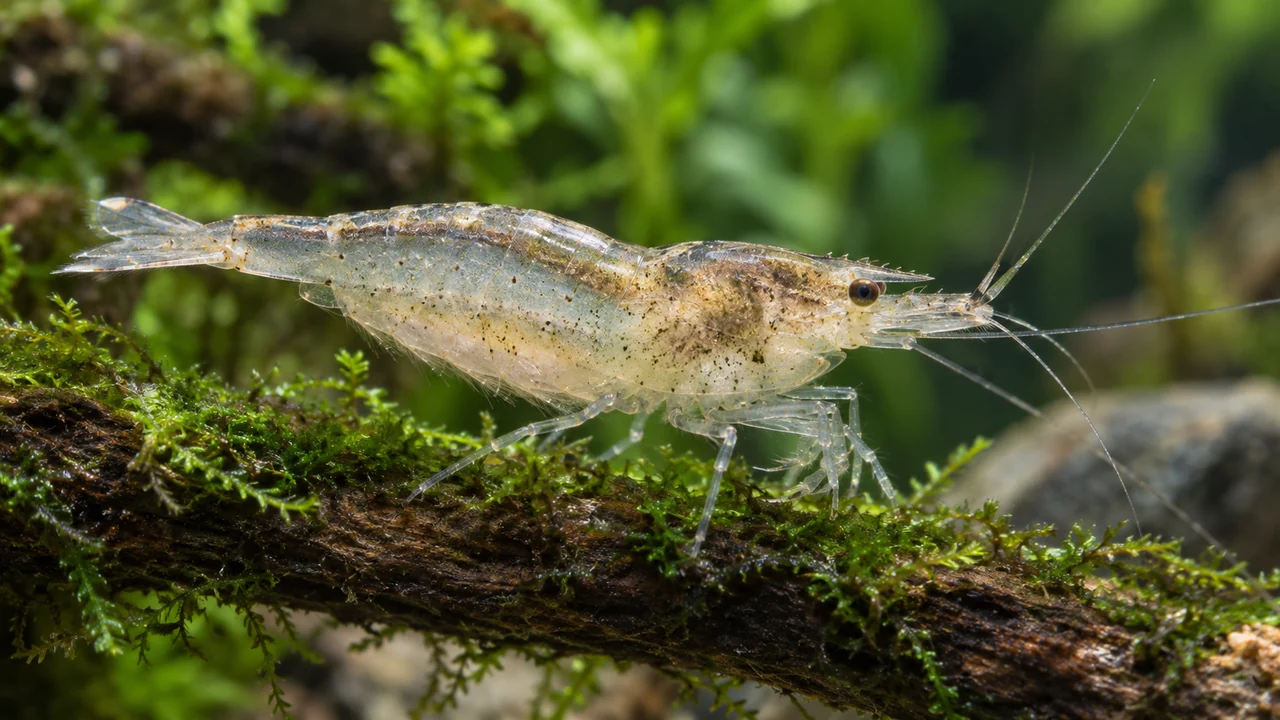
- Identity
- Neocaridina palmata (Shen, 1948); Pearl trade names are not diagnostic.
- Adult scale
- A small dwarf shrimp, commonly around 2–3 cm, with females generally more substantial.
- Aquarium
- A mature planted 45 × 30 cm footprint is a useful modest-colony starting point.
- Temperature
- Recommended maintenance starting range: 20–24°C.
- Water
- Suggested pH 6.5–7.8, GH 6–12°dGH, KH 3–8°dKH; favour consistency.
- Reproduction
- Freshwater development with young able to grow in the adult water; no marine nursery is normally required.
Pearl is a trade description, not a diagnostic test
Neocaridina palmata is a recognised species, originally described by Shen in 1948. Pearl, White Pearl, Blue Pearl and Snowball are commercial names applied to selected aquarium shrimp. They are useful when discussing a line's appearance, but they do not prove that every animal sold under them has the same genetically verified ancestry.
Historical aquarium literature also associates some of these names with Neocaridina zhangjiajiensis. Current taxonomic listings recognise N. palmata and N. zhangjiajiensis separately. It would therefore be misleading to treat the latter automatically as a synonym of the former. This profile covers the palmata-associated Pearl aquarium context while retaining the uncertainty surrounding individual trade populations.
How it differs from Cherry Shrimp
Wild-looking palmata can be translucent or mottled rather than uniformly pearl-white or blue. N. davidi can also vary enormously in colour. A photograph of a pale shrimp cannot reliably settle the distinction. Confident species identification may require examination of anatomical characters that are not visible in an ordinary aquarium portrait.
Natural records place the species in East Asian freshwater, including China and Vietnam in published accounts. Do not assign a particular selected Pearl line to a named wild stream without provenance. Keep the supplier's label, any identification evidence and its captive breeding history. Compare the separate N. davidi guide for husbandry, without merging the two species into one article.
A freshwater colony with useful surfaces
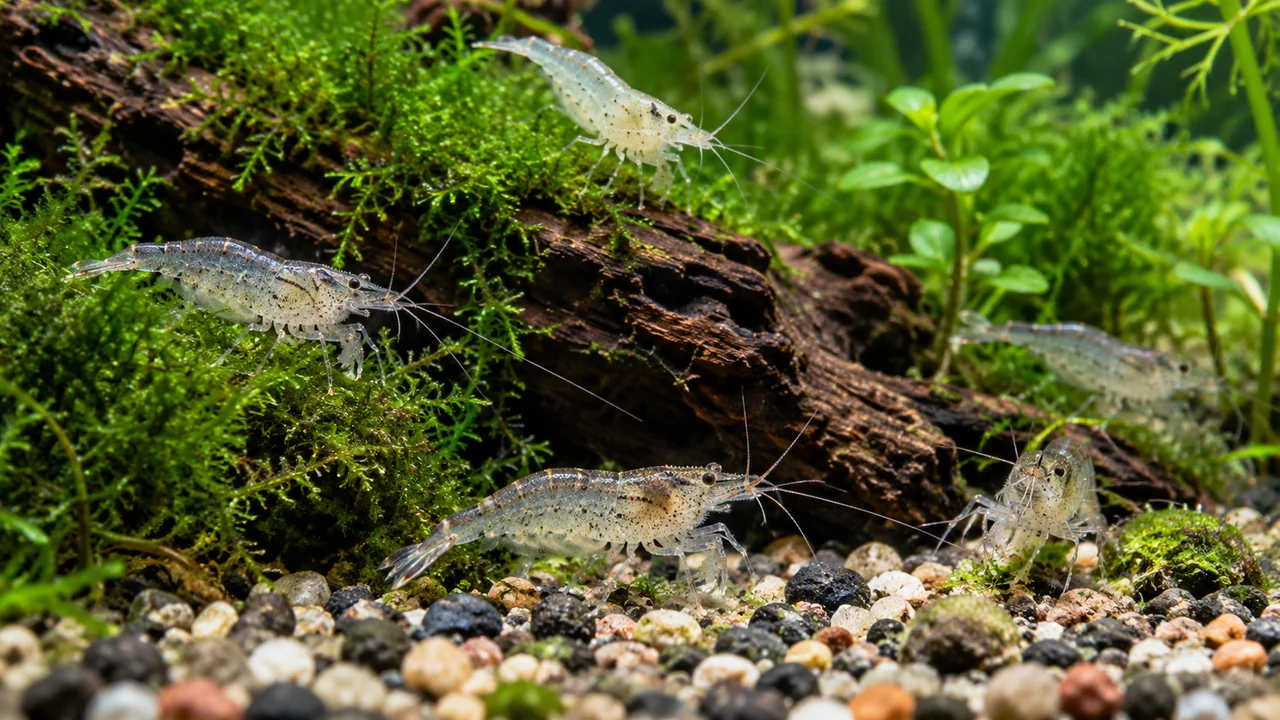
A planted aquarium around 45 × 30 cm provides a practical starting footprint for a modest colony. More space makes population growth and maintenance easier. A very small container may hold water, but offers little margin for errors in temperature, feeding or evaporation. Mature surfaces matter more than selecting a decorative tank shape.
Use a guarded intake, moderate circulation and plants or moss that give juveniles shelter. Aged wood and an accessible feeding patch help distribute activity across the aquarium. Leave a route for gentle siphoning. A floor completely buried under ornaments or decomposing leaves makes it harder to judge food consumption and locate a developing water-quality problem.
Moderate water rather than survival extremes
A useful maintenance starting plan is 20–24°C, pH 6.5–7.8, GH 6–12°dGH and KH 3–8°dKH. These are selected practical recommendations within the wider ranges reported for aquarium stock, not measured physiological limits for every Pearl line. Broad temperature survival claims should not become the everyday target for a colony.
Prepare dechlorinated replacement water consistently and match the established colony before making gradual changes. Inert substrate can work well with a stable moderate-hardness supply. Do not add an acidic substrate simply because other shrimp profiles use one, or force pH down while retaining a large carbonate load. Test the water plan as a whole.
Grazing needs a nutritional back-up
The shrimp spend much of their time picking at surfaces, collecting a mixture of microbial growth and fine food. Biofilm helps support that behaviour, but its presence does not quantify the nutrition available to a growing colony. Offer a suitable complete shrimp food in small measured portions and observe how adults and juveniles reach it.
Complementary foods can add variety, but avoid treating one vegetable, leaf species or mineral powder as a complete ration. Remove deteriorating leftovers and adjust the amount as the population changes. In a mature heavily populated tank, a clean-looking feeding patch can reflect rapid consumption rather than proof that no supplementary food is needed.
Nettle Shrimp Food and Bee Pollen Gold™ Shrimp Pellets provide plant-forward grazing and treat-pellet choices for supplementary variety. Start with an observable portion of one food while retaining the complete ration.
Moults and companions in a breeding colony
Provide fine cover close to grazing surfaces so a soft newly moulted animal can withdraw promptly. Observe the population over time instead of diagnosing every empty shell as a failed moult. Repeated difficulties call for checks of water changes, mineral consistency, feeding and recent chemical treatments.
Peaceful small fish may still consume young shrimp, so a species-focused aquarium is the clearest option for a productive colony. Predatory fish and opportunistic larger crustaceans require a different assessment. Keep selected lines separately when preserving colour and identity matters; mixing uncertain Neocaridina populations can obscure their records even before any particular cross has been demonstrated.
Eggs and young in freshwater
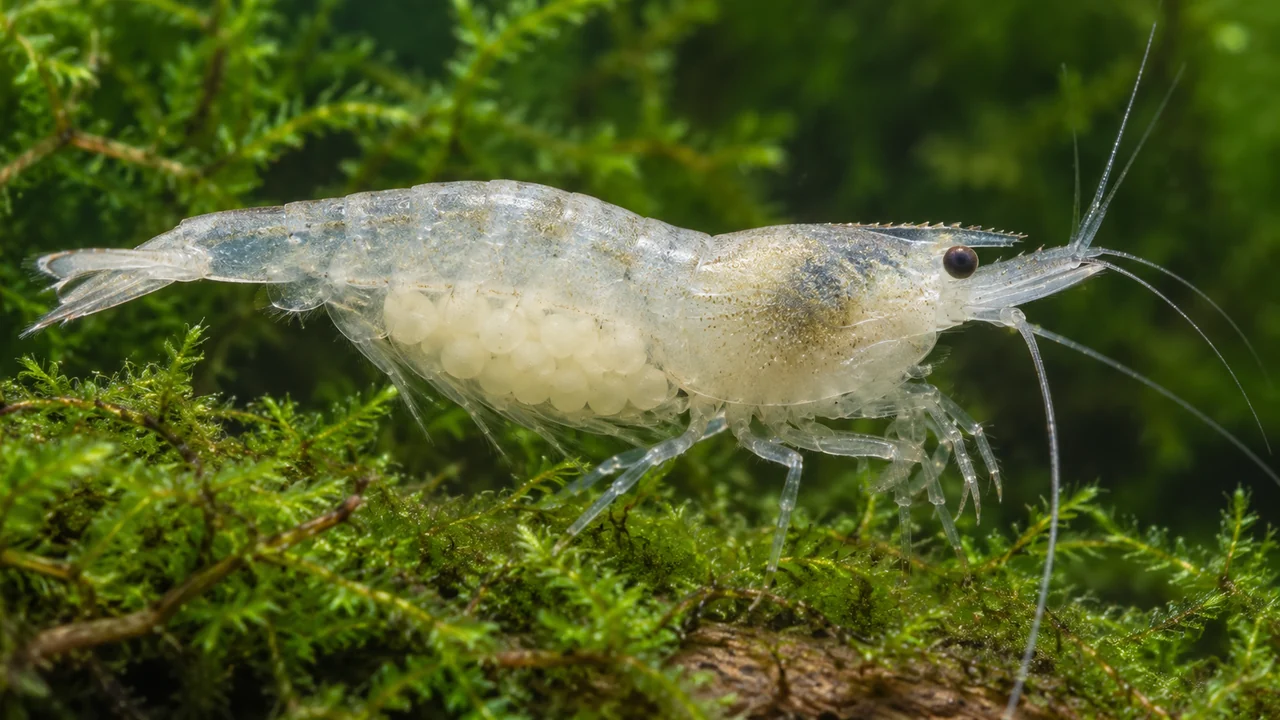
Females carry eggs beneath the abdomen and tend them with the swimmerets. The young can develop in freshwater and use protected fine surfaces within a mature colony. A separate marine larval nursery is not the normal requirement for palmata-associated Pearl aquarium shrimp. This differs fundamentally from the larval challenge described for Amano Shrimp.
White eggs are a familiar feature of some Snowball lines, but egg colour is not a universal species test. Avoid promising a fixed brood size or hatch date for an unidentified commercial population. Temperature, female condition and line history affect what the keeper observes. Protect intakes and provide food small enough to be accessible to young animals.
Leaves support structure without dictating chemistry
A few prepared leaves can extend the grazing surface and offer low cover between moss and wood. Add them gradually, keep openings visible and remove accumulations that prevent circulation. The useful feature is the accessible surface, not the promise that darker water will automatically improve breeding.
Maintain the chosen mineral and carbonate conditions while using botanicals. A leaf cannot compensate for an unstable water supply or excessive food. Read leaf litter as part of the organic load and inspect the material itself rather than relying on tint as a maintenance indicator.
For a modest leaf layer, compare prepared Dried Banana Leaf Pieces – Natural Aquarium Leaf Litter with Dried Cinnamon Leaves – Natural Aquarium Leaf Litter. Keep the feeding patch and the chosen mineral conditions consistent whichever form you select.
First checks when a colony stops growing
Check for hidden predators, intake losses and access to food before assuming infertility. Confirm the animals are mature and that both sexes are present. If losses follow maintenance, compare the replacement water and temperature with the tank, then check ammonia, nitrite and any recent treatment or household contamination.
The unresolved point for many commercial Pearl populations is the strength of the species identification. Retain the actual trade label where appropriate and do not erase N. zhangjiajiensis as an accepted species to simplify a sales description. Practical stable freshwater care can be explained clearly without inventing a certified family tree.
Further reading and sources
Identity and natural-history sources are distinguished from aquarium husbandry. Recommended care is not a set of experimentally established survival limits; breeding conditions may differ from adult maintenance.
- WoRMS taxonomic listings — Neocaridina — Separate accepted entries for N. palmata and N. zhangjiajiensis; a trade association is not a universal synonym.
- ITIS — Neocaridina genus listings — Independent taxonomic listing; useful for separating species names from colour-line labels.
- Fauna Sinica — Chinese freshwater caridean treatment — Systematic reference listing the two names separately, rather than proof of commercial line identity.
- Garnelenhaus — Neocaridina palmata — Specialist aquarium account on appearance, maintenance and freshwater reproduction; broad tolerance ranges are not used as preferred conditions.