Fish · Ram Cichlid
Ram Cichlid — Mikrogeophagus ramirezi: Habitat and Care
The familiar blue ram is a warm-water cichlid for a mature, carefully maintained aquarium. Give a compatible pair defined floor space, oxygenation and small foods; neither its colour nor its small size makes it a general-purpose community fish.
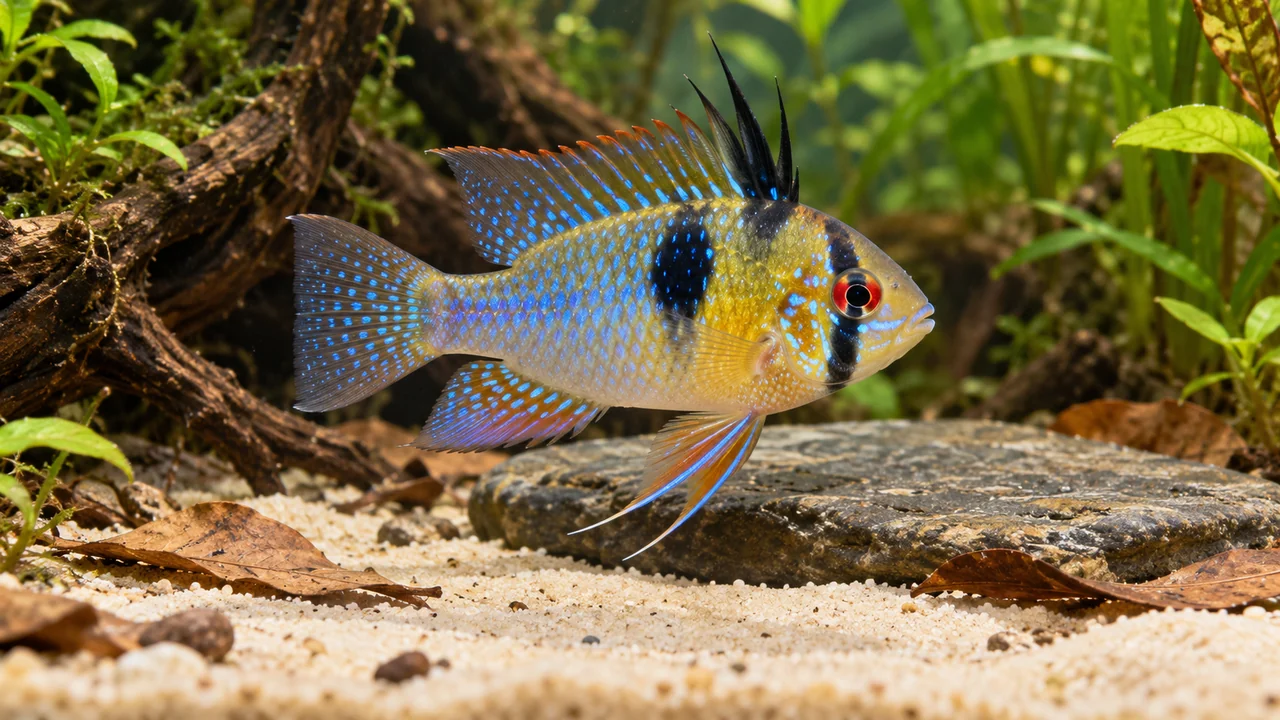
- Identity
- Mikrogeophagus ramirezi, distinct from the Bolivian ram M. altispinosus.
- Adult scale
- Common aquarium planning scale around 5–7 cm overall; do not confuse this with approximately 4 cm standard-length records.
- Aquarium footprint
- 60 × 30 cm is a published pair starting base; prefer a longer 80–90 cm aquarium with retreat and feeding space.
- Temperature
- 27–30°C specialist guidance; around 28°C is a useful maintenance target with good gas exchange.
- Water plan
- Soft, mildly acidic prepared water; around pH 5.5–6.8 and 2–8°dGH is a practical captive-stock starting choice.
- Reproduction
- Open-substrate spawning with care by both parents; a shop pair is not guaranteed compatible.
Recognise the ram and the form being offered
A standard blue ram has a compact oval body, a dark eye bar, a conspicuous flank patch and blue iridescent spotting. Yellow or orange tones are normal towards the front. Females often show a pink belly, but age, mood and selected forms can obscure familiar sexing clues. Longer dorsal rays alone do not reliably sex every young fish.
German Blue, gold, electric blue and long-finned are aquarium form labels, not separate species or proof of geographic origin. The photographs here show normally proportioned standard blue fish. Assess body shape, breathing, fin condition, appetite and source quality instead of buying solely for the most intense colour. M. altispinosus is a different species with its own care needs, not a cooler version covered by this profile.
Warm Orinoco lowlands, not one universal blackwater scene
The species is associated with the Colombian and Venezuelan Orinoco llanos, a seasonal landscape of lowland waterways and inundated margins. This is a different starting point from the southern seasonal setting of borellii. Suitable aquarium cover can include plants, low wood and open substrate without requiring an opaque forest-floor imitation.
Keep wild distribution separate from the origin of domestic colour forms. A fish bred under a commercial label has not thereby acquired a documented collecting locality. Choose a repeatable home care plan based on established stock and measured water, and avoid using the words Amazon or blackwater as substitutes for species research.
Territorial floor space and an actual compatible pair
A 60 × 30 cm pair base appears in specialist guidance. Prefer an 80–90 cm long aquarium for ordinary home keeping, allowing separate refuge, feeding access and room to observe interactions. This additional space is a recommendation rather than a claim that every smaller set-up fails or every larger one succeeds.
Juveniles can associate together before mature pairs claim territory. Do not keep adding adults to force a preferred pair. If starting with youngsters, have capacity to separate surplus fish as relationships change. Purchasing one of each sex does not guarantee a bond; persistent pursuit or a fish unable to feed calls for separation, even when no eggs are visible.
A warm mature system needs deliberate gas exchange
Seriously Fish gives 27–30°C, while the Nordic cichlid society also recommends warm keeping around 28–30°C. Around 28°C is a useful ordinary maintenance target. Do not compromise the ram’s temperature to fit cooler companions, and do not run at the hottest endpoint simply to intensify colour or hurry reproduction.
Warm water makes gas exchange particularly important. Renew the surface visibly and ensure the filter is working, while leaving sheltered areas out of a harsh current. Use mature biological filtration rather than moving rams into a freshly assembled aquarium that only looks complete. Check temperature independently of the heater dial and reassess oxygenation during hot weather or any sudden increase in breathing rate.
Prepare water and make maintenance repeatable
Broad published guidance includes pH 4.0–7.0 and 1–10°dGH. For established captive fish, soft water around pH 5.5–6.8 and 2–8°dGH is a practical starting choice within it, not a new tested tolerance limit. Know the source conditions and measure KH as well as GH. Extreme acidity is not a requirement to impose on every blue ram.
Prepare replacement water consistently, remove feeding waste and use regular partial changes to keep the system stable. Check ammonia and nitrite after disturbances and whenever fish behave abnormally. A particular water-change percentage does not prove adequate maintenance if waste remains. Avoid cleaning every filter component and stripping all substrate cover on the same day.
An open floor with sheltered edges
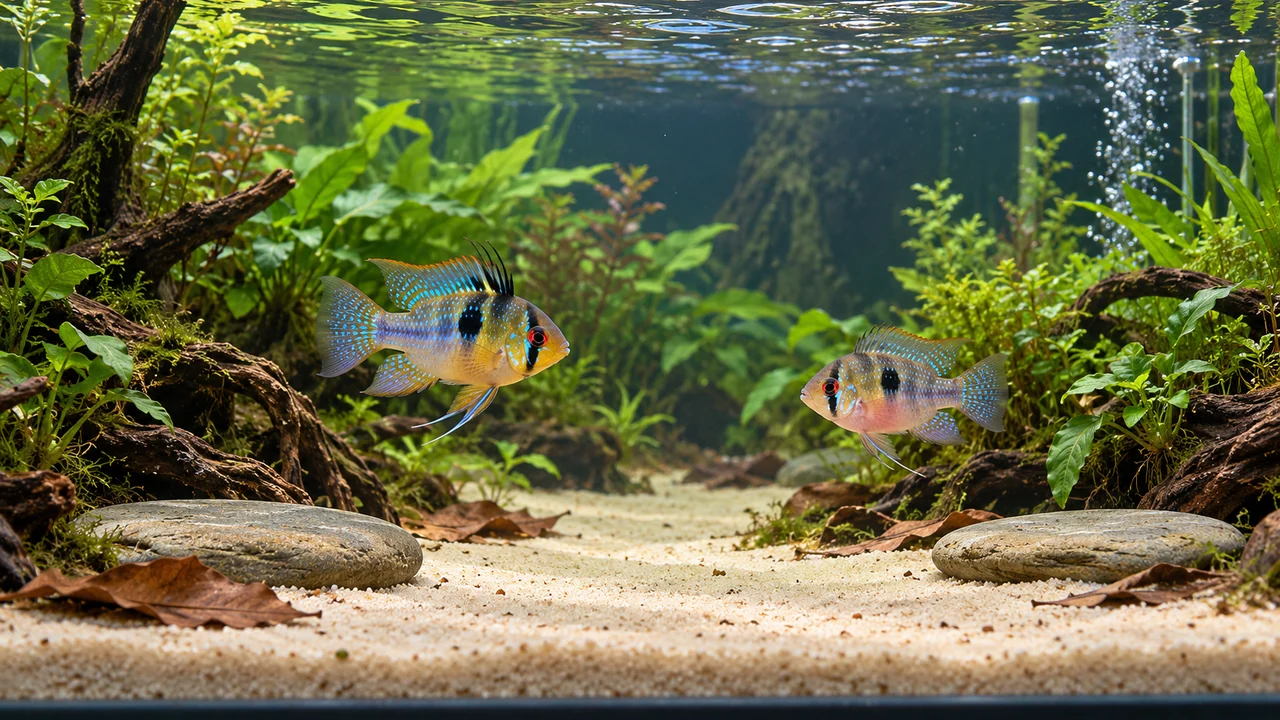
Use fine sand where fish can investigate small food particles, low stable roots and plants around the margins. Leave open feeding patches and more than one retreat route. Suitable planting must tolerate the chosen warmth; the appearance of a plant in an aquarium image does not establish that it is native to the ram’s habitat.
A few prepared leaves add texture and browsing surfaces, but keep the layer modest enough to inspect and service. Do not assume darker water means safer water. At a warm temperature, accumulated food and decomposing material still need attention. Maintain access to the intake, heater and sheltered floor without collapsing every territory during routine care.
For the leaf-and-structure margin beside the shoal, compare Dried Arjuna Leaves (Kumbuk) – Natural Aquarium Leaf Litter with TanninBae Beginner Variety Pack – 50-Piece Botanical Starter Mix. Use selected material in small stages while keeping the swimming corridor and feeding area open. A mixed box provides material to choose from over time, rather than a quantity to add all at once.
Feed small foods close to the fish
Offer a varied menu of suitably small live or frozen invertebrates alongside a complete fine sinking food where accepted. Rams investigate the substrate but can also take food above it. Deliver modest portions where each fish can eat and verify actual intake rather than relying on a clean-looking surface after feeding.
A fast community can intercept meals before a cautious ram responds. If one fish becomes thin, examine competition, food size and appetite as well as water quality. Do not leave extra food to decay beneath roots. Incidental organisms on botanical surfaces are useful browsing opportunities, not a substitute for a dependable complete diet.
If the fish accepts prepared sinking food, Artemia SuperSoft Fish Food is a soft-food option to compare with the ration above. This listing is the 1.4–2.2 mm grade: use it only where the actual fish can swallow the pieces readily, and keep portions accessible to quieter individuals.
A flat spawning surface and shared care
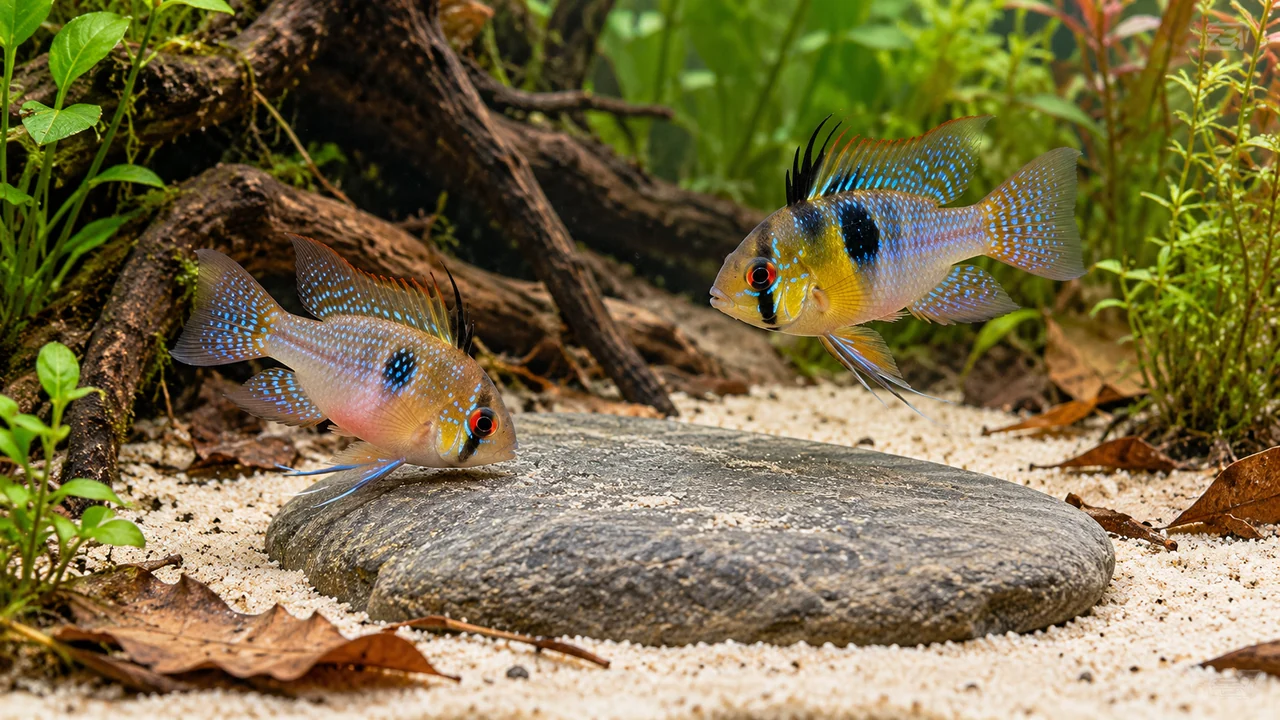
Eggs are normally deposited on an exposed firm surface such as a flat stone, wood, a broad leaf or aquarium glass. This is open-substrate spawning, not the concealed cave-ceiling pattern described for many Apistogramma. Both parents can participate in care. The supporting image shows a suitable site without claiming eggs or a successful brood.
For deliberate rearing, prepare a dedicated mature arrangement, protected intake and suitably small first foods. Initially free-swimming fry may need microscopic foods before taking larger Artemia nauplii; observe mouth size and actual feeding. A lost clutch does not automatically prove bad parents or a need for medication. Check fertilisation, water quality, disturbance and adult interaction, and provide grow-out capacity before repeated spawning creates more young.
Choose companions for warmth and access
Peaceful small open-water fish may work when their temperature and water requirements genuinely overlap. The completed cardinal and green-neon profiles are useful comparisons. This is not a universal community recommendation: many familiar fish prefer cooler water, harder water or a faster feeding routine. Check adult requirements rather than settling for a narrow overlap on a shop chart.
Avoid competing territorial floor residents and aggressive feeders. Shrimp and small fry may be eaten, and a breeding territory can change previously calm relationships. Keep a separation option ready. When a fish hides or breathes rapidly, check pursuit, temperature, gas exchange, ammonia and nitrite before adding treatments. Persistent unexplained illness deserves qualified help; botanicals do not replace diagnosis or guarantee recovery.
Further reading and sources
Identity and natural-history sources are distinguished from aquarium husbandry. Recommended care is not a set of experimentally established survival limits; breeding conditions may differ from adult maintenance.
- Kullander (2011) — Mikrogeophagus nomenclature — Primary taxonomic analysis of the correct genus and older names; no husbandry experiment implied.
- NCBI — Mikrogeophagus ramirezi — Current taxon identity and original Apistogramma combination.
- IUCN — ramirezi assessment — Institutional identity and Orinoco natural-range context.
- Seriously Fish — Mikrogeophagus ramirezi — Species-specific husbandry, adult scale, social arrangements and reproduction. Read explanatory water notes, not just summary numbers.
- Nordic Cichlid Society — ramirezi — Society husbandry account supporting warm, soft-water keeping; not conditions for every other dwarf cichlid.