Fish · Umbrella Dwarf Cichlid
Umbrella Dwarf Cichlid — Apistogramma borellii: Habitat and Care
A yellow-faced, blue-flanked dwarf cichlid from southern South America. Give it a cooler-centred care plan, usable bottom territories and small meals; it is not a miniature ram that needs permanent tropical heat.
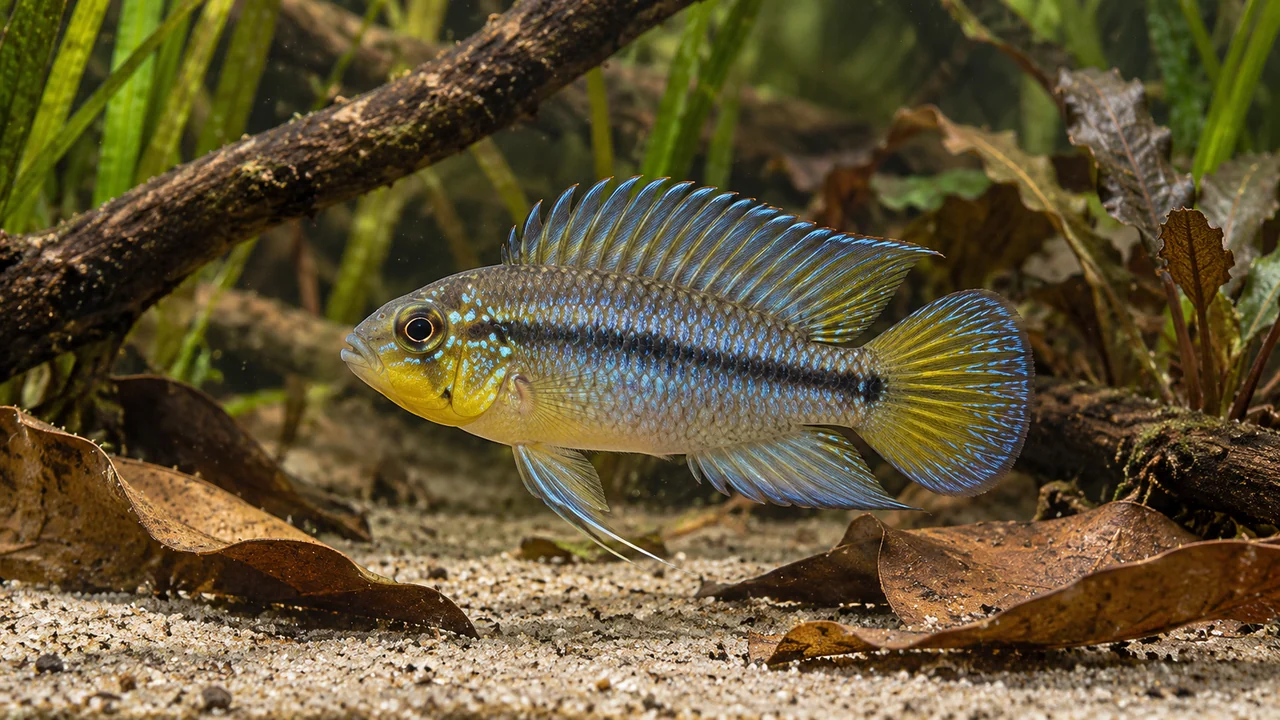
- Identity
- Apistogramma borellii; umbrella or yellow dwarf cichlid.
- Adult scale
- Plan for males around 6–7 cm overall, with smaller females; length reports use different conventions.
- Aquarium footprint
- Prefer at least 60 × 30 cm for a compatible pair; larger floor area for additional territories.
- Temperature
- Published husbandry: 20–26°C; around 22–24°C is a sensible ordinary maintenance choice.
- Water plan
- Captive stock: a stable pH around 6.0–7.5 and 3–12°dGH is a practical subset of broader guidance.
- Reproduction
- Sheltered substrate/cavity spawner; female normally provides most brood care.
Recognise the umbrella, not just a yellow fish
An adult male typically combines a yellow head and throat with blue iridescence and broad, spreading fins. The rounded tail and high connected dorsal give a different impression from the tall individual front spines of a cockatoo dwarf cichlid. Females are smaller and less expansive in their fins; breeding colour can be strongly yellow with dark markings. Do not sex an immature fish from brightness alone.
The valid name has two final letters i: Apistogramma borellii. Heterogramma borellii is the original combination, and reitzigi and aequipinnis occur in older literature. Opal is a trade colour label, not proof of a collection locality. Buy from an identifiable source and retain its supplied name; an attractive blue fish sold as a generic apisto may belong to another species.
A southern distribution changes the temperature plan
Recorded populations occur in the Paraguay and lower Paraná drainage region of southern South America. This is a more seasonal setting than a permanently hot equatorial aquarium. Marginal vegetation, shallow cover and changes in weather matter when interpreting its habitat. Neither a brown-water photograph nor the word South America establishes one temperature for all dwarf cichlids.
Seriously Fish gives 20–26°C, while Aquarium Glaser describes a cooler annual phase for Paraguayan fish. Around 22–24°C is a useful everyday starting choice for established captive stock. Do not engineer a sudden cold spell or assume a British unheated room is suitable all year. Measure the actual minimum and maximum; use a heater where necessary and prevent summer overheating rather than running permanently near ram temperatures.
Give a pair choices, not a single contested doorway
A published specialist starting base is 45 × 30 cm for a pair. For an ordinary home arrangement, prefer at least 60 × 30 cm to gain retreat and feeding space; this is a planning recommendation, not a universal biological minimum. A taller narrow tank does not replace floor area. Confirm that each fish can stay out of the other’s view.
Pair keeping can work, and larger arrangements may contain more than one female, but neither a purchased pair nor a fixed ratio guarantees compatibility. A single male can be kept without breeding companions. If keeping sexes together, arrange safe separation before problems arise. Persistent cornering, surface hiding or a fish excluded from food calls for action, even in a species often described as relatively peaceful.
Shelter with an open route to food
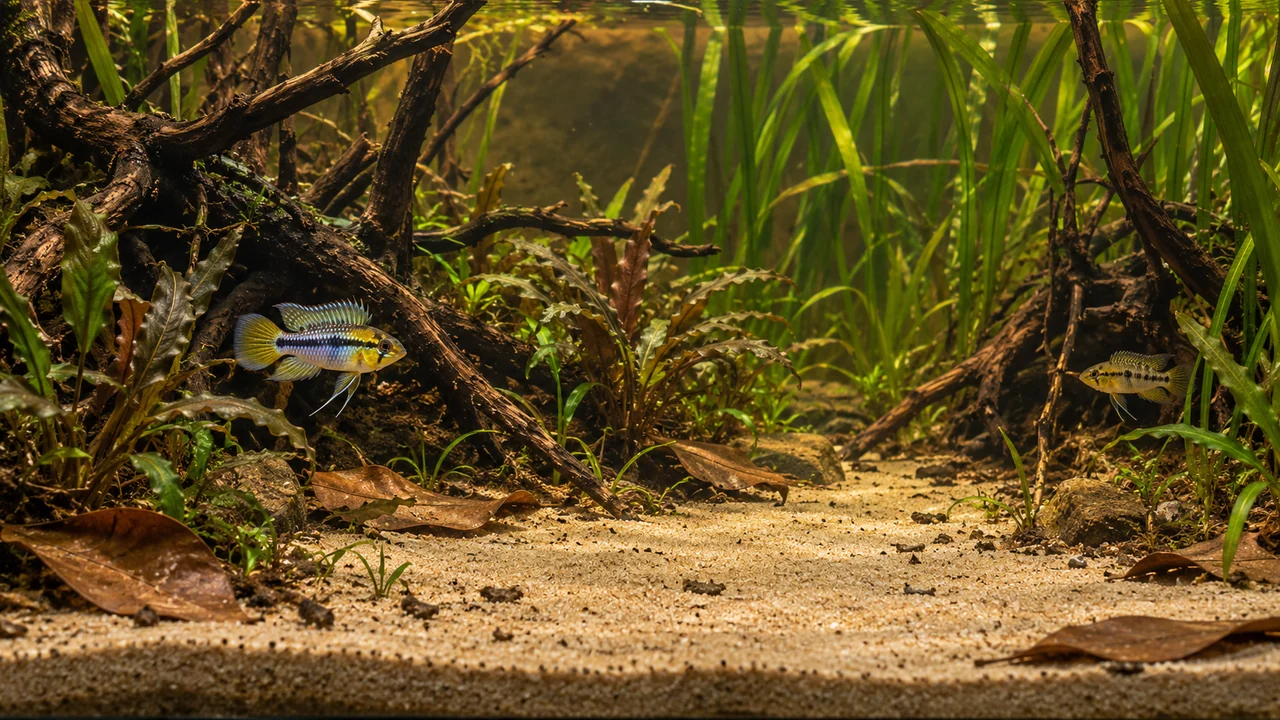
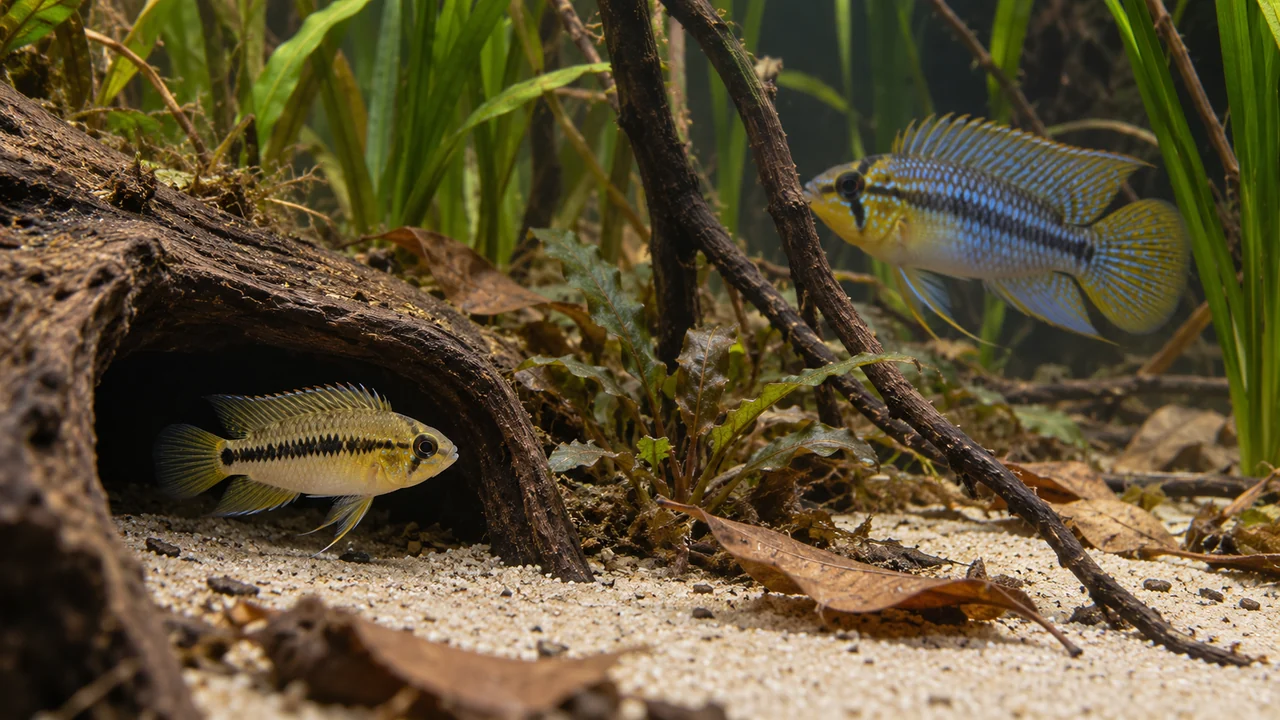
Use fine sand, a branching wood structure and patches of plants that break low-level sightlines. Put shelters in different orientations with open exits and usable space around them. A smaller female needs cover that is not simply the far end of the male’s feeding lane. Leave enough room to inspect a resting fish without dismantling every root.
Prepared leaves can make sheltered edges and small grazing surfaces. Keep some visible sand available for food delivery and waste removal. Check pod or shell openings against adult body shape, including extended fins, before using them as enclosed shelter. A low safe cavity is useful; a decorative hole with a sharp rim or narrowing interior is not automatically a suitable cave.
For the sheltered lower layout, compare Ourico Nut Pod – Natural Brazil Nut Botanical Shelter with Dried Beech Leaves (Fagus sp.) – Natural Aquarium Leaf Litter. Inspect the actual pieces for adult entry, turning space and accessible exits; position them beside an open feeding patch rather than making every route pass through one refuge.
Water flexibility still needs a consistent routine
Published guidance spans pH 5–8 and 1–15°dGH, with important differences between origins. For ordinary captive stock, a measured plan around pH 6.0–7.5 and 3–12°dGH sits within that guidance without making either extreme a target. These are care choices, not survival limits. The institutional risk summary also cites older, harder-water aquarium recommendations; that does not justify suddenly changing a fish’s settled conditions.
Measure source and aquarium water, including KH, before deciding whether adjustment is needed. Prepare replacement water consistently and avoid repeatedly adding acid to the stocked tank. Mature filtration and gentle circulation should keep the lower zones usable while renewing the surface. Base partial water changes on measured waste and actual feeding, rather than using the species’ flexibility to postpone maintenance.
Small meals reach more than the boldest fish
Offer suitably small complete sinking foods alongside varied live or frozen invertebrates. Place food in more than one accessible patch and watch each fish take it. A fish waiting beneath cover may need a quieter delivery point rather than a larger broadcast meal. Adjust particle size if food is repeatedly mouthed and dropped.
Remove accumulating leftovers from shelter entrances and under dense leaf piles. Incidental organisms on mature wood and leaves provide browsing opportunities, not a dependable complete diet. Appetite is also social information: if one fish stops feeding, look for blocking or chasing as well as checking temperature, ammonia and nitrite. Do not respond automatically with medication or an extra handful of botanicals.
If the fish accepts prepared sinking food, Artemia SuperSoft Fish Food is a soft-food option to compare with the ration above. This listing is the 1.4–2.2 mm grade: use it only where the actual fish can swallow the pieces readily, and keep portions accessible to quieter individuals.
Choose companions for this cooler-centred aquarium
Peaceful small upper-water fish can be considered when their temperature, water and feeding requirements overlap. Evaluate their adult size and behaviour, not only how they look in the shop. Warm-water specialists are poor choices if keeping them would force borellii into permanent high heat. The ram profile is a comparison, not a recommendation to mix the two.
Other bottom-dwelling cichlids can remove the retreat space that made the arrangement work. Small shrimp and fry may be eaten, and even calm catfish can intrude at a defended shelter. During breeding, reassess the floor as a territory rather than assuming the previous community remains safe. Keep escape routes and a separation option available.
Cavity spawning and preparing for young
Eggs are generally attached within a sheltered cavity, with the female providing most care. A compatible pair and suitable water may spawn without dramatic manipulation. Glaser reports occasional male participation, but do not depend on shared care: a defending female can also drive the male away. Watch their actual access to food and refuge.
If raising young is the goal, prepare a quiet mature set-up, protected filter intake and small live first foods before spawning. Newly free-swimming fry need food within reach, such as suitable Artemia nauplii or microworms, with careful removal of surplus. A larger grow-out plan is needed as young become independent. Do not impose a cold season, heating spike or additive dose as a guaranteed breeding trigger.
First checks when the fish stays hidden
Start with temperature and social pressure. A fish constantly exposed to heat, a tankmate patrolling every exit or a blocked food route can make a beautiful aquarium function poorly. Observe before feeding and again after it; this often reveals a subordinate fish that is otherwise missed.
Check measured water quality, filter flow, recent changes and actual intake before altering several things at once. Keep the useful structure while removing waste; replacing all litter and rearranging every territory simultaneously makes the response harder to interpret. Botanicals support layout and browsing, but they do not guarantee health or repair an unsuitable stocking plan.
Further reading and sources
Identity and natural-history sources are distinguished from aquarium husbandry. Recommended care is not a set of experimentally established survival limits; breeding conditions may differ from adult maintenance.
- Kullander — South American Cichlidae checklist — Taxonomic names, original combinations and recorded river basins; specimen lengths are not maximum aquarium total lengths.
- Seriously Fish — Apistogramma borellii — Species-specific husbandry, adult scale, social arrangements and reproduction. Read explanatory water notes, not just summary numbers.
- Aquarium Glaser — Paraguayan borellii — First-hand importer account: seasonal cooler keeping, water adaptability and variable parental roles.
- US Fish & Wildlife Service — umbrella cichlid screening — Institutional synthesis of identity/range and older aquarium figures; not a new husbandry experiment.