Fish · Agassiz’s Dwarf Cichlid
Agassiz’s Dwarf Cichlid — Apistogramma agassizii: Habitat and Care
A slender territorial dwarf cichlid with striking males and attentive maternal care. Choose stock with known background, build separated floor-level refuges and distinguish everyday keeping from specialist wild-population breeding.
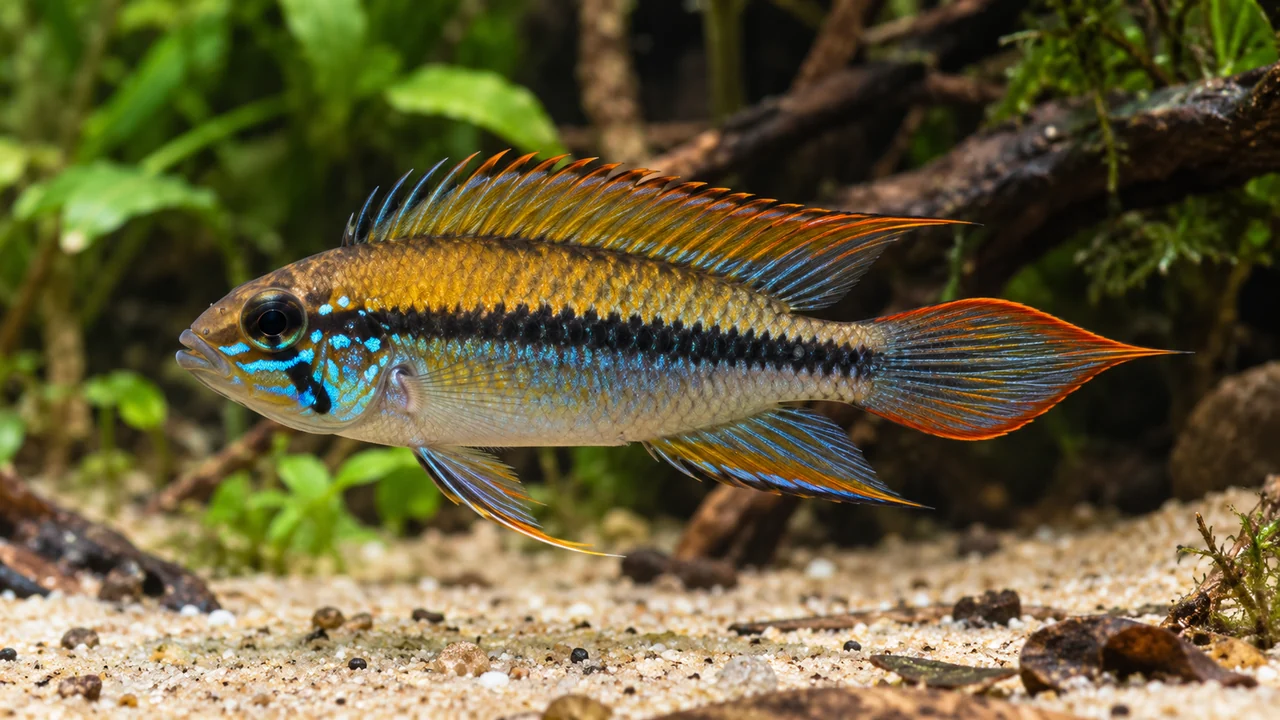
- Identity and size
- Apistogramma agassizii. Published maximum about 7.5 cm male / 5 cm female standard length; aquarium accounts also quote males around 8–9 cm overall.
- Space and sexes
- Published starting base 60 × 30 cm for a compatible pair; prefer an 80 cm or longer structured aquarium. Multiple females need genuinely separate territories and more floor area.
- Temperature
- Published 22–29°C; 24–27°C is a practical routine interval within separate husbandry guidance.
- Water for typical captive stock
- Soft mildly acidic water, around pH 5.5–7.0, is a useful planned range. Start with consistent modest hardness, roughly 2–10°dGH; wild populations can require different conditions.
- Feeding
- Small sinking complete pellets where accepted, plus varied suitable live/frozen invertebrates delivered near cover.
- Breeding
- Cavity/substrate spawner; female cares for eggs and fry. A male may need separation, particularly when she defends young.
Identify species, form and actual sex
Apistogramma agassizii is an elongated dwarf cichlid; a mature male commonly has a pointed, lance-like tail rather than the cockatoo’s conspicuous front dorsal crest. Females are smaller with more modest fins, often becoming strongly yellow with dark markings around breeding. Fin shape and body pattern should support identification, not colour alone.
Geophagus agassizii is the original combination and Apistogramma parva appears in synonymy. The one-i spelling agassizi is a common search variant, not another article. Locality forms and domestic selections require different descriptions: a bright red tail does not prove wild origin. Keep genuine collection or breeder records and do not assign a named river form from resemblance to the new portrait.
Range, habitats and population differences
The species is recorded widely through the Amazon/Solimões system, including Peru and Brazil. Slower margins with accumulated leaves occur within that broad setting. Museum specimen records provide a real natural-history anchor, but even a precisely identified specimen does not turn one habitat measurement into a universal aquarium recipe.
Origin matters when choosing stock and planning breeding. A long-established aquarium strain may be kept successfully in conditions that are unsuitable for reproducing a particular wild population. Preserve locality information and avoid mixing identifiable geographical forms in a breeding project. For a display without reliable provenance, describe the fish honestly as aquarium stock and choose a measured care plan rather than inventing a wild history.
Territories determine the floor plan
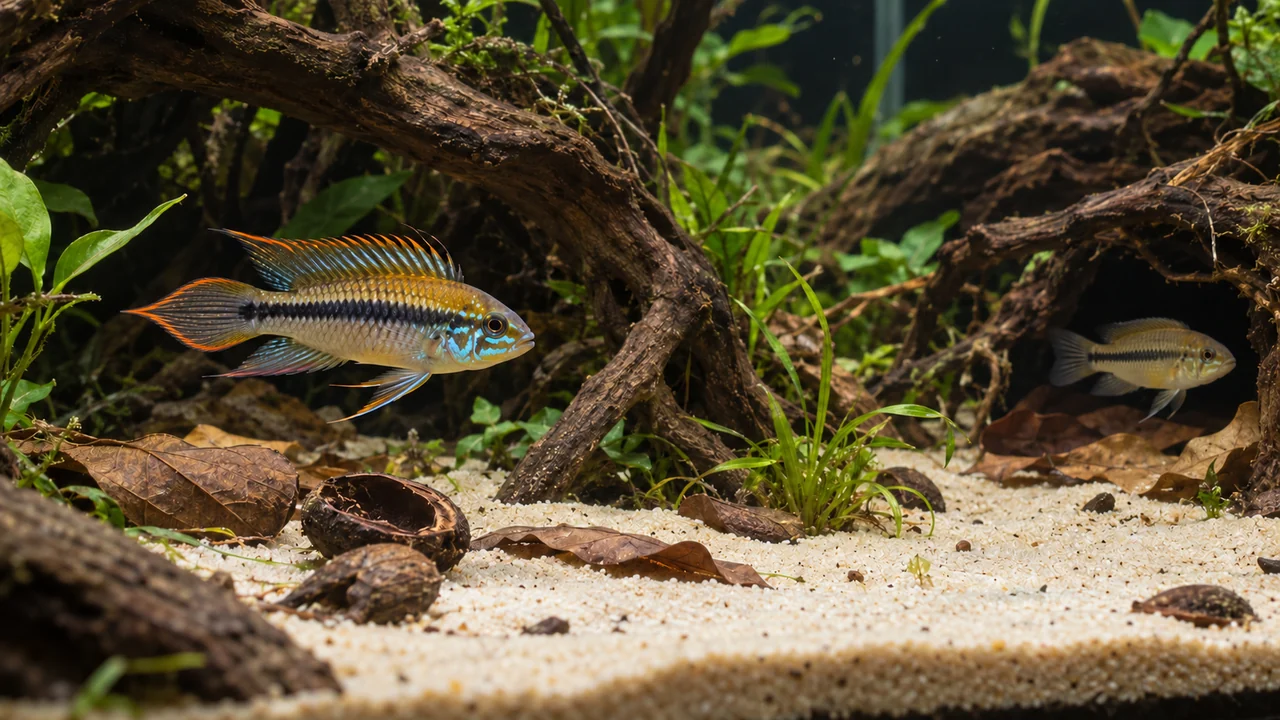
A 60 × 30 cm base is published for a single compatible pair, but an aquarium at least 80 cm long gives more scope for shelter and separation. The important word is compatible: purchasing one fish of each sex does not establish a safe pair. Watch both directions of aggression and have a working separation option before putting them together.
Agassizii can form polygynous arrangements, but adding females is not a cure for a persistent male. Each female needs a defensible area with shelter and feeding access beyond another’s immediate view. That means substantially more usable floor space, not several caves in one exposed pile. Multiple males or a mixed-Apistogramma collection are not the default recommendation for a small community.
Plan adult water; treat breeding separately
For established captive stock, soft mildly acidic water around pH 5.5–7.0 is a useful planned range, supported by the separate importer husbandry account. A stable 24–27°C lies within published guidance. Modest hardness around 2–10°dGH is a practical starting overlap between sources, not a biological threshold or an instruction to change a settled aquarium abruptly.
Seriously Fish’s summary shows pH 3–4, but its explanatory paragraph applies those values to breeding some wild populations. They must not be copied as the daily requirement of every agassizii. Know GH and KH, prepare replacement water consistently and use a controlled soft-water source if needed. No acid-dosing recipe is required for an ordinary domestic display. A specialist breeding project needs its own population-specific evidence and equipment.
Shelters, sand and accessible routes
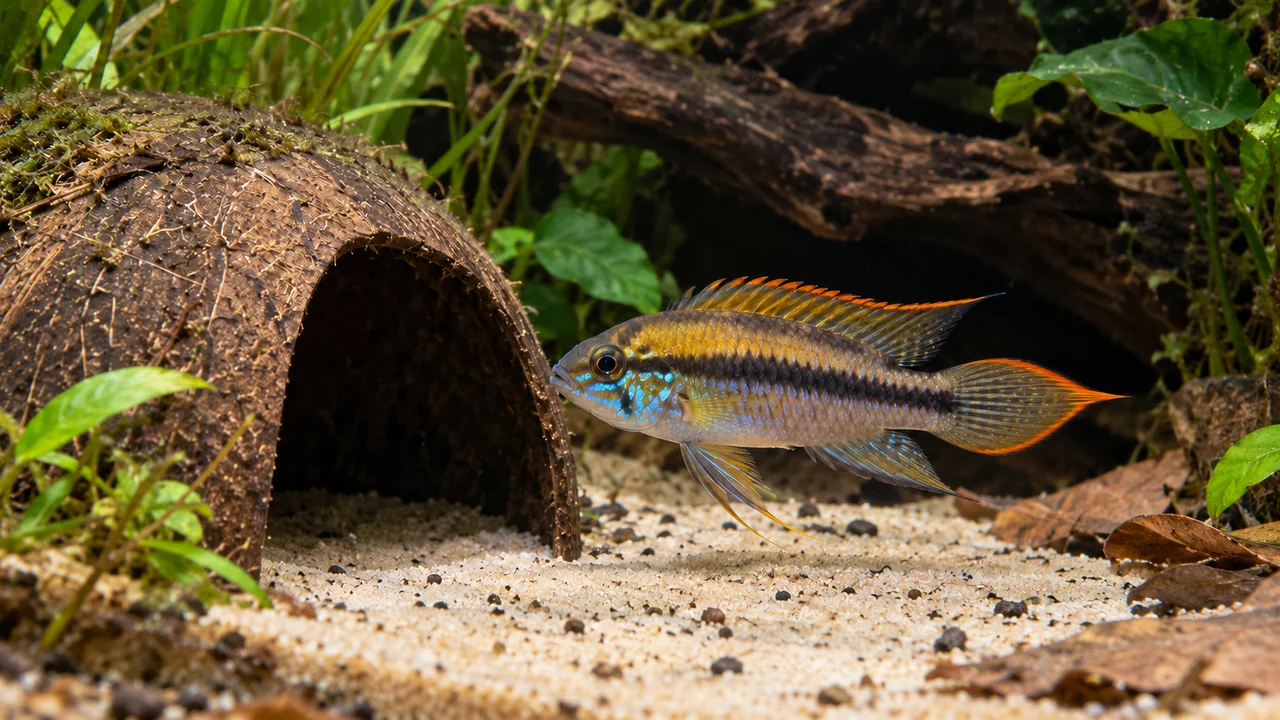
Use fine safe sand with roots that divide the view near the bottom. Place suitable cavities in separate shaded areas and turn entrances away from each other. Keep exits and routes past the shelter open: a fish should not have to cross another animal’s defended entrance to reach every meal.
Prepared leaves can soften the floor around wood, and larger suitable pods or shells may provide cover only after checking their openings against the adult fish. A decorative cavity can be a trap if the body fits in but cannot turn or leave. Maintain access for a siphon and a net. The best layout is one you can service or divide without collapsing the whole aquarium during a territorial dispute.
For the sheltered lower layout, compare Coconut Cup (Cocos nucifera) – Natural Botanical Cave with Blackwater Botanical Box – Pods, Bark & Seeds. Inspect the actual pieces for adult entry, turning space and accessible exits; position them beside an open feeding patch rather than making every route pass through one refuge. A mixed box provides material to choose from over time, rather than a quantity to add all at once.
Filtration and water changes that fit the stock
Provide mature biological filtration and visible surface movement, with a calm lower zone around shelters. A gentle return does not remove the need for oxygenation or waste control. Check ammonia and nitrite after changes or if behaviour deteriorates, and use a thermometer rather than trusting the heater dial alone.
Set a regular partial-change routine from the actual stocking and feeding load. Small predictable changes can suit a lightly stocked specialist aquarium, but a quoted percentage is not sufficient when waste accumulates. Match replacement conditions sensibly and remove food deposits around caves. Avoid simultaneously stripping the filter, replacing all litter and rebuilding territories; those changes obscure the cause of any subsequent problem.
Feed near cover without overfeeding caves
Offer small suitable live or frozen invertebrates and a complete sinking pellet where accepted. Deliver food so the female or subordinate fish can eat near cover without having to pass the male. Confirm actual intake; an enthusiastic male at the front is not evidence that both fish are receiving enough.
Vary the menu and adjust size to the individual. Remove persistent leftovers rather than leaving them to decay inside a pod. If a fish spits food, examine particle size and condition; if it never emerges, inspect the social arrangement as well as possible illness. Botanicals provide surfaces and structure, not a guaranteed complete diet or a treatment for digestive problems.
For prepared-food variety, compare Artemia SuperSoft Fish Food with Premium Freeze-Dried Australian Blackworms. Check acceptance and portion size at the fish’s own feeding position; SuperSoft granules are the listed 1.4–2.2 mm grade, while the freeze-dried blend remains a supplementary option.
Companions in a changing territory
Peaceful small fish may fit above the cichlid’s area where water, adult size and feeding needs overlap. That does not mean every bottom resident can share its cave zone. Consider the floor used by catfish, other cichlids and large shrimp instead of counting them as harmless simply because they are usually calm.
Breeding can change a previously peaceful combination. Protect an escape route for the male and companions, and do not add other Apistogramma species to force a more colourful display. Tiny shrimp and fry can become food. A comparison link to the cockatoo profile helps choose between species; it is not a stocking recommendation to house both together.
Female care and a realistic breeding plan
Eggs are normally laid within a cavity or sheltered crevice, with the female caring for eggs and fry. Provide a mature dedicated arrangement if raising young is the objective. A defending female may drive away the male; observe the actual situation and separate safely if necessary rather than assuming a permanent pair bond.
Prepare appropriately small fry foods, protected filtration and careful maintenance before spawning. Keep lineage records and distinguish a domestic strain from a population requiring specialised acidic breeding water. Neither leaves nor a coconut shelter can guarantee fertility, hatch rate or a chosen sex ratio. Do not change temperature to pursue an unverified outcome while overlooking the adults’ welfare or the rearing capacity available.
Common problems and sensible priorities
For one fish always in hiding, assess territory, sightlines and food access. For a whole aquarium breathing rapidly, check temperature, oxygen and water tests first. An unexplained failed brood is not evidence that the display needs a larger dose of tannins; identification, parental interactions, water and egg condition all merit a calm review.
Record symptoms and recent changes and seek appropriate fish-health advice for persistent illness. Keep a divider or separate suitable aquarium ready for aggression. Make botanical additions gradually and inspect their effect on maintenance. The practical success is a stable fish with room to withdraw, eat and be observed, not a brightly coloured male continually defending an unsuitable enclosure.
Further reading and sources
Identity and natural-history sources are distinguished from aquarium husbandry. Recommended care is not a set of experimentally established survival limits; breeding conditions may differ from adult maintenance.
- Seriously Fish — Apistogramma agassizii — Species-specific husbandry, adult scale, social arrangements and reproduction. Read explanatory water notes, not just summary numbers.
- Aquarium Dietzenbach — Agassizii husbandry — Separate captive-care range, adult total-length estimates and territorial layout guidance; do not adopt claims of tail uniqueness across the entire genus.
- Swedish Museum specimen NRM 17722 via iDigBio — Primary museum collection record identified by Kullander, with habitat remarks; not a universal husbandry recipe.
- WoRMS — Apistogramma name listing — Taxonomic listing links agassizi spelling to accepted agassizii; this article concerns freshwater only.