Fish · Panda Dwarf Cichlid
Panda Dwarf Cichlid — Apistogramma nijsseni: Habitat and Care
The panda name comes into focus in the boldly marked female. This Peruvian soft-water cichlid needs carefully planned territories, a genuinely compatible partner if breeding, and close attention to food and water rather than a generic apisto recipe.
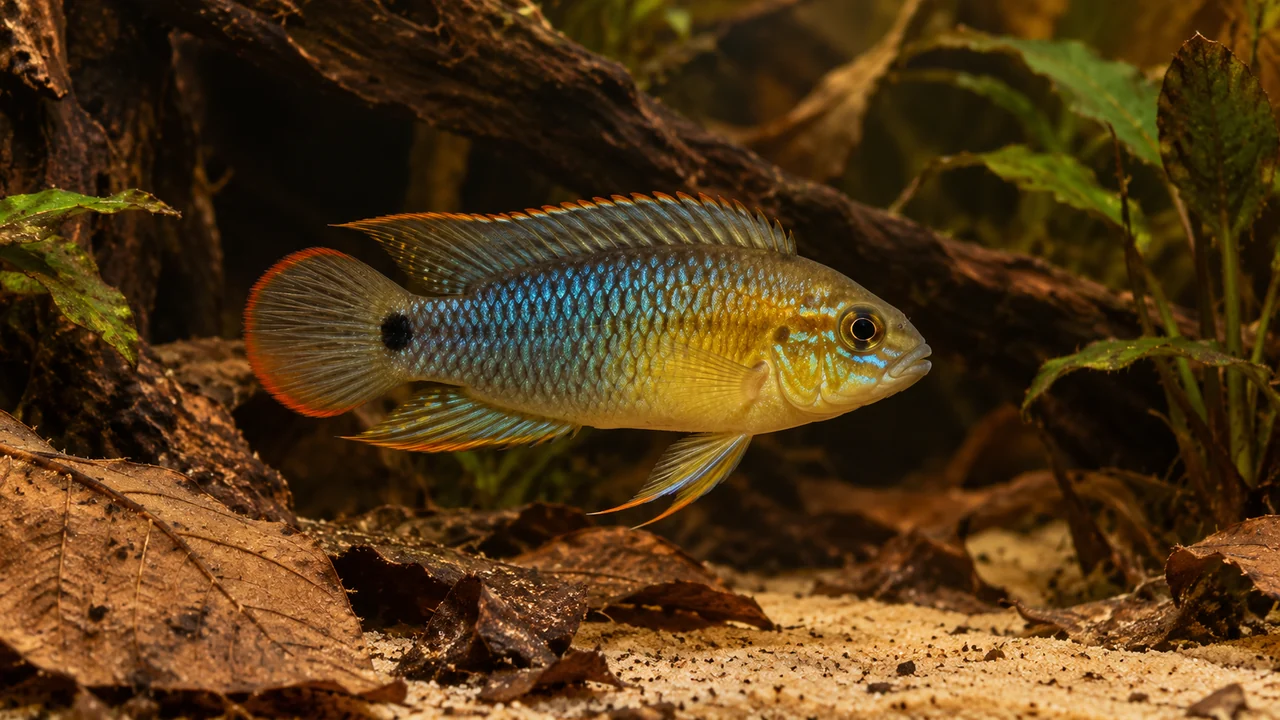
- Identity
- Apistogramma nijsseni; distinct from A. panduro, also sold under panda names.
- Adult scale
- Plan for an adult male around 8 cm overall and a smaller female; published SL figures differ.
- Aquarium footprint
- 60 × 30 cm is a published pair starting base; prefer 80–90 cm length for retreat and maintenance.
- Temperature
- 24–28°C guidance; around 25–26°C is a practical adult starting choice.
- Water plan
- Soft acidic water; pH 5.0–6.5 and up to about 4°dGH in the specialist account.
- Reproduction
- Sheltered cavity spawner; female brood care, partner choice and potential aggression matter.
The female makes the panda comparison useful
Males typically show blue across the rear body, yellow towards the front and an orange-red edge to a rounded tail. The female can become strongly yellow with broad dark cheek and flank markings. These are more useful starting observations than expecting a male to look like a black-and-white panda. Mood, age and breeding condition change the apparent pattern.
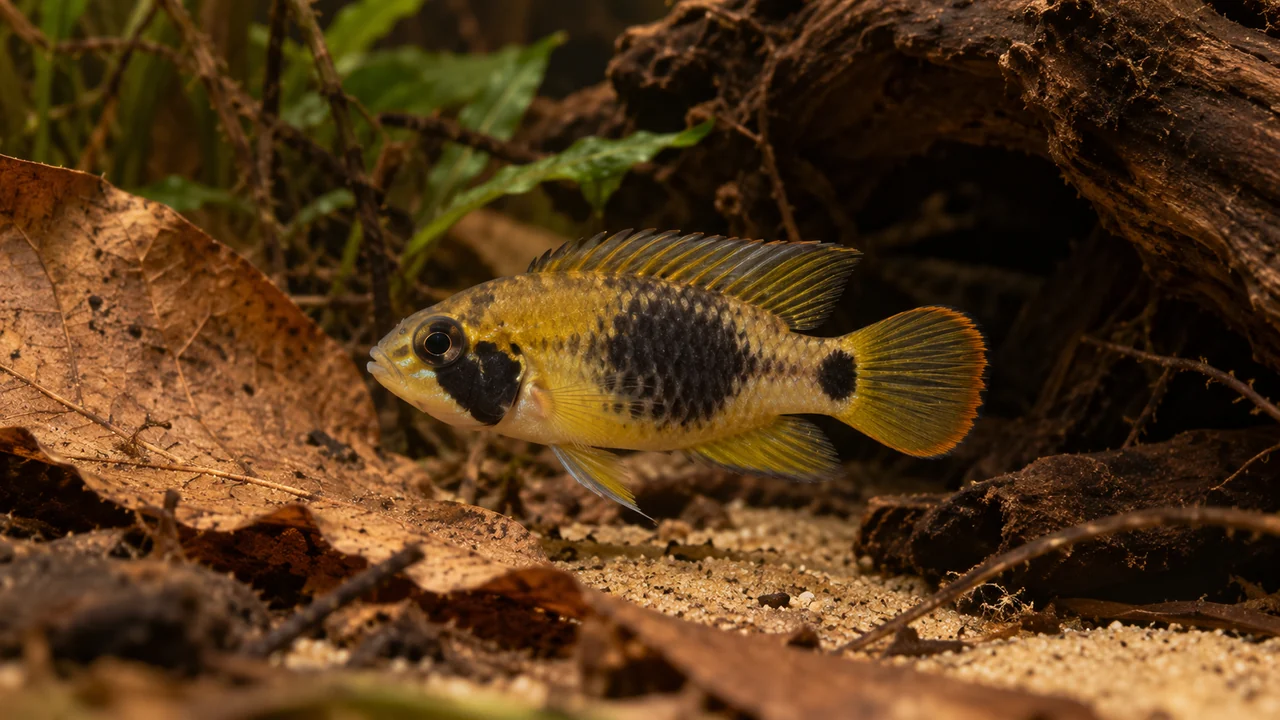
Do not merge nijsseni with panduro. Experienced identifiers compare the cheek pattern, flank blotch, tail-base spot and dorsal shape together: a female nijsseni often carries a broader flank blotch and more extensive dark face than a female panduro. A single photograph or a shared common name is insufficient to certify an uncertain fish. Keep source information with any breeding stock.
Forest-stream origins and their limits as a recipe
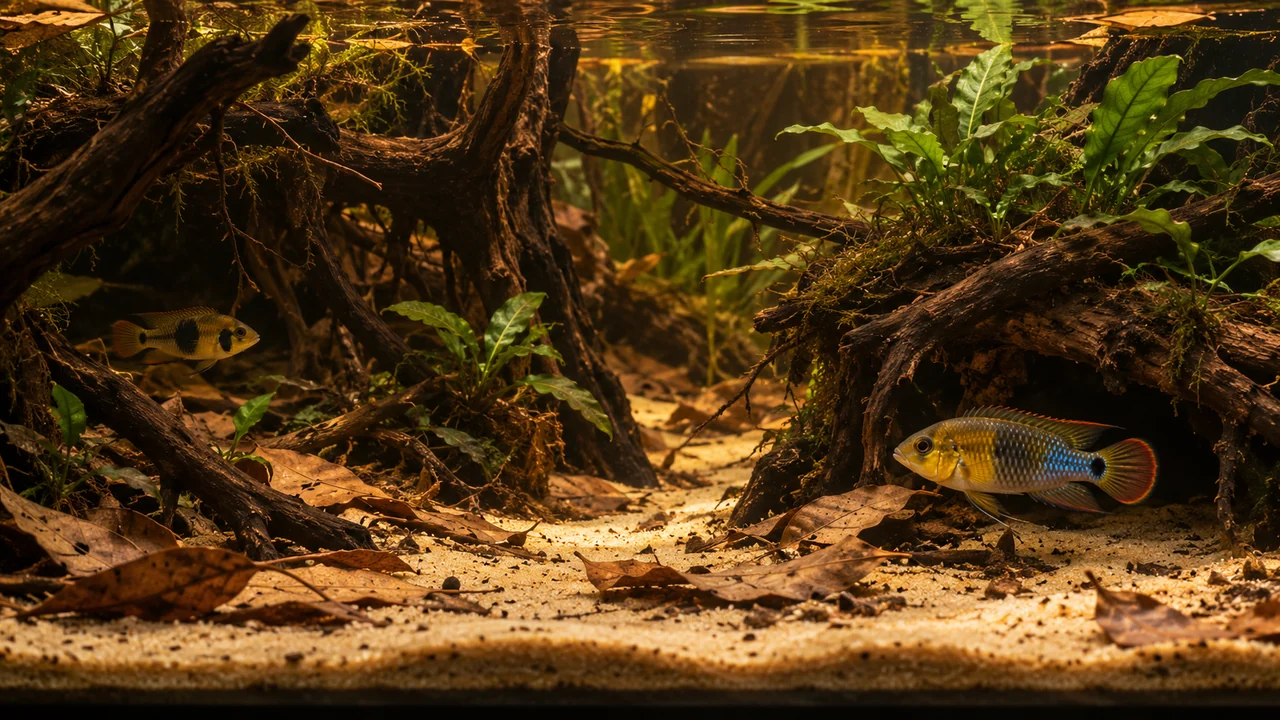
The species is documented from Peru’s Ucayali region, with the type locality in the Río Copal near Jenaro Herrera. Accounts describe shaded slow water, woody cover and accumulations of leaves. Such a habitat provides broken views and low-level refuge as well as distinctive chemistry; matching the tint alone recreates very little of it.
For a domestic aquarium, translate this into soft prepared water and separate sheltered areas that can still be cleaned. Do not reproduce a deep decaying forest floor in a small enclosed tank. Natural field measurements describe a particular place and time; they are not instructions to drive a newly purchased captive fish abruptly to the lowest reported pH.
Compatibility must be observed, not bought
A 60 × 30 cm base is published for a pair; an 80–90 cm long arrangement gives a more useful margin for separated refuge. This is extra planning space, not a guarantee. A tall tank with only one protected corner can be less usable than a shallower one with a well-divided floor.
Michael Scharfenberg’s long-term breeding account describes both successful pairs and a polygynous arrangement in a substantially larger aquarium, alongside severe aggression and rejected partners. That is evidence against a universal ratio. Start from an actually compatible arrangement, with a divider or spare set-up ready. A smaller fish stranded at the surface or continually driven from cover needs protection, regardless of its sex.
Read the female’s markings without disturbing her
The supporting view shows the broad dark cheek and flank pattern of a yellow female. Colour can help direct attention, but it does not prove eggs are present or certify her reproductive state. Observe appetite, movements and interactions from outside the aquarium instead of lifting shelters whenever she changes colour.
If a female begins defending a site, check that the male retains somewhere safe to rest and feed. More caves do not necessarily help when every entrance faces the same open area. Stable low wood, screened sightlines and exits around the back give practical alternatives. Assess openings against the adult fish rather than assuming a small hole is a suitable refuge.
A soft-water plan with a mature filter
Seriously Fish recommends 24–28°C, pH 5.0–6.5 and very soft water up to about 4°dGH. Around 25–26°C is a sensible adult starting choice, adjusted to the established stock. Measure GH and KH as well as pH, prepare replacement water consistently and keep the biological filter mature. Extremely low buffering makes uncontrolled additions especially unhelpful.
Provide gas exchange at the surface while leaving a calmer lower zone. Siphon accessible waste and match partial changes to actual feeding and stocking. A breeder reported successful rearing at pH 6.0–6.5 and 26–28°C; this is a named aquarium observation, not proof that every population needs those exact values. Avoid repeatedly changing chemistry after each unsuccessful spawn.
For the sheltered lower layout, compare Cocoa Pods – Hollow Theobroma cacao Botanical Shelters with Blackwater Botanical Box – Pods, Seeds & Spirals. Inspect the actual pieces for adult entry, turning space and accessible exits; position them beside an open feeding patch rather than making every route pass through one refuge. A mixed box provides material to choose from over time, rather than a quantity to add all at once.
Food must reach the sheltered fish
Use small suitable live or frozen invertebrates and a complete fine sinking food if accepted. Deliver modest portions near different sheltered positions, then watch both fish eat. A food item that sinks fast is useful only if it lands where the intended fish can reach it without confrontation.
Remove leftovers that collect behind roots. If one fish is losing condition, inspect social access and particle size as well as measured water quality. Repeatedly broadcasting extra food can conceal the feeding problem while increasing waste. Microorganisms on leaves and wood offer browsing opportunities, but they do not replace a controlled varied diet.
For supplementary feeding variety, Premium Freeze-Dried Australian Blackworms is a freeze-dried worm blend to assess in a small portion matched to the actual mouth. Confirm that the fish takes and swallows it while retaining the accepted complete and live or frozen ration described above.
Make the lower aquarium readable
Use fine sand with root clusters and limited leaf patches, retaining an open route across the front for observation and cleaning. Plant around the back and sides rather than filling every exit. Keep filter intakes protected where young might occur, and ensure circulation reaches around the sheltered areas without blasting the fish.
Choose companions cautiously for soft warm water and manageable adult size. Other dwarf cichlids compete directly for the same space; a list of related species is a comparison tool, not a stocking plan. Small shrimp or fry may be eaten. Even otherwise calm bottom fish can become unwanted intruders around a spawning site.
Cavity spawning is only the beginning
Eggs are normally laid within a sheltered site, with the female taking the main role in care. A functioning pair is more useful than two fish selected only for beauty. A breeding aquarium should already provide mature filtration, safe separation, appropriately small foods and somewhere for growing juveniles to go.
Free-swimming fry can take suitably sized Artemia nauplii and microworms, provided they can reach them. The long-term breeder describes several early brood losses before successful rearing; his interpretation of learning should not be turned into a guaranteed schedule. Observe fertilisation, parental behaviour and water quality. Temperature can influence sex ratios in this group, but no precise sex-selection recipe is justified here.
When hiding or aggression becomes persistent
Compare normal retreat with exclusion. A fish that rests beneath wood but emerges to eat is different from one that never reaches food or spends all day at the top. Watch both directions of pursuit; either partner can become the aggressor. Use the prepared separation option before physical damage makes the decision obvious.
Then check temperature, ammonia, nitrite, filter operation and recent maintenance changes. Keep useful shelter while removing actual waste. A darker aquarium or another handful of leaves cannot substitute for a compatible social arrangement, and botanicals are not a treatment for unexplained illness or repeated brood failure.
Further reading and sources
Identity and natural-history sources are distinguished from aquarium husbandry. Recommended care is not a set of experimentally established survival limits; breeding conditions may differ from adult maintenance.
- Kullander — South American Cichlidae checklist — Taxonomic names, original combinations and recorded river basins; specimen lengths are not maximum aquarium total lengths.
- Seriously Fish — Apistogramma nijsseni — Species-specific husbandry, adult scale, social arrangements and reproduction. Read explanatory water notes, not just summary numbers.
- Michael Scharfenberg — nine-year nijsseni keeping account — First-hand breeding history: mate compatibility, variable social arrangements, early brood losses and observed water conditions.
- Aquarium Glaser — nijsseni — Importer observations of captive stocks and temperature-related rearing sex ratios; no numerical sex-selection protocol inferred.
- Mike Wise — nijsseni and panduro comparison — Named specialist identification commentary; markings vary and must be assessed together.