Fish · Panduro Dwarf Cichlid
Panduro Dwarf Cichlid — Apistogramma panduro: Habitat and Care
A blue-bodied Peruvian dwarf cichlid with a distinctive tail-base marking and a reputation for selective pairing. Give it a soft-water, territory-led aquarium and a safe separation plan rather than treating it as another colour of nijsseni.
- Identity
- Apistogramma panduro Römer, 1997; pandurini is an older trade usage.
- Adult scale
- Published aquarium planning scale about 7–8 cm for males, with smaller females; measured specimen SL is shorter.
- Aquarium footprint
- At least 60 × 30 cm is published for a compatible pair; prefer around 80–90 cm length with separate refuges.
- Temperature
- 22–29°C broad guidance; around 25–27°C is a practical stable maintenance choice.
- Water plan
- Soft acidic water preferred: roughly pH 5.5–6.5 and 1–5°dGH for established captive stock.
- Reproduction
- Cavity/crevice spawning; formed pairs may persist, but buying two sexes does not establish a bond.
Panduro is a species, not a trade shade
Apistogramma panduro was described in 1997. The older aquarium usage pandurini remains helpful when searching historical reports, but it does not justify a second profile. Blue panda, blue sky and azure are common-name labels. Do not use them alone to identify a fish or claim a collection locality.
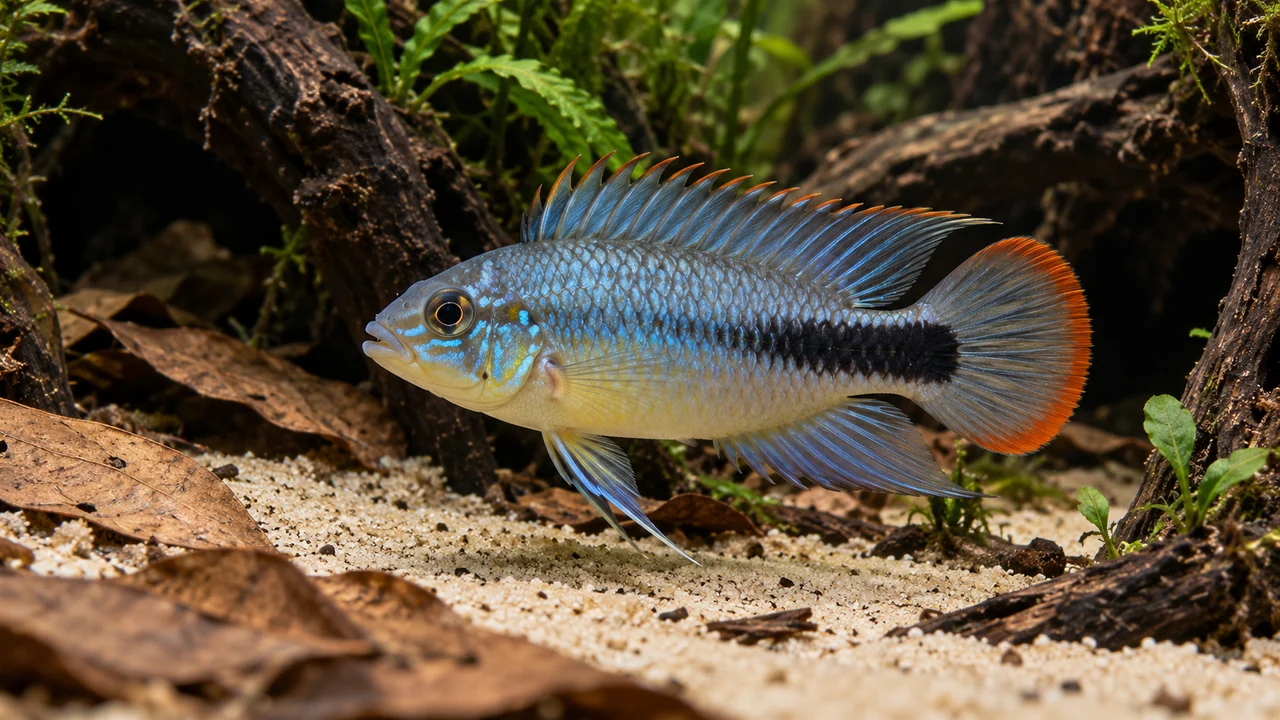
Adult males can be sky blue with a dark tail-base mark extending horizontally into the rounded tail and an orange-red margin. A slightly projecting lower jaw is another useful character. Females become yellow with dark markings that can extend towards the lower flank and belly. Compare the whole pattern with nijsseni; neither the amount of blue nor a single black spot is definitive by itself.
Peruvian creeks, with locality uncertainty retained
The original description and checklist place the species in small forest brooks east of Jenaro Herrera in Peru. Additional aquarium accounts discuss the Tahuayo area and related-looking fish from neighbouring drainages. Keep uncertain variants separate in records rather than turning every similarly coloured import into the same known locality.
The useful habitat translation is slow-water cover, fine substrate, leaves and separate low-level spaces. This does not require every inch of the aquarium to be filled. Retain visibility and maintenance routes so a hidden fish, uneaten food or an escalating dispute can actually be noticed. An attractive regional arrangement is not proof that it reproduces a documented collecting site.
Plan for a selected pair, not a routine harem
Published guidance gives 60 × 30 cm as a pair starting base; prefer an 80–90 cm long home arrangement for more retreat options. A larger nominal volume is useful only when it adds usable territory. Do not rely on a high narrow tank or a solid maze of roots with a single exit.
Panduro can be aggressive towards its own species. Once established, pairs may remain together, so a harem is not automatically required. Historical keeper reports also describe selective partners and severe pursuit. A male and female offered together in a shop are not necessarily bonded. Keep a divider or spare mature set-up ready, and separate a persistently excluded fish instead of adding more individuals to dilute the problem.
A closer look at the female pattern
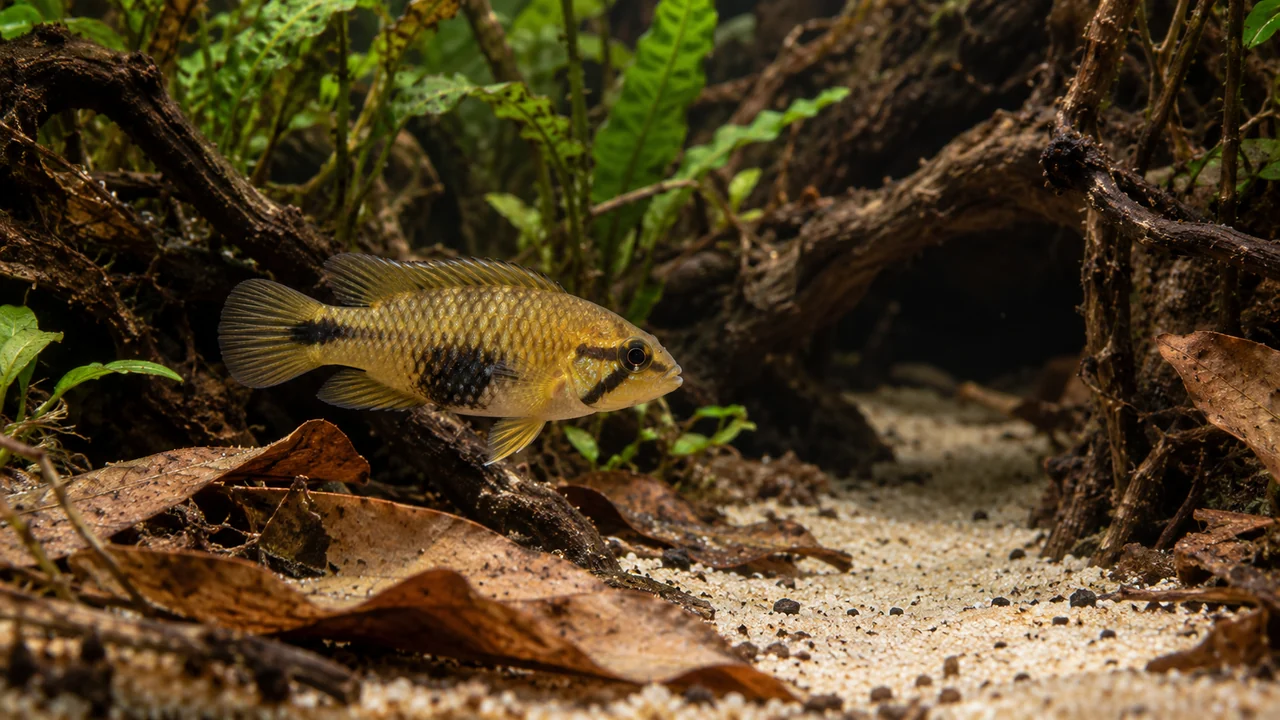
A female’s yellow ground colour and irregular lower-flank blotch offer a useful comparison with the broader panda markings of nijsseni. The supporting image places the fish beside cover without claiming an active brood. Markings change with mood; normal colour variation is not itself evidence of illness or successful reproduction.
Observe whether she can pass between shelter and food without a chase. Turn neighbouring entrances away from each other and interrupt direct views with plants or low wood. A cavity should have safe edges and enough internal space for the adult. Provide alternative refuge that can be serviced or reached with a net if behaviour changes.
Separate broad tolerance from the chosen care plan
Seriously Fish lists 22–29°C, pH 4.0–6.5 and 0–5°dGH. For established captive fish, around 25–27°C with soft water near pH 5.5–6.5 and 1–5°dGH is a practical starting plan, not a new experimentally determined limit. The lower pH endpoint is not a target to force upon ordinary aquarium stock.
The Nordic cichlid society’s register gives a broader, less acidic aquarium range. These accounts are not identical; record how the actual stock has been maintained rather than averaging all endpoints. Use measured GH and KH, prepare replacement water consistently and avoid chasing pH inside the stocked tank. Maintain biological filtration, surface exchange and a calm lower zone.
For the sheltered lower layout, compare Badam Pods – Natural Botanical Pods with Curated Blackwater Botanical Pod Pack – 13-Piece Mix. Inspect the actual pieces for adult entry, turning space and accessible exits; position them beside an open feeding patch rather than making every route pass through one refuge. A mixed box provides material to choose from over time, rather than a quantity to add all at once.
Offer food beside more than one refuge
Use fine complete sinking food where accepted, with varied suitable live or frozen invertebrates. Newly acquired fish may recognise moving foods before prepared diets. Watch actual intake and introduce unfamiliar food in small amounts rather than assuming anything that disappears into the leaves has been eaten.
Place portions where the less confident fish has safe access. Remove persistent leftovers from behind shelter entrances, and avoid using large meals to tempt a fish out during pursuit. Browsing surfaces complement feeding but cannot guarantee a complete diet. If condition declines, investigate the social layout and measured water quality alongside the menu.
If the fish accepts prepared sinking food, Artemia SuperSoft Fish Food is a soft-food option to compare with the ration above. This listing is the 1.4–2.2 mm grade: use it only where the actual fish can swallow the pieces readily, and keep portions accessible to quieter individuals.
An aquarium that stays accessible
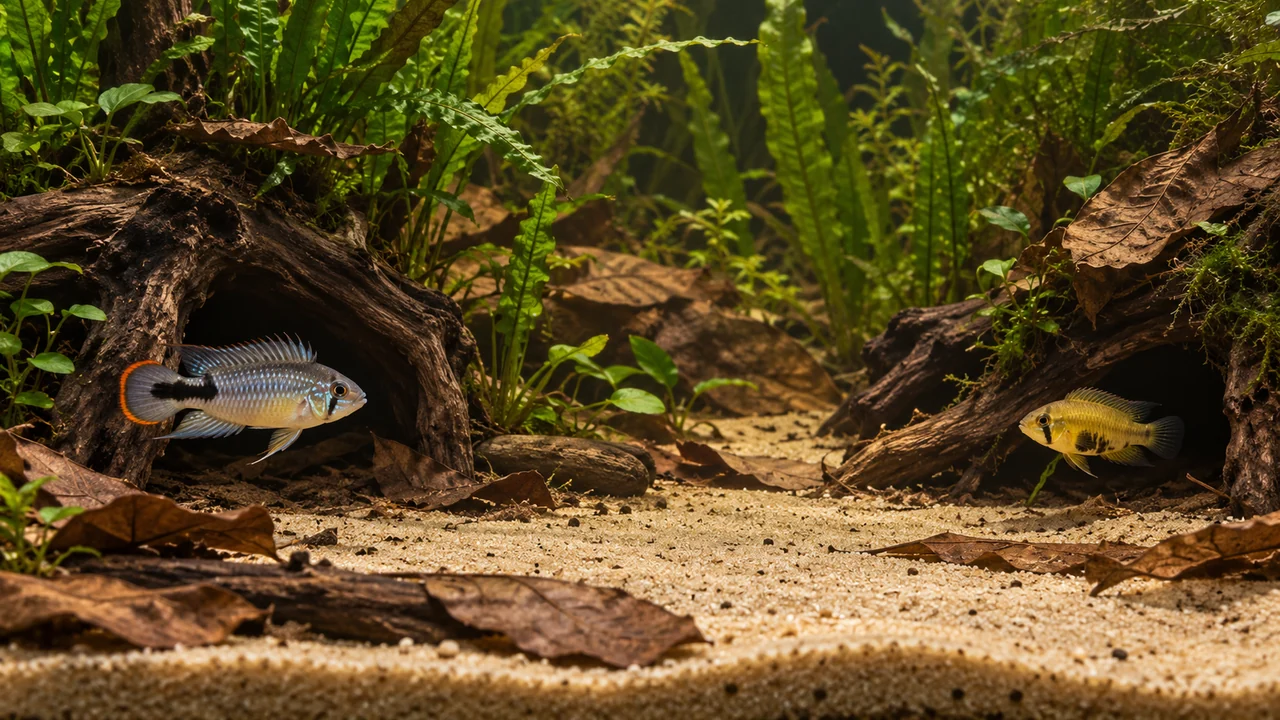
Make a broad sand lane with two separated root clusters and limited leaf patches. Plants can shield the back of each refuge while the front stays observable. Keep equipment and a siphon route accessible; a perfect-looking jungle becomes impractical if every maintenance action destroys a defended site.
Peaceful small upper-water companions may fit where their adult needs agree, but do not crowd the aquarium with other territorial floor residents. Small shrimp and fry can be prey. A species-focused arrangement is often clearer for observing a pair and raising young. The reciprocal nijsseni link helps choose between species, not keep both together.
Female care, fry foods and a separate rearing objective
Spawning normally takes place in a cavity or crevice. The female generally tends eggs and young, while adult relationships need continued observation. Historical accounts include variation in parental participation; do not require the male to remain if he is being attacked or disrupting care.
Before attempting to raise fry, prepare small live foods, protected filtration and grow-out capacity. Deliver appropriate food within reach once young swim freely and maintain water quality as feeding increases. Spawning alone does not demonstrate successful fertilisation or rearing. Investigate a repeated failure carefully instead of responding with progressively lower pH, extra heat or an unverified additive recipe.
First checks for a nervous blue fish
Distinguish settled sheltering from social exclusion. Observe after lights come on and during feeding, checking both partners. Continual surface hiding, frayed fins, rapid breathing or a shrinking abdomen calls for a specific response. Protect the fish from pursuit while checking temperature, ammonia, nitrite and filter operation.
Avoid changing several variables together or assuming that a name such as panda implies gentle behaviour. Retain provenance, measurements and observations so later decisions have a foundation. Botanicals can provide cover and browsing surfaces, but do not make an incompatible pair safe or guarantee successful breeding.
Further reading and sources
Identity and natural-history sources are distinguished from aquarium husbandry. Recommended care is not a set of experimentally established survival limits; breeding conditions may differ from adult maintenance.
- Kullander — South American Cichlidae checklist — Taxonomic names, original combinations and recorded river basins; specimen lengths are not maximum aquarium total lengths.
- ITIS — Apistogramma panduro — Valid identity and Römer 1997 authority; corrects the conflicting year shown on one husbandry page.
- Seriously Fish — Apistogramma panduro — Species-specific husbandry, adult scale, social arrangements and reproduction. Read explanatory water notes, not just summary numbers.
- Nordic Cichlid Society — panduro register — Aquarist society record; less acidic care range differs from the specialist profile.
- The Krib — historical panduro keeping reports — Named first-hand accounts, mate choice and variable parental observations; old trade names and uncertain identifications remain contextual.
- Mike Wise — nijsseni and panduro comparison — Experienced identification commentary; not a promise that every fish expresses one fixed marking.