Fish · Cockatoo Dwarf Cichlid
Cockatoo Dwarf Cichlid — Apistogramma cacatuoides: Habitat and Care
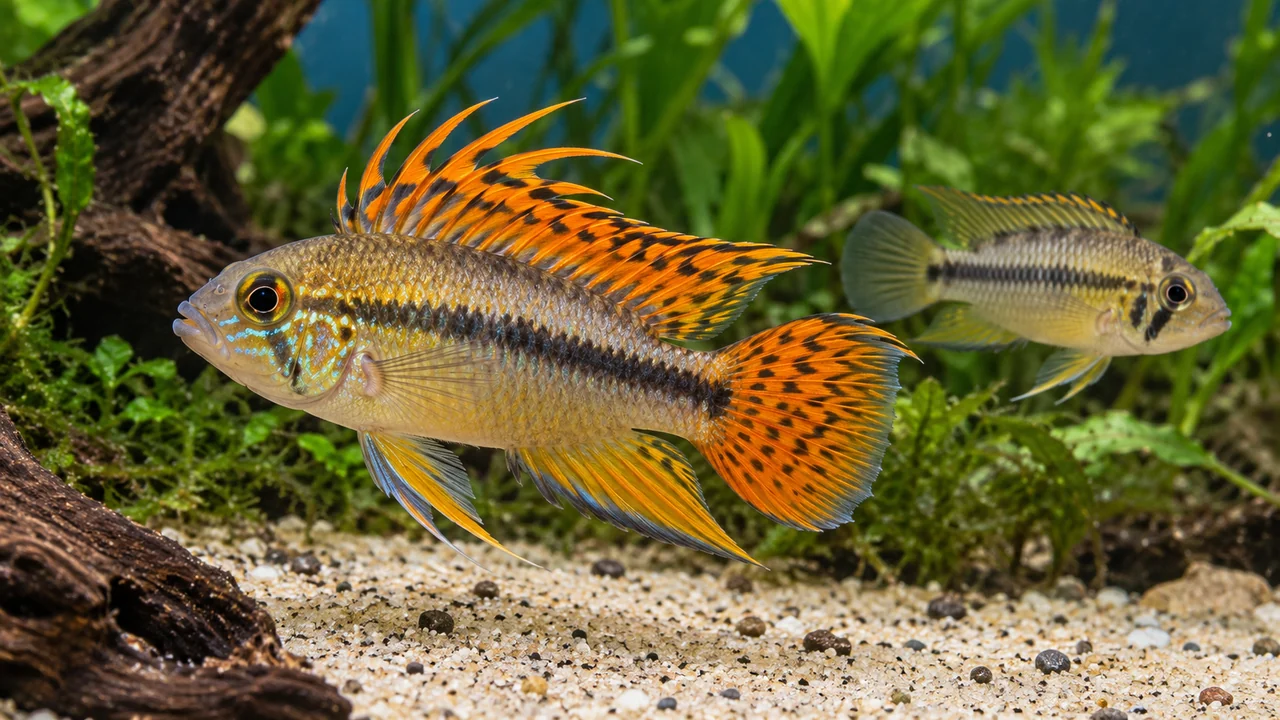
The male’s raised dorsal crest gives this dwarf cichlid its name. Domestic colour forms can be adaptable, but territories, female brood defence and separate feeding access still need deliberate planning.
- Adult identity
- Apistogramma cacatuoides. Male aquarium accounts around 8–9 cm overall, females about 5 cm; published standard-length maxima differ.
- Practical space
- A single adult male is a possible non-breeding display choice. A compatible pair needs a structured floor; 60 × 30 cm is a published starting base, with 80 cm or longer preferable.
- Water for domestic stock
- Published captive-care range pH 6.0–7.5, 2–12°dGH; steady conditions matter more than forcing a strongly acidic blackwater recipe.
- Temperature
- Separate domestic guidance 24–28°C; 25–27°C is a useful central routine choice.
- Shelters and feeding
- Several separate low shelters with safe entrances; fine sand and targeted small sinking food.
- Reproduction
- Cavity spawner with female egg/fry care. Breeding aggression can require separation; neither pairing nor a fixed harem ratio guarantees compatibility.
Recognising the cockatoo
The adult male’s extended front dorsal rays form the distinctive crest. A stockier outline, strong mouth and different tail shape help separate it from the slender, lance-tailed Agassiz’s dwarf cichlid. Females are smaller and do not carry the male’s exaggerated crest; yellow brood coloration and dark markings are not a smaller copy of a male colour form.
Apistogramma cacatuoides remains the accepted identity. Orange Flash, Double Red and similar labels describe selected aquarium forms, not separately established wild species. The main image represents an orange-finned domestic male, without certifying a particular breeder’s line or wild locality. Do not identify provenance from orange or red fins, or describe a selected strain as a direct portrait of every wild cockatoo.
Western Amazon origins, domestic histories
The natural distribution is associated with the upper Amazon region, including Peru and western Brazil. The original Suriname type-locality statement was corrected in later taxonomic work. Slow margins and leaf accumulations are relevant, but habitat and water can differ with locality and season.
That history matters when choosing stock. A documented wild population and a domestic line raised for generations in local water should not automatically receive the same chemistry prescription. Keep genuine supplier or breeder details. For ordinary domestic keeping, choose a measured practical plan before purchase rather than relying on the assumption that every dwarf cichlid needs an extremely acidic aquarium or comes from the same forest stream.
Choose a social arrangement you can manage
For a display without breeding, one adult male can be kept without manufacturing a pair or harem. If a pair is wanted, compatibility must be observed, not presumed from sex. The published starting footprint is 60 × 30 cm for a pair; a well-divided aquarium at least 80 cm long offers a more practical margin for retreat and maintenance.
Multiple females need larger floor space and independently defensible sites, not a mandatory numerical ratio applied to every tank. Rival females and a defending mother can create problems as well as an assertive male. Avoid multiple males in a small layout. Have a real separation option ready and judge whether every fish can feed, rest and move away without being followed continually.
Domestic care is not extreme breeding water
Aquarium Dietzenbach gives 24–28°C, pH 6.0–7.5 and 2–12°dGH for captive stock. A steady 25–27°C is a useful central choice. These are practical maintenance figures, not a promise of identical tolerance in all wild populations or selected lines. Measure the water you will use and keep preparation repeatable.
Seriously Fish displays pH 5–6 in its summary, but the explanatory wording concerns breeding some wild populations and notes the flexibility of commercially produced fish. Do not turn that breeding context into a requirement to acidify every domestic cockatoo aquarium. Know GH and KH separately, use conditioned replacement water and avoid abrupt changes. A colour-form name cannot replace knowledge of the actual stock’s established conditions.
Build separate entrances and sightlines
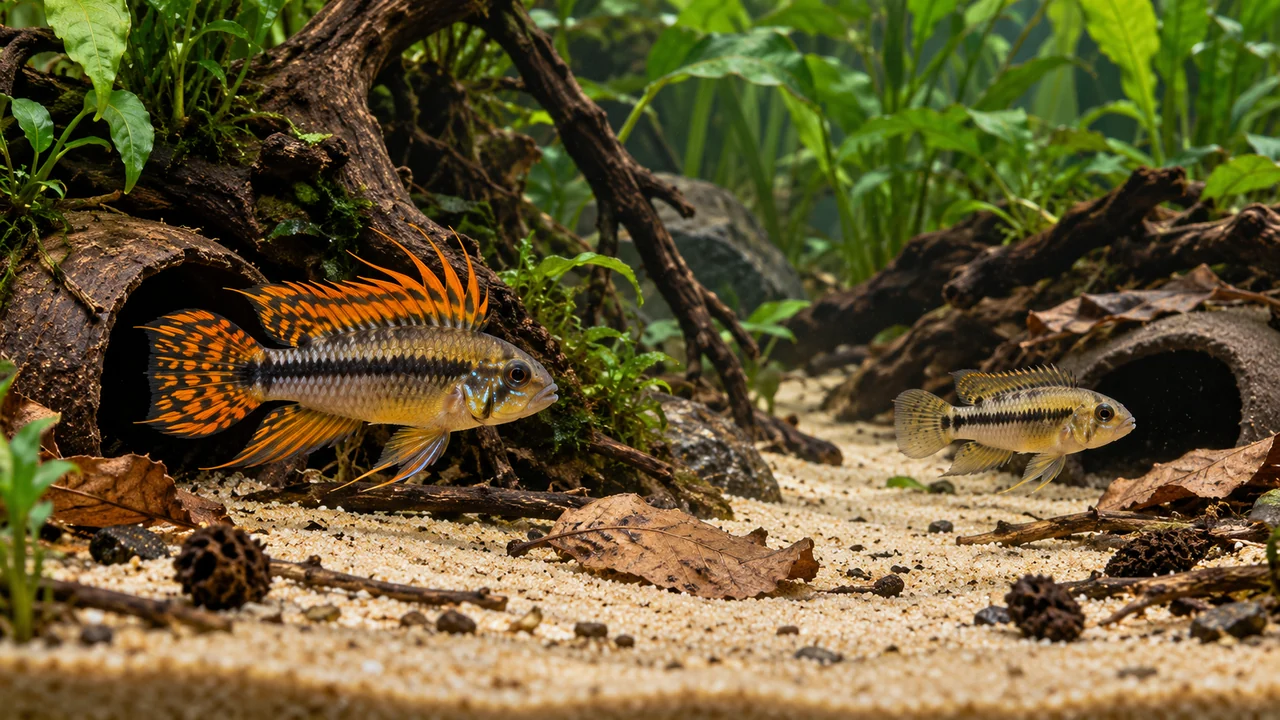
Use fine safe sand, lower roots and planting to divide the floor into sheltered areas. Position suitable caves or pods with entrances pointing away from one another. Two holes side by side beneath the same exposed root are not two independent territories, however attractive they look from the front.
Leave routes around major pieces and feeding positions outside the strongest fish’s immediate view. Check that an adult can enter, turn and exit any natural cavity without snagging fins or becoming wedged. Keep access for inspection and a net. The layout should let you respond to aggression without having to dismantle every shelter while a defending female or trapped companion remains inside.
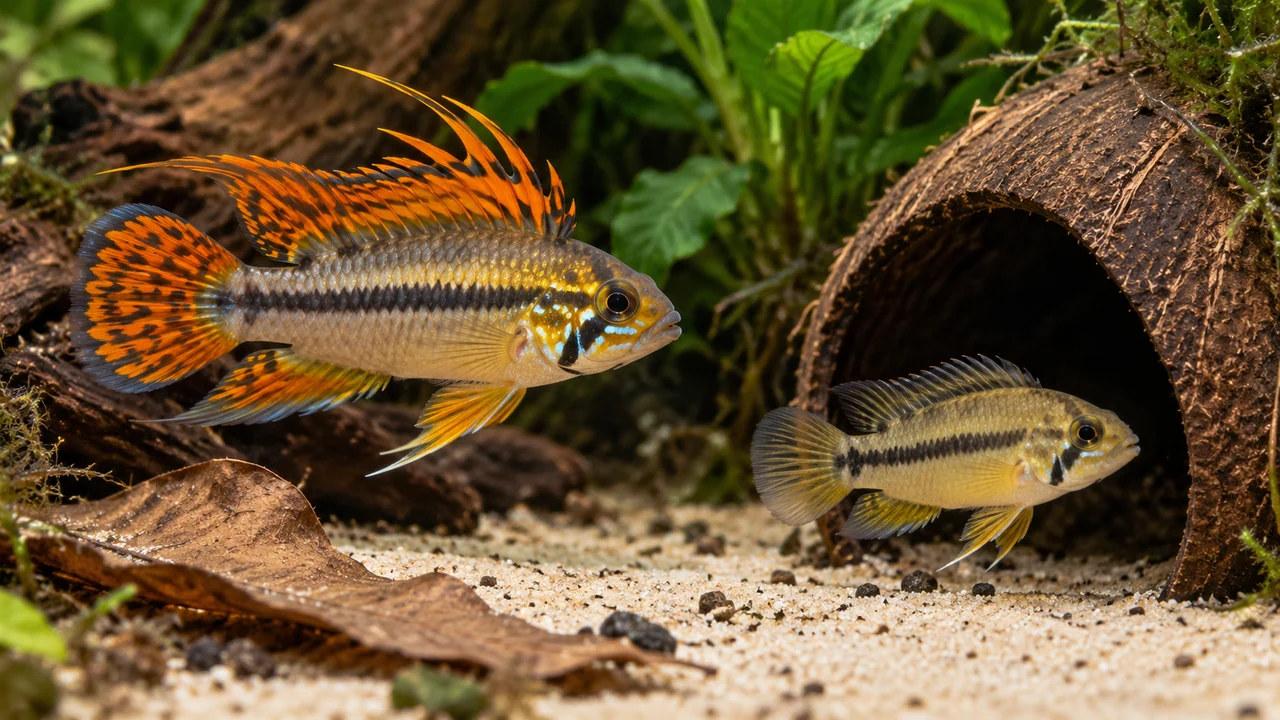
For the sheltered lower layout, compare Coconut Nut Pod – Natural Three-Quarter Coconut Hide with Blackwater Botanical Box – Pods, Bark Tubes & Shelters. Inspect the actual pieces for adult entry, turning space and accessible exits; position them beside an open feeding patch rather than making every route pass through one refuge. A mixed box provides material to choose from over time, rather than a quantity to add all at once.
A stable filter and practical litter
Mature biological filtration, conditioned water and oxygenation remain essential in a softly lit aquarium. Distribute the return so the bottom is calm without leaving dead areas behind caves. Check ammonia and nitrite after changes and investigate breathing changes promptly rather than assuming that dark water makes the aquarium safe.
Add prepared leaves in manageable patches and inspect them for trapped food. Partial water changes should suit the actual waste load and replacement water; a fixed small percentage is not a substitute for testing and observation. Maintain one part at a time when possible. A litter layer is useful structure, but it cannot compensate for an overloaded filter, a blocked intake or long-unnoticed leftovers inside a shelter.
Deliver the meal to the quieter fish
Small sinking complete pellets, where accepted, can be varied with appropriate live or frozen invertebrates. Present food near the lower feeding area rather than letting faster midwater fish remove every portion. Different sizes and individuals may need different particle sizes; confirm swallowing instead of merely seeing interest.
Use separate feeding locations if keeping more than one cichlid. A female remaining near a shelter still needs access, especially when defending a brood. Avoid filling the cave itself with food that will be difficult to remove. Assess condition over time and adjust the next portion if leftovers persist. Neither a pod nor decomposing leaves supplies a balanced measured adult ration.
If the fish accepts prepared sinking food, Artemia SuperSoft Fish Food is a soft-food option to compare with the ration above. This listing is the 1.4–2.2 mm grade: use it only where the actual fish can swallow the pieces readily, and keep portions accessible to quieter individuals.
Community choices at adult scale
Suitable small companions can occupy other areas where their water and behaviour fit, but the floor is not unlimited shared space. Consider catfish visiting a cave, large shrimp approaching fry and other cichlids defending the same route. Breeding can change the risk after weeks of apparent calm.
Avoid treating domestic origin as a guarantee of community peace. Small shrimp and offspring can be eaten, and a fish large enough to swallow a companion is not made safe by a species label. Do not put both featured Apistogramma into a small display because their care summaries overlap. Choose the species and social arrangement first, then assess each proposed neighbour against that actual plan.
Maternal care and breeding recovery
Cockatoos normally lay eggs in a cavity or crevice and the female cares for eggs and fry. A dedicated mature setup gives better control when raising young is the objective. The male may need removal if she becomes strongly defensive; separation is a practical welfare decision, not proof that either fish is defective.
Prepare small fry foods, protected filtration and a manageable rearing space before spawning. Domestic lines may reproduce without the extreme chemistry associated with some other Apistogramma, but no single method guarantees success for every line. Keep strain records and do not mix unknown forms then assign a prestigious locality name to the young. Shelter, food and parental behaviour deserve as much attention as a pH number.
Troubleshooting without a chemistry spiral
If one fish is thin or hidden, watch territory and feeding access. If all occupants breathe faster, check temperature, surface exchange, filter flow and ammonia/nitrite first. For a repeatedly unsuccessful brood, assess adult interactions and the actual eggs or fry before assuming that the whole aquarium needs acidification.
Keep a record of symptoms, maintenance and new arrivals, and obtain appropriate fish-health advice for persistent illness. Check a domestic male’s large fins against sharp openings and unsuitable current. Add botanicals gradually and keep them maintainable. The dependable display is one in which the fish can live and be monitored comfortably; constant courtship, maximum fin spread or continual breeding is not required to prove that care is working.
Further reading and sources
Identity and natural-history sources are distinguished from aquarium husbandry. Recommended care is not a set of experimentally established survival limits; breeding conditions may differ from adult maintenance.
- Seriously Fish — Apistogramma cacatuoides — Species-specific husbandry, adult scale, social arrangements and reproduction. Read explanatory water notes, not just summary numbers.
- Aquarium Dietzenbach — Cockatoo husbandry — Domestic maintenance ranges, size estimates, selected colour forms and floor-level territory planning.
- ITIS — Apistogramma cacatuoides — Institutional taxonomic identity and authority, not a stocking rule.
- NCBI — Apistogramma cacatuoides — Independent institutional identity reference.