Fish · Macmaster’s Dwarf Cichlid
Macmaster’s Dwarf Cichlid — Apistogramma macmasteri: Habitat and Care
A robust, colourful Colombian dwarf cichlid whose name is often confused in trade. Start with a reliable identity, separate bottom territories and food access, not a promise that a red fish or a purchased trio will behave as expected.
- Identity
- Apistogramma macmasteri; A120. A. viejita is a separate species, not a synonym.
- Adult scale
- Males may reach about 8 cm overall; females commonly smaller, around 5–6 cm.
- Aquarium footprint
- Prefer at least 80 × 30 cm for a compatible pair; multi-female layouts need substantially more usable floor.
- Temperature
- 24–28°C published; around 25–26°C suits ordinary captive maintenance.
- Water plan
- Soft water, pH around 6.0–6.8; specialist GH guidance 0–5°dGH, not a command to use unmineralised water.
- Reproduction
- Cavity/crevice spawning with maternal egg and fry care; aggression may require separation.
A name must survive the shop label
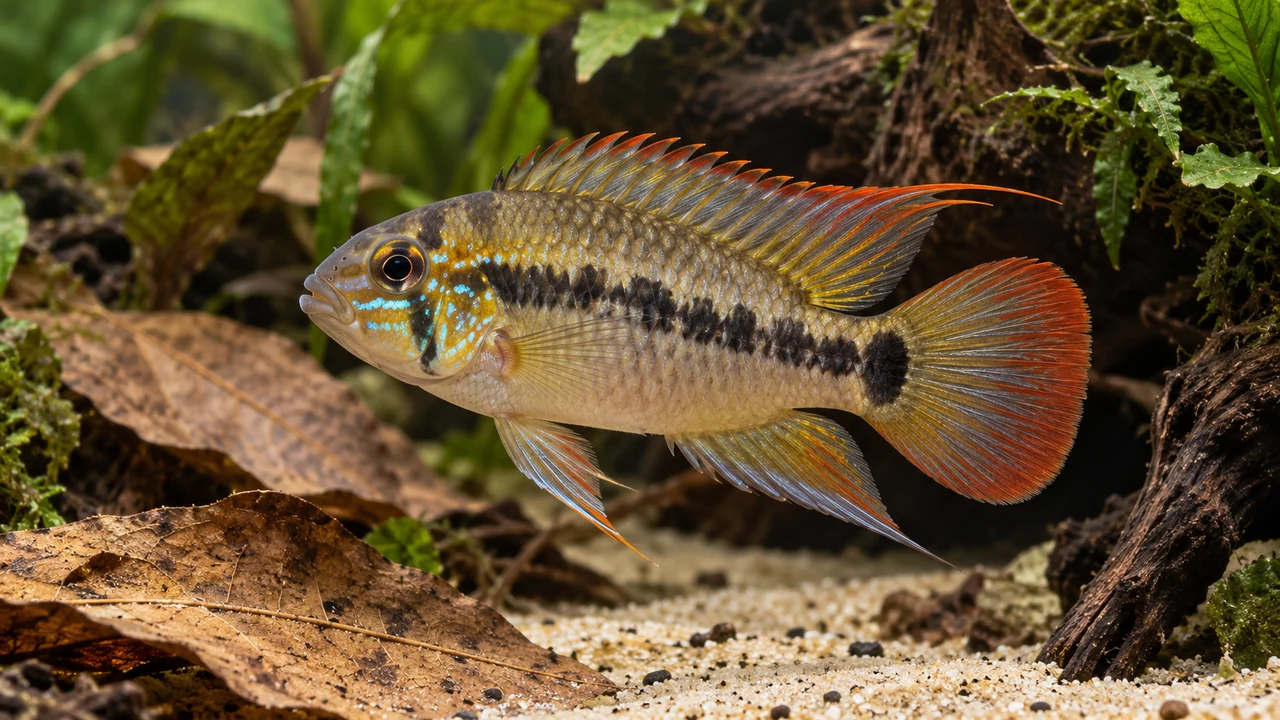
Macmasteri is a fairly deep-bodied Apistogramma, with a dark lateral pattern, a conspicuous tail-base mark and variable red and blue colour. Adult males normally develop larger, longer fins than females. The main portrait represents restrained domestic coloration without certifying a named line. Young or subordinate males may be pale, so a small colourless individual is not automatically female.
Apistogramma viejita remains a distinct species. Trade labels have often been confused, and Red Mask or Super Red describes appearance rather than establishing ancestry. Do not identify a fish solely by how much red it shows. Ask for the breeder’s identity and provenance, use several adult characters and keep uncertain stock labelled honestly rather than silently merging the two species.
Upper Meta origins, rather than a generic Amazon map
The species is recorded from the Guaytiquía and Metica systems of Colombia’s upper Meta drainage, within the Orinoco basin. That geographical identity matters when comparing accounts or purchasing locality fish. A selected aquarium colour form should not be assigned a wild collecting place simply because it resembles a photograph.
Translate the bottom-oriented habitat use into separate sheltered spaces, fine substrate and reliable maintenance access. A domestic aquarium can include suitable plants without pretending every ornamental plant occurs at the collection site. Distinguish an effective home layout from a documented biotope, and let the actual source of the fish guide any specialist water preparation.
A pair needs a footprint and a way to separate
Seriously Fish quotes 45 × 30 cm for a pair, whereas Christian Splettstößer’s detailed keeping account recommends at least 80 × 30 cm for ordinary pair maintenance. Prefer the latter footprint for a home display: it gives more scope to split feeding positions and break sightlines. These are different husbandry judgements, not interchangeable guarantees of compatibility.
The same breeder describes considerably more floor for a trio and aggression between females as well as males. Do not add a second female as a routine cure for chasing. Use a single male for a non-breeding display if appropriate, or an actually compatible pair with prepared separation. A fish living permanently behind the heater or at the surface has not found an acceptable territory.
Build territories you can maintain
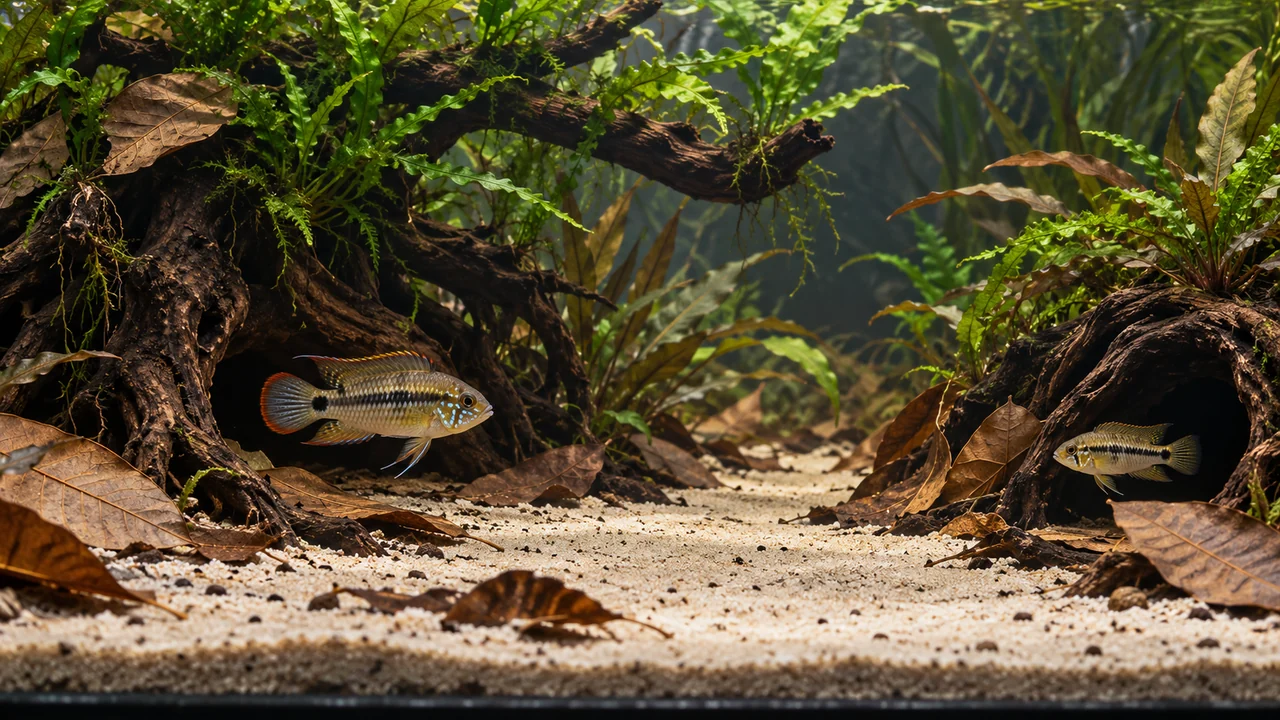
Create two or more sheltered low-level areas using stable wood and planting. Keep a clear sand route between them, and turn cavity entrances away from direct confrontation. The ability to pass safely matters more than the number of ornaments. Avoid a central feeding point that forces every fish through the same defended doorway.
Prepared leaves can soften margins and offer browsing surfaces, while open sand supports feeding and cleaning. Check cavity openings and sharp edges before introducing fish. Arrange roots so a net, divider and siphon can still be used; a separation plan becomes much less useful if the entire hardscape must first be removed.
Soft water without chasing extreme numbers
Published temperature guidance is 24–28°C, with the first-hand keeper reporting good routine results near 25°C. Around 25–26°C offers a practical maintenance choice. A pH around 6.0–6.8 is also consistent with that account. The specialist summary gives 0–5°dGH; soft water is sensible, but the lower endpoint is not an instruction to pour untreated pure RO water into the aquarium.
Know both GH and KH and prepare replacement water before use. Retain stable conditions for established captive fish rather than repeatedly correcting a decimal. Keep biological filtration mature and surface exchange visible, with a quieter bottom zone. Remove food deposits from behind shelters and make regular partial changes according to the actual waste load.
For the sheltered lower layout, compare Palmyrah Pod Half (Arecaceae sp.) – Natural Botanical Cave with Blackwater Botanical Box – Pods, Leaves, Cones & Large Feature Piece. Inspect the actual pieces for adult entry, turning space and accessible exits; position them beside an open feeding patch rather than making every route pass through one refuge. A mixed box provides material to choose from over time, rather than a quantity to add all at once.
Feeding on an accessible floor
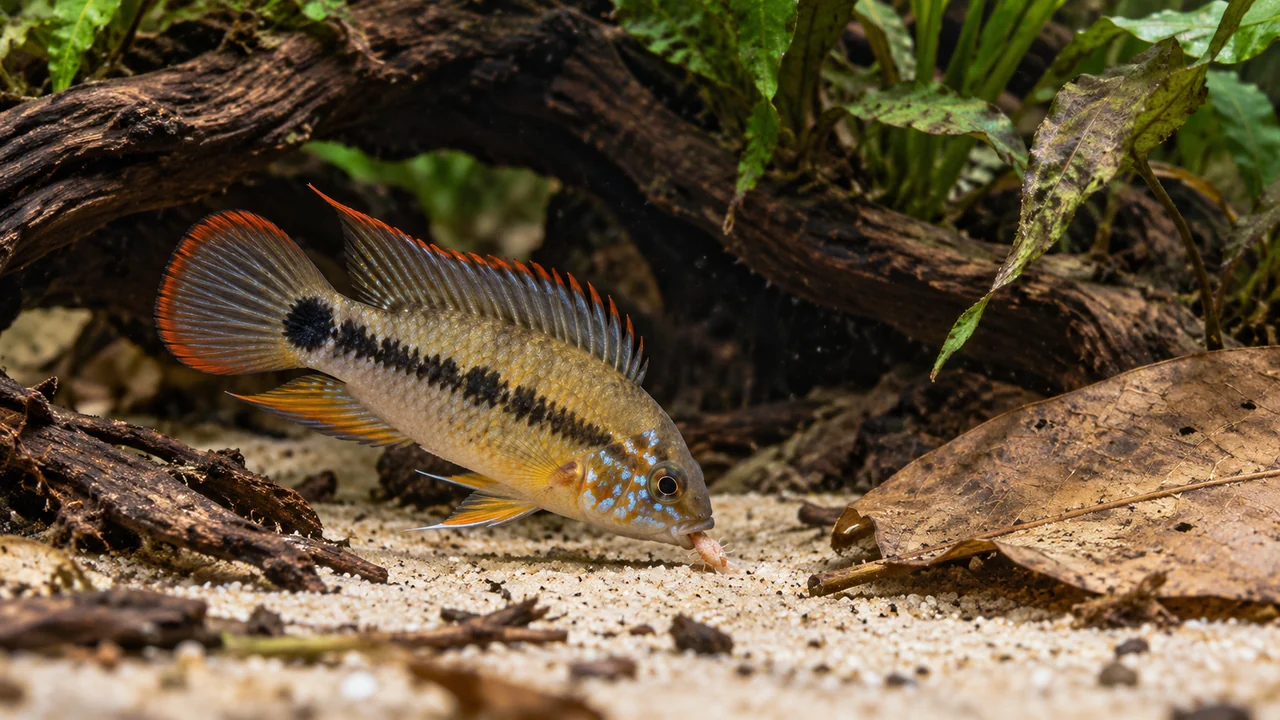
Offer a varied small-food menu including suitable live or frozen invertebrates and complete fine sinking food that the fish accepts. Macmasteri searches close to the substrate, so delivery and particle size matter. Feed separate areas and check the less conspicuous fish; a well-fed dominant male can conceal a hungry companion.
Fine sand lets fish investigate food without a bed of coarse sharp gravel. Do not leave a mass of food inside a cave to lure out a female. If she is defending a site, give a small accessible portion nearby and remove leftovers gently. Wood and leaves enrich the foraging setting but do not supply a complete nutritional programme.
If the fish accepts prepared sinking food, Artemia SuperSoft Fish Food is a soft-food option to compare with the ration above. This listing is the 1.4–2.2 mm grade: use it only where the actual fish can swallow the pieces readily, and keep portions accessible to quieter individuals.
Community choices change when a cave is defended
Peaceful upper-water companions can be considered in a properly sized aquarium when their water and temperature needs agree. Do not interpret the word dwarf as permission to stack several cichlid territories on the same floor. Other bottom residents may repeatedly enter the defended area even when they are not themselves aggressive.
Small shrimp and young fish may be prey. A previously tolerated companion can become a target during reproduction. Observe the whole aquarium, including routes behind roots, and separate if a fish cannot feed or rest. The links to agassizii and cacatuoides help compare different care plans; they are not a recommendation for a mixed-Apistogramma display.
Cave ceiling, maternal care and grow-out space
Eggs are attached within a sheltered site, often to the ceiling of a cavity. The female tends eggs and larvae, and can defend the surrounding space strongly. A male may need removal if the arrangement becomes unsafe. Do not repeatedly lift a cave to count eggs or assume that spawning proves a permanently compatible pair.
Have small first foods such as Artemia nauplii available for free-swimming young, along with a protected intake and a separate grow-out plan. Feed within reach while limiting waste. A community spawn is not assurance that fry will survive: companions and older siblings can remove young. Repeated loss needs observation of fertilisation, water quality and behaviour rather than an automatic increase in acidity or botanical quantity.
Useful first checks
When one fish is hiding or thin, inspect access to food and low-level aggression before blaming the water’s colour. Verify temperature, ammonia and nitrite, and look for trapped waste in the sheltered areas. Rapid breathing, damaged fins or continuous pursuit require a prompt practical response rather than waiting for a numerical sex ratio to solve matters.
Keep a record of source identity, settled water conditions and any actual breeding observations. Avoid changing diet, substrate, filter and chemistry together. Sound care comes from an identifiable fish in a maintainable territory; no leaf, pod or colour-form label can guarantee health, pair compatibility or breeding success.
Further reading and sources
Identity and natural-history sources are distinguished from aquarium husbandry. Recommended care is not a set of experimentally established survival limits; breeding conditions may differ from adult maintenance.
- Kullander — South American Cichlidae checklist — Taxonomic names, original combinations and recorded river basins; specimen lengths are not maximum aquarium total lengths.
- Seriously Fish — Apistogramma macmasteri — Species-specific husbandry, adult scale, social arrangements and reproduction. Read explanatory water notes, not just summary numbers.
- Christian Splettstößer — keeping and breeding macmasteri — First-hand husbandry and dated breeding observations: 80 × 30 cm pair planning, feeding access, maternal care and trade-identification caution.