Fish · Bolivian Ram
Bolivian Ram — Mikrogeophagus altispinosus: Habitat and Care
A sand-sifting South American dwarf cichlid with a cooler care plan than the blue ram, open spawning surfaces and a need for accessible feeding territory.
- Adult size
- Around 8 cm standard length; extended fins add to the outline.
- Practical temperature
- 24–27°C for routine care; warmer breeding advice is not a permanent requirement.
- Water plan
- Soft to moderately mineralised water; approximately pH 6–7.5 and 1–10°dGH, with stability and cleanliness prioritised.
- Adult space
- Plan a 90 × 45 cm base or larger for one established pair; 120 cm gives more room for separation and companions.
- Social plan
- Choose an established pair or manage a juvenile group with a realistic separation plan.
- Feeding
- A small benthic omnivore needing dedicated, appropriately sized sinking food.
A different ram, not a cooler-coloured blue ram
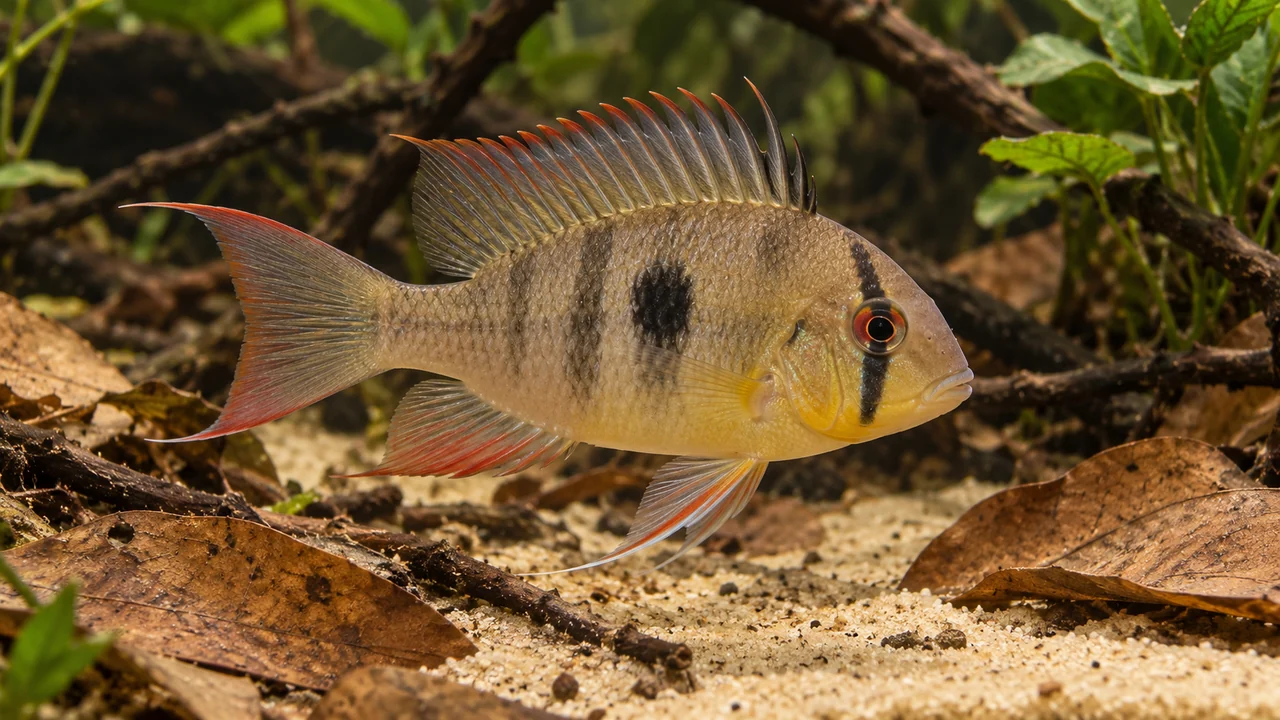
Mikrogeophagus altispinosus is a distinct species from M. ramirezi. Its beige-grey body, yellowish breast, dark eye stripe and flank blotch contrast with red-edged fins. The body is relatively elongated and lacks the blue ram’s dense bright blue spangling. Shop lighting, mood and age alter colour, so use the whole shape and pattern rather than one photograph.
The distinction changes the aquarium plan. A Bolivian ram does not need the permanently very warm conditions often recommended for blue rams. Neither a shared common name nor similar adult size makes the two interchangeable. Ask for the scientific name and buy alert, well-fed fish that can maintain position and take food normally; do not choose an unusually swollen or compressed body as a harmless variation.
A river-basin fish with a working aquarium floor
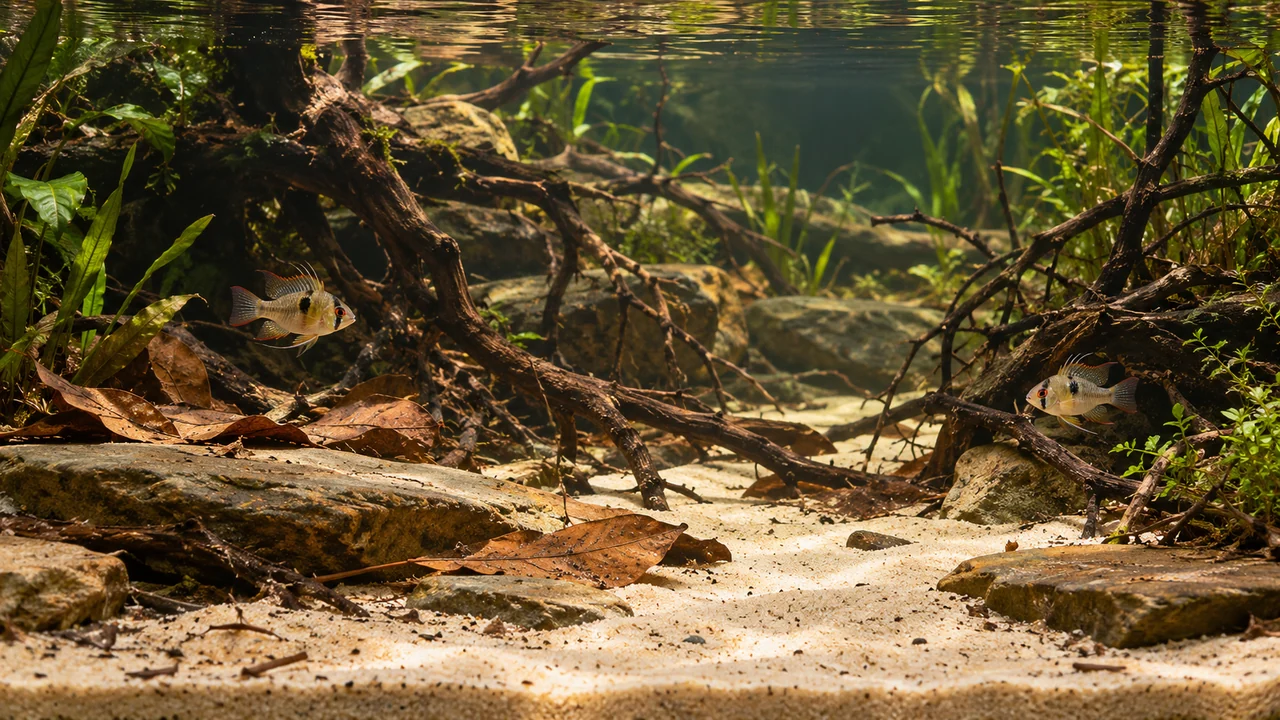
The documented range lies in the upper Madeira system of Bolivia and Brazil, including the Mamoré and Guaporé/Iténez drainages. This is not evidence that every wild locality is an identical dark, leaf-packed pool. Sheltered margins and substrates where fish can browse provide more useful design cues than making the aquarium as brown as possible.
Give an adult pair a broad bottom area, with 90 × 45 cm a sensible starting footprint and extra length valuable when other fish are present. A 120 cm aquarium allows more distinct feeding and retreat areas. These are planning recommendations, not a guarantee that any two purchased fish will tolerate each other. Height and nominal litres cannot compensate for a narrow, contested floor.
Build a stable, moderately warm system
A routine target of 24–27°C is appropriate within the published 24–28°C husbandry range. Soft to moderately mineralised water around pH 6–7.5 and 1–10°dGH gives a useful starting framework. Establish what the actual stock has been kept in and move it gradually into the prepared aquarium. Do not lower pH rapidly merely because the fish is South American.
Use a mature biological filter, gentle circulation across the occupied floor and good gas exchange. Ammonia and nitrite should be undetectable. Check nitrate trends and the accumulation of solids rather than relying on clear water as proof of cleanliness. A covered aquarium, guarded filter intake and regular, temperature-matched maintenance are practical safeguards; the lower floor still needs oxygen even when the filter outlet looks lively.
Sand is a feeding surface
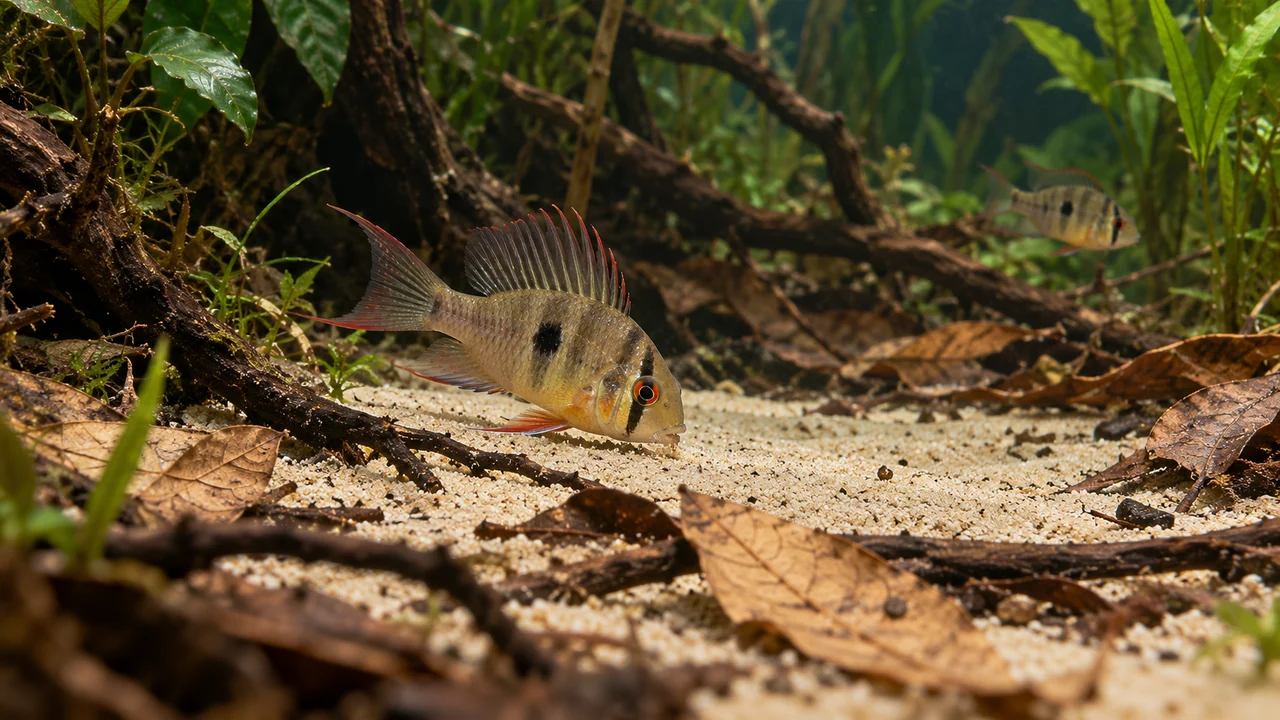
Fine, smooth sand lets the fish take small mouthfuls and sort edible particles. Provide a shallow, maintainable layer with accessible open patches. Sharp gravel and a floor completely buried under large pods make this natural feeding route harder to use. Watch the fish’s mouth, breathing and appetite when assessing a new substrate or arrangement.
Place low branches, a few prepared leaves and plants so that cover breaks sightlines without sealing the whole bottom. Leave routes between refuges and enough room to turn around a flat stone. Keep wood stable and inspect openings at adult size. An enclosed hole is not automatically a useful spawning cave for a fish that commonly lays eggs on an exposed surface.
Feed the fish you can see
Offer small sinking pellets or granules, supplemented with suitable frozen or live invertebrate foods such as Artemia or appropriately sized insect larvae. A varied, complete diet is more reliable than expecting sand, biofilm or leaves to supply everything. Crumble or choose food to suit the fish’s mouth, and observe actual swallowing rather than counting a quick inspection as a meal.
In a community, distribute food where the ram can reach it after faster midwater fish have fed. A shy individual may remain behind wood while the others consume the entire portion. Check body condition and food access on both sides of a pair’s territory. Remove persistent leftovers; extra food hidden in leaf litter adds waste without proving that the intended fish has eaten.
For prepared-food variety, compare Artemia SuperSoft Fish Food with Spirulina SuperSoft Fish Food. Check acceptance and portion size at the fish’s own feeding position; SuperSoft granules are the listed 1.4–2.2 mm grade, while the freeze-dried blend remains a supplementary option.
Pairs, groups and companions
Bolivian rams can display and chase, especially around a spawning site. Starting with several juveniles can allow social choices, but it requires a larger footprint and somewhere suitable for surplus or excluded fish. Keeping one male and one female together is not proof of compatibility. Separate fish if one cannot feed, rest or leave cover without sustained attack.
Choose peaceful companions with genuinely overlapping temperature and water needs. Small, steady shoaling fish may occupy another zone, but their speed, mouth size and feeding behaviour still matter. Other bottom-dwelling cichlids compete for the same floor, and breeding parents may challenge catfish. Shrimp young and fish eggs are potential food. A quiet community arrangement is not the same as a safe breeding setup.
Open spawning surfaces and parental care
An established pair may clean a flat stone or another exposed substrate before laying adhesive eggs. Both parents can take part in guarding eggs and young, with larvae moved to prepared depressions as development progresses. A photograph of two fish beside a stone establishes neither a bonded pair nor a successful brood. Observe behaviour without repeatedly rearranging their territory.
Successful rearing needs a separate plan for tiny first foods, protected filtration and stable, clean water. Eggs or fry may be eaten by neighbours, and inexperienced parents may lose a brood. Do not respond by dosing a display aquarium or forcing large temperature and pH changes. Establish adult health and compatible behaviour first, then decide whether a dedicated breeding arrangement is appropriate.
Botanicals as structure, not a water recipe
Prepared leaves can soften visual boundaries and provide additional surfaces within the lower habitat. Use them alongside open sand, not as a substitute for it. Wood creates useful sight breaks, while a small amount of leaf litter makes observation and cleaning easier than a deep, unexamined layer. Introduce materials gradually and retain access to the filter and feeding areas.
Tannin colour cannot tell you the aquarium’s pH, hardness or oxygen supply. Measure the water and consider the organic load independently. This species does not require a theatrical blackwater display to be kept well. Select materials for the role they serve, inspect sharp edges and openings, and remove a collapsing item if it obstructs circulation or hides an accumulation of uneaten food.
For the leaf-and-structure margin beside the shoal, compare Dried Magnolia Leaves – Natural Aquarium Leaf Litter with TanninBae Beginner Variety Pack – 45-Piece Botanical Starter Box. Use selected material in small stages while keeping the swimming corridor and feeding area open. A mixed box provides material to choose from over time, rather than a quantity to add all at once.
First checks when a ram withdraws
A fish sitting dark and motionless, breathing rapidly or repeatedly rejecting food needs assessment. Check temperature, ammonia, nitrite, oxygenation, recent maintenance and whether a companion is excluding it. Watch an actual feeding session. A pinched belly, damaged mouth or persistent rapid breathing is more informative than a temporary change in colour during a display.
If the problem followed a new arrangement, check whether feeding routes or access to open sand have disappeared. If it followed a water change, compare temperature and the source water’s chemistry. Correct an identified environmental problem carefully and seek a competent aquatic professional for persistent illness. More leaves, extra heat or a stronger amber tint are not general treatments for an unexplained decline.
Further reading and sources
Identity and natural-history sources are distinguished from aquarium husbandry. Recommended care is not a set of experimentally established survival limits; breeding conditions may differ from adult maintenance.
- Seriously Fish — Mikrogeophagus altispinosus — Species-specific husbandry, adult scale, social arrangements and reproduction. Read explanatory water notes, not just summary numbers.
- Kullander: Mikrogeophagus nomenclature — Primary taxonomic discussion of the genus; not a husbandry trial.
- Kullander: South American cichlid checklist — Taxonomic and drainage context; aquarium recommendations are separately identified.