Fish · Green Neon Tetra
Green Neon Tetra — Paracheirodon simulans: Habitat and Care
A tiny blackwater-associated fish with a long turquoise stripe and a small mouth. Build a quiet mature aquarium around soft-water preparation, secure group cover and food that every fish can reach.
- Identity
- Paracheirodon simulans; green neon, blue neon or false neon tetra. Not a young cardinal or a green colour form of P. innesi.
- Adult scale
- Approximately 2–2.5 cm overall. Its very small mouth matters as much as its short body.
- Group and space
- At least 8–10 together; 45 × 30 cm is a published starting footprint. A longer aquarium offers more room for a group with companions.
- Adult water guide
- Seriously Fish recommends 24–27°C, pH 3.0–6.5 and 1–8°dGH. The low-pH edge is not a beginner target or permission for sudden acid dosing.
- Food access
- Fine complete food plus appropriately tiny live/frozen foods. Confirm swallowing; larger foods suitable for cardinals may be unusable here.
- Experience
- Best approached with a mature system and confidence preparing stable soft water. Breeding is not a routine promise.
A separate species with a different stripe
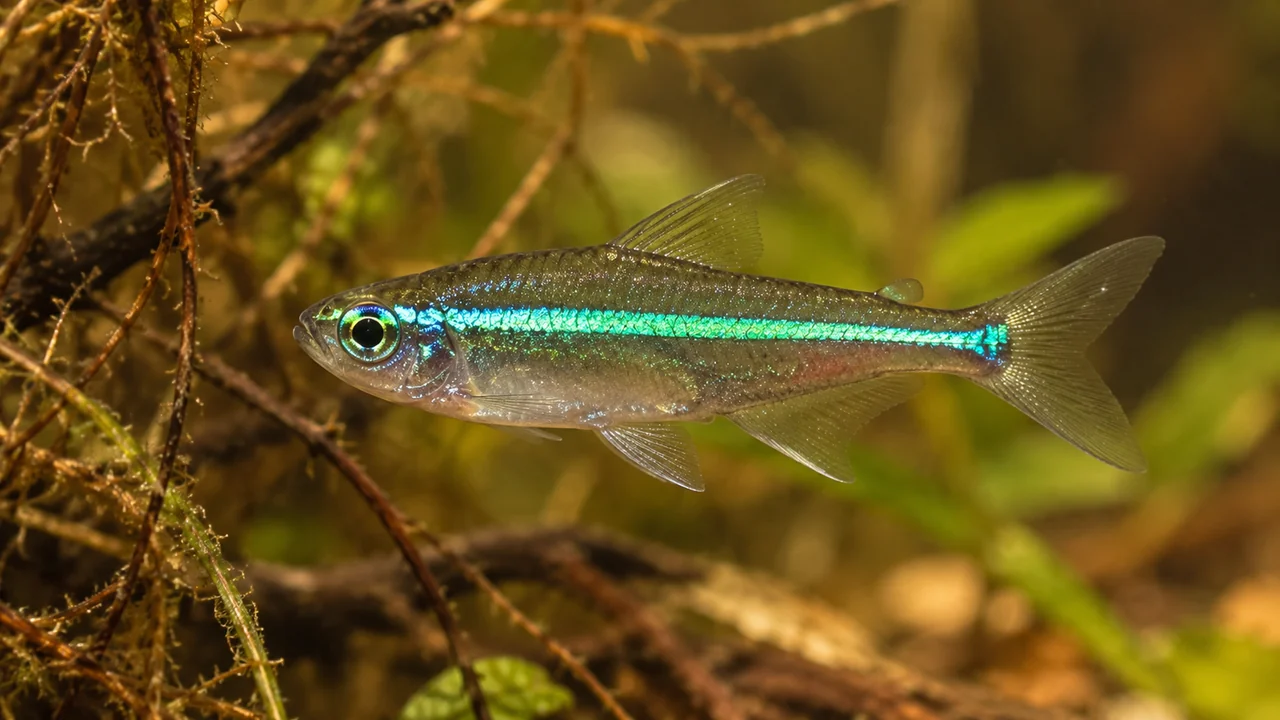
Paracheirodon simulans is the green neon tetra. The fine blue-green line reaches farther back towards the base of the tail than in its familiar relatives, while red on the lower flank is much reduced. The apparent hue shifts with lighting and viewing angle; a greener photograph alone is not a diagnostic test.
Do not buy a mixed unlabelled batch on the assumption that all tiny neons are immature P. innesi. Compare the complete pattern and scientific name. The cardinal has a strong full red lower band, and the ordinary neon shows a red rear half and pale front belly. Older Hyphessobrycon simulans labels refer to this same species, not another library entry.
Blackwater does not mean the same habitat everywhere
Institutional and primary accounts place the species in Negro and upper Orinoco drainages. It is strongly associated with low-mineral blackwater habitats. Field work documents separation from cardinals at particular palm-swamp sites despite overlapping regional distributions; the fish are not necessarily neighbours just because both are labelled Amazonian.
Some measured green-neon habitats became substantially warmer than cardinal sites. Those observations are ecological evidence, not a recommended aquarium maximum. A small tank has neither the space nor the choices of a wetland. Plan measured stable conditions and oxygenation rather than trying to recreate the most extreme number in a paper.
A small fish still needs a proper group
Use at least eight to ten green neons as the social starting plan, with space and feeding for the whole group. A published 45 × 30 cm base recommendation describes a small dedicated arrangement; it is not permission to stock a tiny cube with several different shoals. A longer tank is easier to divide into sheltered and open areas.
Their size makes them vulnerable to both predation and competition. A quiet species-focused aquarium is a straightforward option. If adding companions, start with genuinely diminutive peaceful fish that fit the water, and keep the community light enough to see whether green neons remain confident at feeding time.
Prepare water before adding the fish
Seriously Fish gives 24–27°C, pH 3.0–6.5 and hardness 1–8°dGH as adult husbandry guidance. Retailer accounts also describe successful keeping in more alkaline water. These are different types of evidence, not a reason to average the figures or assume every newly imported fish will adapt equally well.
For a new setup, follow the species-specific soft, acidic-water approach and compare the actual source water before purchase. If using reverse-osmosis water, prepare it consistently with appropriate mineral content rather than using pure water without a plan. Avoid chemical swings. Check temperature independently of the heater setting, maintain a mature filter and keep ammonia and nitrite undetectable.
A quiet edge with visible open water
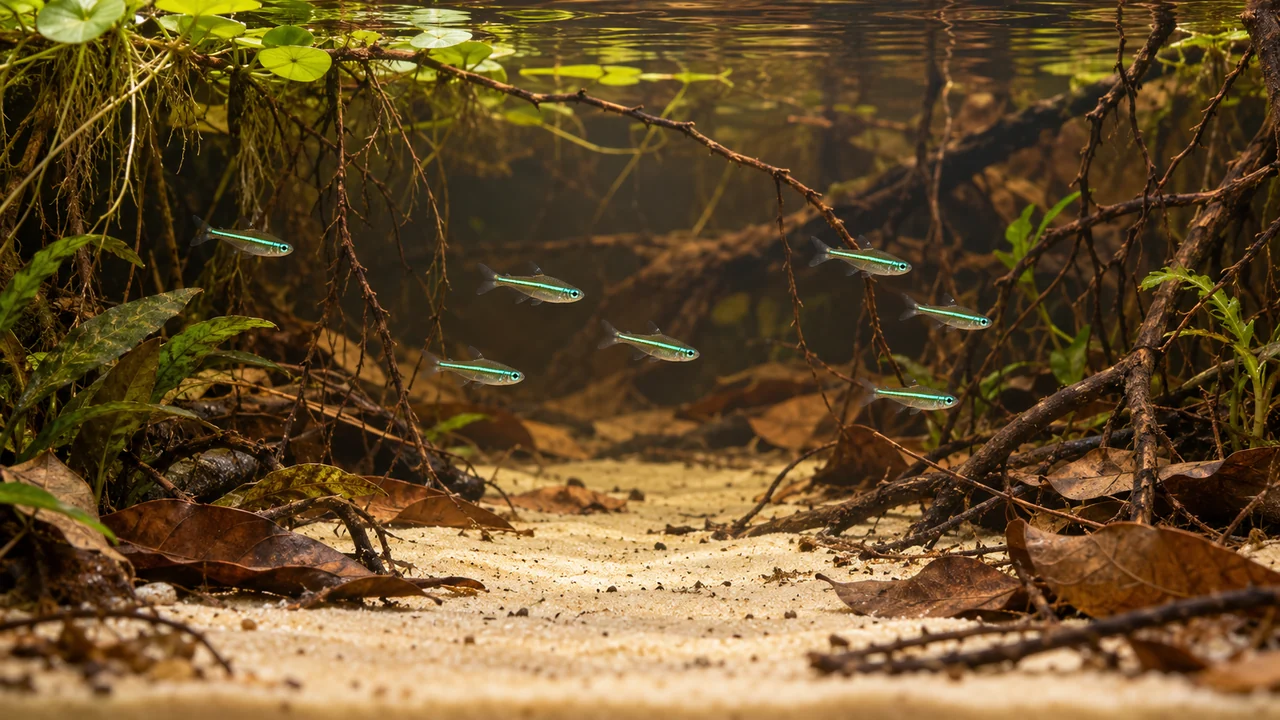
Fine branching roots and small leaf pockets can frame a clear swimming and feeding area. Use restrained flow, diffuse light and some floating or side planting. A sponge-protected intake is useful around such small fish; inspect it and retain enough water movement for gas exchange.
Leave room to siphon the leaf edge and see the fish. The pictured arrangement is deliberately open in the centre, with cover close by. A planted display can be attractive without claiming dense underwater vegetation at every wild locality. Our plants guide helps keep shade, growth and swimming space in balance.
Small mouths need a different feeding scale
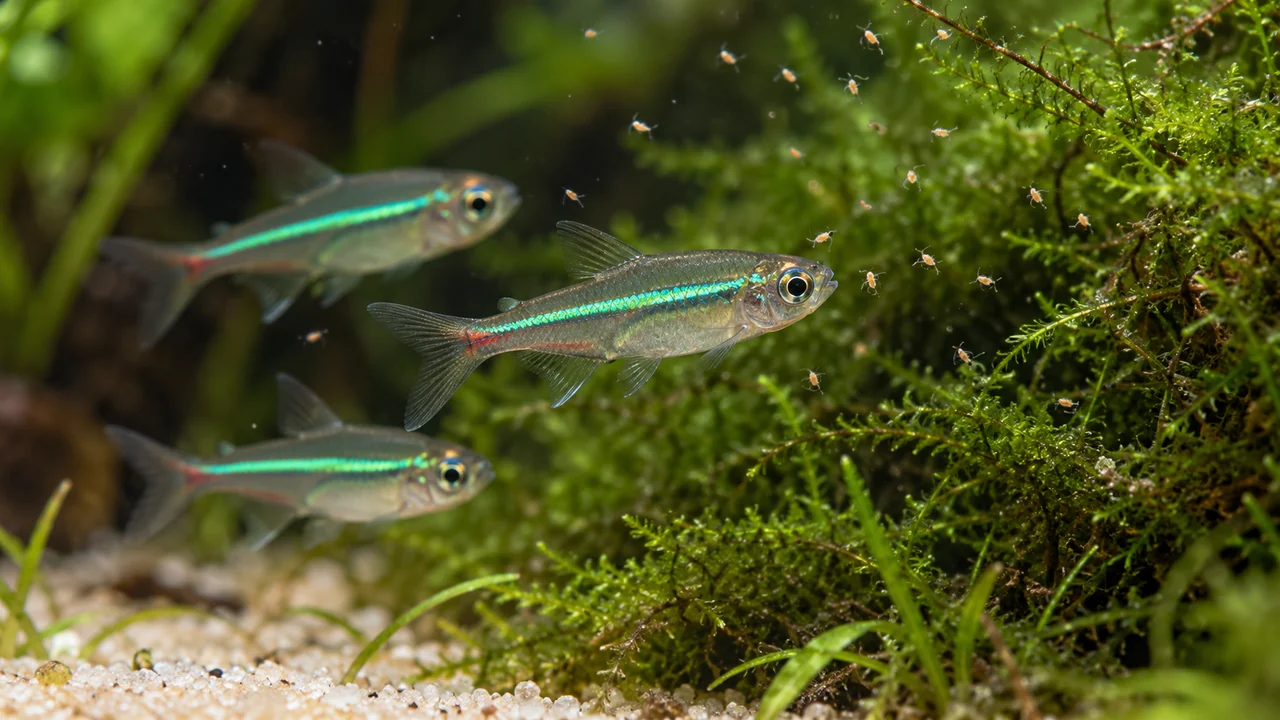
Offer fine complete food in genuinely small particles, supplemented with tiny live or frozen foods such as suitably sized Moina or newly hatched Artemia. Check that the fish take and swallow the food. A busy feeding response can hide repeated spitting, and an intact granule on the sand is not evidence that everyone ate.
Introduce small portions near the group and use more than one point if other fish rush the food. Keep nutritious meals available without allowing a cloud of leftovers to settle into leaves. Surface micro-organisms may supplement feeding opportunities, but a new botanical addition does not guarantee enough or the right nutrition.
Calm companions and safe cover
Avoid boisterous feeders, predators and persistent chasers. A fish too large to share the water chemistry or too fast at every meal is not made suitable by a peaceful label. Adult shrimp may be compatible in an appropriate setup, but very small shrimplets can be eaten and a shrimp breeding colony needs its own assessment.
Green neons can distribute loosely around cover when comfortable. Persistent isolation, clamped fins or repeated darting may indicate poor conditions or pressure rather than a need to buy more species. Check sharp openings and narrow channels in hardscape against the actual fish, leaving unimpeded routes back to open water.
Reproduction: a specialist goal, not routine recruitment
Do not transfer the familiar commercial-neon breeding reputation to P. simulans. Aquarium spawning is possible, but published practical guidance is less established than for P. innesi, and the trade has relied heavily on wild collection. A planted community should not be expected to produce a growing population.
A deliberate attempt needs correctly identified, conditioned adults, separate very soft-water breeding provision, protection of eggs from adults and suitable cultures for minute first-feeding fry. The egg-scattering biology of the genus does not establish a guaranteed recipe for this species. Keep adult care successful first, and use a documented species-specific method rather than heating or acidifying the display to provoke spawning.
Leaves and wood have a role, not a magic effect
A few prepared leaves and branches create shelter boundaries and changing grazing surfaces within the wider food web. Their effect on chemistry depends on the material and the source water. They cannot convert strongly buffered tap water into a low-conductivity habitat simply by making it brown.
Prepare materials and introduce them gradually, keeping oxygen and cleanliness in view. Remove trapped food and investigate cloudy water rather than assuming it is a necessary blackwater stage. The organic-load article explains why decomposition and tint must be considered separately; no botanical guarantees disease prevention, spawning or fry survival.
For the leaf-and-structure margin beside the shoal, compare Dried Beech Leaves (Fagus sp.) – Natural Aquarium Leaf Litter with Blackwater Leaf Box – Leaf Litter Starter Mix. Use selected material in small stages while keeping the swimming corridor and feeding area open.
First checks when something is wrong
Rapid breathing or a group gathering unusually near the surface calls for prompt checks of oxygen, filter function, temperature, ammonia and nitrite. Confirm what changed most recently: new fish, replacement water, heating, cleaning or a large organic addition. Correct an identified problem with suitable water and aeration; do not respond with an unmeasured pH correction.
Thin individuals, food refusal or repeated losses also merit a closer look at particle size, feeding competition and arrival condition. Separate suspected disease for assessment where appropriate and seek knowledgeable aquatic-health help. A dull stripe can accompany ordinary lighting changes, but persistent poor condition is not resolved by adding tannins.
Further reading and sources
Natural-history research and taxonomic records are distinguished from aquarium recommendations. Care ranges below are husbandry guidance, not survival limits; breeding conditions are discussed separately. Botanical materials do not replace appropriate water, food or maintenance.
- California Academy of Sciences: Eschmeyer’s Catalog of Fishes — Institutional accepted-name and distribution record; older scientific names belong to this same profile.
- Bittencourt et al. (2020): Paracheirodon relationships and Petitella revision — Primary molecular and morphological work: separate neon species, native-drainage context and the transfer of bleheri into Petitella. Not an aquarium care trial.
- Marshall et al. (2011): Temperature differences in cardinal and green neon habitats — Primary field measurements from distinct Rio Negro palm-swamp habitats. Short-term field maxima are not recommended aquarium settings.
- Seriously Fish: Paracheirodon simulans — Species-specific husbandry synthesis for size, group/space, adult water guidance and reproductive context; recommendations, not controlled survival thresholds.
- Aquarium Co-Op: Green Neon Tetra care — Supplementary retailer husbandry observations; practical experience is not treated as a laboratory study or a guarantee for all stock.