Fish · Neon Tetra
Neon Tetra — Paracheirodon innesi: Habitat and Care
The familiar blue-striped tetra deserves its own cooler-water care plan. Provide a settled group, fine food and planted swimming space rather than treating it as a small warm-water cardinal.
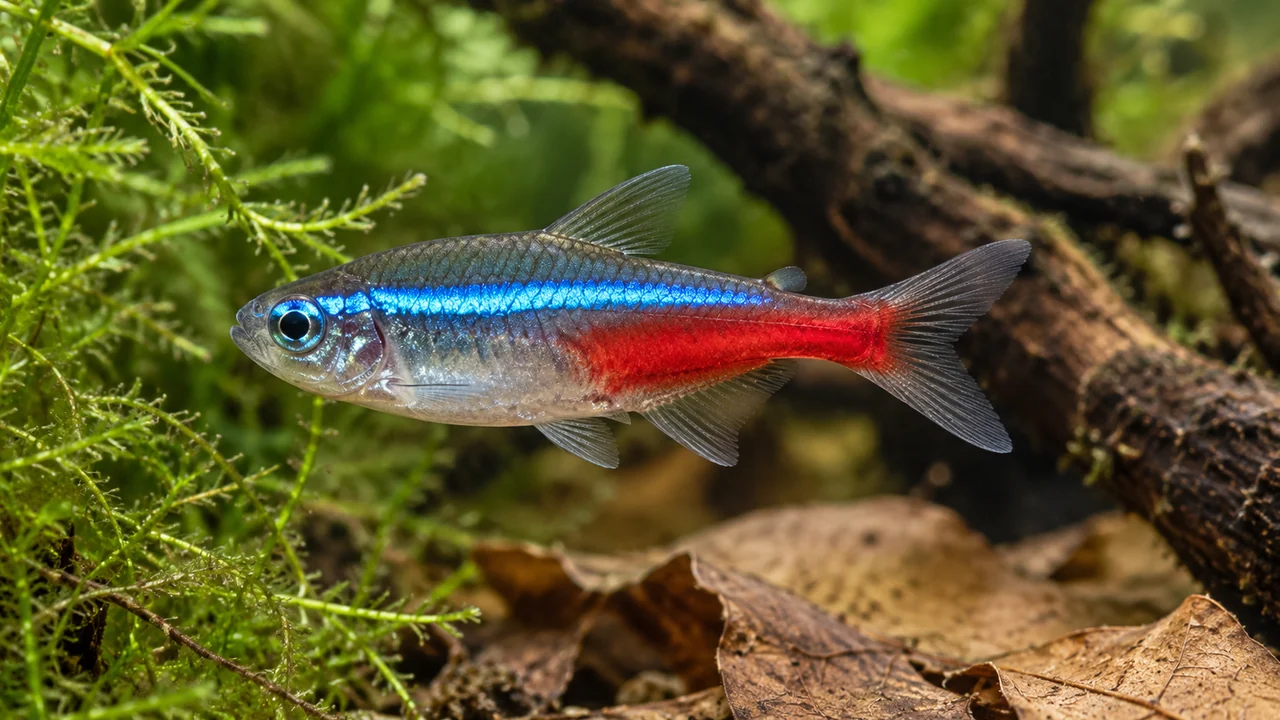
- Identity
- Paracheirodon innesi; neon tetra. Its red band occupies the rear lower flank, leaving a pale front abdomen.
- Adult scale
- Common aquarium adults approach 3–4 cm overall. Standard length excludes the tail; do not confuse it with total length.
- Group and footprint
- Keep at least 8–10 together. A published 60 × 30 cm base recommendation provides a starting plan for an appropriate adult group.
- Adult water guide
- Seriously Fish recommends 21–25°C, pH 4.0–7.5 and 1–12°dGH. This is cooler routine guidance than for cardinals; breeding recommendations are separate.
- Food
- Small complete foods with suitable small live/frozen variety. Watch individual swallowing and body condition.
- Stock selection
- Choose healthy settled stock and quarantine new arrivals. A familiar name does not make a newly set-up aquarium suitable.
Recognise the ordinary neon
Paracheirodon innesi has a blue lateral stripe, a red patch across the rear lower body and a silvery-white front abdomen. The cardinal carries red much farther forward; the green neon is smaller with less red and a stripe reaching towards the tail base. Long-finned, golden or other selected shop forms need the same attention to species identity and practical swimming ability.
Older Hyphessobrycon innesi names refer to this fish. A shop tank with several blue-striped species should not be treated as one interchangeable group. Look for intact fins, straight balanced swimming and good body condition, and observe the actual batch feeding before buying where possible.
Forest streams, not one universal blackwater recipe
The Catalog of Fishes places P. innesi in the Solimões drainage of Brazil, Colombia and Peru. Research describes blackwater and clearwater tributary habitats. The important connection is with smaller forest waters and their cover, not a requirement that every aquarium must be dark brown.
Many aquarium neons are captive-bred, while field records describe wild populations. Those are different contexts. A carefully planted aquarium with appropriate, stable water can provide shelter and swimming routes without pretending to replicate a particular wild stream. Avoid using a single collection measurement as the permanent target for all domestic stock.
A group and an uninterrupted swimming route
Start with at least eight to ten of the same species. A published 60 × 30 cm base recommendation is a useful floor plan, provided the adult group, filter and proposed companions fit it. Height alone does not provide the long route along which a shoal can move; a tall small-footprint container is not equivalent.
Leave room for the group to pass in front of and between plant masses. A little space behind the wood is also useful for maintenance and retreat. Do not fill the aquarium to its practical limit at once, and avoid interpreting repeated hiding as proof that another species needs to be added as reassurance.
Keep routine care cooler than cardinal care
Seriously Fish recommends 21–25°C for adult maintenance, with pH 4.0–7.5 and hardness 1–12°dGH. The FWS synthesis cites a somewhat wider 20–26°C aquarium range. These recommendations overlap; neither is a reason to keep ordinary neons permanently at the hot breeding conditions sometimes quoted for tetras.
Use stable measured water suited to the stock, established filtration and good gas exchange. Ammonia and nitrite should be undetectable. Check the aquarium during hot weather as well as in winter: an accurately set heater cannot cool it. Make planned partial changes with conditioned, appropriately matched water and avoid sudden swings from repeatedly chasing a number.
A planted lane with cover close by
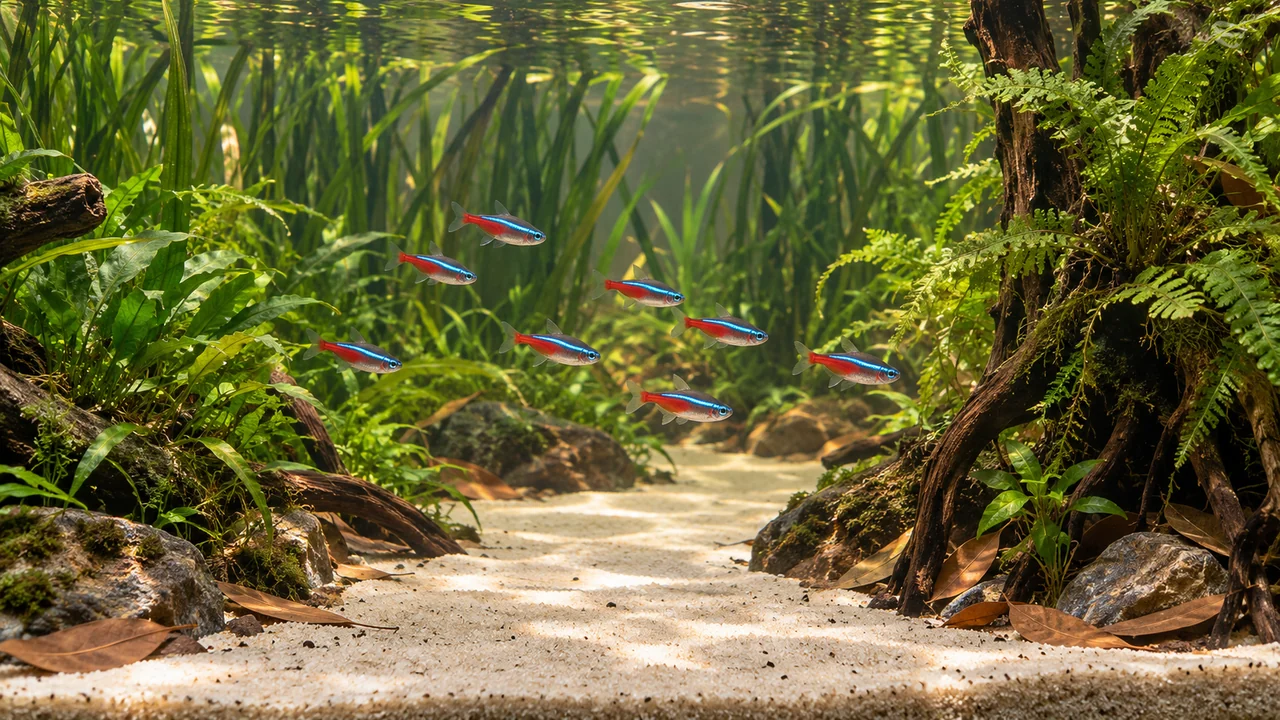
Group planting towards the rear and sides, with branching wood that does not block the whole middle. Retain a clear feeding and swimming lane. Floating shade can be useful, but keep enough open surface and access to trim plants before they close the route.
The arrangement shown here uses planted banks rather than a wall of stems from front to back. Scatter a few prepared leaves near the wood where they can be inspected. Our planted-corridor guide explores that same design decision; adapt the structure to the actual aquarium rather than copying the picture centimetre for centimetre.
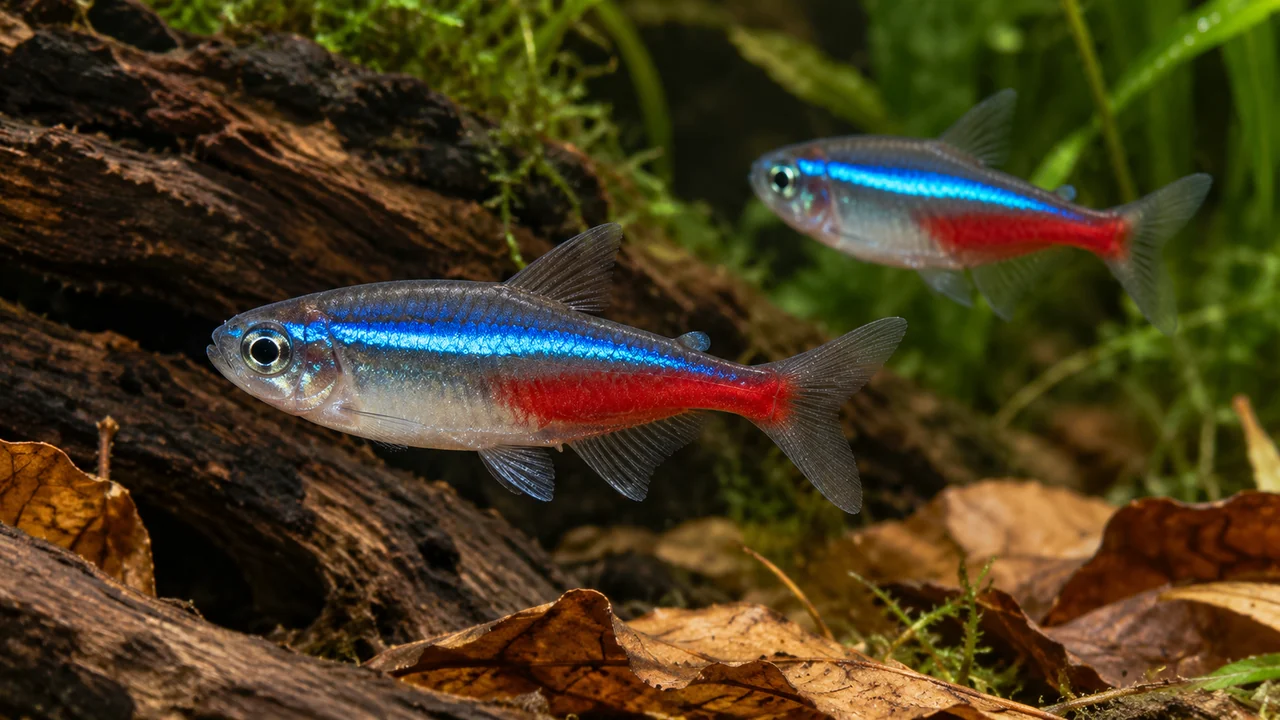
Look closely at the flank and fins
A settled side view makes the pale front belly and red rear patch much easier to distinguish than a moving flash under blue lighting. The outline should remain that of a small tetra, with clear fins and a small adipose fin behind the dorsal fin.
Use pattern together with the stated scientific name; colour intensity varies with light, rest and condition. Neither this view nor any attractive photograph identifies an unknown sick fish. For selected long-finned forms, assess whether the animal can feed and swim comfortably in the planned current.
Feed small portions that actually get eaten
Use a balanced complete food that can be taken without repeated spitting, plus suitably sized live or frozen foods for variety. Finely crushing a flake may improve access; adding more large granules will not. Feed where the group gathers while keeping a view of shy or thinner individuals.
Neons are not grazers that can be left to live on leaf litter. Remove excess trapped in planting and review feeding speed if companions take everything first. A thin fish in a crowded display may be losing access to food, but persistent wasting can also require a health assessment. Improve observation before assuming the cause.
For supplementary invertebrate-food variety, Microalgae Freeze Dried Tubifex Worm Cubes offers a freeze-dried cube format that can be presented at the surface or against the glass. Offer only an appropriately small wetted portion the fish can swallow; this is a prepared food, not live prey or a fry starter.
Companions and meaningful observation
Choose calm companions that share the cooler adult-care plan. Do not place a neon with a large predator simply because it is labelled peaceful, or assume a warm-water species is ideal because both look Amazonian. Adult size and mouth risk are useful starting points.
Small shrimp offspring and eggs can be eaten. Give any shrimp a separate compatibility assessment instead of treating neon size as proof of safety. A relaxed group may spread out; forcing constant tight schooling is not the objective. Persistent isolation, unusual breathing or refusal to feed matters more than a momentary change of stripe brightness.
Spawning differs from keeping the adults
Neons scatter eggs and do not guard the young. A deliberate breeding attempt uses a separate low-light aquarium, very soft appropriately acidic water, safe gentle filtration and a means of keeping adults away from eggs. Published spawning methods may use warmer conditions than routine adult maintenance; these are separate phases.
Prepare first foods before moving conditioned adults. Newly swimming fry need minute foods such as an appropriate infusoria culture, followed by larger foods only when their mouths can use them. Protect early eggs and fry from excessive light, and keep nursery water clean with small matched changes. A leaf-rich community is not a reliable replacement for those preparations.
Botanicals and common problems
Wood and modest leaf additions can frame shaded margins and create extra surfaces, but they do not remove the need for a filter or correct unsuitable source water. Prepare them and inspect the spaces beneath them. Distinguish organic load from tint rather than judging maintenance by water colour.
For rapid breathing or losses, check oxygen, temperature and nitrogen waste first. Persistent pale patches, abnormal swimming or wasting should be assessed rather than diagnosed from the name neon tetra disease. Several conditions can look similar; quarantine new fish and seek qualified help when signs persist. Do not promise treatment from leaves, and never release fish or aquarium contents into natural waters.
For the leaf-and-structure margin beside the shoal, compare Dried Banana Leaf Pieces – Natural Aquarium Leaf Litter with TanninBae Beginner Variety Pack – 45-Piece Botanical Starter Box. Use selected material in small stages while keeping the swimming corridor and feeding area open. A mixed box provides material to choose from over time, rather than a quantity to add all at once.
Further reading and sources
Natural-history research and taxonomic records are distinguished from aquarium recommendations. Care ranges below are husbandry guidance, not survival limits; breeding conditions are discussed separately. Botanical materials do not replace appropriate water, food or maintenance.
- California Academy of Sciences: Eschmeyer’s Catalog of Fishes — Institutional accepted-name and distribution record; older scientific names belong to this same profile.
- Bittencourt et al. (2020): Paracheirodon relationships and Petitella revision — Primary molecular and morphological work: separate neon species, native-drainage context and the transfer of bleheri into Petitella. Not an aquarium care trial.
- US Fish and Wildlife Service: Neon tetra assessment — Institutional synthesis of native range and published size/water records; standard and total length are distinguished.
- Seriously Fish: Paracheirodon innesi — Species-specific husbandry synthesis for size, group/space, adult water guidance and reproductive context; recommendations, not controlled survival thresholds.