Fish · Cardinal Tetra
Cardinal Tetra — Paracheirodon axelrodi: Habitat and Care
A warm-water shoaling tetra with a full red lower flank. Give the group shaded edges, a clear swimming lane and small varied meals; a brown tint alone does not recreate its river habitat.
- Identity
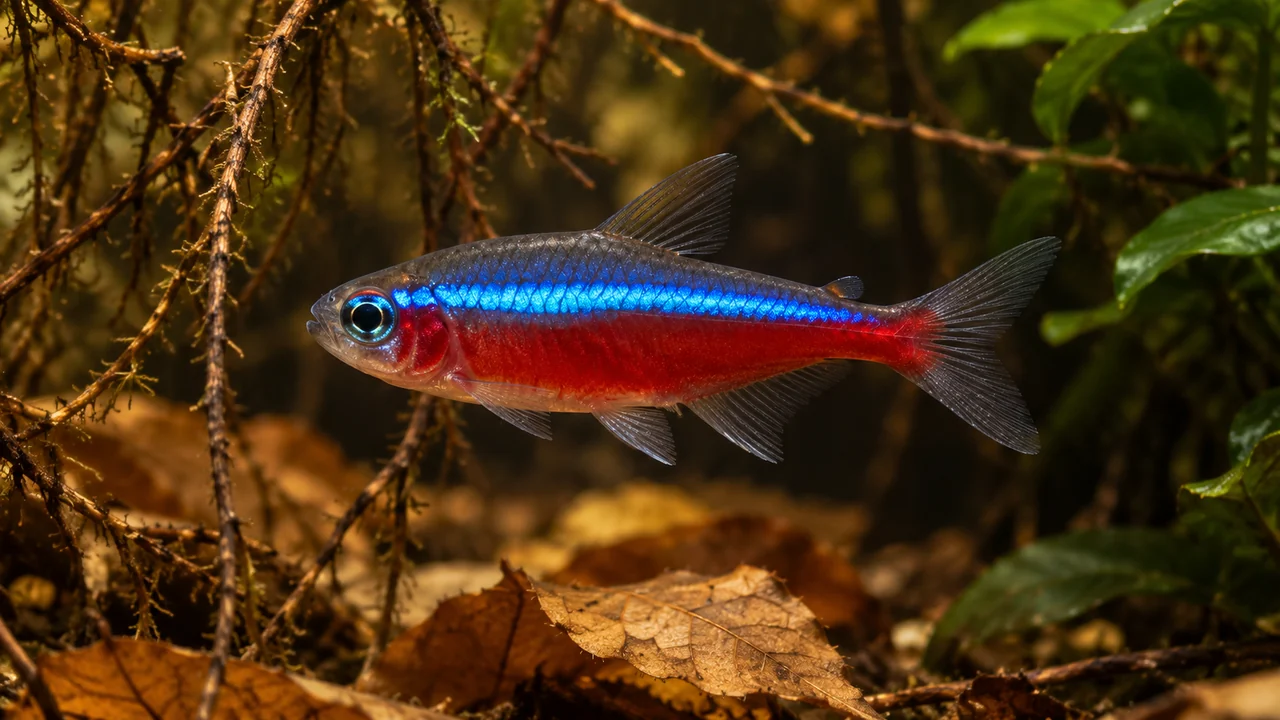
- Paracheirodon axelrodi; cardinal tetra or red neon. The red lower band extends forward to the gill region.
- Adult scale
- Plan for a fish about 4–5 cm overall; taxonomic standard-length figures exclude the tail and may be smaller.
- Group and footprint
- Aim for at least 8–10 of this species. A 60 × 30 cm base is a published starting recommendation; more length is useful for larger groups and communities.
- Adult water guide
- Seriously Fish: 23–29°C, pH 3.5–7.5, hardness 1–12°dGH. Do not treat the extreme acidic end as a routine target; wild fish merit particular care with source water.
- Feeding
- Small complete granules or finely crushed flakes, supported by appropriately sized live or frozen foods.
- Main distinction
- Warmer routine care than the ordinary neon tetra; neither is simply a colour form of the other.
Identity: the red band matters
The cardinal tetra is Paracheirodon axelrodi, originally described under Cheirodon. Its blue line sits above a broad red lower flank that reaches forward towards the gill cover. A normal neon tetra has a pale front abdomen and a red rear half, while the smaller green neon has much less red and a longer-looking turquoise line. Use the whole pattern rather than one flash of blue.
Choose alert, evenly swimming fish with intact mouths and fins. A fish that is temporarily pale after transport is harder to identify and assess than a settled animal. Ask for the scientific name and whether the batch is captive-bred or wild-sourced; those details are useful for acclimatisation and water planning, rather than a claim that one source is automatically healthier.
A river fish shaped by seasonal habitat
The accepted range includes the upper Orinoco and Negro basins in Brazil, Colombia and Venezuela. Forest tributaries and flooded margins are more informative aquarium references than a picture of a large muddy Amazon channel. Native habitats include dark, low-mineral waters, but a locality name is not a single permanent set of water measurements.
Marshall and colleagues measured different thermal patterns in habitats used by cardinals and green neons. That evidence helps explain why the species should not be merged into one care account. It does not justify reproducing a hot field maximum in a tank. Read the flood-pulse guide for the movement of water and habitat through the seasons, not a fixed recipe for a deep leaf carpet.
Plan for the group, not one small fish
A group of at least eight to ten is the usual husbandry starting recommendation. Several cardinals and several ordinary neons are not interchangeable halves of one social group. Budget space and feeding for the adult group before adding a second shoaling species; more different names do not necessarily make a better community.
A published 60 × 30 cm aquarium base is a starting footprint, not proof that any tank with that label can house every proposed companion. Longer aquariums make it easier to retain a continuous swimming lane and separated quiet edges. Watch whether the group moves freely or stays compressed behind one object, and keep a cover fitted around equipment gaps.
Warm, stable water without chasing extremes
The adult husbandry range in Seriously Fish is 23–29°C, pH 3.5–7.5 and 1–12°dGH. That broad pH span covers very different circumstances. For ordinary keeping, prepare a stable suitable supply before purchase rather than dosing acid into a hard, strongly buffered tank. Ask how the actual stock has been held, then compare measured source and aquarium water.
Use a mature filter, a reliable thermometer and enough surface movement for gas exchange. Warm water and a heavy organic addition make oxygen management more important, not less. Ammonia and nitrite should be undetectable. Match replacement water appropriately, make regular partial changes and avoid combining a major chemistry correction with a large livestock introduction.
Shaded margins around an open lane
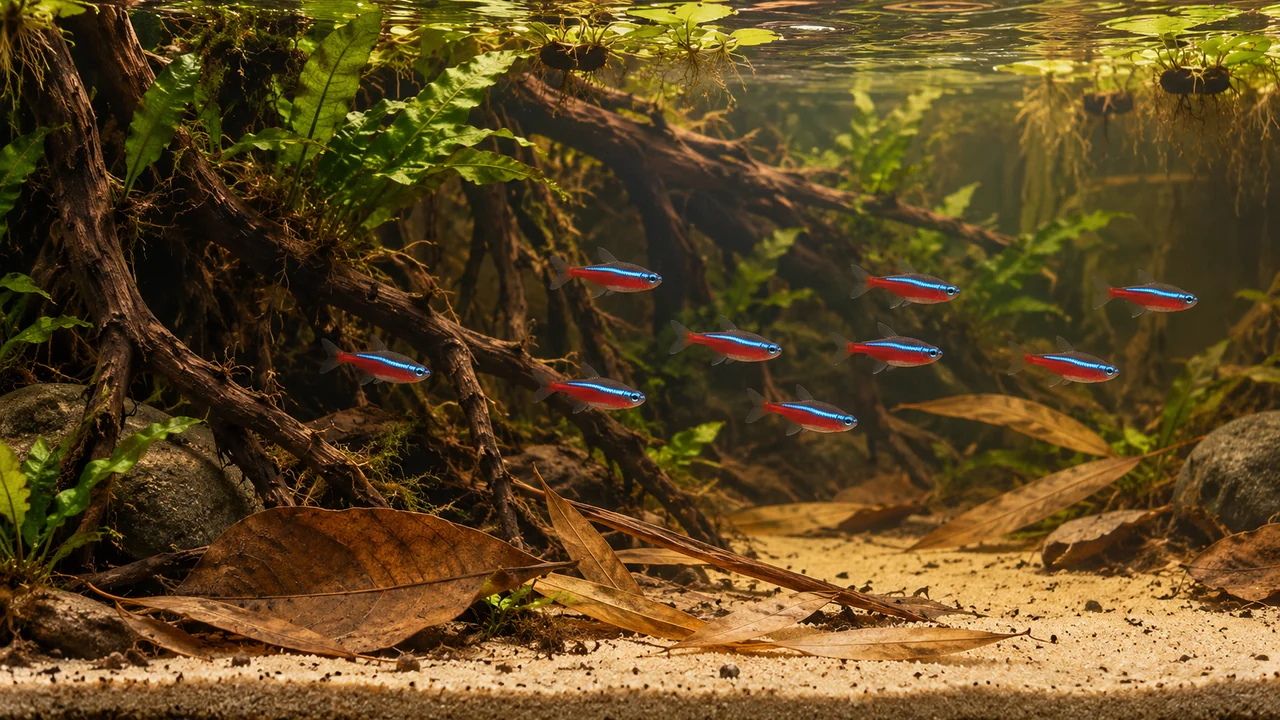
Set branching wood towards the sides or rear so the group can pass through the middle without squeezing between stems. A few prepared leaves can soften the floor; keep a clear place to feed and to remove debris. Patchy floating cover or planting can provide shade without sealing the surface.
The pictured layout uses a restrained leaf margin and an open sand route. It is a practical aquarium arrangement, not a documented wild collection site. Our branching layout guide develops the same balance between structure and usable water. Check behind the wood during maintenance rather than letting the most attractive corner become inaccessible.
Make feeding visible and deliberate
Offer a suitable complete food in pieces small enough to be taken cleanly, with small live or frozen foods for variety. Spread a modest portion into moving water near the group instead of dropping it all at the far end. A useful observation is whether each fish takes and swallows food, not simply whether the shoal gathers.
Keep meals controlled and remove excess that collects below the roots. Leaf litter and incidental organisms do not guarantee a complete ration. If a fish repeatedly spits out a granule, try a smaller appropriate particle before adding more. The feeding view illustrates access to fine food in midwater; it is not a measured daily dose.
For supplementary invertebrate-food variety, Microalgae Freeze Dried Tubifex Worm Cubes offers a freeze-dried cube format that can be presented at the surface or against the glass. Offer only an appropriately small wetted portion the fish can swallow; this is a prepared food, not live prey or a fry starter.
Companions and everyday behaviour
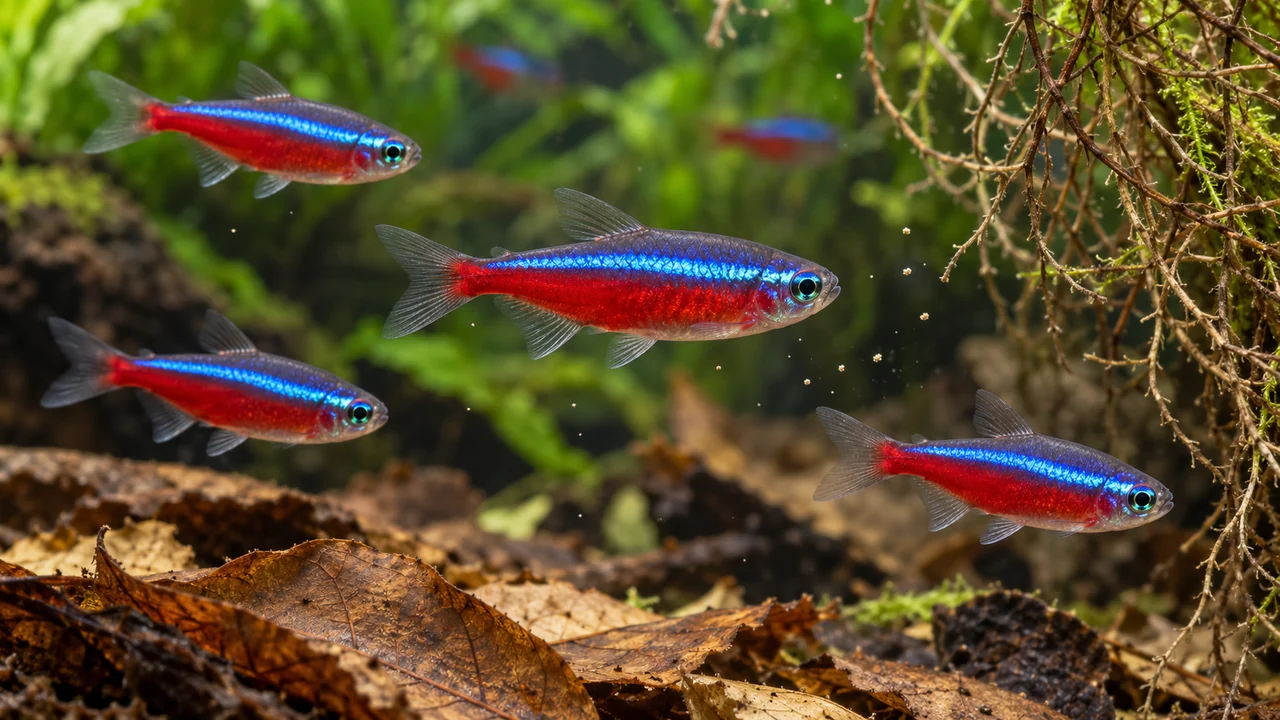
Cardinals suit calm communities whose temperature and water requirements genuinely overlap. Small peaceful companions can work; a placid-looking large fish may still be able to swallow them. Assess adult mouth size, feeding speed and territory use rather than buying from a compatibility label alone.
Allow the group to spread loosely as well as gather. Constant tight schooling is not a welfare target in itself. Persistent hiding, isolated individuals or frantic movement deserves a check of current, lighting, water quality and pressure from companions. Shrimplets and fish eggs remain potential food even when adult shrimp are tolerated.
Spawning and fry are a separate project
These tetras scatter eggs and provide no parental care. Reliable fry production requires a prepared breeding space with protection from adult egg predation, low light and very soft, appropriately acidic water. Conditioning adults and having live cultures ready matter more than adding one particular leaf.
Newly free-swimming fry need food small enough to take immediately, followed by larger foods as they grow. Gentle filtration must not trap them, and small carefully matched water changes must keep the nursery clean. Spawning recommendations are not instructions to raise the whole community permanently to breeding temperatures. Do not promise recruitment simply because a female looks rounded.
What botanicals add — and what they cannot do
Wood supplies structure; leaves change cover and create additional surfaces as they decompose. Neither replaces a maintained filter, a full diet or prepared source water. Water colour cannot tell you GH, KH, pH or dissolved oxygen, and tinting a hard aquarium does not make it chemically equivalent to a Negro tributary.
Use the preparation guide and add modest amounts progressively, retaining access to remove trapped waste. The distinction between tannins and organic load is especially useful in a warm shoaling aquarium. Conservation and Project Piaba offer context for responsible ornamental-fish sourcing; an aquarium purchase should not be assumed to support a particular project without evidence.
For the leaf-and-structure margin beside the shoal, compare Dried Oak Leaves – Natural Aquarium Leaf Litter with TanninBae Beginner Variety Pack – 50-Piece Botanical Starter Mix. Use selected material in small stages while keeping the swimming corridor and feeding area open. A mixed box provides material to choose from over time, rather than a quantity to add all at once.
Common problems: start with the conditions
A pale group after a sudden light change may settle, but pallor with rapid breathing or loss of balance needs immediate attention to oxygen, temperature and water quality. Confirm the heater and filter are working before adding a remedy. Stop feeding into a suspected water-quality failure and correct the measured problem with suitable conditioned water.
For repeated losses, poor body condition or persistent abnormal swimming, review arrival history, quarantine, diet and possible disease with competent aquatic-health support. Colour loss alone does not identify a pathogen. Do not medicate the community blindly, and never claim a botanical is a cure. Keep fish and aquarium contents out of natural waterways.
Further reading and sources
Natural-history research and taxonomic records are distinguished from aquarium recommendations. Care ranges below are husbandry guidance, not survival limits; breeding conditions are discussed separately. Botanical materials do not replace appropriate water, food or maintenance.
- California Academy of Sciences: Eschmeyer’s Catalog of Fishes — Institutional accepted-name and distribution record; older scientific names belong to this same profile.
- Bittencourt et al. (2020): Paracheirodon relationships and Petitella revision — Primary molecular and morphological work: separate neon species, native-drainage context and the transfer of bleheri into Petitella. Not an aquarium care trial.
- Marshall et al. (2011): Temperature differences in cardinal and green neon habitats — Primary field measurements from distinct Rio Negro palm-swamp habitats. Short-term field maxima are not recommended aquarium settings.
- Seriously Fish: Paracheirodon axelrodi — Species-specific husbandry synthesis for size, group/space, adult water guidance and reproductive context; recommendations, not controlled survival thresholds.
- Aquarium Co-Op: Cardinal Tetra care — Supplementary retailer husbandry observations; practical experience is not treated as a laboratory study or a guarantee for all stock.