Fish · Checkerboard Cichlid
Checkerboard Cichlid — Dicrossus filamentosus: Habitat and Care
A slender checker-marked cichlid that investigates the lower aquarium in loose company. Give it a long accessible floor, small foods and clean soft water; its open-surface spawning and social life are not an Apistogramma cave routine.
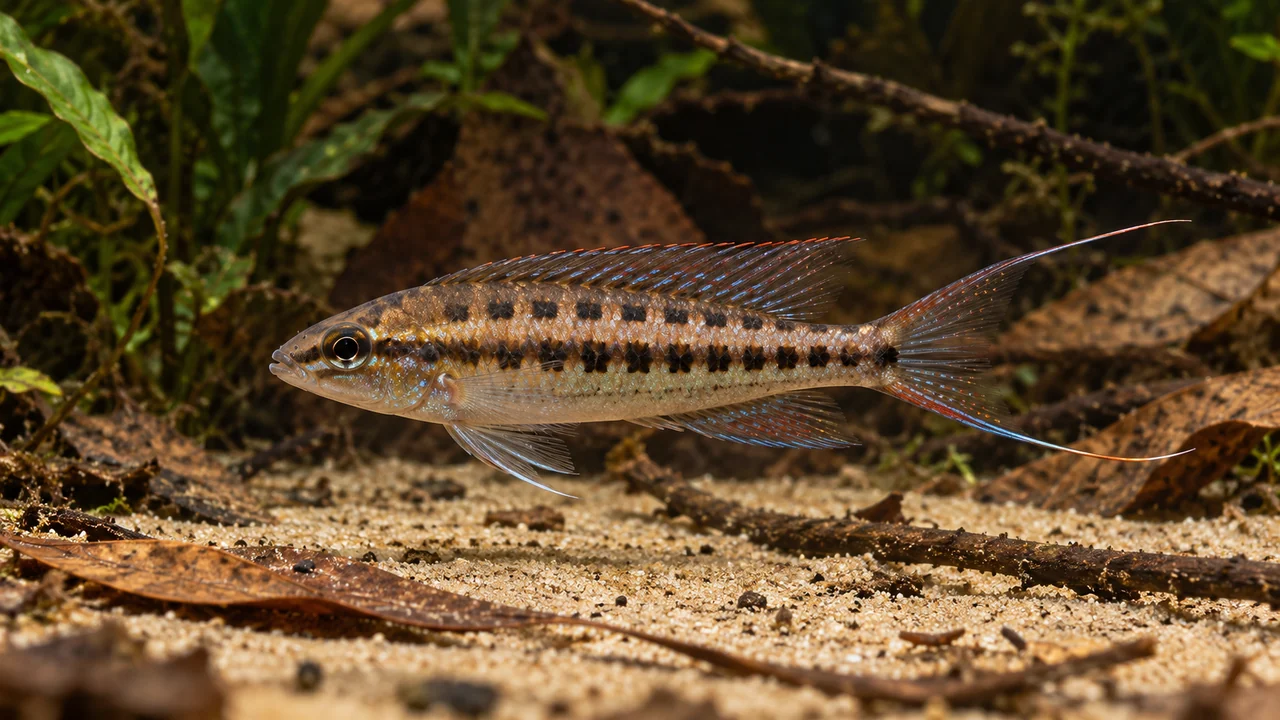
- Identity
- Dicrossus filamentosus; formerly Crenicara filamentosa. Two checkerboard rows and a mature male’s symmetrical lyretail are useful features.
- Adult scale
- Plan for males up to about 8–9 cm overall including extended tail; females smaller. Specimen SL records are much shorter.
- Aquarium footprint
- Prefer a long 120 cm aquarium for a group, with divided bottom areas and food access.
- Temperature
- 26–28°C in a detailed keeper account; another specialist recommends 27–30°C. Around 27°C is a useful maintenance starting point.
- Water plan
- Soft acidic water: roughly pH 5.0–6.5 and below 5°dGH for maintenance; some wild stocks need more demanding breeding water.
- Reproduction
- Open-substrate eggs on a leaf, stone or similar surface; female tends eggs and young.
A slender checkerboard, with different adult tails
Look for a long low body and rows of dark squared blotches rather than the deeper outline of most Apistogramma. An adult male develops a lyre-shaped tail with extensions on both its upper and lower lobes. Females retain a rounded tail and can show reddish pelvic fins. Pattern changes with mood, and a juvenile without developed streamers cannot be identified from tail shape alone.
The original name Crenicara filamentosa explains older reports. Other Dicrossus species are separate fish, not alternative colours of filamentosus. In particular, the two-sided mature lyretail differs from the upper-only extension of gladicauda. Keep collection or breeding-source information where available and do not label every checker-marked import from a general photograph.
Negro and Orinoco records, not an exact tank history
Recorded distribution includes the Negro basin and parts of the Orinoco system in Brazil, Colombia and Venezuela. Leaf-strewn lower habitats and small woody structures provide useful context for its aquarium behaviour. This is a fish to observe close to the floor, not one that should have to compete continuously in an exposed midwater feeding frenzy.
Aquarium accounts describe males approaching 8–9 cm overall, while the checklist records a much smaller measured standard length, excluding the tail. These are different records and measurement conventions. Do not convert one into the other or use a tiny specimen measurement to justify cramped accommodation. Plan the aquarium around mature behaviour and extended fins.
A group needs real horizontal space
Radek Bednarczuk’s detailed keeping account favours a group in an aquarium at least 120 cm long. A different specialist page gives a 60 × 30 cm base; those are materially different housing approaches. For the group-oriented arrangement described here, prefer the longer footprint rather than applying a small pair-tank number to several adults.
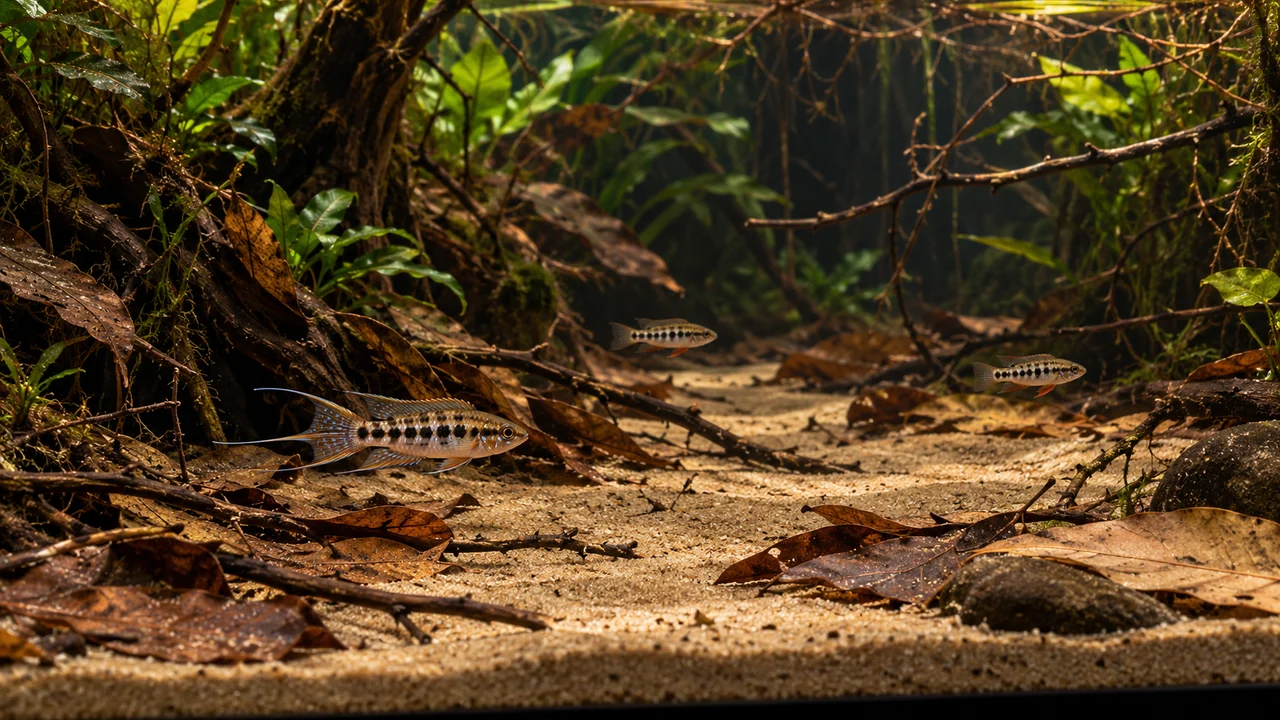
Allow loose spacing, with separate lower refuges and more than one feeding area. Males may associate with multiple females, but that does not establish a universally safe ratio or make several males harmless. Observe actual territorial behaviour as fish mature. A subordinate animal needs a route away and a place to eat; increasing stocking to suppress displays does not solve a lack of usable space.
Broad leaves are surfaces, not automatic caves
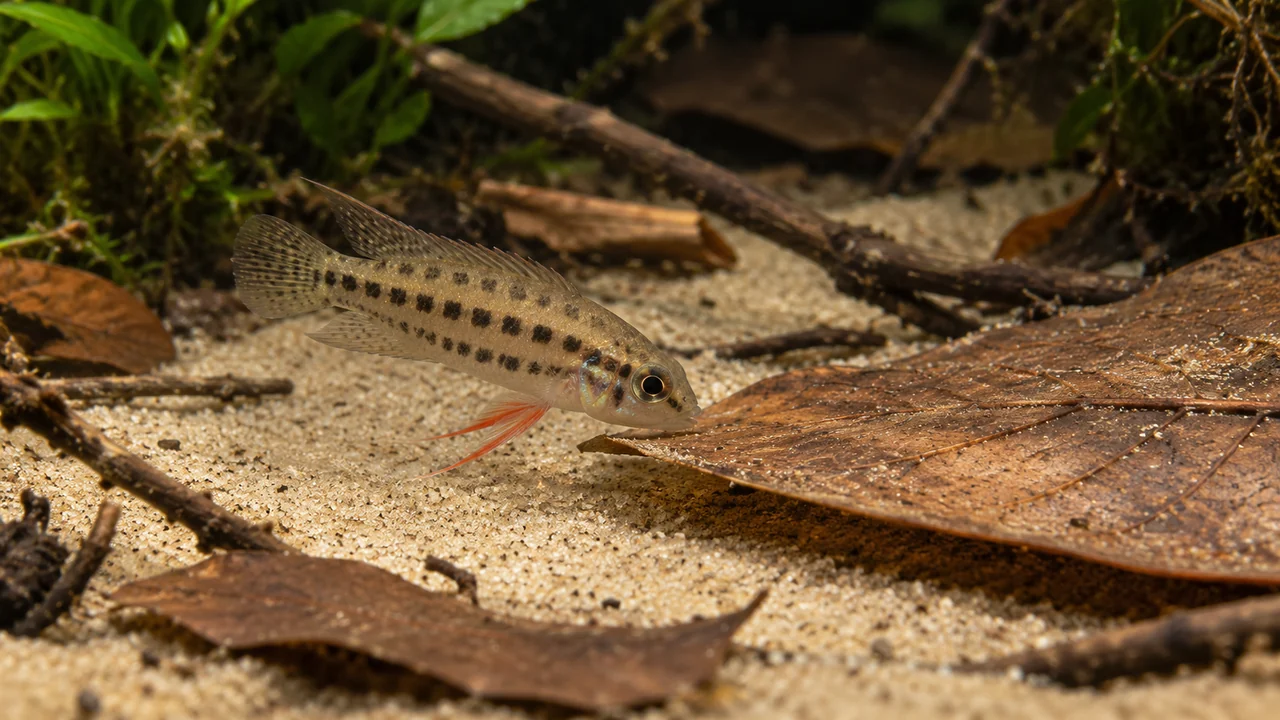
The female supporting view shows a rounded tail and a broad leaf surface within reach. This species lays eggs on exposed surfaces such as plant leaves or stones rather than following a standard cave-ceiling recipe. Pelvic colour can be informative, but do not use it alone to prove a previous spawn or claim an active brood.
Keep these surfaces stable and accessible without filling the whole floor with litter. Low root screens and a few open leaf edges offer both cover and observable foraging places. Sharp narrow cavities are unnecessary as the central design feature. Retain a clean route along the front for targeted feeding and gentle waste removal.
For the leaf-and-structure margin beside the shoal, compare Dried Bodhi Leaves (Ficus religiosa) – Aquarium Leaf Litter with Premium Mangrove Leaves – Natural Aquarium Leaf Litter. Use selected material in small stages while keeping the swimming corridor and feeding area open.
Choose a water plan; recognise the disagreements
Bednarczuk describes 26–28°C, pH about 4.0–6.5 and GH below 5°dGH for maintenance; Seriously Fish recommends a warmer 27–30°C range. A stable aquarium near 27°C with soft acidic water around pH 5.0–6.5 is a sensible starting plan for established stock. These are husbandry choices, not experimentally determined survival boundaries.
The breeding accounts also differ: Glaser emphasises almost mineral-free water near pH 5, whereas Bednarczuk reports less extreme conditions for captive-reared fish. Keep origin and breeding history in view. Measure GH and KH separately, prepare replacement water consistently and do not progressively acidify a community aquarium to imitate a specialist breeding trial.
Small mouths and quiet delivery
Offer small suitable live or frozen crustaceans and a complete fine sinking diet if accepted. Deliver portions close to different bottom areas and observe individual intake. These fish can lose out to faster companions even when a generous amount of food enters the aquarium. A fine meal scattered high above them is not necessarily an accessible meal.
Check thin fish, particle size and food recognition before increasing quantity. Use small portions and remove persistent leftovers. Mature wood and leaf surfaces add foraging interest but cannot be assumed to sustain the group. Newly imported fish may need familiar foods while gradually learning an appropriate complete prepared diet.
For supplementary invertebrate-food variety, Microalgae Freeze Dried Tubifex Worm Cubes offers a freeze-dried cube format that can be presented at the surface or against the glass. Offer only an appropriately small wetted portion the fish can swallow; this is a prepared food, not live prey or a fry starter.
The floor, filtration and companion choice work together
Use fine safe sand and scattered leaves with low branches, keeping long routes open between cover patches. A few shade-tolerant plants can soften the margins. Do not cover all feeding ground beneath a thick mat, or position the return so that every quiet refuge becomes a stagnant waste pocket.
Provide mature biological filtration, good gas exchange and regular partial changes while avoiding a forceful bottom current. Calm small open-water companions may work where adult needs overlap. Boisterous feeders and territorial cichlids can make the arrangement fail; a published community list is not a guarantee for every tank. Tiny shrimp or fry may be eaten, and breeding females can defend their immediate area.
Open spawning and a separate fry-rearing plan
Eggs can be placed on a leaf, stone or another firm surface. The female cares for eggs and young; an adult male may defend a wider area but can also become a risk to the brood. Observe the actual relationship and separate where necessary. A sheltered arrangement is useful without turning the species into a cave spawner.
Very soft water and careful cleanliness can be especially important for egg development, but no single pH guarantees success. Prepare protected filtration and suitable first foods before fry become free-swimming. Small live foods such as appropriately sized Artemia nauplii or microworms must be delivered near them. Plan grow-out capacity and waste removal rather than assuming maternal care replaces feeding and maintenance.
A thin or hidden checkerboard needs investigation
Watch the group during meals and at rest. Look for a fish displaced from every bottom patch, persistent chasing or food monopolised by companions. Check measured temperature, ammonia, nitrite and filter operation. Rapid breathing calls for an immediate look at gas exchange and water quality, not an automatic increase in heat.
Avoid changing chemistry and the entire hardscape together. Preserve useful refuges while addressing actual waste and social pressure. Repeated egg loss also needs attention to fertilisation, development and adult behaviour. Leaves provide cover and surfaces; they are not a guaranteed spawning stimulant, disinfectant or cure for an unsuitable aquarium.
Further reading and sources
Identity and natural-history sources are distinguished from aquarium husbandry. Recommended care is not a set of experimentally established survival limits; breeding conditions may differ from adult maintenance.
- Kullander — South American Cichlidae checklist — Taxonomic names, original combinations and recorded river basins; specimen lengths are not maximum aquarium total lengths.
- Deutsche Cichliden-Gesellschaft — Dicrossus — Recognised separate species and original generic literature; not aquarium water guidance.
- Radek Bednarczuk — keeping Dicrossus filamentosus — Named keeper account: long group aquarium, maintenance water, feeding and open spawning. Its guarantees, medicinal advice and botanical antimicrobial claims are not adopted.
- Aquarium Glaser — Dicrossus filamentosus — Importer observations: overall adult size, sex differences, leaf-surface spawning and demanding breeding water.
- Seriously Fish — Dicrossus filamentosus — Species-specific husbandry, adult scale, social arrangements and reproduction. Read explanatory water notes, not just summary numbers.